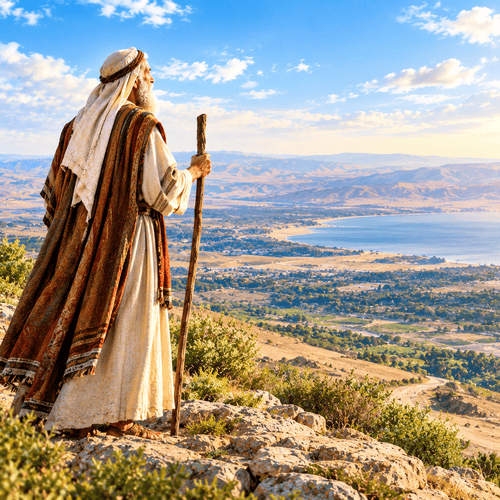
Moses stood on a mountain and looked at everything God had promised—hills, valleys, cities and land stretching to the sea. Then he died. He never put one foot inside the land.
That mountain was Mount Nebo, on a high ridge the Bible calls Pisgah. It’s one of the saddest scenes in the Old Testament. But it’s not the end of Moses’ story. More than 1,400 years later, Moses stood on another mountain—this time inside the Promised Land—talking with Jesus.
Between those two mountains lies one of the clearest lessons in the Bible: the law can show you the promise, but it cannot take you into it. Only Christ can.
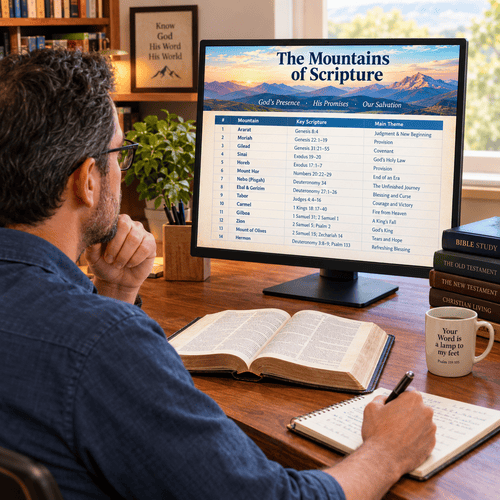
This post continues our Mountains of Scripture series on Old Testament mountains with New Testament meaning. We’ve climbed Moriah, Sinai, Zion, Carmel and the Mount of Olives. Now we climb Nebo.
AT A GLANCE
- Where: Mount Nebo, “the top of Pisgah”, east of the Jordan River, opposite Jericho (Deut 34:1).
- Old Testament event: God shows Moses the Promised Land, but Moses dies outside it (Deut 34).
- New Testament fulfilment: Moses stands inside the land at the Transfiguration (Matt 17:3), and Hebrews 3–4 shows that Christ, not Moses, brings God’s people into rest.
Nebo, Pisgah and Horeb: Getting the Mountains Right
Mount Nebo stands east of the Jordan River, in modern Jordan. Pisgah is the ridge or summit area on it, which is why Moses went up “to Mount Nebo, to the top of Pisgah” (Deut 34:1).
Nebo is sometimes confused with Horeb. But Horeb is another name for Mount Sinai: “The LORD our God made a covenant with us in Horeb” (Deut 5:2). The difference matters. Horeb is where the law was given. Nebo is where the man who received the law died outside the land. One mountain gives the law; the other shows its limits.
The Long Road to Nebo
Timeline: Moses’ Journey to the Border
- Exodus 3—Horeb: God calls Moses and promises “a good and broad land, a land flowing with milk and honey” (Exod 3:8).
- Exodus 19–24—Sinai: God gives Israel His law through Moses.
- Numbers 13–14—Kadesh: The people refuse to enter the land, and a whole generation must die in the wilderness.
- Numbers 20—Meribah: Moses strikes the rock, and God says he will not lead the people in.
- Numbers 23—Pisgah: Balaam, hired to curse Israel, blesses them from this very ridge.
- Deuteronomy 34—Nebo: Moses sees the land, dies at 120 and is buried by God.
What Happened on the Mountain
“The LORD showed him all the land” (Deut 34:1). Then God said:
“This is the land of which I swore to Abraham, to Isaac, and to Jacob, ‘I will give it to your offspring.’ I have let you see it with your eyes, but you shall not go over there”
Deut 34:4
- God kept His word. On this same ridge Balaam had been forced to say, “God is not man, that he should lie… Has he said, and will he not do it?” (Num 23:19). The promise was safe.
- Moses saw it. The view was a gift, not a cruel joke. Moses died knowing God had not failed.
- But Moses could not go. The greatest prophet Israel ever had (Deut 34:10) stopped at the border.
It was not old age that stopped him: “His eye was undimmed, and his vigour unabated” (Deut 34:7). He was stopped by one thing only—the word of God.
Why Could Moses Not Enter?
The answer goes back to Numbers 20. The people had no water. God told Moses to speak to the rock. Instead Moses shouted, “Hear now, you rebels: shall we bring water for you out of this rock?” and struck it twice (Num 20:10–11). God replied:
“Because you did not believe in me, to uphold me as holy in the eyes of the people of Israel, therefore you shall not bring this assembly into the land that I have given them”
Num 20:12
- Unbelief: God named the root sin—“you did not believe in me.” Moses trusted his own anger and staff more than God’s word.
- Public dishonour: He treated God as if God were as impatient as he was, in front of the whole nation (Deut 32:51).
- A picture spoiled: Paul says “the Rock was Christ” (1 Cor 10:4). Earlier the rock was to be struck (Exod 17:6); now Moses was only to speak. Many Bible teachers see the point: Christ was struck once for sin (Heb 9:28), and now we come to Him by asking.
- The people’s sin too: “the LORD was angry with me because of you” (Deut 3:26). Moses shared in their failure—but could not remove it.
After the golden calf, Moses had even offered himself in Israel’s place: “please blot me out of your book” (Exod 32:32). God refused: “Whoever has sinned against me, I will blot out of my book” (Exod 32:33). Moses could not be their substitute. He was a sinner too.
EVEN THE BEST MAN UNDER THE LAW FELL SHORT
If the law could bring anyone into God’s promise, it would have been Moses. He received it from God’s hand and spoke with God “face to face” (Deut 34:10). Yet one failure of faith stopped him at the border. The law does not grade on a curve: “Cursed be everyone who does not abide by all things written in the Book of the Law, and do them” (Gal 3:10).
The Law Shows the Promise but Cannot Take You In
In the Bible, Moses stands for the law. “For the law was given through Moses; grace and truth came through Jesus Christ” (John 1:17). So Moses on Nebo, looking at a land he cannot enter, is a living picture of what the law can and cannot do.
The law is not bad: “the law is holy, and the commandment is holy and righteous and good” (Rom 7:12). The problem is us. “God has done what the law, weakened by the flesh, could not do” (Rom 8:3).
| WHAT THE LAW CAN DO | WHAT THE LAW CANNOT DO |
|---|---|
| Show God’s holy standard (Rom 7:12) | Give us power to keep it (Rom 8:3) |
| Show us our sin (Rom 3:20) | Take our sin away (Heb 10:4) |
| Point us to the promise (Gal 3:24) | Give life to sinners (Gal 3:21) |
| Lead us to Christ | Take the place of Christ (Heb 7:19) |
John Calvin compared the law to a mirror. It shows your face as it really is, but a mirror cannot wash your face. Paul says, “if a law had been given that could give life, then righteousness would indeed be by the law” (Gal 3:21). No such law exists. The law was “our guardian until Christ came, in order that we might be justified by faith” (Gal 3:24).
Augustine of Hippo taught, in effect, that the New Testament lies hidden in the Old and the Old is made clear in the New. Nebo shows why. The law brings you right to the edge. You see the promise clearly. But the law cannot carry you across.
Joshua, Not Moses, Leads Them In
After Moses died, God said to Joshua: “Moses my servant is dead. Now therefore arise, go over this Jordan, you and all this people, into the land that I am giving to them” (Josh 1:2).
Not Moses, the giver of the law, but Joshua leads Israel in. His Hebrew name, Yehoshua, means “the LORD saves.” In Greek it is Iēsous—the same name as Jesus. This is not our clever wordplay. Hebrews builds on it.
Place matters too. Joshua crossed the Jordan near Jericho (Josh 3:16), the very area Moses saw from Nebo. Elijah—who would later stand with Moses at the Transfiguration—crossed the Jordan near Jericho and was taken up on its eastern side (2 Kings 2:4–11). And John baptised “in Bethany across the Jordan” (John 1:28), where Jesus’ public ministry began.
Hebrews 3–4: A Better Leader and a Better Rest
- Christ is greater than Moses. Moses was “faithful in all God’s house as a servant… but Christ is faithful over God’s house as a son” (Heb 3:5–6).
- Israel failed through unbelief. “So we see that they were unable to enter because of unbelief” (Heb 3:19).
- Even Joshua did not give the final rest. “For if Joshua had given them rest, God would not have spoken of another day later on. So then, there remains a Sabbath rest for the people of God” (Heb 4:8–9).
Moses could not bring the people in. Joshua brought them into the land, but not into God’s final rest. That rest is still open—“we who have believed enter that rest” (Heb 4:3). And what is it? “Whoever has entered God’s rest has also rested from his works as God did from his” (Heb 4:10).
Here Hebrews and Paul agree. Hebrews names unbelief as Israel’s failure; Paul names trust in law-works as ours. Both say the same thing: you cannot work your way into God’s rest. You enter by trusting Christ.
| Comparison | MOSES | CHRIST |
|---|---|---|
| Position | Servant in God’s house (Heb 3:5) | Son over God’s house (Heb 3:6) |
| What he brought | The law (John 1:17) | Grace and truth (John 1:17) |
| At the border | Stopped outside (Deut 34:4) | Opens the way into rest (Heb 4:3) |
| Offer to bear sin | Refused (Exod 32:33) | Accepted “once for all” (Heb 10:10) |
| His grave | Hidden, still occupied (Deut 34:6) | Known, and empty (Matt 28:6) |
Canaan always pointed beyond itself. Geerhardus Vos showed that the land was a type—an earthly picture of the heavenly inheritance. The patriarchs “desire a better country, that is, a heavenly one” (Heb 11:16). O. Palmer Robertson has argued that in Christ the land promise grows until Abraham’s offspring are “heir of the world” (Rom 4:13). Moses saw a strip of land. The promise was always bigger.
Moses Finally Stands in the Land
“Jesus took with him Peter and James, and John his brother, and led them up a high mountain by themselves. And he was transfigured before them… And behold, there appeared to them Moses and Elijah, talking with him”
Matt 17:1–3
Whether on Mount Tabor or Mount Hermon, this happened inside the land God promised Israel. The man who heard “you shall not go over there” now stands there. How?
- Not by the law: Moses’ record had not changed. He was still the man who struck the rock.
- By grace, beside Christ: He stands as Christ’s guest, next to the One he had pointed to all along. “For he wrote of me,” said Jesus (John 5:46).
- Talking about the cross: Moses and Elijah “spoke of his departure, which he was about to accomplish at Jerusalem” (Luke 9:31). The Greek word is exodos. Moses led the first exodus. Now he speaks with Jesus about the greater one—the death and resurrection that bring God’s people into rest.
Then the Father speaks: “This is my beloved Son, with whom I am well pleased; listen to him” (Matt 17:5). That echoes Moses’ own promise of a coming prophet: “it is to him you shall listen” (Deut 18:15). Finally, “they saw no one but Jesus only” (Matt 17:8). The law and the prophets step aside. Christ remains.
FROM NEBO TO THE TRANSFIGURATION
On Nebo, Moses saw the land with the law in his hands and could not enter. On the mountain of Transfiguration, he stood in the land with Christ beside him. The distance between those two mountains is the distance between law and gospel.
Moses Died Outside; Christ Suffered Outside
Moses died outside the land, partly because of the people’s sin (Deut 3:26). But his death could not carry their sin away.
Christ also died outside: “Jesus also suffered outside the gate in order to sanctify the people through his own blood” (Heb 13:12). The difference is total. Moses was a sinner who could not save himself. Jesus was “without sin” (Heb 4:15). He was shut out in our place—“My God, my God, why have you forsaken me?” (Matt 27:46)—so that we could be brought in. “Christ also suffered once for sins, the righteous for the unrighteous, that he might bring us to God” (1 Pet 3:18).
Testing the Case: Four Objections
- “Was Moses lost?” No. Hebrews 11 counts him among the faithful; “he was looking to the reward” (Heb 11:26). At the Transfiguration he appears in glory (Luke 9:31). Missing Canaan was God’s discipline in this life, not judgement on his soul.
- “Is the law bad, then?” No. It is “holy and righteous and good” (Rom 7:12). It is weak only because of us (Rom 8:3). A perfect ladder is no use to a man with broken legs.
- “Isn’t this reading Jesus into the Old Testament?” No. Hebrews itself compares Moses with Christ (Heb 3:1–6) and Joshua’s rest with the rest that remains (Heb 4:8–9). Jesus explained Himself “beginning with Moses and all the Prophets” (Luke 24:27).
- “Should Christians ignore the law now?” No. The Westminster Confession of Faith (19.6) says believers are not under the law as a covenant of works, to be justified or condemned, yet it remains of great use as a rule of life. The law cannot bring you in—but once Christ brings you in, it shows you how to walk.
One clarification keeps the case watertight. This is not a contrast between an Old Testament religion of works and a New Testament religion of grace. Moses himself was saved by grace, and the Confession (7.5) teaches that the one covenant of grace was administered under the law through promises, sacrifices and types pointing to Christ. The contrast is between the law used to earn the promise, and Christ, who gives it.
What This Means for You
- Stop trying to climb in by the law. If Moses could not earn his way in, neither can you.
- Let the law do its real job. Let it show you your sin, then send you to Christ.
- Do not settle for the view. Admiring the promise from a distance is not entering it. Trust Christ and rest “from [your] works” (Heb 4:10).
Conclusion
Nebo is a mountain of sorrow, not despair. The law brought Moses to the edge of the promise and could go no further. But on another mountain, inside the land, Moses stood beside the true Joshua and spoke of the exodus He would accomplish. What the law could only show, Christ gives. When the cloud lifts, look to “Jesus only” (Matt 17:8).
Tough Questions, Honest Answers
Where is Mount Nebo today, and can you visit it?
Mount Nebo is in western Jordan, about 10 kilometres north-west of the town of Madaba. Visitors can go to the summit, called Siyagha, where the Franciscans maintain the Memorial Church of Moses with its ancient Byzantine floor mosaics. On a clear day you can see the Jordan Valley, the Dead Sea and the area of Jericho. Pope John Paul II visited in 2000 and Pope Benedict XVI in 2009. The site is a place of memory, not proof of the exact spot where Moses stood.
Who buried Moses, and why does no one know where his grave is?
Deuteronomy says “he buried him in the valley in the land of Moab… but no one knows the place of his burial to this day” (Deut 34:6). The “he” is the LORD. Many interpreters suggest God hid the grave so that Israel would not turn it into a shrine. Jude 9 mentions the archangel Michael disputing with the devil about Moses’ body, probably drawing on a Jewish tradition known in his day. Scripture does not tell us more, and we should not speculate beyond it.
Could Moses really see the whole land from Mount Nebo?
Deuteronomy 34:1–3 lists places from Dan in the far north to the “western sea” (the Mediterranean). Some of these cannot normally be seen from Nebo because of distance and hills. Some read the Hebrew as “towards” these regions. Others, both Jewish and Christian, see a special act of God: the text says “the LORD showed him,” not simply that Moses looked. Either way, the point is that God let Moses see the promise in full.
Who wrote Deuteronomy 34 if Moses died?
Moses could not have written about his own burial and the mourning that followed. Jewish tradition in the Talmud (Bava Batra 14b–15a) says Joshua wrote the last verses. Phrases like “to this day” (Deut 34:6) and “there has not arisen a prophet since” (34:10) suggest an inspired writer looking back. This does not weaken the view that Moses wrote the Pentateuch; it simply means a faithful successor recorded his death.
Did Jeremiah hide the ark of the covenant on Mount Nebo?
This story comes from 2 Maccabees 2:4–8, which says Jeremiah hid the tent, the ark and the altar of incense in a cave on the mountain Moses climbed. Second Maccabees is not part of the inspired Old Testament, so the claim has no biblical authority. In fact, Jeremiah himself said the ark would one day not be missed or made again (Jer 3:16). No archaeological evidence supports the legend.
What is the bronze serpent sculpture on Mount Nebo?
At the summit stands a modern sculpture of a serpent twisted around a cross-shaped pole, by the Italian artist Giovanni Fantoni. It recalls the bronze serpent Moses lifted up in the wilderness so that bitten Israelites could look and live (Num 21:8–9). Jesus applied that event to Himself: “as Moses lifted up the serpent in the wilderness, so must the Son of Man be lifted up” (John 3:14). The sculpture is a fitting reminder of the gospel at the place where the law stopped.
What does a “Pisgah sight” mean, and why did Martin Luther King Jr. refer to it?
In English, a “Pisgah sight” is a glimpse of something good that you may never reach—taken from Moses’ view in Deuteronomy 34. On 3 April 1968, the night before he was killed, Martin Luther King Jr. told a Memphis crowd that he had been to the mountaintop and seen the Promised Land, though he might not get there with them. For Christians, a Pisgah sight is never the final word: Moses himself later stood in the land with Christ.
Related Reads
- Mountains in the Bible: From Eden to the New Jerusalem
- Mount Moriah in the Bible: Araunah’s Threshing Floor and Why It Matters
- Mount Sinai in Arabia: What Paul Meant in Galatians 4:25
- Mount Zion Meaning: From David’s Hill to the People of God
- Mount Carmel in the Bible: Elijah’s Fire and the Cross of Christ
- Mount of Olives in the Bible: Where the King Wept and the Glory Returns
- Mount Ararat in the Bible: Where Judgement Ended and Rescue Began
- Mount Hermon in the Bible: Dew, Watchers and the Gates of Hell
- Mounts Gerizim and Ebal: Blessing, Curse and the Cross
- The Rock Moses Struck: Finding Jesus in Exodus 17
- Jude 9: Why Do Michael and Satan Dispute Over Moses’ Body?
- Mountaintop Moments: The Transfiguration’s Timeless Truths
- Joshua & Yeshua: Exploring the Name and Life Connections
- The Bronze Serpent and the Cross: Seeing Jesus in Numbers 21