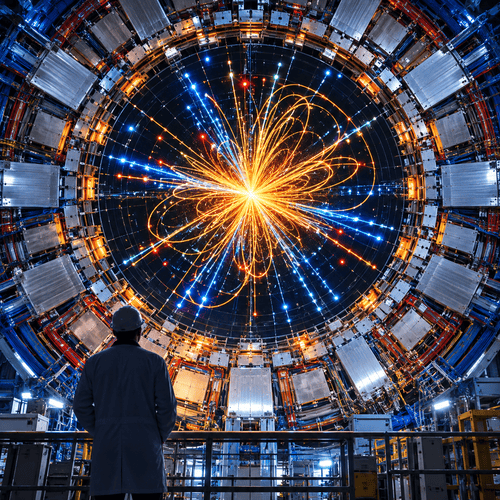
On 4 July 2012, newspapers around the world carried a strange headline: scientists had found ‘the God particle’.
Some people cheered. Others panicked. And some made a bold claim: now we don’t need God any more.
Think about that. Here’s a particle so small that no one has ever seen one. It lives for less than a billionth of a trillionth of a second. Yet this tiny thing, we were told, could push the Maker of heaven and earth out of His own universe.
Is that true? Let’s find out what the ‘God particle’ really is, who said it disproves God, and why the claim falls apart. In fact, we shall see something surprising: the Higgs boson doesn’t make God any smaller. It shows how great He is.
First, a Surprise: CERN Never Said It
Many people believe CERN announced the Higgs boson disproves God. (CERN is the European Organization for Nuclear Research, a giant science laboratory near Geneva in Switzerland.)
But CERN never said this. In fact, its head of communication has said its researchers reject the ‘God particle’ nickname.
Peter Higgs, the British scientist the particle is named after, disliked it too. Though he didn’t believe in God, he called the nickname ‘so misleading’ and worried it could offend religious people.
So Where Did the Name Come From?
The name came from a 1993 book by American physicist Leon Lederman. Frustrated by the long search for the particle, Lederman wanted to call his book The Goddamn Particle. His publisher said no and shortened it to The God Particle.
So the famous name began as a cuss word, not a statement of faith.
What Exactly Is the Higgs Boson?
To understand the Higgs boson, we need 3 simple ideas: particles, mass and fields.
- Particles: Everything around us is made of tiny pieces called atoms. Atoms are made of even smaller pieces, such as electrons and quarks. These tiny pieces are called particles.
- Mass: Mass is how much ‘stuff’ something has. The more mass an object has, the harder it is to push.
- Fields: A field is something invisible that spreads through space. We cannot see the field around a magnet, but we can see it pull a paper clip.
The Higgs field is an invisible field that fills every corner of space. Some particles ‘feel’ it as they move through it, and they gain mass. Other particles, like light, don’t feel it at all. That’s why light has no mass.
So what is the Higgs boson? A boson is simply one type of particle. The Higgs boson is a tiny ripple in the Higgs field. Think of a still lake. Throw in a stone, and the ripples prove the lake is there. In the same way, finding the Higgs boson proved the Higgs field is real.
A SIMPLE PICTURE: THE CROWDED PARTY
In 1993, British physicist David Miller won a competition to explain the Higgs field in simple terms. Imagine a crowded party. An ordinary guest walks across the room easily. But when a famous person walks in, everyone crowds around them, and they move slowly, as if they have become ‘heavy’.
The lesson: The Higgs field is like the crowd. Particles that gather a big ‘crowd’ gain a lot of mass; particles the crowd ignores stay light.
The Higgs Story: A Short Timeline
- 1964: Peter Higgs and five other physicists, working in three small teams, suggest the idea.
- 2008: CERN switches on the Large Hadron Collider (LHC), a 27-kilometre underground ring that smashes particles together at nearly the speed of light.
- 4 July 2012: Two CERN teams, called ATLAS and CMS, announce that they have found the Higgs boson.
- 2013: Peter Higgs and the Belgian physicist François Englert receive the Nobel Prize in Physics.
- April 2024: Peter Higgs dies, aged 94.
4 Myths About the ‘God Particle’
Its nickname has spread many wrong ideas. The table below sets them right.
| THE MYTH | THE TRUTH |
|---|---|
| ‘CERN says it disproves God.’ | No scientific body has ever claimed this. CERN’s own scientists reject the nickname. |
| ‘The Higgs boson gives you your weight.’ | It gives mass to electrons and quarks. But about 99% of your body’s mass comes from the energy that binds quarks together inside protons and neutrons. |
| ‘It explains where the universe came from.’ | It explains how some particles get their mass. It works inside a universe that already exists. |
| ‘It is something divine or all-powerful.’ | It is a created thing—a ripple that breaks apart in a tiny fraction of a second. |
Still, the Higgs matters greatly. Without it, electrons would have no mass, atoms could not hold together, and there would be no life.
Who Said It Removes God?
So who did say it? Mostly popular writers and speakers, not the laboratory.
- Lawrence Krauss: This American physicist argued that the universe could come from ‘nothing’ by itself, so science ‘makes it possible not to believe in God’. Later editions of his book A Universe from Nothing added a section on the Higgs.
- Morgan Freeman: The actor, who hosted a science TV series, told a talk-show audience that the Higgs ‘explains everything—creation’.
- Stephen Hawking: The British physicist did argue God wasn’t needed. But his 2010 book The Grand Design, written with Leonard Mlodinow, based that claim on gravity, not the Higgs.
Hawking’s book made a famous claim: ‘Because there is a law such as gravity, the universe can and will create itself from nothing.’
Oxford mathematician John Lennox replied with one sharp sentence: ‘Nonsense remains nonsense, even when talked by world-famous scientists.’
Why so blunt? Because the argument falls apart in at least six places.
6 Reasons the Higgs Cannot Disprove God
1. Explaining ‘How’ Is Not Explaining ‘Who’
John Lennox gives a simple example. Imagine you open the bonnet of a Ford car and learn exactly how the engine works. Does that prove there was no Henry Ford? Of course not.
In the same way, the Higgs boson explains how some particles get mass. It cannot tell us who made them. The Bible never hides God in the parts of nature we do not understand. It says He stands behind all of it:
For by him all things were created, in heaven and on earth, visible and invisible, whether thrones or dominions or rulers or authorities—all things were created through him and for him. And he is before all things, and in him all things hold together.
Colossians 1:16–17, ESV
Every particle, including the Higgs boson, was made through Christ and is held together by Him.
2. The Higgs Field Is Not ‘Nothing’
Krauss’s ‘nothing’ is not really nothing. It includes energy, invisible fields and precise mathematical laws. The Higgs field is something, not nothing.
David Albert, a philosopher of physics at Columbia University, made this point in a famous review of Krauss’s book. Fields and their laws, he explained, are just another arrangement of things that already exist. And a thing inside the universe cannot explain why there is a universe at all.
The Bible tells a very different story:
By faith we understand that the universe was created by the word of God, so that what is seen was not made out of things that are visible.
Hebrews 11:3, ESV
God did not shape the world out of some older material. He spoke, and it came to be.
3. Laws Describe; They Do Not Create
Look again at Hawking’s claim. A law of nature is not a thing that acts. It describes how things normally behave. The law of gravity has never created a single apple. It only describes how apples fall once they exist.
Where, then, does the order of nature come from? Christians have always answered: from God’s faithful care. The Heidelberg Catechism (1563) describes providence as ‘the almighty and everywhere present power of God; whereby, as it were by his hand, he upholds and governs heaven, earth, and all creatures’. Dutch theologian Herman Bavinck taught that natural laws aren’t powers standing beside God, but the regular way God’s own power works.
The laws of nature are faithful because the Lawgiver is faithful.
4. A Universe We Can Understand
In 1964, Peter Higgs and others wrote mathematics on paper. Forty-eight years later, a real particle turned up just where that mathematics said it would be.
Why should the universe obey mathematics worked out by human minds? Albert Einstein wrote, ‘The eternal mystery of the world is its comprehensibility.’
Blind chance cannot explain this. But Christians expect it. A rational God made an orderly world. Then He made human beings in His image, able to think His thoughts after Him—a phrase often linked to the astronomer Johannes Kepler.
So God created man in his own image, in the image of God he created him; male and female he created them.
Genesis 1:27, ESV
John Calvin loved this. Writing on Genesis 1, he said of astronomy: ‘it cannot be denied that this art unfolds the admirable wisdom of God.’ His words fit particle physics just as well.
2 WAYS TO SEE THE SAME DISCOVERY
- A world without God: The atheist physicist Steven Weinberg wrote, ‘The more the universe seems comprehensible, the more it also seems pointless.’
- A world made by God: The more the universe seems comprehensible, the more it shows the glory of its Maker. ‘The heavens declare the glory of God, and the sky above proclaims his handiwork’ (Psalm 19:1).
5. A Universe Set on a Knife-Edge
Scientists use the term fine-tuning for numbers in nature that seem set just right for life—like a radio dial turned to exactly the right station. The Higgs field is one of the clearest examples.
| WHAT IS FINE-TUNED | IN SIMPLE WORDS | WHY IT MATTERS |
|---|---|---|
| The Higgs mass | The Higgs boson is far lighter than physics says it ‘should’ be. Huge effects must cancel out to about 1 part in 10³⁴ (a 1 followed by 34 zeros). | Without this balance, atoms could not form. |
| The strength of the Higgs field | In 1998, physicists Stephen Barr, John Donoghue and their colleagues showed that if it were only a few times stronger, the atoms we need could not form. | Only the simplest atoms could exist, so there could be no life. |
| The stability of the universe | Measurements place our universe very close to the edge between stable and unstable. | Our world sits on a knife-edge, yet holds steady. |
Calvin called creation ‘this most beautiful theater’ of God’s works. The Higgs field is one of its hidden stage settings, adjusted with breathtaking care.
6. Lab Science Is Not the Same as a Story About the Past
It helps to separate two kinds of science.
- Operational science: This studies how the world works today, using tests we can repeat. The Higgs discovery belongs here.
- Historical science: This tries to rebuild past events that no one saw and no one can repeat, so it depends on assumptions.
Christians who believe in a young creation welcome the Higgs discovery completely. It is careful, repeatable science, and it says nothing about the age of the universe. But claims that the Higgs field ‘switched on’ just after the Big Bang belong to the second kind. They are a model of the unseen past, not something anyone has observed.
The Belgic Confession (1561) describes creation as ‘a most elegant book, wherein all creatures, great and small, are as so many characters’ pointing us to God. But it adds that God makes Himself known ‘more clearly and fully’ in His Word. The American theologian Charles Hodge put it this way: ‘The Bible is to the theologian what nature is to the man of science.’ Both books come from the same Author, so, rightly read, they never truly disagree.
‘But What About…?’ Answering the Sceptics
Here are the strongest replies sceptics make, with Christian answers.
| The sceptic says | The Christian answer |
|---|---|
| ‘There are endless universes, so one was bound to be fine-tuned.’ (This idea is called the multiverse.) | No one has ever observed another universe, and no test can reach one. A universe-making machine would also need its own fine-tuning, so the question is only pushed back. |
| ‘Fine-tuning is just a human feeling of surprise.’ | Some physicists, such as Sabine Hossenfelder, do argue this. But even if our surprise is mistaken, the numbers still allow life, and the laws still need an explanation. |
| ‘God is a God of the gaps. As science grows, He shrinks.’ | The Bible never puts God in the gaps. He is the reason there is anything to study at all. The more we discover, the more we have to praise Him for. |
Science Grew in Christian Soil
The idea that faith and physics are enemies is a modern myth. Many founders of physics believed the universe showed God’s hand.
- Isaac Newton: He described gravity, and believed the order of the heavens pointed to God.
- Michael Faraday: This pioneer of electricity and magnetism, whose work gave physics the very idea of fields, served as an elder in his church.
- James Clerk Maxwell: The Scottish physicist who explained light had Psalm 111:2 carved in Latin over the door of Cambridge’s Cavendish Laboratory: ‘Great are the works of the LORD, studied by all who delight in them.’
Dutch theologian and prime minister Abraham Kuyper famously said: ‘There is not a square inch in the whole domain of our human existence over which Christ, who is Sovereign over all, does not cry: “Mine!”’ That includes the subatomic world. Every quark and every Higgs boson belongs to Him.
So What Does the Higgs Boson Really Say About God?
- God is a God of order: The Higgs field follows laws so precise that mathematics predicted it 48 years before anyone found it.
- God is a God of detail: The Westminster Confession of Faith (1646) says God governs all things ‘from the greatest even to the least’. He rules galaxies and fleeting particles alike.
- God holds everything together: The Higgs field is set on a knife-edge, yet the world holds steady, because Christ ‘upholds the universe by the word of his power’ (Hebrews 1:3).
RC Sproul once wrote: ‘If there is one single molecule in this universe running around loose, totally free of God’s sovereignty, then we have no guarantee that a single promise of God will ever be fulfilled.’ The good news is that there is no such molecule—and no such particle.
And here’s the most wonderful part. The same Christ who holds every Higgs boson in place didn’t stay far away. He became a man, died on a cross for sinners and rose again. The hands that uphold the universe were pierced for us.
So do not let anyone tell you the ‘God particle’ has made God unnecessary. It’s not the God particle at all. It is God’s particle—and it points straight back to Him.
Tough Questions, Honest Answers
Is the Large Hadron Collider dangerous? Could it create a black hole?
Before the LHC was switched on in 2008, some people feared it might create a tiny black hole that would swallow the Earth. A few even went to court to stop it. Safety studies found no danger. Particles from space, called cosmic rays, constantly strike the Earth, the Moon and the Sun with far more energy than the LHC can produce, and they are all still here. But Christians have an even deeper reason for peace. The future of the world rests not with a machine but with its Maker: ‘He set the earth on its foundations, so that it should never be moved’ (Psalm 104:5).
Why is there a statue of Shiva at CERN?
In 2004, the Indian government gave CERN a two-metre statue of Shiva as Nataraja, the ‘lord of the dance’, to mark India’s long partnership with the laboratory. A plaque beside it compares Shiva’s dance to the dance of subatomic particles, drawing on the ideas of the writer Fritjof Capra. This does not mean CERN worships Shiva. A video that went viral in 2016, showing a fake ‘sacrifice’ near the statue, was a prank, and CERN said so. Still, the statue teaches Christians something. When people stand in awe of the wonders of matter, their hearts reach for worship. The Bible warns against worshipping ‘the creature rather than the Creator’ (Romans 1:25), and it invites us to praise the One who made every particle.
Did Stephen Hawking say the Higgs boson could destroy the universe?
In a way, yes. In 2014, Hawking warned that at extremely high energies, the Higgs field could become unstable and trigger a ‘vacuum decay’—a kind of collapse spreading through space. But he also said that reaching such energies would need a particle collider bigger than the Earth. In other words, there is no practical danger. For Christians, the end of the universe is not a matter of random collapse. It rests in God’s hands, and He has promised something far better: ‘according to his promise we are waiting for new heavens and a new earth in which righteousness dwells’ (2 Peter 3:13).
Is the Higgs boson the same as dark matter?
No. Dark matter is the name scientists give to an unseen kind of matter they believe exists, because galaxies spin in ways that visible matter cannot fully explain. No one has yet detected it directly. The Higgs boson is different: it breaks apart almost instantly, while dark matter would need to last. Some physicists wonder whether the Higgs might act as a ‘doorway’ to dark matter, but there is no proof yet. Even with all our science, much of the universe remains a mystery. Job put it well: ‘Behold, these are but the outskirts of his ways, and how small a whisper do we hear of him!’ (Job 26:14).
Does the Bible say anything about atoms or invisible particles?
The Bible is not a physics textbook. John Calvin noted that Moses ‘wrote in a popular style’, using language that ordinary people could understand. Yet the Bible does say something striking: ‘what is seen was not made out of things that are visible’ (Hebrews 11:3). Paul also tells us that Christ created all things, ‘visible and invisible’ (Colossians 1:16). His main point there is about spiritual powers, but the principle covers every hidden part of creation. We should not claim that these verses predicted particle physics. But they fit beautifully with a world built from invisible fields and particles.
Is there anything smaller than the Higgs boson?
Size is tricky at this level. Scientists call the Higgs boson, the electron and the quark ‘fundamental’ particles, because no smaller parts have been found inside them. But history should make us humble. The word ‘atom’ comes from a Greek word meaning ‘cannot be cut’, yet atoms were later split. Some theories suggest an even deeper layer of reality, but none has been proven. However deep science digs, it will never find something that exists by itself. Only God has life in Himself (John 5:26)—theologians call this His aseity, or self-existence—and every particle depends on Him.
What has CERN discovered since the Higgs boson?
Quite a lot. Scientists have measured rare ways in which the Higgs boson breaks apart, and in 2026 the ATLAS team reported spotting rare high-energy Higgs bosons for the first time. CERN has also found unusual combinations of quarks, called tetraquarks and pentaquarks. However, many scientists hoped the LHC would find a whole family of new particles, and so far it has not, which makes the fine-tuning of the Higgs even more puzzling. CERN is now upgrading the LHC and studying plans for a much larger collider. As the hunt goes on, Proverbs 25:2 seems fitting: ‘It is the glory of God to conceal things, but the glory of kings is to search things out.’
Related Reads
- Is God’s Existence a Matter of Faith or Fact?
- End of the World: What Science and the Bible Predict
- Order in Chaos: What the Hadron Collider Shows Us About the Universe
- The Fine-Tuning Argument: Why the Universe Looks Designed for Life
- Fine-tuned Universe: Design Or Random Chance?
- Creation From Nothing: What Do We Truly Mean?
- What Is Scientism? Why It Fails Its Own Test
- The God Equation: Quantum Physics and the Evidence for Design
- The BGV Theorem: How Physics Points to a Spaceless, Timeless Creator
- Bible Verses About Science: 15 Claims That Stood the Test of Time