
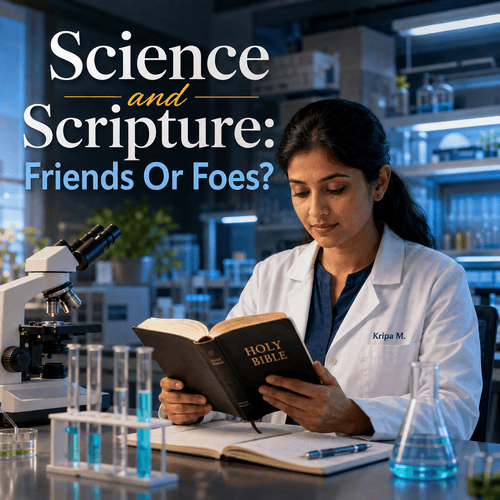
Bible verses about science
Long before microscopes, satellites or Newton’s equations, the Bible’s writers described the natural world in ways that would not be confirmed for centuries, and in some cases millennia. Neighbouring cultures explained nature through mythology—the earth resting on the backs of animals, the sky held up by pillars, the sun as a god’s chariot.
Scripture’s language, by contrast, keeps landing surprisingly close to what we now know to be true. Sample 15 of the clearest examples, organised by field, with the honest caveats that responsible apologetics requires.
| PASSAGE | WHAT IT SAYS | MODERN SCIENCE |
|---|---|---|
| Isaiah 40:22; Job 26:7 | The earth is a “circle,” hung “on nothing” | A sphere suspended in space by gravity |
| Job 9:8; Isaiah 42:5; Jeremiah 51:15 | God “stretches out” the heavens | The universe is expanding |
| Genesis 15:5; Jeremiah 33:22 | The stars “cannot be numbered” | Billions of galaxies, each with billions of stars |
| Hebrews 11:3 | “What is seen was not made out of things visible” | Matter is built from atoms, invisible to the naked eye |
| Psalm 19:4-6; Jeremiah 33:25 | The sun runs a fixed “circuit,” under “fixed laws” of heaven | Predictable orbital mechanics governing day, night and season |
| Ecclesiastes 1:7; Job 36:27-28 | Water rises, forms clouds, and falls again without the sea overflowing | The hydrological cycle: evaporation, condensation, precipitation |
| Ecclesiastes 1:6 | Wind travels in circuits that return to where they began | Global atmospheric circulation: trade winds, convection cells |
| Job 28:5 | Beneath the earth is “turned up as it were fire” | A molten core beneath the crust and mantle |
| Psalm 8:8 | The seas have “paths” | Ocean currents, mapped by Matthew Maury |
| Genesis 1:24-25 | Creatures reproduce “after their kind” | Genetic inheritance within species; no interspecies reproduction |
| Genesis 3:20; Acts 17:26 | All nations descend from one man | Genetics traces humanity to a common ancestral population |
| Leviticus 17:11 | “The life of the flesh is in the blood” | Blood carries oxygen and nutrients essential for survival |
| Genesis 17:12 | Circumcision commanded on the eighth day | Vitamin K and prothrombin peak on day eight, aiding clotting |
| Genesis 6:15 | The ark: 300 x 50 x 30 cubits | A 6:1 length-to-width ratio, recognised today as ideal for stability |
| Leviticus 13; Numbers 19:11-12 | Isolate the infected; wash after touching the dead | Quarantine and hand hygiene as disease control |
Cosmology and physics
Ancient neighbours of Israel pictured the sky as a solid dome or a god’s body stretched overhead, and the earth as a disc floating on a cosmic ocean or propped on pillars. Against that background, these five passages read differently.
- Earth suspended in space, and a hint of gravity (Isaiah 40:22; Job 26:7): Isaiah describes God sitting “above the circle of the earth,” and Job says he “hangs the earth on nothing.” No pillars, no supporting animal, no edge to fall off—just a sphere held in place with nothing under it. Gravity wasn’t formalised until Newton, more than two thousand years after Isaiah wrote, yet the picture of an unsupported, suspended earth anticipates exactly what gravity does.
- The expanding universe (Job 9:8; Isaiah 42:5; Jeremiah 51:15; Zechariah 12:1): Four separate biblical authors describe God “stretching out” the heavens, using an active, continuing verb rather than a one-off act. Modern cosmology, confirmed by Edwin Hubble’s observations in the 1920s, shows the universe is still expanding today. The language wasn’t intended as a physics statement, but it resonates with a cosmos that stretches rather than sits static.
- Innumerable stars (Genesis 15:5; Jeremiah 33:22): God tells Abraham his offspring will be like the stars—too many to count. Ancient astronomers, working with the naked eye, could see perhaps 6,000 stars and might reasonably have assumed that was close to the total. We now know the observable universe holds an estimated two trillion galaxies, each with billions of stars: a number no ancient observer could have guessed, yet the text treats it as a given.
- Matter built from the invisible (Hebrews 11:3): “What is seen was not made out of things which are visible.” Atomic theory confirms that all matter, however solid it looks, is built from particles too small to see. The writer of Hebrews had no microscope and no reason to expect this beyond the statement itself.
- The sun’s fixed circuit (Psalm 19:4-6; Jeremiah 33:25): Psalm 19 pictures the sun running a circuit “from one end of the heavens to the other,” and Jeremiah speaks of “fixed laws of heaven and earth.” Long before anyone could calculate an orbit, Scripture describes the sky as law-governed and predictable rather than arbitrary or chaotic—which is precisely what orbital mechanics turned out to be.
Earth and weather systems
- The water cycle (Ecclesiastes 1:7; Job 36:27-28): “All the rivers run into the sea; yet the sea is not full,” Ecclesiastes observes, and Job describes God drawing up water in fine drops that distil as rain. Together they sketch evaporation, condensation and precipitation—a closed loop scientists wouldn’t fully document until the sixteenth century, when Bernard Palissy first proposed that rainfall alone could account for rivers and springs.
- Wind circuits (Ecclesiastes 1:6): “The wind blows to the south and goes around to the north; around and around goes the wind, and on its circuits the wind returns.” That’s a remarkably precise description of atmospheric circulation—trade winds, the polar front, convection cells—driven by the earth’s rotation and temperature differences, returning air to where it began.
- Earth’s molten interior (Job 28:5): Job says of the earth that “underneath it is turned up as it were fire.” Nobody in the ancient world had drilled deep enough to observe this directly; it took until the twentieth century, using seismic waves, for geologists to confirm a molten outer core beneath the mantle and crust.
- Ocean currents (Psalm 8:8): The psalm references “the paths of the seas,” implying structured, not random, movement of ocean water. Nineteenth-century naval officer Matthew Maury, credited as the father of oceanography, said this verse directed him to search for currents that behave in predictable patterns—work that became the foundation of modern oceanography.
Biology and genetics
- Reproduction “after their kind” (Genesis 1:24-25): Genesis repeats the phrase “after their kind” ten times across chapter 1, describing stable boundaries around reproduction. Modern genetics confirms exactly this: organisms reproduce within their species, genetic information passes from parent to offspring, and interspecies reproduction doesn’t happen in nature. Real variation occurs within those boundaries—but the boundaries hold.
- One human family (Genesis 3:20; Acts 17:26): Genesis names Eve “the mother of all the living,” and Paul tells the Athenians God “made from one man every nation of mankind.” Population genetics traces every living human back to a shared ancestral population, and geneticists studying mitochondrial DNA and the Y chromosome have both converged on the same conclusion: humanity shares common descent, not separate origins for different peoples.
- Blood as the carrier of life (Leviticus 17:11): “The life of the flesh is in the blood,” Leviticus states, grounding the sacrificial system in that principle. Physiology confirms blood is what carries oxygen and nutrients to every cell; sustained blood loss or circulatory failure is what actually kills, regardless of the wound that caused it. The verse doesn’t merely mention blood—it correctly identifies why it’s indispensable.
- Blood clotting and the eighth day (Genesis 17:12): God commands circumcision specifically on the eighth day of a boy’s life. Twentieth-century medical research found that a newborn’s vitamin K and prothrombin levels—both essential to clotting—peak around day eight, higher than at any other point in infancy. The timing given in Genesis lines up with the day the body is best equipped to handle the procedure safely.
Engineering and public health
- The ark’s proportions (Genesis 6:15): God specifies the ark’s dimensions: 300 cubits long, 50 wide, 30 high—a 6:1 length-to-width ratio. Naval architects today still favour ratios in that range for large vessels because they balance stability against capsizing with resistance to breaking apart in rough seas. It’s the proportion of a serious, seaworthy design, not a crude box.
- Quarantine and hygiene (Leviticus 13; Numbers 19:11-12): Mosaic Law isolates those with infectious skin conditions outside the camp and requires washing after contact with a corpse. These aren’t arbitrary rituals; they anticipate two pillars of modern infection control—quarantine and hand hygiene—centuries before germ theory gave anyone a reason to understand why they worked.
READING THIS LIST RESPONSIBLY
The Bible isn’t a science textbook, and we shouldn’t treat it as one. Its purpose is to reveal God and his redemptive plan, not to anticipate every future discovery. Where its language brushes up against later science, that’s a notable and worth-noting pattern—not proof text mining.
Some of these examples are stronger than others. The water cycle and wind circuits describe observable, repeatable processes in fairly plain language. The ark’s proportions and the day-eight clotting detail are narrower, more striking coincidences. Readers should weigh each on its own evidence rather than treat all fifteen as equally decisive.
Poetic language isn’t a scientific claim, and a scientific claim isn’t required to be poetic. “Stretching out the heavens” is worship language before it’s cosmology. That it also happens to describe an expanding universe is the interesting part—not a claim that Isaiah was doing astrophysics.
We don’t need every example to hold up for the case to matter. Even a handful of genuine anticipations, in a book written across sixteen centuries by dozens of authors who mostly never met, is worth explaining. Coincidence gets harder to invoke as the list grows.
What the neighbours believed instead
The contrast sharpens when we compare Genesis to the cosmologies actually in circulation at the time.
| CULTURE | COSMOLOGICAL BELIEF |
|---|---|
| Babylonian (Enuma Elish) | The sky was formed from the split carcass of the slain goddess Tiamat; the earth floated on a cosmic ocean |
| Egyptian | The sky was the goddess Nut, arched over the earth on her hands and feet, held up by the air god Shu |
| Greek (early) | The earth was a flat disc encircled by the river Oceanus, with the sky as a solid dome |
| Hindu | The earth rested on the backs of elephants, which stood on a giant turtle |
| Genesis | The earth is a circle, hung on nothing, in an expanse (Isaiah 40:22; Job 26:7) |
Genesis was written into a world saturated with these pictures, yet it never borrows them. That restraint is itself worth noticing.
Conclusion
Taken individually, any one of these fifteen examples could be dismissed as a fortunate turn of phrase. Taken together, spanning cosmology, meteorology, geology, biology and public health, written by authors separated by centuries and unfamiliar with each other’s work, the pattern is harder to wave away. These texts avoided the common misconceptions of their own era and landed, again and again, on descriptions later ages would confirm. We hold this with an open hand—some examples are stronger than others, and none of them proves the gospel. But they are a reasonable invitation to take the book seriously as more than a product of its time.
Frequently Asked Questions
Couldn’t this just be coincidence? What do these examples actually prove?
Any single example, taken alone, could plausibly be coincidence. What’s harder to dismiss is the pattern: fifteen separate claims, across five different scientific fields, written by different authors across roughly 1,500 years, consistently avoiding the errors common to their surrounding cultures. That doesn’t constitute mathematical proof of divine inspiration—but it is evidence worth weighing, and it’s the kind of convergence a purely human, era-bound text wouldn’t reliably produce.
Isn’t this cherry-picking the hits and ignoring the misses?
It’s a fair challenge, and the honest answer is: check the misses. Skeptics most often point to 1 Kings 7:23, where the “molten sea” is described with a circumference three times its diameter—read by some as claiming pi equals exactly 3. We’ve addressed that specific objection directly, because a responsible case doesn’t get to only cite favourable evidence. The same goes for claims that the Bible teaches a flat earth. Readers should weigh the strongest objections, not just the strongest examples.
How do we respond to claims that the Bible teaches a “flat earth”?
Phrases like “the four corners of the earth” are idioms for totality, the same kind of language we still use in “the four corners of the globe” without meaning literal corners. Isaiah 40:22, by contrast, describes the earth as a “circle”—a word that, in context, sits far more comfortably with a spherical earth than a flat one. Scripture’s language is often poetic, prioritising theological meaning over technical precision, and the two shouldn’t be confused.
Do modern scientific discoveries really support the Bible’s ancient health laws?
Yes. Practices like isolating the infected, washing after contact with a corpse, and dietary restrictions on carrion-eating animals all align with what we now understand about disease transmission. These laws were given for spiritual and communal holiness, not stated as medical instruction—but their side effect was a healthier camp, centuries before germ theory explained why.
Are these just modern reinterpretations read back into old texts?
Some caution is warranted here, and skeptics are right to ask the question. But several of these readings predate modern science by centuries—Jewish and early Christian commentators noted the “circle of the earth” and the water cycle passages long before satellites or hydrology existed to confirm them. The observation isn’t a twenty-first-century retrofit; it’s an old one that later discoveries happened to vindicate.
Does this mean the Bible is primarily a science book?
No, and treating it that way would misread its purpose. Scripture is a redemptive-historical document: it exists to reveal God, humanity’s need, and Christ’s saving work, not to serve as a physics or biology textbook. When its incidental language brushes against later science, that’s a notable, secondary confirmation of the text’s reliability—not the main point of any passage discussed here.
Related Reads
- 1 Kings 7:23: Did God Get His Math Wrong?
- Does the Bible Say the Earth is Flat?
- The DNA Clock: 3 Surprising Clues That Support a Young Earth
- Historicity of Adam & Eve: The New Testament’s Validation
- Biblical Textual Criticism: Unveiling the Reliability of Scripture
- What Do the Dead Sea Scrolls Prove? The Case for Bible Reliability
- Archaeology Endorses Scripture: Papyri and Dead Sea Scrolls
- Faith Vs. Scepticism: Tackling Hard Questions About Bible Miracles
- What Psalm 139 Knew About Embryology and Life in the Womb
- What Does the Bible Say About Climate Change? A Reformed Perspective
- The Weight of Wind: Job 38's Strange Physics
- Long Before Germ Theory: The Quarantine Laws of Leviticus
- Could Jonah Have Survived in a Whale’s Belly? What Science Says
- The God Particle: What Does the Higgs Boson Really Say About God?