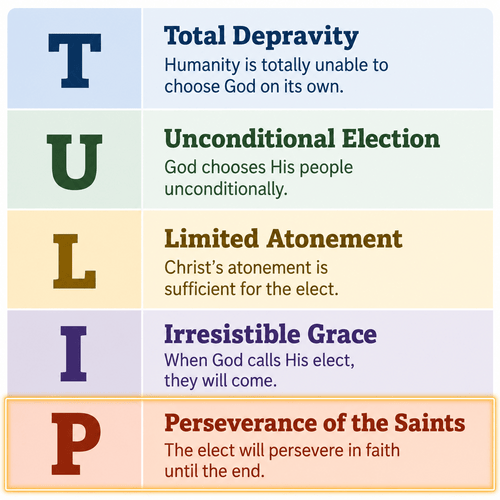
This post is part of our five-part series on the Doctrines of Grace—the biblical teachings known by the acronym TULIP. The name “Doctrines of Grace” reflects the Reformed conviction that every one of the five points answers the same question from a different angle: whose doing is salvation? Total Depravity shows why we cannot save ourselves. Unconditional Election shows us God’s choice rests on His grace, not our merit. Limited Atonement shows Christ’s death actually secured our redemption. Irresistible Grace shows us God’s call overcomes our resistance. Perseverance of the Saints shows us God keeps us to the end. Together, the five make the case that salvation belongs to God—from first to last.
The fifth and final point of TULIP is in many ways the most personal. Total Depravity explains what we are without God. Unconditional Election explains why God chose to save anyone. Limited Atonement explains the certainty of what Christ secured. Irresistible Grace explains how the Spirit brings the dead to life. Perseverance of the Saints answers the question that haunts every honest believer at some point: can I lose this? The answer the Bible gives is no—not because believers are strong, but because God is faithful. This post makes the biblical case for the perseverance of the saints.
What Is Perseverance of the Saints?
Perseverance of the saints is the teaching that those who are truly regenerate—genuinely born again—will not finally and totally fall away from faith. They may stumble, they may fall into grievous sin, they may pass through long seasons of doubt and spiritual darkness. But they will not ultimately apostatise. God, who began the work of salvation in them, will complete it.
The word “perseverance” does the heavy lifting here. This is not the doctrine that a one-time decision guarantees eternal security regardless of how a person subsequently lives. That is a popular but shallow version of the truth, sometimes called “once saved, always saved,” that has done real damage in evangelical culture by suggesting that a prayer prayed at age seven covers a life of unrepentant sin indefinitely. Perseverance of the saints is something richer and more demanding than that: it is the conviction that those who are truly united to Christ will, by God’s preserving grace, continue in faith and repentance throughout their lives.
The saints do not persevere because they are stronger than others. They persevere because God keeps them.
The Biblical Case for Perseverance of the Saints
- John 10:27–29: No One Can Snatch Them Jesus is speaking to the Pharisees when he says of his sheep: “I give them eternal life, and they will never perish, and no one will snatch them out of my hand. My Father, who has given them to me, is greater than all, and no one is able to snatch them out of the Father’s hand.” The language is absolute. No one—no person, no power, no spiritual enemy—can remove Christ’s sheep from his keeping. Two hands hold them: the Son’s and the Father’s. The security is grounded not in the strength of the sheep but in the power of the Shepherd.
- John 6:39: He Will Lose None Earlier in the same Gospel, Jesus states his mission in terms that make final apostasy impossible for the elect: “And this is the will of him who sent me, that I should lose nothing of all that he has given me, but raise it up on the last day.” The will of the Father is that Christ lose none. For any of the elect to finally fall away, Christ would have to fail his Father’s commission. That is not a possibility the New Testament entertains.
- Romans 8:38–39: Nothing Can Separate Paul closes his great eighth chapter of Romans with one of the most comprehensive promises in Scripture: “For I am sure that neither death nor life, nor angels nor rulers, nor things present nor things to come, nor powers, nor height nor depth, nor anything else in all creation, will be able to separate us from the love of God in Christ Jesus our Lord.” Note the scope. Paul runs through every category he can think of—cosmic, temporal, spiritual, physical—and concludes that nothing in all creation can sever the bond between the believer and God’s love. This is not a statement about the believer’s grip on God; it is a statement about God’s grip on the believer.
- Philippians 1:6 — He Who Began Will Complete Paul’s confidence in the Philippian believers rests not on their spiritual maturity or track record but on God’s faithfulness: “I am sure of this, that he who began a good work in you will bring it to completion at the day of Jesus Christ.” The logic is clean. The same God who initiated the work of grace will see it through. He is not an author who loses interest halfway through his story. The work begun at regeneration will reach its completion at glorification.
- 1 Peter 1:3–5 — Kept by the Power of God Peter addresses believers scattered under persecution and grounds their hope in something unassailable: “Blessed be the God and Father of our Lord Jesus Christ! According to his great mercy, he has caused us to be born again to a living hope through the resurrection of Jesus Christ from the dead, to an inheritance that is imperishable, undefiled, and unfading, kept in heaven for you, who by God’s power are being guarded through faith for a salvation ready to be revealed in the last time.” The inheritance is kept in heaven—imperishable, undefiled, unfading. And the saints themselves are “guarded”—the Greek word is phroureō, a military term for standing watch over something to prevent its loss. God is standing guard over His own people. The security is mutual: the inheritance is kept for them; they are kept for the inheritance.
What Perseverance of the Saints Is Not
Some misconceptions need clearing away.
It is not license to sin. The doctrine does not say that the elect can live however they please and their salvation is guaranteed regardless. The New Testament is insistent that genuine faith produces genuine transformation. If a person claims to be a Christian while living in unrepentant, habitual sin with no conflict of conscience, the appropriate question is not whether they will lose their salvation but whether they ever had it (see 1 John 3:6–10). Perseverance includes perseverance in repentance.
It is not that believers never fall seriously. David committed adultery and murder and spent months concealing it. Peter denied Christ three times. The Corinthian church was a catalogue of moral failure. The doctrine of perseverance does not promise sinless behaviour—it promises that God will not abandon those who are truly his, that his convicting, restoring grace will pursue them, and that they will not harden permanently into unrepentance. The mark of the true believer who falls is not that they never sin, but that they cannot ultimately make peace with it.
It is not the same as “once saved, always saved” as popularly understood. That phrase, as it circulates in popular Christianity, sometimes functions as a blank cheque: say the right words, sign the card, and you are covered for life regardless of what follows. Perseverance of the saints is not that. It is the conviction that those who are truly and savingly united to Christ will, because of His preserving work, continue in genuine faith and repentance. The assurance flows from what God does, not from a past decision.
What About the Warning Passages?
Any honest treatment of perseverance must face the warning passages in Hebrews, which are among the most sobering texts in the New Testament.
Hebrews 6:4–6 describes people who were “once enlightened, who have tasted the heavenly gift, and have shared in the Holy Spirit, and have tasted the goodness of the word of God and the powers of the age to come”—and who then fall away. Hebrews 10:26–31 speaks of those who sin deliberately after receiving knowledge of the truth, for whom “there no longer remains a sacrifice for sins, but a fearful expectation of judgment.”
How does the Reformed tradition handle these passages? There are two main approaches, and both deserve a hearing.
- The first approach holds that the people described in Hebrews 6 were never truly regenerate. They had significant external contact with the gospel—they had tasted, been enlightened, participated in the community of the Spirit—but they had never savingly believed. On this reading, the warnings are directed at professing believers whose profession was not matched by reality.
- The second approach—taken by many Reformed commentators—reads the warning passages as genuine threats directed at genuine believers, functioning as the very means by which God keeps His people from apostasy. The warnings are real; they are supposed to produce holy fear; and they work precisely because God uses them to preserve his elect. On this view, the fact that true believers are never described as actually committing the apostasy described is itself significant.
Both approaches preserve the crucial point: John’s apostolic test in 1 John 2:19 defines the category of the apostate—”They went out from us, but they were not of us; for if they had been of us, they would have continued with us.” Those who truly fall away show by their departure that they were never truly united to Christ, however much it may have appeared otherwise.
Perseverance and Assurance of Salvation
One of the great gifts of the doctrine of perseverance is what it does for assurance. Many Christians live in chronic uncertainty about their standing with God—wondering if a bad week, a season of doubt, or a serious sin might have severed the relationship. Perseverance speaks directly to that fear.
If your security rests on your own grip on God, then your assurance will rise and fall with the quality of your spiritual life. Strong week, high assurance. Dark season, no assurance. That is an exhausting way to live, and it is not the assurance the New Testament offers.
Perseverance grounds assurance not in the strength of the believer’s hold on God but in the strength of God’s hold on the believer. Peter says we are guarded by God’s power. Paul says nothing can separate us from God’s love. Jesus says no one can snatch us from his hand. These are not promises conditional on our performance—they are descriptions of what God does for those who are his.
The practical implication is that assurance is found not by searching for signs of unassailable devotion in yourself but by looking outward to the promises of God and the finished work of Christ. The believer in a dark night of the soul can say: “My feelings are unreliable. My faith feels thin. But God’s word does not change, and Christ’s intercession does not fail.” That is not presumption—it is perseverance.
The Capstone of TULIP
Perseverance of the saints is the logical completion of the other four points. If Total Depravity is true and we are dead in sin, then our perseverance cannot rest on our own spiritual vitality. If Unconditional Election is true and God chose us before we existed, then his purposes cannot be thwarted by our weakness. If Limited Atonement is true and Christ’s death actually secured our redemption, then that redemption cannot be undone. If Irresistible Grace is true and the Spirit effectually called us, then the work he began in us will not be abandoned.
Each point builds on the last, and perseverance seals the structure. Salvation belongs to God from first to last—from the election before time, through the atonement at the cross, through the effectual call in our hearts, to the final glorification that awaits. Not one link in that chain breaks.
Tough Questions, Honest Answers
What about people who seemed genuinely converted but later walked away from the faith?
This is the sharpest real-world challenge to the doctrine, and it deserves a frank answer. The apostle John addresses it directly: “They went out from us, but they were not of us; for if they had been of us, they would have continued with us.” (1 John 2:19) The Reformed position is that complete and final apostasy—not a dark season or a painful deconstruction that eventually resolves, but a settled, final rejection of Christ—is evidence that saving faith was never truly present. This is not a retreat from the evidence; it is what Scripture says. It is also cold comfort to those who loved the person. The doctrine does not prevent grief—it prevents us from concluding that God lost one of his own.
Doesn’t this make people complacent about sin?
The opposite tends to be true in practice. Those who understand that their perseverance is God’s work, not their own, are not relieved of responsibility—they are driven to examine whether they are truly in the faith (2 Corinthians 13:5). The doctrine produces sober self-examination rather than complacency. The person who responds to perseverance with “great, so I can live however I want” has almost certainly not understood it, because they have not understood total depravity or genuine regeneration.
What if I am in a season where I doubt everything—am I apostatising?
No. Doubt is not apostasy. Some of the most biblically faithful Christians in history have passed through extended dark nights of the soul—Luther, Bunyan, Spurgeon, Cowper. The difference between the believer in darkness and the apostate is not feeling but direction. The believer in doubt is still turning toward Christ, still bringing their doubts to him, still unwilling to finally and permanently turn away. If you are asking “what if I am falling away?”—that question itself is evidence that you are not.
Is perseverance the same as final justification by works?
No. Perseverance does not teach that we are ultimately saved on the basis of our track record of faith and repentance—as though God tallies our spiritual performance at the end. We are justified by Christ’s righteousness alone, received through faith. What perseverance teaches is that those who are truly justified will, by God’s preserving grace, continue in faith until the end. The continuance is evidence of genuine justification, not the ground of it.
What is the difference between perseverance of the saints and “once saved always saved”?
They overlap but are not the same thing. “Once saved, always saved” as popularly understood tends to focus on the security of a past decision—you prayed a prayer, signed a card, walked an aisle, and that moment guarantees your eternity regardless of what follows. Perseverance of the saints is a richer and more demanding truth: it says that those who are truly regenerate will, by God’s preserving grace, continue in genuine faith and repentance throughout their lives. The security is real, but it is grounded in God’s ongoing work in the believer, not in the bare fact of a past event. A person who made a profession of faith decades ago and has since lived with no evidence of spiritual life, no repentance, no love for Christ, cannot take comfort from perseverance of the saints—because perseverance includes persevering. What the doctrine guarantees is not that a historical moment is sufficient; it is that those who are truly God’s will not ultimately and finally abandon him.
What role do prayer, Scripture, and church play if God is the one preserving us?
A central one—because God preserves his people through means, not around them. He does not keep his saints by putting them in a spiritual glass case where they never need to pray, read Scripture, or gather with other believers. He keeps them by making those very things the channels through which his sustaining grace flows. The Westminster Confession puts it plainly: the saints are kept “through faith”—and that faith is nourished by the word, strengthened in prayer, and sharpened in community. Neglecting these means is not spiritually neutral; it is the kind of drift that genuine believers are warned against throughout the New Testament (Hebrews 2:1; 10:24–25). The doctrine of perseverance does not make the means of grace optional—it makes them the path along which God actually does his preserving work.
Can a true believer fall into prolonged, serious sin and still be saved?
Yes—and Scripture gives us sobering examples. David’s adultery with Bathsheba and the murder of Uriah were not momentary lapses; months passed before Nathan confronted him and repentance came. Peter’s denial was not a private slip but a public, three-fold repudiation of Christ. Yet both were restored. The doctrine of perseverance does not promise that believers will never fall seriously or that recovery will be swift. What it promises is that God’s convicting and restoring grace will pursue those who are truly his, and that they will not finally make peace with their sin and harden permanently into unrepentance. The distinguishing mark is not the absence of serious failure but the impossibility of settling there without conflict. As the apostle John writes, those who are born of God cannot go on sinning as a settled way of life (1 John 3:9)—not because they never sin, but because the new nature God has given them is at war with it.
Related Posts