Imagine a church that gets nearly everything right.
It works hard. It refuses to give up. When false teachers arrive with impressive titles, this church checks their claims and shows them the door. It has held its ground for 40 years under real pressure without growing tired.
Now imagine the risen Christ looking at that same church and saying He may close it down.
That’s the letter to the church in Ephesus (Revelation 2:1-7), and it’s one of the most uncomfortable paragraphs in the Bible. The problem wasn’t bad teaching. The problem was a church that had kept the truth and slowly let go of the love that made the truth worth keeping.
This is the first post in a series on the letters to the 7 churches in Revelation. We begin where the letters begin: in a wealthy port city where the gospel had been taught more thoroughly than almost anywhere else on earth.
7 Letters, 7 Real Cities
Revelation Chapters 2 and 3 contain 7 short letters. Each is addressed to a named church in a named town in the Roman province of Asia, which today is western Turkey.
Two things are true about these letters at the same time, and we need to hold both.
First, they were real letters to real churches. The congregations existed, and the details inside each letter fit the town it was sent to. Colin J Hemer spent years comparing the wording of the letters with local coins, inscriptions and civic customs, and found the fit unusually close. Smyrna, a city destroyed and rebuilt, is told about death and life. Laodicea, famous for its poor water supply, is told it’s lukewarm. Nothing here is vague.
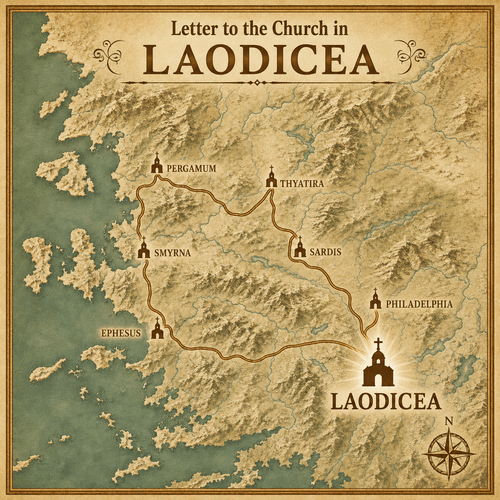
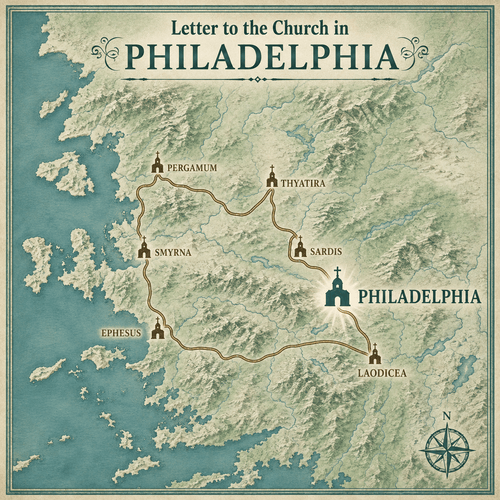
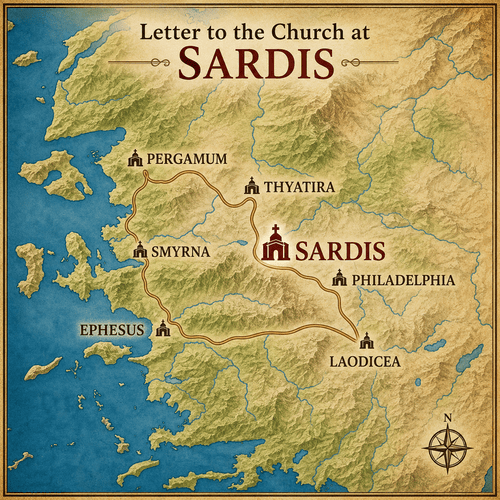
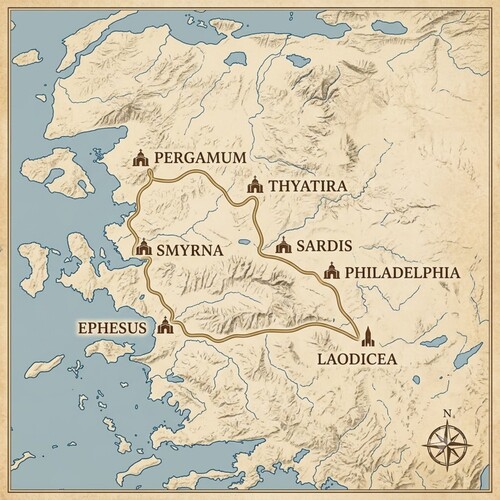
Notice too the 7 towns sit on a road. A messenger carrying this scroll from Patmos would land near Ephesus, travel north, then turn inland and work south. The order of the letters is simply the order of the delivery route.
Table 1. The seven churches, listed in the order a messenger would reach them
| STOP | CITY | CHRIST’S MAIN WORD TO THAT CHURCH |
|---|---|---|
| 1 | Ephesus | Sound in doctrine, cold in love |
| 2 | Smyrna | Poor and persecuted — no rebuke given |
| 3 | Pergamum | Faithful under threat, but tolerating false teaching |
| 4 | Thyatira | Growing in love, but tolerating a false prophetess |
| 5 | Sardis | A reputation for life, but dead |
| 6 | Philadelphia | Little strength, but faithful — no rebuke given |
| 7 | Laodicea | Rich in its own eyes, lukewarm towards Christ |
Second, 7 means “complete”. Revelation counts carefully. 7 spirits, 7 seals, 7 trumpets, 7 bowls, 7 lampstands. In this book, 7 is the number of fullness. And there were other churches in the province. Colossae and Hierapolis were close by, and both had congregations, yet neither receives a letter. 7 were chosen because 7 is enough to stand for all.
So the letters are for real churches, and yet, for every church since. Look at how each one ends: “He who has an ear, let him hear what the Spirit says to the churches.” Not “to this church”. To the churches, plural. Every congregation is meant to read all 7 and ask honestly which one it resembles.
WHY WE DON’T READ THE LETTERS AS 7 AGES OF CHURCH HISTORY
A popular scheme treats the 7 churches as 7 periods of history, with Ephesus as the age of the apostles and Laodicea as our own. It’s a tidy idea, but we don’t think it stands up. Three reasons:
The text never hints at it. Nothing in these 2 chapters mentions eras. The letters address living congregations with named people and named problems.
It could not have helped the first readers. A believer in Thyatira had no way of knowing he was living in Period 4 of 7, and no way of using that information if he did.
It removes the sting. If Laodicea is “our” age, the other six warnings belong to somebody else, safely dead. These letters were written so every church would feel all seven.
The City That Made The Sin Easy
Ephesus wasn’t a quiet market town. It was the leading city of the province and one of the great ports of the Roman world. 4 things shaped daily life there.
- A world-famous temple. The temple of Artemis was counted among the 7 wonders of the ancient world, and pilgrims arrived all year with their money.
- Official loyalty to Caesar. Ephesus held the honoured civic title of temple-warden, meaning it hosted the state worship of the Roman emperor. Public loyalty to Rome was expected, and profitable.
- A centre of magic. Acts 19 describes new believers burning their books of spells in the street. The value destroyed was enormous, which tells us how normal the practice had been.
- A city that rioted over the gospel. When Paul’s preaching damaged the trade in silver shrines, the silversmiths filled the theatre and chanted for two hours.
Now the striking part. Paul stayed in Ephesus for about 3 years, longer than in any other city we know of. He later wrote them a letter we still read. He sent Timothy to lead them. He called their elders to Miletus for a farewell warning, and early tradition connects the apostle John to the same city.
If deep teaching alone could keep a church healthy, Ephesus was safe forever. It wasn’t. Let that land before we go further, because it’s the first thing this letter wants us to feel.
Who Is Writing, and How He Describes Himself
Every one of the 7 letters opens with a description of Christ, and each description is lifted from the vision in Revelation chapter 1. Ephesus gets this one:
“The words of Him who holds the 7 stars in His right hand, who walks among the 7 golden lampstands.” Revelation 2:1
2 pictures, and both of them are gentle warnings.
- He holds. The seven stars stand for the leaders of the seven churches. The word is strong — a firm grip, carrying ownership and protection together. The church at Ephesus did not belong to its elders, its members or its founder. It belonged to the one holding it.
- He walks among. The seven lampstands are the churches themselves; Revelation 1:20 says so plainly. Christ is not watching from a distance. He is walking up and down between them. In the Old Testament, God walks in the garden and in the camp of Israel. This is the language of a visit — and of an inspection.
- He knows. Five of the seven letters open with the words “I know your works”. No annual report is required. The assessment that actually counts has already been written.
This matters for everything that follows. When Christ says something is wrong at Ephesus, he is not repeating a rumour. He has been in the room.
Who is “the angel of the church”?
Three views on “the angel”, and why the practical result is the same
Each letter is addressed to “the angel” of a church. Careful readers land in three places.
A guardian angel assigned to that congregation.
A human messenger or minister—the man who’d read the letter aloud to the gathered church. William Hendriksen takes this line.
A heavenly counterpart of the congregation itself, so that speaking to the angel is speaking to the church. Gregory K Beale argues along these lines.
Whichever view is correct, the letter is delivered to the whole church, and those who lead it carry its weight first. That’s the point we can act on.
What Christ Praises
Read the praise slowly, because it is generous and it comes first.
“I know your works, your toil and your patient endurance, and how you cannot bear with those who are evil, but have tested those who call themselves apostles and are not, and found them to be false. I know you are enduring patiently and bearing up for my name’s sake, and you have not grown weary.” Revelation 2:2–3
- Works. Real activity, not good intentions.
- Toil. The word means labour carried to the point of exhaustion.
- Patient endurance. Not passive waiting, but staying under a heavy weight without collapsing.
- Refusal to tolerate evil. They would not let wickedness settle down and make itself at home in the congregation.
- Testing false apostles. Men arrived claiming the highest authority in the early church. Ephesus examined the claim, found it false, and said so out loud.
- No burnout. Years of this, and they had not grown weary.
Now set that beside what Paul had said to these very elders decades earlier:
“I know that after my departure fierce wolves will come in among you, not sparing the flock; and from among your own selves will arise men speaking twisted things, to draw away the disciples after them.” Acts 20:29–30
Paul warned them that wolves were coming, including from inside their own leadership. Roughly forty years later, Christ confirms that they did exactly what Paul asked. They watched. They tested. They refused. One generation of leaders handed the task to the next, and the guard held.
So let us be clear before the rebuke arrives: this is a genuine achievement, and Christ names it first. Many churches today would not survive the test Ephesus passed.
Who were the Nicolaitans?
“Yet this you have: you hate the works of the Nicolaitans, which I also hate.” Revelation 2:6
We know very little about this group. The name appears only in this chapter — here, and again at Pergamum, where it is set beside “the teaching of Balaam”, a reference to eating food offered to idols and to sexual sin. The likeliest picture is a party inside the churches arguing for compromise: attend the trade guild dinners, join the civic ceremonies, keep your business and your safety, and tell yourself none of it touches your faith. Ephesus said no.
But look closely at the wording, because it is exact. Christ says they hate the works of the Nicolaitans, and that he hates those works too. He does not say they hate the Nicolaitans. He never once commends a church for hating people. It is a small distinction that casts a very long shadow, and we will come back to it before the end.
The One Thing Against Them
“But I have this against you, that you have abandoned the love you had at first.” Revelation 2:4
One sentence, and the whole letter turns.
What is “first love”?
Readers have long argued about whether this means love for Christ or love for one another. We do not think we are forced to choose, and the letter Paul wrote to this same city a generation earlier suggests we should not. Paul had thanked God for their “love toward all the saints”, prayed that they would grasp the immeasurable love of Christ, and closed by pronouncing grace on all who love the Lord Jesus.
Love for Christ and love for his people are two ends of one rope. Pull one and the other moves. A church growing cold towards Christ will grow cold towards each other, and a congregation that has stopped loving its own people has already stopped loving him, whatever its doctrinal statement says.
“Abandoned” is a deliberate word
Christ does not say their love faded, dimmed or was mislaid. He says they abandoned it. They left it behind. That is an active word, and it places the fault exactly where it belongs.
Nobody drifts by accident across forty years. A thousand small decisions were taken, and each looked reasonable at the time. A meeting where the argument mattered more than the person losing it. A visit not made because there was a study to prepare. A newcomer assessed before being welcomed. None of these is a scandal. Together they’re a departure.
Table 2. What Ephesus still had, and what had quietly gone missing
| STILL FIRMLY IN PLACE | QUIETLY GONE |
|---|---|
| Correct doctrine | Warmth towards Christ Himself |
| Hard work | Warmth towards one another |
| Sharp discernment | Patience with weak and struggling believers |
| Endurance under pressure | The gladness they started with |
| A reputation for soundness | The reason for being sound in the first place |
Here’s the diagnosis, put as plainly as we can. Doctrine is the skeleton of a church and love is the flesh on it. A skeleton isn’t a small thing; take it away and nothing stands up at all. But a skeleton on its own isn’t a healthy body. It’s a corpse, correctly assembled. Paul had already told another church that a man may possess every gift and all knowledge and still, without love, be nothing.
Sinclair B Ferguson has argued legalism is never really about rules. It’s about a heart that has quietly stopped trusting how good God is, and then keeps up the outward performance out of duty rather than delight. Michael Horton makes a similar point about churches in our own day: it’s entirely possible to keep the whole form of Christianity while the living centre slips away, and to notice nothing, because the form still works.
Richard D Phillips puts the sharp edge of this letter well. The threat to Ephesus isn’t that it will lose its doctrine. The threat is it will lose Christ.
And notice which danger this is. Ephesus watched the door for wolves. The thing that nearly killed the church didn’t come through the door. It started inside, quietly, among the watchmen.
The Cure: Three Commands
“Remember therefore from where you have fallen; repent, and do the works you did at first.” Revelation 2:5
Christ does not leave them guessing about the remedy. He gives three commands, and the order is deliberate.
Table 3. The three commands of Revelation 2:5, and what each one asks for
| COMMAND | WHAT THE WORD MEANS | WHAT IT LOOKS LIKE IN PRACTICE |
|---|---|---|
| Remember | Keep looking back at what you used to be. In the original language this is a continuing command: go on remembering. | Recall the early days honestly—the prayers, the gladness, the open homes—and admit how far away that now feels. |
| Repent | Turn round and go the other way. A single, decisive command—a change of direction, not a season of feeling sorry. | A settled decision, made once and acted on, to travel back along the road you came down. |
| Do the first works | Repeat the actions love used to produce. Christ asks for old works, not new programmes. | Hospitality resumed. Forgiveness offered. Money given quietly. The difficult person visited anyway. |
Look at that order again and something surprising appears. Ephesus had kept the works and lost the love, and the cure is to recover the love by doing the works again. That’s not a contradiction, and it’s not an instruction to pretend. It’s how God normally restores affection: through the ordinary channels love once ran in. We don’t feel our way into loving action. We act our way back into loving feeling.
One word needs explaining. To repent doesn’t mean to feel sorry. It means to turn round, with your whole life, and walk the other way. A person can be sorry for years and never once repent.
The Threat: A Lampstand Removed
“If not, I will come to you and remove your lampstand from its place, unless you repent.” Revelation 2:5
This is the sharpest sentence in the letter, and it’s easily misread in both directions. So let’s be careful.
- The threat is to a church, not to a Christian. What’s at risk is the lampstand—this congregation’s continued existence as a church that gives light. Christ isn’t saying that those who truly belong to Him may be lost. He’s saying this church may stop being a church.
- Individuals are kept; institutions aren’t. Scripture promises repeatedly that those the Father gives to the Son are held to the very end, and that no one snatches them out of His hand. No such promise is ever attached to a particular congregation, a denomination, or the Christianity of a whole country. Church history is full of empty buildings in places that once burned very bright.
- A lamp that gives no light has already stopped being a lamp. The image comes from the golden lampstand in the tabernacle and the vision of Zechariah 4. A lampstand exists for one purpose. If it stops doing that, removing it destroys nothing healthy; it makes official what has already happened.
There’s hard mercy running through this warning. Christ tells them what He intends to do before He does it. And in a single verse He says “unless you repent” twice. The threat is entirely real, and it’s also an open door.
Timeline: what happened to Ephesus afterwards
- Around AD 95—The letter is written. The church is orthodox, hard-working, respected, and cooling.
- AD 431—Ephesus hosts one of the most significant councils in church history. It is still a centre of the Christian world.
- 6th to 7th centuries—The harbour silts up, trade shifts elsewhere, and the population drains away.
- From the 15th century—The site is largely abandoned. The great church built over the traditional tomb of John falls into ruin.
- Today—The ruins are a tourist site near Selçuk in western Turkey. There’s no continuing congregation at Ephesus.
We should hold this history carefully. The warning was given, and the lampstand isn’t there.
The Promise: A Way Back to the Tree
“He who has an ear, let him hear what the Spirit says to the churches. To the one who conquers I will grant to eat of the tree of life, which is in the paradise of God.” Revelation 2:7
The letter that threatens a removed lampstand ends by offering a garden. Three things are worth seeing.
“The one who conquers” doesn’t mean the strong
Revelation defines its own terms, and it defines this one later in the book: “And they have conquered him by the blood of the Lamb and by the word of their testimony.” They conquer by somebody else’s blood. Christ is the true conqueror, and His people share a victory they didn’t win.
That matters, because the language of conquering can sound like a challenge to perform. It isn’t. Overcoming is the evidence that grace is present, never the price paid to obtain it. In every one of the 7 letters the promise to the conqueror is granted as a gift, not paid out as a wage.
The tree of life closes a story that opened in Genesis
After Adam sinned, God drove Him out of the garden and set cherubim and a flaming sword to guard the way back to the tree of life. That door stayed shut, and nothing in the whole Old Testament reopens it. Now, at the far end of the Bible, a man who was Himself cut off offers the tree freely to anyone who will come. The barrier wasn’t removed by pretending the sword didn’t matter. It was removed because the sword fell somewhere else.
What’s offered is more than Eden
The tree appears once more in the final chapter of Revelation, standing on both sides of a river, in the middle of a city, bearing fruit every month, with leaves for the healing of the nations. Adam had a garden and lost it. The redeemed receive a garden inside a city, with more fruit, more people, and no possibility of exile.
Dennis E Johnson and Vern S Poythress both notice this pattern in Revelation: the end of the story isn’t a return to the beginning, but the beginning carried through to completion. What’s restored is better than what was lost, and it’s permanent.
What This Letter Asks of Us
Ephesus isn’t a warning for churches that are careless about truth. It’s a warning for churches that are careful about it. That’s what makes this letter so useful, and so awkward. Here are 4 honest questions, best asked about ourselves.
- Has our care for truth turned into a habit of suspicion? Ephesus hated the works of the Nicolaitans. The text never says they hated the Nicolaitans. When the satisfaction of catching an error grows larger than the grief over the person caught, something has shifted.
- Is our knowledge growing faster than our patience? A growing library and a shrinking prayer life is the exact profile in this letter.
- Would a visitor sense warmth, or only accuracy? Both can be measured. Usually only one is counted.
- What were our own first works? Name them. The open home. The money given quietly. The difficult person visited anyway. Christ doesn’t ask Ephesus for new works. He asks for the old ones.
RC Sproul often said that theology which doesn’t end in worship has gone wrong somewhere. That’s the test this letter applies. The Christians at Ephesus had a theology that ended in vigilance—real vigilance, aimed at real dangers—and it wasn’t enough.
Christ still walks among the lampstands. He still holds them in His hand. And to any church that hears Him and turns back, the promise isn’t merely survival. It’s the tree of life in the middle of the city. And the door standing open.
Tough Questions, Honest Answers
Where is Ephesus today, and can you still visit it?
The ruins lie beside the modern town of Selçuk in western Türkiye, about an hour south of İzmir. Visitors can walk the marble street, sit in the theatre where the silversmiths rioted against Paul, and stand in front of the famous library façade. The harbour that made the city rich silted up many centuries ago, so the ruins now sit some distance inland, which is part of the reason the city died. There is no continuing congregation at Ephesus. What survives there is stone; what was removed was the lampstand.
Is this the same church that Paul wrote the letter to the Ephesians to?
Almost certainly yes — the same city, and in all likelihood the same congregation, roughly 30 to 40 years later. That’s exactly what gives Revelation 2:4 its edge. Paul had thanked God for their love towards all the saints and prayed they’d grasp how wide and long and high and deep the love of Christ is. A generation later, the one quality he’d celebrated is the one thing Christ says they’ve abandoned. Churches rarely lose their best feature overnight. They lose it slowly, while every official document still says otherwise.
Which of the 7 churches received no rebuke at all?
Smyrna and Philadelphia. Both were small, poor and under real pressure, and both are simply told to hold on. The pattern is worth noticing carefully. The 2 congregations with the least to boast about received the most approval, while Laodicea, the wealthiest and most self-satisfied city on the list, received the harshest words in the whole section. Comfort isn’t a sign of God’s favour and hardship isn’t a sign of His displeasure. These letters quietly reverse almost every measure we normally use to judge a church.
Why do these 7 cities—and not others in the region—get letters?
2 reasons work together. Practically, the 7 sit on a natural circular road, and each one was a regional postal and administrative hub from which a letter could be copied and passed on to the smaller towns around it. Theologically, 7 is the Bible’s number for completeness, so 7 churches can stand for the whole church. We know other congregations existed nearby—Colossae and Hierapolis among them—and they receive no letter, which shows the selection was deliberate rather than a complete list. The choice is a message in itself.
Was the apostle John really connected with Ephesus?
Early Christian writers, including Irenaeus in the 2nd century, record that John spent his later years at Ephesus. That tradition is early, widely repeated and shows no sign of being invented to prove a point, which is about as strong as evidence of this kind gets. The New Testament itself doesn’t say it directly; Revelation tells us only that John was on the island of Patmos, which lies within easy sailing distance of the Ephesian coast. We can hold the tradition as probable without building any doctrine on it. The authority of the book rests on the fact that God gave it, not on our reconstruction of the writer’s address.
Is the “House of the Virgin Mary” near Ephesus genuine?
It’s a popular pilgrimage site on a hill above the ruins, and the claim rests on visions recorded in the 19th century by a German nun, Anne Catherine Emmerich, who never travelled to the region. Searchers later found a ruined building that matched her description, and the site has been venerated since. There’s no evidence from the first 1000 years of church history connecting that house to Mary. It’s also worth noticing that Scripture tells us nothing whatever about where Mary spent her final years, and that silence is itself instructive. The Bible keeps pointing our attention to her Son.
What does “He who has an ear, let him hear what the Spirit says to the churches” mean?
It’s a call to pay attention, and Jesus used almost the same words during His earthly ministry when He wanted His hearers to stop and think rather than nod along. Two details in it repay a second look. First, the letter is dictated by the risen Christ, yet the closing line says it is the Spirit who speaks—the words of Christ reach his churches by his Spirit, which is exactly how Scripture still reaches us. Second, the word is “churches”, plural, and it appears at the end of every single letter. Ephesus was meant to read the letter sent to Laodicea, and Laodicea the letter sent to Ephesus. So are we.