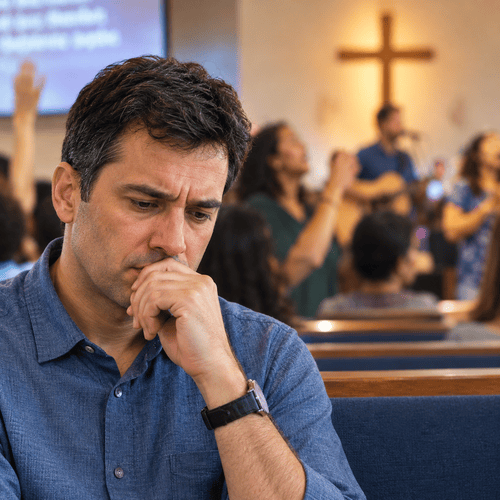

If our neighbour’s house were on fire, would we stay quiet because we were afraid of seeming rude? Of course not. We’d shout and bang on the door.
Yet we believe something far more serious: that people without Christ will face the judgement and wrath of God. And yet stay quiet. A friend asks, ‘So what do you believe?’—and we change the subject.
We’re not alone. In a Jesus Film Project survey of more than 1,600 people, fear was the number one reason Christians gave for not sharing their faith. A 2019 Barna study found 47 % of practising Christian Millennials thought it at least somewhat wrong to share their faith with someone of another religion in the hope that they would believe.
So what do we do with our fear of evangelism? We will see that fear is common—even among the greatest believers in the Bible. But fear is never the final word. God cures it with a bigger fear, a firmer confidence and a deeper love.
This post is part of our series What Do We Do When…?, which takes the hard moments of the Christian life to Scripture and asks how God would have us respond. Other posts in the series ask what we do when God seems distant and silent, when God closes a door we prayed would open, when we don’t know what step to take next, when we fall into the same sin again, when life doesn’t go according to plan, when doubt and anxiety won’t let go, when we can’t forgive someone, when we feel trapped in a meaningless existence, when we’re afraid of the future, when our family opposes our faith, when we have no feelings for God and when our evangelism seems to bear no fruit…
KEY TERM: WHAT DOES ‘EVANGELISE’ MEAN?
The word comes from the Greek euangelion, meaning ‘good news’. To evangelise is to tell people the good news that Jesus died for sinners and rose again, and that everyone who turns from sin and trusts in Him will be forgiven.
Pastor J Mack Stiles describes evangelism as teaching the gospel ‘with the aim to persuade’. It isn’t about being loud or clever. It’s telling the truth in love.
1. We’re Not the First: Afraid Saints in the Bible
We often think, ‘Real Christians aren’t scared.’ But some of God’s greatest servants were afraid too.
Timeline: Fearful Messengers, Faithful God
- The Exodus—Moses: God called him to speak to Pharaoh, and Moses replied, ‘I am slow of speech and of tongue.’ Then he begged, ‘Oh, my Lord, please send someone else’ (Exodus 4:10, 13). God answered, ‘Who has made man’s mouth? … I will be with your mouth’ (Exodus 4:11–12).
- About 627 BC—Jeremiah: ‘Ah, Lord GOD! Behold, I do not know how to speak, for I am only a youth’ (Jeremiah 1:6). God replied, ‘Do not be afraid of them, for I am with you to deliver you’ (Jeremiah 1:8).
- About AD 30—Peter: The man who promised to die for Jesus was frightened by a servant girl. ‘Woman, I do not know him,’ he said (Luke 22:57). Weeks later, the same Peter spoke so boldly that the rulers were astonished (Acts 4:13).
- About AD 50—Paul in Corinth: The great apostle admitted, ‘I was with you in weakness and in fear and much trembling’ (1 Corinthians 2:3). So the Lord came to him at night and said, ‘Do not be afraid, but go on speaking and do not be silent, for I am with you’ (Acts 18:9–10).
- About AD 67—Timothy: Paul reminded his young helper, ‘God gave us a spirit not of fear but of power and love and self-control’ (2 Timothy 1:7).
Notice the pattern. God never says, ‘You’re too shy, so I’ll use someone else.’ Instead, He says again and again, ‘I am with you.’ The answer to our weakness isn’t our strength. It’s His presence. His enabling.
2. What’s Behind Our Fear of Evangelism?
Not all fear is the same. Some is sin, some is weakness, and some is simply how God made us. The table below shows 4 common kinds of fear, what lies beneath each, and where the Bible answers it.
| KIND OF FEAR | WHAT IT SOUNDS LIKE | WHAT LIES UNDERNEATH | WHERE THE BIBLE ANSWERS IT |
|---|---|---|---|
| Fear of people | ‘What will they think of me?’ | Wanting people’s approval more than God’s | Proverbs 29:25; Matthew 10:28 |
| Shame | ‘People will laugh at what I believe.’ | Forgetting how great and powerful the gospel is | Romans 1:16; 2 Timothy 1:8 |
| Feeling unready | ‘I don’t know enough. I’ll say it wrong.’ | Thinking the result depends on my skill | Exodus 4:11–12; Matthew 10:19–20 |
| Personality | ‘I’m quiet. Talking to people tires me out.’ | Not a sin—just how God made you | Mark 5:19; 1 Peter 3:15 |
The first kind is the biggest. The Bible calls it ‘the fear of man’: ‘The fear of man lays a snare, but whoever trusts in the LORD is safe’ (Proverbs 29:25). A snare is a hunter’s trap. Fear of people traps us in silence.
John’s Gospel shows this trap at work. Some leaders believed in Jesus, ‘but for fear of the Pharisees they did not confess it … for they loved the glory that comes from man more than the glory that comes from God’ (John 12:42–43). Their problem wasn’t what they knew. It was what they loved.
Counsellor Edward T Welch makes a sharp point in When People Are Big and God Is Small. If you think the fear of man doesn’t bother you, he says, just think about one word: evangelism.
BEING QUIET IS NOT THE SAME AS BEING DISOBEDIENT
Some Christians are introverts: they’re more comfortable alone or in small groups. That’s not a sin. But being quiet doesn’t cancel the call to speak about Jesus. It only shapes how you do it—a kind message, a good book, a story over tea.
Ask yourself one honest question: Is my silence serving their good, or my comfort?
3. The Cure for Fear Is… a Greater Fear
This may sound strange, but Jesus doesn’t tell us to have no fear. He tells us to fear the right person: ‘And do not fear those who kill the body but cannot kill the soul. Rather fear Him who can destroy both soul and body in hell’ (Matthew 10:28).
The fear of the Lord isn’t terror. It’s deep respect and wonder before God—taking Him more seriously than anyone else. When God becomes big in our eyes, people become smaller. Their opinions still matter, but they no longer rule us.
God asks through Isaiah, ‘Who are you that you are afraid of man who dies?’ (Isaiah 51:12). Paul understood this: ‘Therefore, knowing the fear of the Lord, we persuade others’ (2 Corinthians 5:11). His fear of God didn’t make him silent. It made him speak.
4. God Saves People—We Don’t
Here’s one of the most freeing truths in the whole Bible: we cannot save anyone, and God doesn’t ask us to.
Many of us fear that if we say the wrong word, someone will be lost forever. That’s a crushing weight—and God doesn’t put it on our shoulders.
Of Lydia, the first convert in Europe, Luke writes: ‘The Lord opened her heart to pay attention to what was said by Paul’ (Acts 16:14). Paul spoke, but the Lord opened her heart. As Paul says, ‘I planted, Apollos watered, but God gave the growth’ (1 Corinthians 3:6).
That’s God’s sovereignty in salvation: God is the King who rules over all things, including who comes to faith. The Bible also speaks of election: before the world began, God chose a people to save in Christ (Ephesians 1:4).
Does this make evangelism pointless? The opposite. The Lord told the frightened Paul in Corinth, ‘Do not be afraid … for I have many in this city who are my people’ (Acts 18:9–10). They hadn’t yet believed, but God already knew them. So Paul stayed 18 months and kept preaching.
JI Packer put it memorably in Evangelism and the Sovereignty of God (1961): ‘So far from making evangelism pointless, the sovereignty of God in grace is the one thing that prevents evangelism from being pointless.’ If salvation depended on our skill, we’d have every reason to fear. Because it depends on God, we have every reason to hope.
BUT IF GOD HAS ALREADY CHOSEN, WHY SHOULD I SPEAK?
The short answer: God has chosen not only who will be saved, but also how they will be saved. He saves people through the message of the gospel.
Paul asks, ‘How are they to believe in him of whom they have never heard? And how are they to hear without someone preaching?’ (Romans 10:14). Then he answers, ‘So faith comes from hearing, and hearing through the word of Christ’ (Romans 10:17). Our words are the tools God uses.
The Canons of Dort (1619), a historic Protestant statement of faith, say the gospel must be declared ‘to all nations, and to all persons … without distinction’. We don’t know whom God has chosen. So we tell everyone.
History agrees. In the 1550s, John Calvin’s Geneva quietly sent trained pastors into France and a small mission to Brazil. In 1792, William Carey, a shoemaker who believed firmly in God’s sovereign grace, urged, ‘Expect great things from God; attempt great things for God.’ He then spent over 40 years in India translating the Bible and preaching. A great God didn’t make these men lazy. He made them brave.
5. The Command Has Not Changed
Our fear is real, but it doesn’t cancel the command: ‘Go therefore and make disciples of all nations’ (Matthew 28:19). Notice what surrounds it. Before: ‘All authority in heaven and on earth has been given to me.’ After: ‘I am with you always, to the end of the age’ (Matthew 28:18, 20). The command sits between 2 promises. Jesus doesn’t send us out alone or weak.
Jesus also said, ‘You will be my witnesses’ (Acts 1:8). Witnesses simply tell what they’ve seen and heard. We don’t need a degree, only to have met Jesus. As Peter and John said, ‘We cannot but speak of what we have seen and heard’ (Acts 4:20).
6. Boldness Is a Gift We Can Ask For
Good news for shy people: in the Bible, boldness isn’t a personality type. It’s a gift from God, and we can pray for it. The New Testament word parrēsia means ‘freedom in speaking’—saying what’s true openly, without hiding.
When the rulers threatened Peter and John, the church prayed. They didn’t ask God to remove the danger. They asked, ‘Grant to your servants to continue to speak your word with all boldness’ (Acts 4:29). God answered: ‘They were all filled with the Holy Spirit and continued to speak the word of God with boldness’ (Acts 4:31). Even Paul asked for prayer to open his mouth ‘boldly’ (Ephesians 6:19).
In 2 Timothy 1:7, the word translated ‘fear’ is deilia, meaning cowardice or timidity. That fear does not come from God’s Spirit, who gives ‘power and love and self-control’. So we do not have to stay timid. We can ask.
7. Love Pushes Fear Out
Our deepest problem may not be fear but a lack of love. ‘For the love of Christ controls us’ (2 Corinthians 5:14). The more we see how Jesus loves us, the more we will love others enough to speak. Paul felt ‘great sorrow and unceasing anguish’ for his unbelieving people (Romans 9:2).
Seminary leader Ligon Duncan points out we all love to talk about what matters most to us. New grandparents show you photo after photo, and they’re not embarrassed—they’re delighted. When Jesus is our greatest joy, speaking about Him feels less like a duty and more like sharing good news.
Charles Spurgeon, the London preacher, put it strongly in an 1860 sermon: ‘If sinners be damned, at least let them leap to hell over our bodies.’ That’s the voice of love, not of fear.
8. Boldness Isn’t Rudeness
Some of us have seen evangelism done badly—shouting at strangers, angry arguments. Biblical boldness is never rude. We share our hope ‘with gentleness and respect’ (1 Peter 3:15), with speech that is ‘gracious, seasoned with salt’ (Colossians 4:6).
But sometimes we call our silence ‘wisdom’ when it is really fear. The table below helps tell the difference.
| WISE CAUTION SAYS… | FEARFUL SILENCE SAYS… |
|---|---|
| ‘Let me choose the right time and place’ (Colossians 4:5). | ‘There will never be a right time.’ |
| ‘Let me listen first and understand this person.’ | ‘Let me avoid the subject completely.’ |
| ‘I will be gentle so they can hear the message.’ | ‘I will be so gentle that I never mention Jesus.’ |
| ‘I will avoid needless danger,’ like Paul escaping Damascus in a basket (Acts 9:25). | ‘I will hide my faith so I am never rejected,’ like the leaders in John 12:42. |
| Goal: their eternal good. | Goal: my comfort. |
In many places, including parts of India, witness can cost family peace, work or even legal trouble. Jesus told us to be ‘wise as serpents and innocent as doves’ (Matthew 10:16). We never use pressure, money or tricks (2 Corinthians 4:2)—only honest words and real love. But wisdom never means silence about Jesus.
9. Small Steps for Fearful Witnesses
We don’t need to become street preachers tomorrow. We can start small.
- Pray by name: Choose three people who do not know Jesus. Pray for them daily, and pray for boldness (Colossians 4:3).
- Tell your story: Jesus told a healed man, ‘Go home to your friends and tell them how much the Lord has done for you’ (Mark 5:19).
- Invite people to look: The Samaritan woman knew little theology. She simply said, ‘Come, see’ (John 4:29).
- Bring people along: Andrew ‘first found his own brother Simon’ (John 1:41). Invite someone to church or a Bible study.
- Go with a friend: Jesus sent His disciples ‘two by two’ (Luke 10:1). Evangelism is easier together.
- Learn the basics: Learn to explain the gospel simply—God, sin, Christ and our response.
10. When We’ve Already Failed
Perhaps we feel guilty, remembering times we stayed silent. Remember Peter. He denied Jesus 3 times. But the risen Jesus asked him 3 times, ‘Do you love me?’ and then gave him a job: ‘Feed my sheep’ (John 21:17). Jesus restored him and used him.
Our standing with God doesn’t depend on how many people we’ve told about Jesus. It depends on what Jesus has done for us. Evangelism driven by guilt soon stops. Evangelism driven by grace keeps going.
Speak Afraid If You Must—But Speak
Moses, Jeremiah, Peter and Paul all felt afraid. We probably will too. But fear doesn’t have to win. Fear God more than people. Trust Him to open hearts. Ask Him for boldness. Then, let’s open our mouths, even if our voices shake.
The gospel isn’t weak, even when we are: ‘it is the power of God for salvation to everyone who believes’ (Romans 1:16). Spurgeon once compared God’s Word to a lion. We don’t need to defend a lion. We only need to let it out.
This week, let’s pray for one person by name, and ask God for one opportunity to speak. And remember His promise: ‘I am with you always.’
Next in this series: What Do We Do When Our Evangelism Seems to Bear No Fruit?
Tough Questions, Honest Answers
Is every Christian called to evangelise, or only people with the gift of evangelism?
God gives some people the special gift of being an evangelist (Ephesians 4:11). These believers are especially skilled at explaining the gospel and calling people to faith. But every Christian is called to be a witness. Peter tells all believers that they are ‘a chosen race … that you may proclaim the excellencies of him who called you out of darkness into his marvellous light’ (1 Peter 2:9). Not everyone will lead large meetings, but everyone can tell others what Jesus has done. Think of it like this: not everyone is a doctor, but everyone should know how to call for help.
Will God hold me responsible if someone I never told about Jesus is lost?
In Ezekiel 3 and 33, God tells the prophet that if he fails to warn the wicked, their blood will be on his hands. Paul echoes this when he says, ‘I am innocent of the blood of all, for I did not shrink from declaring to you the whole counsel of God’ (Acts 20:26–27). These verses show that God takes our witness seriously. But they do not mean that anyone’s salvation finally depends on us. Every person is responsible for their own sin, and God alone saves. If you have failed to speak in the past, take that failure to the cross, receive forgiveness, and ask God for fresh courage today.
Did Francis of Assisi really say, “Preach the gospel; use words if necessary”?
There’s no record of Francis saying this in any of his own writings, and it seems to have been attached to his name much later. Francis did teach that a holy life matters, but he also preached with words often. More importantly, the Bible says, ‘Faith comes from hearing, and hearing through the word of Christ’ (Romans 10:17). A good life can make people curious, but it cannot explain who Jesus is or why He died. Our lives should back up our words, but they can never replace them.
What should I say when someone asks a question I can’t answer?
Say honestly, ‘I don’t know, but I will try to find out.’ This is not failure. It shows humility, and it gives you a reason to talk again. Even trained theologians cannot answer every question. You can study the question, ask your pastor or read a trusted book, and then go back to the person. Remember that your main job is not to win every argument but to point people to Jesus. Over time, it is good to learn answers to the common questions people ask, because Peter tells us to be ‘prepared’ (1 Peter 3:15).
How do I share the gospel with family members who’re hostile to it?
Family is often the hardest place to witness, because they know us best and the relationship matters so much. Jesus warned that the gospel would sometimes divide families (Matthew 10:34–36). Start by living a changed life at home: be more patient, more humble and more helpful than before. Pray for them faithfully, and look for natural moments rather than forcing an argument at every meal. Be honest about your faith when asked, but do not nag. Peter even tells wives that husbands who have already heard the word may be won ‘without a word’ by their godly conduct (1 Peter 3:1).
How do I start a gospel conversation without it feeling forced?
Most gospel conversations grow out of real friendship and good questions. Ask people about their lives, their hopes and their struggles, and really listen. Then look for natural bridges, such as a death in the news, a worry they share, or a question about why you go to church. Jesus Himself began a life-changing conversation simply by asking a woman for a drink of water (John 4:7). You can also simply ask, ‘Can I tell you why my faith matters so much to me?’ Most people are more open than we expect.
Is it appropriate to share my faith at work?
Yes, but with wisdom. Your first witness at work is doing your job honestly and well, ‘as for the Lord and not for men’ (Colossians 3:23). Respect your employer’s rules, and don’t use work time for long religious discussions. But lunch breaks, tea breaks and friendships with colleagues often open natural doors. When a colleague is going through a hard time, an offer to pray or a kind word about God’s care can mean a great deal. Paul urges us to make ‘the best use of the time’ with outsiders (Colossians 4:5), and work is where many of us spend most of our time.
Related Reads
- What Do We Do When God Seems Distant and Silent?
- What Do We Do When God Closes a Door We Prayed Would Open?
- What Do We Do When We Don’t Know What Step to Take Next?
- What Do We Do When We Fall Into the Same Sin Again?
- What Do We Do When Life Doesn’t Go According to Plan?
- What Do We Do When Doubt and Anxiety Won’t Let Go?
- What Do We Do When We Can’t Forgive Someone?
- What Do We Do When We Feel Trapped in Meaningless Existence?
- What Do We Do When We’re Afraid of the Future?
- What Do We Do When Our Family Opposes Our Faith?
- What Do We Do When We Have No Feelings for God?
- What Do We Do When Our Evangelism Seems to Bear No Fruit?
- How Timid Christians Stand Up to Intimidation: Courage Under Fire
- Can We Be Saved If We’ve Never Evangelised?
- Apologetics in Evangelism: Combining Reason and Love
- Do Altar Calls Help or Hurt Evangelism?
- What Is Hyper-Calvinism—and Why Do Calvinists Reject It?
- What About Those Who’ve Never Heard the Gospel?…
- Is God Calling Me to Missions? How to Know for Certain
- When Courage Fails: Will I Be Forgiven If I Deny Christ in Persecution?
- The Synod of Dort: The Debate That Gave Us TULIP