
It’s Monday again. The same alarm—the same rude awakening. The same bus. The same desk, the same pile of dishes, the same four walls. On Tuesday we do it all over again. Then one night, lying awake, a quiet question comes: Is this it? Is this all my life will ever be?
But long before the question formed itself in our minds, the Bible asked it. One whole book in the Bible begins with a man crying out everything is empty. Even pointless. And God put that book in our Bibles on purpose.
In this post we shall see why life, sometimes, feels like a trap, and why the world’s answers fail. Where can lasting meaning be found? And what can faithful Christians do when the heaviness will not seem to lift?
This post is part of our series What Do We Do When…?, which takes the hard moments of the Christian life to Scripture and asks how God would have us respond. Other posts in the series ask what we do when God seems distant and silent, when God closes a door we prayed would open, when we don’t know what step to take next, when we fall into the same sin again, when life doesn’t go according to plan, when doubt and anxiety won’t let go and when we can’t forgive someone…
You’re Not the First: The Bible Names This Feeling
The book of Ecclesiastes is written by “the Preacher” (in Hebrew, Qoheleth). He was a very rich and wise king. He tried everything: work, money, pleasure, building projects, learning. And this was his verdict:
“Vanity of vanities, says the Preacher, vanity of vanities! All is vanity.”
Ecclesiastes 1:2
KEY TERM: WHAT DOES “VANITY” MEAN IN ECCLESIASTES?
- The Hebrew word: hebel. It means “breath”, “vapour” or “mist”. Think of your breath on a cold morning: you see it, and then it’s gone.
- It appears about 38 times in Ecclesiastes. The ESV says “vanity”. Some other Bibles say “meaningless”. Scholar Michael V Fox translates it “absurd”.
- “Under the sun” is the key phrase. The Preacher is describing life as it looks when we leave God out of the picture.
The Preacher isn’t alone. Job said, “I loathe my life… my days are a breath” (Job 7:16)—and “breath” there is the same word, hebel. The prophet Elijah, right after a great victory, sat under a tree and prayed, “It is enough; now, O LORD, take away my life” (1 Kings 19:4).
Timeline: God’s People Who Felt Trapped
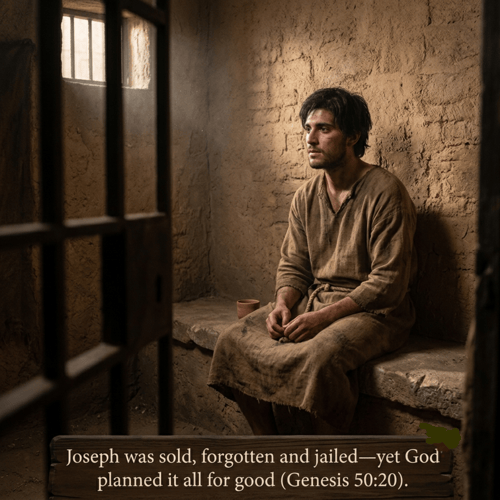
- About 1900 BC—Joseph: Sold by his own brothers, then locked in an Egyptian prison for a crime he did not commit.
- About 860 BC—Elijah: Worn out and afraid, he asked God to let him die.
- 597–538 BC—The exiles: God’s people were carried away to Babylon and told they would stay for seventy years.
- About AD 60—The apostle Paul: Chained to Roman soldiers, writing letters from prison.
- 1500s—Martin Luther: Suffered dark spiritual attacks he called Anfechtungen (attacks of fear and doubt).
- 1700s—William Cowper: A poet who battled deep depression all his life, yet wrote hymns we still sing.
- 1800s—Charles Spurgeon: London’s most famous preacher, often crushed by depression.
Spurgeon told young pastors plainly, “Fits of depression come over the most of us.” So the feeling itself doesn’t prove you’re a weak Christian, or no Christian at all. You’re in very good company.
Why Life Feels Like a Trap
The Bible doesn’t tell us to pretend everything’s fine. It explains why life often feels empty. When Adam and Eve first sinned, God cursed the ground. Work became hard and painful, full of “thorns and thistles”. And life now ends in death: “you are dust, and to dust you shall return” (Genesis 3:18–19).
The apostle Paul explains what this means for the whole world:
“For the creation was subjected to futility, not willingly, but because of Him who subjected it, in hope that the creation itself will be set free from its bondage to corruption.”
Romans 8:20–21
“Futility” means being unable to reach our goal—like running hard on a treadmill and never arriving anywhere. Here’s something wonderful: Paul’s Greek word for futility (mataiotēs) is the very word the ancient Greek Old Testament used for hebel in Ecclesiastes. Paul is deliberately answering the Preacher.
So our feeling isn’t foolish. It’s reading something true about a broken world. But notice 2 small words in Romans 8: “in hope”. The trap is real. But it isn’t final.
The World’s Ways Out—and Why They Fail
People without God offer several ways out. Here are the main ones:
| THE VIEW | WHAT IT SAYS | WHERE IT LEAVES YOU |
|---|---|---|
| Nihilism (from the Latin for “nothing”) | Nothing has any meaning or value at all. | With no reason to get up, and no reason to be kind. |
| Absurdism (Albert Camus) | Life is absurd, so rebel by living anyway. “One must imagine Sisyphus happy”—a man pushing a rock uphill for ever. | Pushing your rock for ever, told to smile about it. |
| Existentialism (Jean-Paul Sartre) | No God gives meaning, so you must invent your own. | With a meaning you know you made up. |
| Pleasure and success (modern culture) | Fill your life with fun, money and achievement. | Always needing more—exactly what the Preacher tried and found empty (Ecclesiastes 2). |
Each view starts from “there is no God”. Each ends somewhere cold.
Atheist philosopher Bertrand Russell was at least honest. He said we must build our lives on “the firm foundation of unyielding despair”. Think about why:
- If there’s no God, the universe will one day grow cold and dark. Every person, book and building will be gone.
- If everything ends in nothing, then nothing we do truly lasts. Meaning that doesn’t last is only a short pause before the dark.
- If I invent my own meaning, I know it’s make-believe—like printing a certificate that says “World’s Best Person” and presenting it to myself.
- So, if life has real meaning, it must come from outside us—from Someone who lasts for ever.
Francis Schaeffer noticed nobody actually lives as if life is meaningless. People still love their children and fight for justice—borrowing a Christian view of the world while denying the God who makes it true. William Lane Craig agrees: without God life is absurd, yet no one can live that way happily.
Meaning Is Received, Not Made
Here is the heart of the Christian answer. You do not have to create the meaning of your life. You receive it from the God who made you. He says of his people that he made them “for my glory” (Isaiah 43:7). He made every human being “in his own image” (Genesis 1:27). That means we are made to reflect what God is like and to care for his world on his behalf.
God has also built a longing into us: “he has put eternity into man’s heart” (Ecclesiastes 3:11). That is why short-lived things never fully satisfy. Augustine of Hippo wrote to God, “You have made us for yourself, and our heart is restless until it rests in you.”
The Westminster Shorter Catechism sums it up in its very first answer: “Man’s chief end is to glorify God, and to enjoy him for ever.” A “chief end” is your main purpose.
| Aspect | MEANING YOU MAKE | MEANING YOU RECEIVE FROM GOD |
|---|---|---|
| Where it comes from | Your own feelings and choices | The God who made you |
| How long it lasts | Until you die, or change your mind | For ever |
| When you fail | Your meaning collapses | Your purpose still stands, because it rests on God |
| Who decides your worth | You, or other people | God, who made you in his image |
Made-up meaning depends on you. Received meaning depends on God.
How Ecclesiastes Really Ends
Ecclesiastes is not a book of despair. All through it, the Preacher opens small windows “above the sun”. He sees that simple joys are gifts:
“There is nothing better for a person than that he should eat and drink and find enjoyment in his toil. This also, I saw, is from the hand of God.”
Ecclesiastes 2:24
Then the book ends like this: “Fear God and keep his commandments… For God will bring every deed into judgement” (Ecclesiastes 12:13–14). That may sound frightening. But if God will judge every deed, then every deed counts. Nothing you do is lost in the mist.
Derek Kidner explained that Ecclesiastes clears away all our false hopes so that we will look to God alone. David Gibson calls this “living life backward”: when we face the fact that we will die, we stop trying to make this life into heaven, and we are free to enjoy each day as a gift.
Easter Changes Everything
The Preacher could only see so far. We can see further, because Jesus Christ has risen from the dead. In 1 Corinthians 15, Paul writes the Bible’s longest chapter on the resurrection. Then he ends with this:
“Therefore, my beloved brothers, be steadfast, immovable, always abounding in the work of the Lord, knowing that in the Lord your labour is not in vain.”
1 Corinthians 15:58
“Not in vain” is the opposite of hebel. Because Jesus rose in a real body, God will one day renew this whole world, and what is done for him will last. Even people who were truly trapped heard this. Paul told slaves, “Whatever you do, work heartily, as for the Lord and not for men… You are serving the Lord Christ” (Colossians 3:23–24).
Abraham Kuyper put it powerfully: “There is not a square inch in the whole domain of our human existence over which Christ, who is Sovereign over all, does not cry: ‘Mine!’” Your kitchen, your office and your hospital bed are included.
WHY THE RESURRECTION MATTERS FOR MEANING
If Christ is not risen, Paul admits, Christians “are of all people most to be pitied” (1 Corinthians 15:19). Our faith would be one more breath of mist.
But Christ is risen. This is a claim about history, not a feeling. Because it is true, your faithful work, your quiet kindness and your tears are not wasted.
Trapped, but Not Forgotten
The Bible teaches providence. That means God’s constant care and control over everything that happens, big and small. Nothing in your life is random. Look at how God worked for people who felt trapped:
- Joseph in prison: Years later he told his brothers, “you meant evil against me, but God meant it for good” (Genesis 50:20).
- The exiles in Babylon: God told them not to sit and wait for rescue but to “build houses and live in them; plant gardens”, and to “seek the welfare of the city” (Jeremiah 29:5, 7).
- Paul in chains: He wrote that his imprisonment “has really served to advance the gospel” (Philippians 1:12).
John Calvin taught that God gives each person a “calling”, a place in life, like “a sort of sentry post so that he may not heedlessly wander about throughout life.” A sentry does not choose his post, but he knows the commander put him there. And Calvin added that “no task will be so sordid and base” that it will not “shine and be reckoned very precious in God’s sight” when done in obedience to him.
The Heidelberg Catechism asks, “What is your only comfort in life and in death?” Its answer: “That I am not my own, but belong—body and soul, in life and in death—to my faithful Saviour Jesus Christ.” William Cowper, who knew deep darkness, wrote that “behind a frowning providence” God “hides a smiling face”.
What Kind of “Trapped” Are You Feeling?
A good doctor finds out what is wrong before giving medicine. So ask what kind of heaviness you are carrying. Often it is a mix.
| KIND OF HEAVINESS | WHAT IT CAN LOOK LIKE | WHAT HELPS MOST |
|---|---|---|
| The weight of a broken world | Tired of the same struggles, losses and unfairness | Honest prayer, patience, hope (Romans 8) |
| Depression (a real illness of body and mind) | Low mood most days for weeks, poor sleep, no energy, no joy in anything | A doctor or trained counsellor, alongside prayer and church care |
| Acedia (spiritual laziness) | Nothing seems worth doing; avoiding prayer and duties | Small daily acts of faithfulness |
| The emptiness of sin | Chasing something God forbids, then feeling hollow | Turning back to God (Jeremiah 2:13) |
| Spiritual dryness | God feels far away; the Bible feels dead | Keep going to God’s Word, prayer and church |
| Plain exhaustion | Burnt out, no rest for months | Sleep, food and rest—like Elijah |
Name the kind of heaviness first; then choose the right help.
Hard Questions People Ask
- “Real Christians never feel like this.” The Bible’s heroes did. Feelings rise and fall; God’s promises do not.
- “Isn’t faith just a comforting story?” A comforting story would not include Ecclesiastes or Psalm 88. And Christianity rests on a historical event—an empty tomb—not on feelings.
- “If God is in control, then he trapped me.” He placed you, yes. But he “does not afflict from his heart” (Lamentations 3:33). His purposes for his children are good, even when they hurt.
How Believers Actually Cope
- Lament honestly: Psalm 88 is prayed in darkness, yet it begins, “O LORD, God of my salvation”. Bring your complaint to God, not away from him.
- Talk to yourself: “Why are you cast down, O my soul… Hope in God” (Psalm 42:5). Martyn Lloyd-Jones asked, “Have you realised that most of your unhappiness in life is due to the fact that you are listening to yourself instead of talking to yourself?”
- Care for your body: God’s first answer to Elijah was not a sermon but food and sleep: “Arise and eat” (1 Kings 19:5).
- Stay close to the means of grace: These are the ordinary ways God strengthens faith—the Bible, prayer, the Lord’s Supper and worship with his people. Keep going, even when you feel nothing.
- Do the next small, faithful thing: Wash the dishes. Phone your mother. Pray for your neighbour. Remember the exiles: build, plant, seek the good of your city.
- Learn contentment: Paul said, “I have learned in whatever situation I am to be content” (Philippians 4:11). It is learned. Jeremiah Burroughs called contentment a “sweet, inward, quiet, gracious frame of spirit” that rests in God’s “wise and fatherly disposal in every condition”.
- Keep eternity in view: “This light momentary affliction is preparing for us an eternal weight of glory beyond all comparison” (2 Corinthians 4:17).
- Ask for help: Talk to your pastor or a mature Christian friend. If the darkness is deep or lasting, see a doctor too. That is not weakness; it is wisdom.
The Alarm Will Still Ring on Monday
The alarm will still ring on Monday. The bus may still be late, and the dishes will still be waiting. Faith in Christ doesn’t always change our situation. It changes what our situation means.
Under the sun, life is a breath. But we don’t live only under the sun. We live under the eye of a Father who planned our days, beside a Saviour who rose from the grave, and with a hope that will not fade like mist. So get up. Do the next faithful thing. In the Lord, our labour isn’t in vain.
Tough Questions, Honest Answers
Is it a sin for a Christian to feel that life is meaningless?
No, the feeling itself is not a sin. Many godly people in the Bible felt it, and God included their words in Scripture. What matters is what we do with the feeling. If we bring it to God in honest prayer, it can draw us closer to him. But if we let it grow into bitterness, or use it as an excuse to stop obeying God, it can lead us into sin. Bring your empty feelings to the Lord, not away from him.
Does feeling empty mean I’m not really saved?
Your salvation does not rest on your feelings but on what Jesus has done for you. The Bible teaches that God keeps his true children to the end. This is often called the perseverance of the saints. John writes, “whenever our heart condemns us, God is greater than our heart, and he knows everything” (1 John 3:20). Ask yourself: Do I trust in Christ alone? Do I want to please him? If so, your feelings are not the final word.
Is an existential crisis the same as depression?
Not exactly. An existential crisis is a time when you question the purpose of your life. Depression is a medical illness that affects your mood, sleep, energy and thinking. The two can overlap, and one can lead to the other. If you have felt low most days for more than two weeks, please see a doctor. God often helps us through doctors and medicine as well as through prayer.
Why does the ESV say “vanity” where other Bibles say “meaningless”?
Both are trying to translate the Hebrew word hebel, which means breath or vapour. In older English, “vanity” meant emptiness, not pride about your looks. Many scholars think “meaningless” is too strong. The Preacher does not say nothing matters, since he also tells us to fear God and enjoy his gifts. He means life is brief, hard to grasp and frustrating when lived without God. Words like “breath” or “vapour” may capture the idea best.
Should I leave a job or situation where I feel trapped?
Sometimes, yes. Paul told slaves that if they could gain their freedom, they should take it (1 Corinthians 7:21). There is nothing wrong with changing jobs or moving house wisely. But do not run away simply because you feel restless, since the same empty feeling may follow you. Pray, seek advice from wise Christians and check your reasons. If you are in danger or being abused, seek help and safety straight away.
How can I help a friend who says life is pointless?
First, listen. Do not rush to fix them or give quick answers. Job’s friends did best when they simply sat with him in silence. Ask gently whether they have had thoughts of ending their life. Asking will not put the idea in their head, and it may save them. Stay close, pray with them and point them to Christ. If they are in danger, help them get professional help straight away.
Who wrote Ecclesiastes, and does it matter?
The book calls its author “the son of David, king in Jerusalem” (Ecclesiastes 1:1). Christians have traditionally believed this was Solomon. Some scholars think a later writer spoke in Solomon’s voice, but the book itself points to the wisest and richest king of Israel. This matters because it shows that even a man who had everything found life empty without God. If wealth, wisdom and pleasure could not satisfy Solomon, they will not satisfy us either.
Related Reads
- What Do We Do When God Seems Distant and Silent?
- What Do We Do When God Closes a Door We Prayed Would Open?
- What Do We Do When We Don’t Know What Step to Take Next?
- What Do We Do When We Fall Into the Same Sin Again?
- What Do We Do When Life Doesn’t Go According to Plan?
- What Do We Do When Doubt and Anxiety Won’t Let Go?
- What Do We Do When We Can’t Forgive Someone?
- Jesus in Ecclesiastes: Finding Christ, the Greater Solomon
- Boredom’s Crushing Weight: What’s God Trying to Teach Me?
- Godliness with Contentment: Why Does Paul Call it ‘Great Gain’?
- Christian Contentment: Discover True Joy in a ‘Never Enough’ World
- Strangers and Exiles: Why Don’t We Ever Feel Quite at Home Here?
- Why Work Hard If God Is Sovereign and Already Knows the Outcome?
- From Empty to Overflow: The Abundant Life Jesus Promised
- Is Taking Antidepressants a Failure of Faith?