
Mormons say they were Israelites who sailed to ancient America. Jehovah’s Witnesses say they are lower-class believers who will never enter heaven. A church in the Philippines has linked them to Filipinos. A famous American pastor suggested they might include people of other religions. Some people online even say they are aliens.
Who are “they”? They are the “other sheep” Jesus spoke about in one short verse:
And I have other sheep that are not of this fold. I must bring them also, and they will listen to my voice. So there will be one flock, one shepherd.
John 10:16, ESV
Many groups claim this verse. But read slowly, in its setting, its meaning is clear—and more surprising than any of the guesses. Jesus said he already had these sheep, before they had ever heard his name. Some of them may be reading this page right now.
THE SHORT ANSWER
The “other sheep” are people from the non-Jewish nations whom God the Father has given to Jesus. They belong to Jesus even before they believe. Jesus died to bring them in. They come when they hear his voice through the gospel. And they join Jewish believers as one flock, under one shepherd.
Key words used in this article
| WORD | SIMPLE MEANING |
|---|---|
| Gentile | Any person who is not Jewish. |
| Fold | A walled pen where sheep were kept safe at night. |
| Flock | A group of sheep that belong together and follow one shepherd. |
| Gospel | The good news that Jesus died and rose again to save sinners. |
| Election | God’s choice, before time began, of the people he would save. |
Where and when Jesus said it
John 10 is not a new scene. It carries on from John 9. There, Jesus heals a man born blind. The religious leaders, called Pharisees, question him, insult him and finally throw him out of the synagogue, the Jewish place of worship.
And they cast him out. Jesus heard that they had cast him out, and having found him he said, “Do you believe in the Son of Man?”
John 9:34–35, ESV
The leaders cast the man out. Jesus finds him, then turns to those same leaders and speaks about sheep and shepherds (9:40–10:1).
A picture from village life
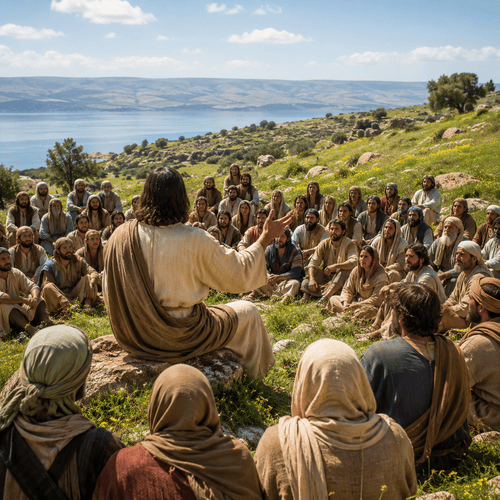
In Jesus’ time, several families often kept their sheep together in one stone pen at night. In the morning, each shepherd called, and his own sheep knew his voice.
The sheep hear his voice, and he calls his own sheep by name and leads them out.
John 10:3, ESV
In this picture, the “fold” is Israel—the Jewish people with their temple, laws and leaders. Jesus calls his own sheep out of it. The blind man is the first one we see. The leaders threw him out, but really the Good Shepherd was leading him out. Then Jesus says something new: he has sheep somewhere else too.
Reading John 10:16 word by word
Almost every phrase here matters. The table shows the Greek word John used (the New Testament was first written in Greek) and why it is important.
John 10:16 phrase by phrase
| PHRASE (ESV) | GREEK | WHAT IT MEANS | WHY IT MATTERS |
|---|---|---|---|
| “I have” | echō | Present tense: “I have right now.” | Jesus owns these sheep before they believe. |
| “other sheep” | alla probata | Sheep from outside Israel. | The non-Jewish nations are in view. |
| “this fold” | aulē | A walled pen. | Israel was the old boundary. |
| “I must bring them” | dei | A divine “must.” | This is God’s plan, not just a hope. |
| “they will listen” | akousousin | Future tense: “they surely will.” | Jesus’ call will not fail. |
| “one flock, one shepherd” | mia poimnē, heis poimēn | One people, one leader. | Not two classes of believers. |
Two points stand out. First, the word “must”. John uses the same Greek word in 4:4: “And he had to pass through Samaria.” Jesus had to go there, because a Samaritan town was going to believe. They ended up calling him “the Saviour of the world” (4:42). God’s “must” always has people in it.
Second, Jesus does not push the other sheep into the Jewish fold. As Donald A. Carson, a leading New Testament teacher, points out, Jesus leads his sheep out of the old pen and forms one new flock. Jewish and Gentile believers do not move into each other’s pen. Together they follow one Shepherd.
John explains it himself
We do not need to guess who the other sheep are. John shows us as his Gospel moves on.
Timeline: the nations in John’s Gospel
- John 4—Samaria: Jesus “had to” visit a despised, mixed people. Many believe.
- John 10—The other sheep: Jesus says he has sheep outside Israel and “must” bring them.
- John 11—The scattered children: Jesus would die “not for the nation only, but also to gather into one the children of God who are scattered abroad” (11:52).
- John 12—The Greeks arrive: Non-Jewish visitors say, “Sir, we wish to see Jesus” (12:21).
- John 17—“Through their word”: Jesus prays for those “who will believe in me through their word” (17:20)—the apostles’ message.
Two verses, one message
| QUESTION | john 10:16 | john 11:52 |
|---|---|---|
| Who are they? | “other sheep” | “the children of God” |
| Where are they? | “not of this fold” | “scattered abroad” |
| How do they come? | “I must bring them” | Jesus dies “to gather” them |
| What is the result? | “one flock” | “into one” |
Notice: they are “the children of God” before they are gathered, just as they are Jesus’ sheep before they hear him. God knows his people long before they know him.
The Old Testament saw it coming
- Isaiah 56:8—More to be gathered: “I will gather yet others to him besides those already gathered.” This is very close to John 10:16.
- Ezekiel 34:23—One shepherd: After judging Israel’s selfish leaders, God promised “one shepherd, my servant David.” Jesus, the Son of David, is that shepherd.
- Isaiah 49:6—A light for the nations: Saving Israel alone was “too light a thing.” God’s servant would be “a light for the nations.”
What this verse teaches about salvation
John 10:16 shows not only who is included, but how God saves.
- God chooses first: Jesus tells his enemies, “you do not believe because you are not among my sheep” (10:26). He does not say, “You are not my sheep because you do not believe.” Being his sheep comes first. Believing follows.
- Jesus died for his sheep: “I lay down my life for the sheep” (10:15). His death was a rescue with real people in view. That is why he can say he “must” bring them and they “will” listen.
- His voice does not fail: “My sheep hear my voice, and I know them, and they follow me” (10:27).
- They can never be lost: “no one will snatch them out of my hand” (10:28).
John Calvin, the sixteenth-century Bible teacher in Geneva, wrote that he had “no doubt that Christ had in his eye the calling of the Gentiles.” To Calvin, these people were already sheep in God’s plan while they were still wandering far away.
Charles Haddon Spurgeon, the great London preacher, put it personally: “I believe the doctrine of election, because I am quite sure that, if God had not chosen me, I should never have chosen Him.”
A FAIR QUESTION: DOES “THE SHEEP” MEAN “EVERYONE”?
Some point out that Paul says Christ “gave himself for me” (Galatians 2:20), yet Christ did not die only for Paul. True. But in John 10, Jesus sets “the sheep” next to people who are “not among my sheep” (10:26). And his death does not just make the gathering possible. It makes it certain: “I must bring them… they will listen.”
WHY THIS GIVES US COURAGE TO SHARE THE GOSPEL
If God has already chosen his people, must we still share the gospel? Yes! When Paul was afraid in Corinth, the Lord said:
Do not be afraid, but go on speaking and do not be silent, for I am with you… for I have many in this city who are my people. (Acts 18:9–10, ESV)
“I have many… who are my people”—before they believed. James I. Packer made the same point in Evangelism and the Sovereignty of God: because God rules over salvation, telling others is never wasted. The other sheep are out there. God uses our voices to carry Christ’s voice.
Wrong answers—and why they fail
Because “other sheep” sounds mysterious, many groups have filled it with their own ideas. Here they are, tested against the verse.
Popular claims about the “other sheep”
| THE CLAIM | WHO TEACHES IT | WHAT THE VERSE ACTUALLY SAYS |
|---|---|---|
| People of other religions, saved without knowing Jesus | Rob Bell and other “inclusivists” | They hear Jesus’ voice and join his one flock. |
| In the end, everyone is a sheep | Universalists | Some are “not among my sheep” (10:26). |
| People become sheep by choosing to believe | Many Arminian teachers | Being a sheep comes before believing (10:26). |
| An earthly group who never go to heaven | Jehovah’s Witnesses | The two become “one flock.” |
| The Nephites in ancient America | Latter-day Saints (Mormons) | Jesus gathers them by his death and the apostles’ message. |
| Filipinos | Some Iglesia ni Cristo teachers | No nation is named; they are “scattered abroad.” |
| “One fold” means one visible church organisation | Some Roman Catholic arguments | The Greek says “one flock,” gathered round one Shepherd. |
Rob Bell: “Jesus is at work in other religions”
Rob Bell, founding pastor of Mars Hill Bible Church in Michigan, wrote the bestseller Love Wins in 2011. Around that time he pointed to Jesus’ words about sheep “not of this flock” to suggest that Jesus may save people through other faiths, even if they never trust him by name. This view is called inclusivism. Many felt it also leaned towards universalism—the belief that everyone is saved in the end.
Bell is right that Jesus has sheep outside the first fold. But the verse rules out his idea in four ways:
- The sheep belong to Jesus: “I have” them. They are not other religions’ sheep that Jesus kindly accepts.
- They hear his voice: In John, Jesus’ voice means his word (5:24–25), which reaches people “through their word” (17:20). “Faith comes from hearing, and hearing through the word of Christ” (Romans 10:17).
- There is only one door: “I am the door. If anyone enters by me, he will be saved” (10:9). Anyone who climbs in another way is “a thief and a robber” (10:1).
- Not everyone is a sheep: “you are not among my sheep” (10:26). So the verse cannot mean all will be saved.
What about John 12:32, where Jesus “will draw all people” to himself? Greeks had just come asking for him. He means all kinds of people. And in 6:44, everyone the Father draws, Jesus “will raise… up on the last day.” If that meant every person, all would be raised to life—yet John 3:36 says God’s wrath “remains on” whoever does not obey the Son.
“They chose to become sheep”
Many Christians follow Jacobus Arminius, a Dutch teacher who died in 1609. They believe God chose people because he saw ahead that they would believe. But John 10:26 turns this around: some do not believe because they are not his sheep. Faith is the sign of being a sheep, not its cause. “All that the Father gives me will come to me” (6:37). The giving comes first.
Jehovah’s Witnesses: “an earthly class”
Jehovah’s Witnesses teach that only 144,000—the “little flock” of Luke 12:32—go to heaven. Since the 1930s they have called the “other sheep” a larger group who will live forever on earth, but never in heaven. Yet Jesus does not promise two flocks with two hopes. He says, “there will be one flock.” The Witnesses divide what Jesus joins. And Revelation’s “great multitude” is “in heaven” (19:1), “standing before the throne” (7:9).
Latter-day Saints: “the Nephites in America”
The Book of Mormon (1830) claims the risen Jesus visited the Nephites in ancient America and told them, “ye are they of whom I said: Other sheep I have” (3 Nephi 15:21). But John has already told us how the other sheep come: by Jesus’ death (11:52) and the apostles’ message (17:20), not by a journey to another land. Also, the Nephites supposedly came from Israel, so they would belong to “this fold.” And in 2014 the Mormon church itself admitted that Native American DNA points mainly to Asia.
Iglesia ni Cristo: “Filipinos”
Some teachers in Iglesia ni Cristo, founded in the Philippines in 1914 by Felix Manalo, link the “other sheep” to Filipinos. But the verse names no nation. God’s children are “scattered abroad” (11:52)—in many lands, not one.
“One fold” or “one flock”?
The King James Version (1611) reads “one fold, and one shepherd,” following the Latin Bible of Jerome, which used ovile, “a pen.” Some argued from this for one visible church organisation. But John used two different Greek words, and William Tyndale had already rightly written “one flocke” in 1526.
Fold or flock? 2 Greek words in 1 verse
| GREEK WORD | MEANING | WHERE IT APPEARS | WHAT IT TEACHES |
|---|---|---|---|
| aulē | Fold—a walled pen | “not of this fold” | An old boundary Jesus leads his sheep out of. |
| poimnē | Flock—sheep that belong together | “one flock” | A people joined by one Shepherd, not by walls. |
Some scholars, following Raymond Brown, see quarrels between first-century Christian groups here. That is guesswork; John 11:52 points to the Gentiles.
Faithful Bible teachers on this verse
What trusted teachers saw in John 10:16
| TEACHER | WHEN | WHAT THEY SAW |
|---|---|---|
| Augustine of Hippo | Early 400s | In God’s knowledge, many sheep are still outside and many wolves inside. |
| John Calvin | 1553 | The calling of the Gentiles, chosen before they came. |
| Charles Spurgeon | 1800s | God’s choice is why anyone comes—so preach to all. |
| JI Packer | 1961 | God’s rule over salvation fills evangelism with hope. |
| Don Carson | 1991 | Not Gentiles moved into Israel’s pen, but one new flock. |
| Andreas Köstenberger | 2004 | A preview of the church’s mission to the nations. |
1 flock from every race, caste and nation
Our world divides people by race, tribe, caste, class and language. Jesus breaks those walls down.
For he himself is our peace, who has made us both one and has broken down in his flesh the dividing wall of hostility.
Ephesians 2:14, ESV
So no believer is a second-class sheep. A church that keeps walls Jesus pulled down is not listening to his voice. The story ends with “a great multitude that no one could number, from every nation, from all tribes and peoples and languages, standing before the throne” (Revelation 7:9). That is John 10:16 fully come true.
Are you 1 of the other sheep?
Many look for the “other sheep” somewhere far away. Jesus meant something much closer.
If you are not Jewish and you trust Jesus today, you are part of the answer to John 10:16. He knew you before you knew him. He died to bring you in. And one day, his voice reached you.
If you have not yet come, listen. The Shepherd is still calling: “whoever comes to me I will never cast out” (John 6:37).
Tough Questions, Honest Answers
Are the “other sheep” the lost ten tribes of Israel?
Some groups, including British Israelism and parts of the Book of Mormon, teach that the “other sheep” are the ten northern tribes that Assyria took away. But the ten tribes were never fully lost. Many from the north had already joined Judah (2 Chronicles 11:16), and the New Testament still knows of people from their tribes, such as Anna from the tribe of Asher (Luke 2:36). James even writes to “the twelve tribes in the Dispersion” (James 1:1). Most of all, John 10:16 contrasts Israel with those outside it. Israelites, wherever they lived, belonged to “this fold”.
Does John 10:16 refer to aliens on other planets?
No. The other sheep “listen to my voice” and become one flock with Jewish believers, so they are people who hear the gospel on earth. Jesus became a human being to save human beings. Hebrews 2:16 says, “For surely it is not angels that he helps, but he helps the offspring of Abraham.” The Bible does not tell us whether life exists elsewhere, and we should not build teaching on guesses. This verse is about the nations of our world.
If Jesus said He was sent “only to the lost sheep of the house of Israel” (Matthew 15:24), how can He have other sheep?
These two sayings are about order, not opposition. During his earthly life Jesus focused his work on Israel, because the promises came to the Jews first. Paul says the gospel is “to the Jew first and also to the Greek” (Romans 1:16). After his death and resurrection, Jesus sent his followers to “make disciples of all nations” (Matthew 28:19). Even in Matthew 15 he healed a Gentile woman’s daughter, which was a small preview of what was coming.
How can I know if I am one of Jesus’ sheep?
You do not need to look into God’s secret plans. Jesus gives a simple mark: “My sheep hear my voice… and they follow me” (John 10:27). If you trust Jesus for your salvation and want to follow him, that is the sign of a sheep. If you are not sure, come to him now. He promises, “whoever comes to me I will never cast out” (John 6:37). Sheep do not prove themselves by being strong; they rest on a strong Shepherd.
What does Jesus mean when he says, “I am the door of the sheep”?
In John 10:7–9 Jesus calls himself the door of the sheepfold. A door is the only safe way in and out of a pen. Jesus means that he is the only way to be saved and to belong to God’s people. “If anyone enters by me, he will be saved and will go in and out and find pasture” (10:9). The picture shows both safety and freedom: inside, the sheep are protected; outside, they find good food. No religious leader or system can replace this door.
Why does the Bible call God’s people sheep?
It is not an insult, but it is honest. Sheep wander, get lost easily and cannot defend themselves. Isaiah 53:6 says, “All we like sheep have gone astray; we have turned—every one—to his own way.” Yet the picture is also full of love. Sheep are known, named, fed and protected by their shepherd (Psalm 23). The point is not how clever the sheep are, but how good the Shepherd is.
Who is the “hired hand” in John 10:12–13?
The hired hand works only for money. When the wolf comes, he runs away, because the sheep are not his own. Jesus was speaking about religious leaders who cared more about themselves than about God’s people. This is still a warning for pastors and church leaders today. Peter tells elders to shepherd God’s flock “not for shameful gain, but eagerly” (1 Peter 5:2). Jesus is the opposite of the hired hand: he does not run from danger, he lays down his life for the sheep.
Related Reads
- I Am the Good Shepherd: A Death Freely Chosen (John 10:11)
- I Am the Door: The Only Way Into the Fold (John 10:7)
- Christianity vs Mormonism: 7 Core Differences That Cannot Be Reconciled
- What Do Jehovah’s Witnesses Believe? A Biblical Examination of JW Doctrine
- Bible Mystery: Who Are the 144,000 Really?
- For Whom Did Christ Die? The Biblical Case for Definite Atonement
- To the Jew First: Why Must Missions Start With Israel?
- Am I Among God’s Elect? How Can I Be Sure?