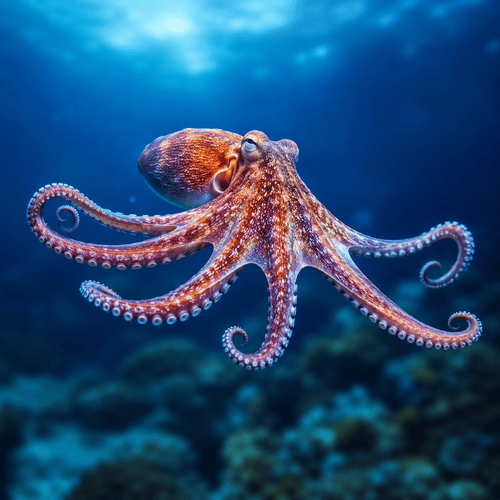
Meet a creature so strange that scientists who study it run out of words to describe it. Watch one in open water glowing a pale blue, and then, in less than half a second, watch it become a barnacle-crusted rock—the exact colour, the exact bumpy texture—all of this while, almost certainly, being completely colourblind. What kind of process produces that?
Consider what we’re dealing with:
- A central brain plus a nerve-centre in each of its eight arms—and two-thirds of its 500 million neurons (the cells that carry thought) sit not in its head but in its limbs.
- Three hearts—two to push blood through the gills, one to drive it round the body.
- Blue blood, built on copper rather than iron, better suited to cold, low-oxygen deep water.
- Skin that changes colour, shine, and texture in milliseconds, producing photorealistic camouflage on demand.
- A life of only one or two years—in which it solves mazes, opens jars, uses tools, plays, and even appears to dream.
- A solitary life, with no herd, no family, no culture—and yet a mind that rivals that of a dog or raven.
This isn’t a dolphin or a chimpanzee. It’s a mollusc—the same broad family as the clam, the oyster, and the garden snail. By every expectation, it should be a slow, simple creature. Instead it’s one of the most astonishing minds in the animal kingdom. And the more closely we look, the harder it becomes to believe it assembled itself by accident.
The Camouflage That Shouldn’t Exist
Octopus camouflage isn’t one trick but three working systems layered into the skin.
- First come the chromatophores—tiny sacs of pigment, each ringed by muscles wired directly to the nervous system. Tighten the muscles and the colour spreads; relax them and it shrinks.
- Beneath these sit iridophores, cells that produce colour not with pigment but with microscopic structure, bending light the way a soap bubble does to throw off metallic blues and greens.
- Then come the papillae—muscular bumps that can lift the skin from smooth glass to jagged, coral-like roughness in under a second.
Each system is complex on its own. Together they form a living, real-time screen—and here’s the twist that has baffled researchers for decades: octopuses are almost certainly colourblind. Their eyes carry only one kind of light-detecting cell. How, then, do they match colours they apparently cannot see? Scientists are still working it out. One leading idea is that the odd shape of their pupils splits incoming light so they can judge a colour by how sharply it comes into focus. Another is that their skin itself contains light-sensitive proteins—that an octopus may, in a real sense, “see” with its body as well as its eyes. Either way, we’re looking at a creature with eyes and skin that perceive light in ways we’re only beginning to decode. And that only makes the design more remarkable, not less.
A Mind in the Arms
Most animals keep their thinking in one place. The octopus does not. Two-thirds of its neurons live in its arms, and each arm carries a bundle of nerves dense enough to act largely on its own. An arm can taste, smell, feel its way around an obstacle, and work at a problem while the central brain attends to something else entirely. Most striking of all, a severed octopus arm will keep reaching and reacting purposefully for over an hour—as though it has a small will of its own.
This is intelligence built on a blueprint utterly unlike our own—spread through the body rather than gathered in one head. And the behaviours that flow from it are no mere reflexes. In study after study, octopuses have shown they can:
- Recognise people and treat individuals differently depending on past encounters—a friendly face from one that once annoyed them.
- Play—pushing a floating bottle back and forth into a water jet again and again, for no reward beyond the fun of it.
- Use tools—carrying coconut-shell halves across the seabed to assemble later as portable shelters.
- Find their way through mazes and remember the solution days afterward.
- Show curiosity and apparent boredom, and even what looks like individual personality—some bold, some shy.
- Dream—their sleeping skin flickering through colour sequences that mirror their waking camouflage, as if replaying the day’s scenes.
What Evolution Cannot Explain
The usual story of how intelligence arises leans heavily on social life: large groups, family bonds, the need to outwit rivals, long childhoods in which the young learn from the old. The octopus has none of this. It lives alone, breeds once, and dies young, never even meeting its offspring. There’s no school of octopus culture passing wisdom down through generations. The very conditions evolution usually credits for a clever mind are simply absent—and yet the mind is unmistakably there.
The fossil record offers no relief for the gradual account either. When the soft-bodied, intelligent octopus we know finally appears in the rocks, it’s already complex—arms, eyes, and nervous system in place. There’s no patient sequence of in-between creatures showing a distributed brain being wired up nerve by nerve, or a three-layer camouflage system being assembled one layer at a time. The sophisticated animal turns up essentially whole, which is precisely what a slow, step-by-step build isn’t supposed to look like.
So how do biologists account for the octopus’s sophistication? Chiefly by appealing to convergent evolution—the claim that the same complex solution arose twice, independently, in creatures that never shared it. The octopus eye, for example, is remarkably like the human eye, though the two lines share no ancestor that had anything resembling such an eye. But calling this “convergence” doesn’t explain it; it merely gives the puzzle a name. To say that camera-like eyes and advanced minds each appeared twice, by separate strokes of luck, along entirely different paths, doesn’t make the event more likely. It asks us to believe lightning struck twice.
There’s a sharper problem still. The three-layer camouflage system only works as a whole. Colour-changing skin without texture control cannot mimic barnacled rock; texture without colour fails just as badly; and neither does anything without a nervous system driving them in concert. Each part needs the others before the animal gains any real advantage. A half-built version offers nothing for nature to preserve—it’s simply extra weight the octopus must feed. Systems whose parts are useless until all are present and working together resist the slow, step-by-step path evolution depends on.
The Problem of Information
Step back from any single organ and a deeper difficulty emerges. Every one of these systems runs on information—coded instructions written into the genes and carried out in living tissue. The wiring plan that coordinates a brain and eight arm-centres is information. The pattern that fires thousands of pigment cells into a perfect rock-mimic, in the right places at the right instant, is information. And here’s the rub: random mutation, the raw material evolution works with, is blind to function. It cannot foresee a useful design and aim at it. Natural selection can only preserve a working system once it already exists; it cannot write the instructions that bring the system into being in the first place.
What’s written in the octopus’s genes only sharpens the point. Octopuses carry a greatly expanded set of protocadherin genes—genes that govern how nerve cells grow and connect to one another. They have more than twice as many as we do, and far more than their simple mollusc relatives—genes once thought to be expanded only in backboned animals like us. The instructions for building such an elaborate nervous system do not lie waiting in the clam or the snail, ready to be inherited and adjusted. They appear, in full richness, exactly where the riddle demands them—and nowhere on the supposed road leading up to them.
Stranger still, the octopus does something almost no other animal can. Our genes work in two stages: DNA is the master copy, and RNA is the working message sent out to build proteins. The octopus rewrites that message on the fly—editing it at more than 20,000 places, mostly in its nervous system, and ramping the editing up within hours when the water turns cold, to keep its nerves working in the new conditions. This is real-time information processing of a kind we humans simply do not possess. The octopus isn’t waiting on slow, accidental mutation; it’s actively re-coding its own instructions to suit the moment.
Blind chemistry doesn’t proofread and rewrite its own messages. A mind does.
The Problem of Excess
Now add a feature the survival story struggles even to address: the octopus is extravagant. Its gifts run far beyond anything mere survival requires. A creature that lives a single year, breeds once, and dies has no obvious need to dream, to play with a bottle for the fun of it, to recognise a particular human face, or to puzzle over a maze for no reward. Its camouflage isn’t merely effective; it’s, frankly, beautiful—patterns and shimmer of a kind no predator demands.
And this excess carries a real price. A brain of half a billion neurons is enormously expensive to run; nervous tissue burns through energy faster than almost anything else in the body. In nature, such a costly brain normally only “pays for itself” in a long-lived, social animal that can spend years cashing in on its cleverness—learning, cooperating, raising young, building on the wisdom of the group. The octopus has none of those returns. It’s solitary, and it’s gone within a year. From a strict survival standpoint, lavishing so much costly intelligence on so short and lonely a life is a terrible investment—exactly the kind of extravagance a blind, cost-counting process should weed out, not produce.
The Riddle the Octopus Leaves Us With
Put all the pieces next to each other and the picture becomes clear. Here’s a mind that grew without the social life evolution says is needed to produce it. A body that shows up in the fossil record already complete, with no trail of simpler forms leading up to it. A camouflage system of three layers that only works when all three work together. An eye like a camera and a sharp intelligence that we’re told appeared twice, separately, by chance. Genes for building a complex brain that are found nowhere among its simple relatives, and the astonishing ability to rewrite its own genetic messages in real time. And a creature given far more beauty and ability than its short, solitary life could ever use.
Now take the tools evolution offers—random mutation, natural selection, huge stretches of time, and the hopeful idea that the same thing simply happened twice—and hold them up against that list. They don’t just fall short of explaining the octopus. They don’t even begin to. At best, each tool explains how a system that already exists manages to survive. None of them explains where the system came from in the first place—the coded instructions that build it, the careful way its parts fit together, or the abundance that spills far beyond what it needs.
But there’s one cause we all recognise, from everyday experience, that does produce these very things—working machines, coded information, and beauty beyond bare necessity: a mind. So when we watch an octopus melt into a reef, the most sensible conclusion isn’t that blind chance stumbled twice onto such brilliance, but that brilliance stands behind it. In the end the octopus doesn’t leave our understanding baffled. Quietly, it points us—past the creature, toward its Maker. The tardigrade makes the same case in miniature—a water bear barely the width of a full stop, yet engineered with integrated survival systems no earthly environment could have shaped.
Tough Questions, Honest Answers
Aren’t octopuses just reacting on instinct rather than truly thinking?
This was once the easy assumption, but it no longer fits the evidence. Octopuses recognise individual people, solve mazes and remember the answer days later. They carry coconut shells to build shelters with, and play with objects for no reward at all. Pure reflex cannot plan ahead, remember, or experiment. And even if we set their intelligence aside entirely, the sheer engineering of their bodies wired with nine nerve-centres and a three-layer camouflage screen would still cry out for an explanation.
Isn’t calling the octopus “nine-brained” an exaggeration? Don’t biologists say it has one brain and eight nerve clusters?
It’s a fair clarification, and we’re glad to be precise: the octopus has one central brain and eight richly wired nerve-centres, one in each arm—what scientists call ganglia. But precision doesn’t shrink the wonder; it deepens it. Two-thirds of the animal’s neurons sit in those arms, each of which can taste, feel, and work at a problem with striking independence—a severed arm keeps reaching purposefully for over an hour. Whether we call them “mini-brains” or “ganglia,” we’re describing a thinking system spread through the whole body on a design no human engineer has ever matched—and that’s the thing that needs explaining.
Doesn’t “convergent evolution” explain how the octopus got a camera eye and a sharp mind?
“Convergent evolution” is the claim that the same complex solution arose twice, independently, in unrelated creatures. And it’s more a label than an explanation. Saying the octopus eye and the human eye each appeared by separate accidents, on entirely different paths, doesn’t make the event more likely; it asks us to believe lightning struck twice. Naming a mystery isn’t the same as solving it. Repeating the improbability doesn’t reduce it—it doubles it.
Couldn’t camouflage have evolved one step at a time, since even simple light-or-dark colour change helps an animal hide?
It’s true a single ability—say, darkening the skin—could offer some advantage on its own, and we shouldn’t overstate our case. But the octopus doesn’t merely darken; it produces lifelike, three-dimensional disguises, and that’s what defies a step-by-step account. To impersonate barnacled rock, we need pigment cells for colour, structural cells for shimmer, and muscular bumps for texture. And all of these need to fire together in milliseconds under one control system. The astonishing thing isn’t the existence of camouflage but the seamless joining of three separate systems into one instant, lifelike performance—and integration of that order is the fingerprint of design, not of lucky accumulation.
What is “RNA editing,” and why does it matter for the design argument?
DNA is the master copy of a creature’s instructions; RNA is the working message carried out to build proteins. Remarkably, the octopus rewrites that message on the fly—editing it at more than 20,000 places, mostly in its nervous system, and ramping the editing up within hours when the water turns cold, so its nerves keep working in the new conditions. This is real-time information processing far beyond anything in human biology: the animal isn’t waiting on slow genetic mutation, it’s actively re-coding its own messages to suit the moment. A system that edits its own information intelligently, on demand, points to a source that is itself intelligent. Blind chemistry doesn’t proofread and rewrite its own instructions.
Isn’t this just an argument from ignorance—“we can’t explain it, so God did it”?
Not at all. The case rests not on what we don’t know, but on what we do: in all of human experience, coded information, integrated machines, and beauty beyond necessity come from a mind. Random mutation is blind to function and cannot aim at a useful design, and natural selection can only preserve a working system after it exists—it cannot write the instructions that build it in the first place. Pointing to the one kind of cause actually known to produce such things isn’t a retreat into ignorance; it’s the most reasonable conclusion the evidence allows.
Why bring a Maker into a scientific question at all?
Because the question itself—where did this come from?—is one science can describe but not finally answer. Science can map every nerve and pigment cell of the octopus, yet it cannot explain why coded information exists, what its astonishing mind means, or why a one-year creature is lavished with beauty and ability it will never need. To follow the evidence honestly is to admit that integrated design, coded information, and lavish excess point beyond blind processes to a mind. That’s not abandoning reason—it’s reason arriving at its most honest conclusion.
Our Related Posts
- Testament to Design: The Engineering Marvel of Elephants
- Blue Whales: Mammoth Icons of Intelligent Design
- The Woodpecker’s Design: How Nature’s Headbanger Defies Evolution
- Too Perfect to Be Random: The Giraffe’s Remarkable Design
- How Chameleons Really Change Colour—And Why the Textbooks Got It Wrong