A label that gets in the way. “Amillennialism” may be the least helpful word in Christian theology. The prefix “a-” means “no”, so the term sounds as though it denies the millennium. It doesn’t. Amillennialists believe every word of Revelation 20. They simply believe the thousand years is happening now—that we’ve been living inside it since the first Easter morning. American pastor Jay E Adams argued the label should be scrapped and replaced with “Realised millennialism”. He had a point. Far from shrinking the kingdom, this is the boldest claim on the table: the King is already crowned and already gathering the nations.
A definition first. The millennium (from the Latin for “a thousand years”) is the period of Revelation 20:1-6, where an angel binds Satan and the souls of the martyrs “came to life and reigned with Christ for a thousand years“. The whole debate turns on two questions: when is that thousand years, and what kind of reign is it?
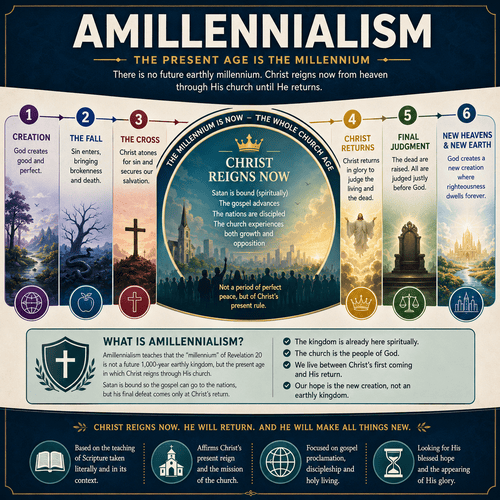
Amillennialism at a glance
- The millennium is now. It runs from Christ’s ascension to His return. “A thousand” is symbolic: a long, complete, God-measured span.
- Christ reigns from heaven. He sits on David’s throne at the Father’s right hand today, not waiting for a future term.
- Satan is bound in a limited way. He’s restrained from one thing: keeping the nations in spiritual darkness.
- Believers who have died reign with Christ. They’re conscious and alive with Him now, awaiting their bodily resurrection.
- One return, one resurrection, one judgement, then the eternal state on a renewed earth.
- Evil will intensify before the end, but Christ crushes it at His coming.
Two ages, not three
Jesus and the apostles divide history into two periods, and only two. There’s “this age” and “the age to come” (Matthew 12:32; Mark 10:30; Ephesians 1:21). Dutch-American scholar Geerhardus Vos showed how much depends on this simple structure.
The hinge between them is the resurrection, and Jesus draws the line sharply (Luke 20:34-36): “The sons of this age marry and are given in marriage, but those who are considered worthy to attain to that age and to the resurrection from the dead neither marry nor are given in marriage, for they cannot die any more“.
Now hold that beside the popular picture of a future earthly millennium, where risen saints in glorified bodies live alongside people who still marry, still sin, still die, and finally join a worldwide rebellion. That’s neither this age nor the age to come. It’s a third thing Scripture never describes.
Amillennialism doesn’t flatten the two ages; it overlaps them—the “already and not yet“. We’ve already been raised with Christ (Ephesians 2:5-6) and tasted “the powers of the age to come” (Hebrews 6:5). Yet we still bury our dead. The church lives in the overlap.
One return, one resurrection, one judgement
This is the strongest ground in the discussion, because it rests on plain teaching rather than contested visions. Wherever the New Testament describes the end in ordinary language, it describes a single event, not a staged sequence.
- One hour, two outcomes. “An hour is coming when all who are in the tombs will hear his voice and come out“—some to the resurrection of life, some to the resurrection of judgement (John 5:28-29). One summons, both groups.
- One resurrection embracing everyone. Daniel 12:2 and Paul before Felix—”there will be a resurrection of both the just and the unjust” (Acts 24:15)—know no thousand-year gap.
- Judgement immediately at his coming. In Matthew 25:31-46 the Son of Man arrives in glory, the nations are gathered, sheep and goats are separated, and each goes straight into its eternal destiny.
- Relief and vengeance on the same day. Persecuted Christians are granted rest “when the Lord Jesus is revealed from heaven“—the same moment God repays their afflicters (2 Thessalonians 1:5-10).
- Then comes the end. Paul’s order in 1 Corinthians 15:23-26 is Christ the firstfruits, then His people at His coming, “then comes the end“, when death is destroyed. A millennium after His coming would leave death reigning for a thousand years after the last enemy fell.
- New heavens and new earth, without a gap. The day of the Lord dissolves the present order and brings “new heavens and a new earth in which righteousness dwells” (2 Peter 3:10-13).
Six passages, one shape. To fit a thousand-year earthly kingdom between the return and the judgement, you must import it from one symbolic vision and read it back into all of these. That’s a heavy load for a single text.
Reading Revelation the way Revelation asks to be read
Revelation belongs to a genre called apocalyptic: visionary writing that speaks through pictures and numbers rather than plain report. Nobody reads it woodenly. Christ isn’t a literal lamb with seven horns. The 144,000 are not a census. 42 months, 1,260 days and 3 and a half years are one period in different clothes.
So what’s a thousand? Ten cubed—and in Scripture ten signals fullness. God owns “the cattle on a thousand hills” (Psalm 50:10), which doesn’t mean He loses interest at hill 1,001. A thousand years is a long, full, God-measured age, not a figure for the calendar.
The book circles back
Dutch-American commentator William Hendriksen called Revelation’s structure progressive parallelism. The book gives us 7 sections, each sweeping across the whole span between Christ’s two comings from a fresh angle, each ending at the final judgement. It doesn’t march in a straight line; it spirals, covering the same ground with deepening intensity. GK Beale argues the same in his major commentary.
If so, Revelation 20 doesn’t follow Chapter 19 on a timeline; it reaches back and shows the same age from underneath. One piece of evidence is striking: the same final battle appears three times.
- Revelation 16:12-16 —the kings of the world gather for battle at Armageddon.
- Revelation 19:19-21 —the beast and the kings gather against the rider on the white horse, and are destroyed.
- Revelation 20:7-10 —Satan gathers the nations, “Gog and Magog“, and fire falls from heaven.
All three draw on the same imagery from Ezekiel 38-39, and all three show the nations massed against God’s people. If Chapter 19 has already destroyed the beast’s armies, who’s left for Chapter 20 to gather? The simplest answer: one battle told three times—which means Chapter 20 has gone back to the beginning.
Inside Revelation 20 itself
What kind of binding?
The passage explains itself. Satan is bound “so that he might not deceive the nations any longer, until the thousand years were ended” (Revelation 20:3). That’s not paralysis but a specific restraint with a specific target: the nations.
The New Testament tells us when it happened. Nobody can plunder a strong man’s house “unless he first binds the strong man“, Jesus said (Matthew 12:29)—then announced He was doing exactly that. “I saw Satan fall like lightning from heaven” (Luke 10:18). “Now will the ruler of this world be cast out” (John 12:31). At the cross God “disarmed the rulers and authorities” (Colossians 2:15).
Want visible proof? Before Christ, saving revelation was largely confined to one small nation. Today the gospel is preached in thousands of languages on every continent. That’s a bound devil: not one who has stopped biting, but one who can no longer keep the world in the dark.
Whose thrones, and where?
John sees thrones, and he sees “the souls of those who had been beheaded” (Revelation 20:4)—psychas, the same word used of the martyrs “under the altar” in Revelation 6:9, who are unmistakably in heaven. Throughout the book, thrones are heavenly furniture. Nothing here describes an earthly government. This is a picture of believers who died for Christ and now reign in His presence.
The comfort here is enormous. The martyr who lost everything didn’t lose. He reigns, and the court that condemned him has already been overruled in heaven.
The first resurrection
“Blessed and holy is the one who shares in the first resurrection! Over such the second death has no power” (Revelation 20:6). Anthony A Hoekema supplied the key: the “second death” here is plainly not the death of a body—it’s the lake of fire. If the second death is not physical, we should not assume the first resurrection must be. Hoekema read it as the believer’s passage at death into conscious life with Christ; others read it of the new birth (John 5:24-25). Either way, “the rest of the dead did not come to life” means the unbelieving dead await only the resurrection of judgement.
How the apostles read the prophets
A common objection is that this fails to read the Old Testament literally. But the real question is whether we read as the apostles read—and they found the promises answered with a yes in Christ (2 Corinthians 1:20).
- Amos on the fallen tent of David is applied by James at the Jerusalem council to Gentiles coming to faith (Acts 15:13-18).
- Joel’s last-days prophecy is applied by Peter to Pentecost morning (Acts 2:16-21).
- The promises to David are applied by Paul to Jesus’ resurrection (Acts 13:32-34).
- The land promise becomes the promise that Abraham “would be heir of the world” (Romans 4:13), and the meek inheriting the earth (Matthew 5:5).
Mount Zion, too, is a place Christians have already reached (Hebrews 12:22-24). This isn’t shrinking the promises but watching them burst their old containers. A shadow isn’t cancelled when the reality arrives.
The same logic governs the people of God. In Christ the dividing wall is demolished and Jew and Gentile are built into one temple (Ephesians 2:11-22). A scheme needing that wall rebuilt works against the grain of the New Testament—and a restored sacrificial system runs into Hebrews 10:1-18, where one offering has ended sacrifice for ever.
The four main views compared
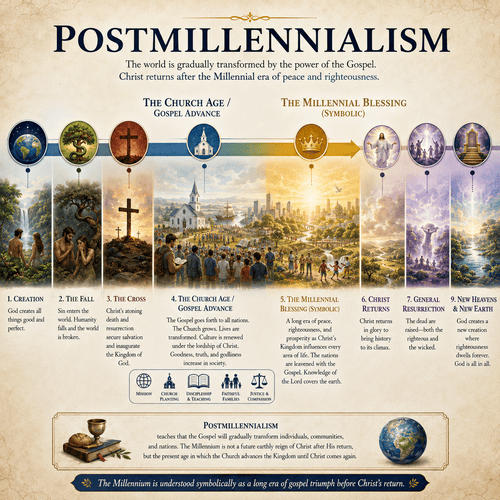
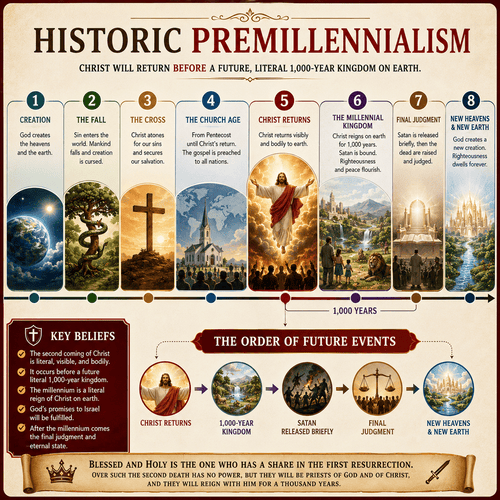
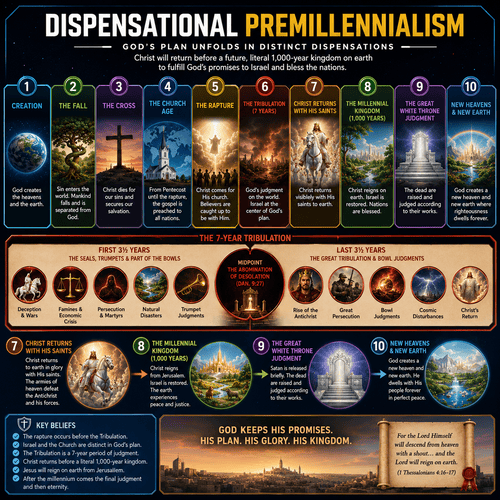
| AMILL | POSTMILL | HISTORIC PREMILL | DISPENSATIONAL PREMILL | |
|---|---|---|---|---|
| The millennium | Now—ascension to return | A future golden age within history | A future earthly reign after Christ returns | A future earthly reign centred on Israel |
| Revelation 20 | Recapitulates this age | Symbolic of gospel advance | Follows chapter 19 in sequence | Follows chapter 19 in sequence |
| Resurrections | One general resurrection | One general resurrection | Two, split by 1,000 years | Two or more, split by 1,000 years |
| Israel and the church | One people in Christ | One people in Christ | One people, future hope for Jews | Kept distinct, separate programmes |
| Temple and sacrifices | Fulfilled in Christ | Fulfilled in Christ | Usually not expected | Rebuilt temple and sacrifices |
What amillennialism is not
- It doesn’t deny the bodily resurrection. It insists on it, for everyone, on the last day.
- It doesn’t deny a real, personal antichrist or a final crisis of persecution before the end.
- It’s not hostile to Jewish people. Jewish believers are not merely included; they’re the olive tree’s original branches (Romans 11:17-24).
- It’s not a heavenly, disembodied hope. The destiny it looks for is a renewed physical creation, not a cloud.
Addressing objections
A case is watertight only if it can take the hardest hits. Here are the four that land.
| The objection | The response |
|---|---|
| “They came to life” must mean the same thing twice | The same Greek verb describes the martyrs and the rest of the dead. Henry Alford argued that if one is bodily, so is the other. This is premillennialism’s strongest card. The reply: John uses the same word in different registers within a few lines—”death” shifts between verses 6 and 14—and the subjects differ, souls in heaven against corpses in tombs. |
| Satan does not look bound | Scripture calls him a prowling lion (1 Peter 5:8) and the god of this world (2 Corinthians 4:4). But Revelation 20:3 never claims he is harmless, only that he can no longer deceive the nations. A dog on a long chain is still dangerous—and still chained. |
| “First resurrection” implies a second of the same kind | It does—the general resurrection at the last day. What the passage denies is that the blessed will face the second death. The force of the ordinal is real, and recapitulation must be argued from the book’s structure, not assumed. |
| Some prophecies describe a transformed but still mortal world | Isaiah 65:20 has someone dying at a hundred; Zechariah 14 pictures nations bringing tribute. These fit neither the present age nor a sinless eternity, which is why they read as prophetic poetry painting an unfamiliar glory in familiar colours. The charge of “spiritualising” is not baseless—but this is how the apostles read such texts. |
Two admissions are also fair. Chiliasm—the early expectation of an earthly millennium—was genuinely held by Papias, Justin Martyr and Irenaeus. And older writing here sometimes drifted towards a thin, ghostly heaven. Both have answers: chiliasm was never the church’s confession, and Cornelis P Venema and others have restored a full hope of a renewed earth.
The hope that’s actually promised
Here’s the irony of the whole debate. Everything the millennial schemes long for—a real earth, real bodies, real cities, real justice—is exactly what the Bible promises in the age to come, only for ever and without sin.
John’s final vision isn’t of believers evacuated to the sky but of the holy city coming down (Revelation 21:2), to a world where “the kings of the earth will bring their glory into it” (Revelation 21:24). The best of human civilisation is carried through the fire and laid at the Lamb’s feet. And there is no temple there, because God and the Lamb are its temple (Revelation 21:22).
Why settle for a thousand years of that when God offers eternity?
Why this matters on an ordinary weekday
- It steadies you under pressure. If the church’s normal condition is fruitfulness plus opposition, suffering is no sign the plan has failed. And it kills date-setting: no charts, no countdowns, just readiness.
- It fuels mission. The devil is bound precisely so the nations can be reached. Evangelism isn’t a scramble before the roof caves in; it’s the King collecting what belongs to him.
- It guards against two opposite errors: utopianism that expects heaven from a government, and fatalism that abandons a burning world.
- It gives comfort at gravesides. Your believing mother isn’t asleep in a waiting room. She reigns with Christ; her body will follow.
A word on tone. Charles Spurgeon and JC Ryle were premillennial. Jonathan Edwards was postmillennial. Not one was a heretic. The millennium isn’t a test of orthodoxy, and this is an argument among brothers and sisters, not an ejection notice. But it’s an argument—and it is the reading that best fits the whole Bible.
Christ isn’t waiting for a throne. He’s on it. And He’s coming back—once, visibly, for good.
Tough Questions, Honest Answers
Is amillennialism the same thing as preterism?
No, though the two are sometimes confused. Preterism holds that most or all of the prophecies in Revelation were fulfilled in the first century, usually in the fall of Jerusalem in AD 70. Full preterism goes further and denies a future bodily return of Christ, which places it outside Christian orthodoxy altogether. Amillennialists insist on a genuinely future, visible, personal return of Christ, a future general resurrection, and a future final judgement. Some amillennialists do adopt a partial-preterist reading of certain passages, but the framework itself is future-facing. GK Beale describes the approach as eclectic or “redemptive-historical idealist”—the visions portray real spiritual conflict across the whole church age, and they still end in a real, dated future event.
Did Augustine invent amillennialism?
He gave it its classic Western expression in The City of God, but he did not invent it. The symbolic reading of the thousand years is found earlier in the Donatist writer Tyconius, whose work Augustine drew upon, and the non-chiliastic reading appears in various forms in Origen, Athanasius and others. Even Justin Martyr, himself a chiliast, admitted that many sincere and orthodox Christians of his day did not share his millenarian expectation. What is true is that Augustine’s reading became the settled view of the Western church for roughly a thousand years, and that John Calvin, Martin Luther and the confessions of the sixteenth century inherited it without controversy. The Second Helvetic Confession explicitly rejects the expectation of an earthly kingdom before the judgement.
What does this view say about the modern state of Israel?
It says that the modern state is a political entity, to be assessed by the same standards of justice as any other nation, and that its founding is not a fulfilment of prophecy. The land promise, on this reading, was always a picture of something larger, and Paul draws it out to its full size when he says Abraham was to be “heir of the world” (Romans 4:13). That does not mean God has finished with Jewish people—far from it. John Murray and Anthony A. Hoekema both read Romans 11:25-27 as promising a large-scale future turning of Jews to their Messiah, while others take “all Israel” to mean the full number of elect Jews gathered across history. This is a genuine in-house disagreement. What all sides reject is the idea that Jewish people are saved on separate terms; there is one Saviour and one gospel for everyone.
Do amillennialists expect the temple in Jerusalem to be rebuilt?
No, and not merely because it seems unlikely. The objection is theological. Hebrews argues that the sacrificial system was a shadow, and that Christ’s single offering has “perfected for all time those who are being sanctified” (Hebrews 10:14). To reinstitute animal sacrifices, even as memorials, would be to reintroduce the very shadows the letter says are obsolete and passing away. Jesus himself pointed forward to worship that is tied to no mountain and no city (John 4:21-24), and identified his own body as the temple that would be raised (John 2:19-21). The temple is not waiting to be rebuilt in stone; it has been rebuilt in flesh, and believers are being built into it (Ephesians 2:21-22; 1 Peter 2:5).
How does this view read Daniel’s seventy weeks?
It reads them as running continuously to their fulfilment in Christ, without a gap of two thousand years between the sixty-ninth and seventieth week. The decisive clue is the content of the seventieth week itself: an anointed one is cut off, a strong covenant is confirmed with many, and sacrifice and offering are brought to an end (Daniel 9:26-27). That is the cross, not a future antichrist’s peace treaty. Meredith G. Kline argued influentially that the seventieth week culminates in Christ’s death and the resulting judgement on Jerusalem, and that the numbers themselves are stylised in the jubilee pattern of sevens rather than being a strict calendar. On this reading the passage is one of the clearest messianic prophecies in the Old Testament—and inserting a gap of unspecified length is what obscures it.
Does this view leave any room for the rapture?
Yes—it simply refuses to make it a separate, secret event. The word comes from the Latin translation of “caught up” in 1 Thessalonians 4:17, and the passage is gloriously public: a cry of command, the voice of an archangel, the sound of God’s trumpet. Nothing about it is quiet. The picture Paul uses is of citizens going out of a city to meet an arriving king and escorting him back in, which is why believers are caught up “to meet the Lord in the air” rather than being taken away to stay there. Paul then tells the same church that relief comes “when the Lord Jesus is revealed from heaven with his mighty angels in flaming fire” (2 Thessalonians 1:7). One coming, one gathering, one judgement—and no seven-year interval in between.
Can someone who is premillennial serve as a pastor or elder?
In most confessional churches, yes. Historic premillennialism—the older form that does not divide Israel and the church or expect a rebuilt temple—has a long and respectable pedigree, and many confessions do not require a specific millennial position for office. The Westminster Confession, for instance, states the single return, single resurrection and single judgement clearly, but leaves the millennial question less precisely defined than some assume. Dispensational premillennialism raises weightier questions, because it carries commitments about the covenants, the law, the church and the people of God that reach well beyond eschatology. The practical rule most churches follow is sensible: what a man may privately hold is broader than what he may publicly press, and no one should make a millennial theory a test of fellowship.
Related Reads
- Christ’s Return: A Primer on the Four Millennial Views
- What Is Dispensational Premillennialism? A Biblical Assessment
- What Is Historic Premillennialism? A Biblical Assessment
- What Is Postmillennialism? The Optimistic End-Times View Explained
- Satan’s Final Defeat: Reformed Perspectives on Revelation 20
- Will All Israel Be Saved? Reformed Views on Romans 11:26
- God’s Kingdom: What is the ‘Already but Not Yet’ Paradox?
- The Mark of the Beast: What Revelation 13 Really Means by ‘666’
- Bible Mystery: Who Are the 144,000 Really?
- Revelation and Daniel 7: Is Johnxe2x80x99s Vision the Sequel?