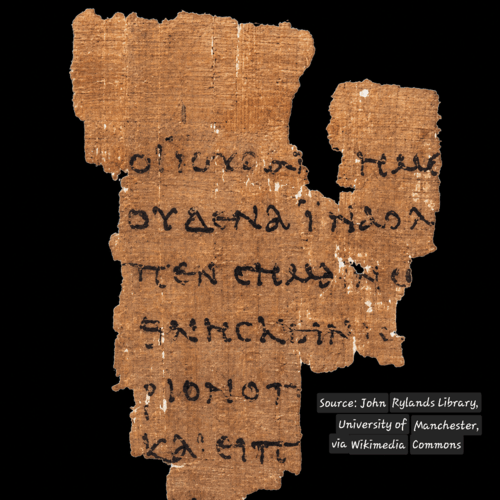
Hold up a credit card. Now imagine a scrap of ancient paper roughly that size, its edges frayed, its surface the colour of strong tea, carrying a handful of Greek letters on each side. That’s Papyrus Rylands Greek 457—known to scholars simply as P52. It may well be the oldest surviving fragment of any book in the New Testament. It sits quietly behind glass in a library in Manchester, England, rarely troubling the news. Yet for nearly a century, this single scrap has carried more weight in arguments about the Bible’s reliability than almost any other object on earth.
Here is why it matters. For two centuries, critical scholars have argued the Gospel of John couldn’t have been written by an eyewitness. On this view, it was composed by a later Christian community, decades after Jesus’s death, and gradually dressed Him in divine clothing He never claimed to wear. P52 speaks directly to that claim—and the answer it gives is more interesting, and more careful, than either side of the argument usually admits.
A Scrap With a Story
Every great manuscript discovery has a human story behind it, and P52’s begins with an Englishman named Bernard Grenfell. In the early 20th century, Grenfell was among the most active collectors of ancient papyrus, buying sacks of discarded scraps from Egyptian dealers on behalf of British libraries. Somewhere in a batch acquired for the John Rylands Library in Manchester around 1920, one small fragment went unexamined for over a decade—filed away among thousands of similar-looking scraps of old Greek writing.
Then, in 1934, papyrologist CH Roberts was cataloguing the library’s Greek fragments when he noticed something remarkable. A handful of words on this particular scrap matched, almost exactly, verses from the John 18, where Pilate questions Jesus before the crucifixion. Roberts compared the handwriting style to other Egyptian papyri that could be dated by other means, such as contracts or receipts with datable references—a discipline called palaeography, the study of ancient handwriting. Based on the letter shapes, he proposed the fragment was copied sometime between 100 and 150 CE. He published his findings in 1935, and a scrap that had spent over a decade unnoticed in a drawer became one of the most discussed objects in New Testament scholarship.
| Fast Facts | |
|---|---|
| Official name | Papyrus Rylands Greek 457 (P52) |
| Contains | John 18:31–33 (front); John 18:37–38 (back) |
| Size | 8.9 cm × 6 cm — about the size of a credit card |
| Housed at | John Rylands Library, Manchester, UK |
| Language | Greek |
| Format | A codex (book) leaf, not a scroll |
| Identified | By CH Roberts in 1934; published in 1935 |
What the Fragment Actually Preserves
Let’s be precise about what survives. P52 doesn’t contain whole verses—only parts of seven lines on each side, torn along irregular edges. What those fragments preserve, though, is a striking scene. In John’s account, Jesus stands before Pontius Pilate, the Roman governor, on the morning of His crucifixion. The fuller passage the fragment comes from reads:
“Then Pilate said to Him, ‘So you are a king?’ Jesus answered, ‘You say that I am a king. For this purpose I was born and for this purpose I have come into the world—to bear witness to the truth. Everyone who is of the truth listens to my voice.’ Pilate said to Him, ‘What is truth?’” (John 18:37–38, ESV)
There’s something almost poetic about a fragment devoted to truth and reliability turning out to preserve exactly this exchange. A pagan governor’s cynical dismissal—“What is truth?”—sits on a scrap of papyrus that has itself spent 90 years being scrutinised for its truthfulness. Reformed readers will recognise the deep irony: John’s Gospel had already answered Pilate’s question three chapters earlier, when Jesus declared, “I am the way, and the truth, and the life” (John 14:6, ESV). The very manuscript tradition sceptics use to question John’s reliability keeps preserving John’s own claims to be reliable.
Why This Became a Weapon Against Sceptical Theories
To understand why a scrap this small became so famous, it helps to know what it was used to answer. In the 19th century, a group of German scholars known as the Tübingen School, led by Ferdinand Christian Baur, argued John’s Gospel was the last and least reliable of the four Gospels, composed as late as 160 to 170 CE, long after any eyewitness could have written it.
If P52 really was copied around 125 CE, as Roberts proposed, the implications were severe for Baur’s theory. A copy that reached provincial Egypt by 125 CE couldn’t itself be the original manuscript, called an autograph. Time was needed for John to write his Gospel in the first place, traditionally placed in Ephesus, for that autograph to be copied at least once, and for a copy to travel hundreds of miles to Egypt. Stack up those steps, and a 125 CE copy pushes the original composition back into the first century—exactly where the traditional, confessional view has always placed it, commonly dated around 90-95 CE.
For much of the 20th century, this argument did heavy apologetic lifting. Evangelical and Reformed writers cited P52 confidently as proof that John’s Gospel couldn’t be a late, mythologised invention. That confidence wasn’t misplaced, but it was, as we will see, slightly ahead of what the evidence alone can prove.
The Honest Complication, and Why It Doesn’t Undo the Case
Good apologetics tells the whole truth, even when the whole truth is more modest than a popular argument. Since 2005, that has mattered a great deal for P52.
The date Roberts proposed relies entirely on palaeography, comparing letter shapes to other manuscripts whose dates are known some other way. This is a genuine and useful skill, but it isn’t exact. Handwriting styles overlapped across decades, and a scribe could write in an old-fashioned or up-to-date hand regardless of the actual date. In 2005, American scholar Brent Nongbri published a detailed critique arguing Roberts’s comparison manuscripts were themselves not securely dated, and that a fair reading of the evidence allows for a considerably wider range, potentially into the later second century or even the early third.
A separate, more technical study by palaeographers Pasquale Orsini and Willy Clarysse in 2012 reached a similar, if less dramatic, conclusion, proposing a range of 125 to 175 rather than Roberts’s tighter window.
| Proposal | Date Range | Basis |
|---|---|---|
| CH Roberts (1935) | 100–150 AD | Comparison with a small set of dated Egyptian papyri |
| Kurt & Barbara Aland | 125 AD (±25 yrs) | Standard palaeographic comparison |
| Orsini & Clarysse (2012) | 125–175 AD | Wider comparative database of dated manuscripts |
| Brent Nongbri (2005; 2020) | Possibly into early 3rd c. | Critique of the comparator method itself |
None of this means P52 stopped being valuable evidence. It means the specific figure of 125 AD—often repeated as though it were a settled fact—deserves more care than it has usually received in popular apologetics. A Reformed approach to evidence should welcome this correction rather than resist it. Our confidence in Scripture rests on far more than one fragment’s exact decade, and manufacturing false precision to win an argument serves the truth no better than Pilate’s cynicism did.
What Still Holds, Even on the Widest Estimate
Here’s the case that survives even the more cautious dating:
- The autograph came first. Whatever the exact decade of P52, it’s a copy, not the original. Composition, copying, and transmission across hundreds of miles all had to happen before it.
- Even the latest reasonable estimate still requires those earlier steps. A Gospel first written in the 160s, as Baur proposed, would leave implausibly little time to be copied, carried to Egypt, and copied again before P52’s likely date.
- Every serious scholar dates P52 within a workable window. No responsible study places it later than the early third century, and most still favour the second—comfortably permitting first-century authorship.
In other words, the extreme late-dating theory P52 was originally used to answer—a Gospel invented in the 160s with no connection to eyewitnesses—remains just as untenable under the revised, wider dating as it was under Roberts’s original one. What has changed is the precision of the claim, not its substance.
A Book, Not a Scroll
One detail is easy to miss but worth pausing on: P52 comes from a codex—a book with pages bound down one side—not a scroll. In the wider Graeco-Roman world of the second century, scrolls remained the standard format for serious literature; codices were associated with everyday notes and accounts, not treasured texts.
Early Christians, remarkably, went the other way. From the earliest manuscript evidence available, they overwhelmingly preferred the codex for their Scriptures, even while the surrounding culture still reached for scrolls. One practical explanation is that a codex allows quick cross-referencing, flipping to a specific page rather than unrolling to a specific point, which suits a movement built around checking texts against one another and against Old Testament prophecy. Whatever the full explanation, the codex format tells us that by the time P52 was copied, there was already an established Christian practice around producing and using Scripture. This wasn’t a scattered, informal jotting down of oral tradition; it reflects an organised, book-producing community with settled habits around its sacred texts.
What a New Testament Scholar Noticed in the Letters Themselves
Some of the most interesting recent work on P52 has come from confessionally Reformed scholarship, and it concerns something even smaller than the dating debate: how the scribe wrote the name of Jesus.
Charles E Hill, a New Testament professor at Reformed Theological Seminary, has examined whether P52’s scribe used what specialists call nomina sacra—literally “sacred names.” From the earliest Christian manuscripts we possess, scribes contracted certain sacred words, such as Jesus, Christ, Lord, and God, into abbreviated forms, usually the first and last letters with a line drawn above them, rather than writing them out in full. It was a scribal convention found nowhere else in the ancient world at that time, applied consistently across geographically scattered Christian communities from a very early date.
Hill’s detailed study of P52’s surviving letters engages directly with this question, because if a scribe copying a small provincial fragment was already following the nomina sacra convention, that tells us the practice was not a later, centralised innovation. It was already a shared, portable habit among ordinary copyists soon after the Gospel itself was written. That’s a thought-provoking point for a careful reader: it suggests early Christian communities treated their sacred texts with a settled, reverent, and remarkably uniform scribal culture from the very start, rather than gradually inventing reverence for Jesus over generations, as some sceptical theories assume.
Hill has made a similar argument on a larger canvas in his book Who Chose the Gospels?, where he shows the four canonical Gospels, including John, had already achieved a position of unrivalled authority among Christian writers well before the fourth-century councils sceptics sometimes credit with “choosing” them. P52 is a small but consistent piece of that same picture: a Gospel used, copied, and reverently transmitted from close to its own composition, not selected and elevated centuries later.
Dutch exegete Herman Ridderbos took a complementary line in his major theological commentary on John. Ridderbos argued that John’s Gospel is simultaneously the most theologically reflective of the four Gospels and thoroughly rooted in historical eyewitness testimony—the two belong together rather than in tension, since it is precisely as history remembered and understood that the Gospel does its theological work. A fragment like P52, sitting close to John’s own lifetime, fits that picture far better than a legend that grew slowly over generations.
P52 Among Its Peers
P52 is remarkable, but it is not alone. A handful of other early papyri, all well studied, form a wider manuscript tradition behind our New Testament:
| Papyrus | Contents | Approx. Date | Housed at |
|---|---|---|---|
| P52 (Rylands 457) | John 18 (fragment) | Early–mid 2nd c. | Manchester, UK |
| P66 (Bodmer II) | Most of John’s Gospel | c. 200 CE | Geneva |
| P75 (Bodmer XIV–XV) | Large portions of Luke and John | c. 175–225 CE | Vatican |
| P45 (Chester Beatty I) | Portions of all four Gospels and Acts | 3rd century | Dublin |
| P46 (Chester Beatty II) | Paul’s letters | c. 200 CE | Dublin/Ann Arbor |
Seen together, these manuscripts show John’s Gospel, far from surviving on the strength of one lucky scrap, sits within a dense, overlapping web of very early copies, stretching from a provincial fragment in Egypt to substantial, nearly complete codices within a generation or two afterwards. No other ancient biography or history from this period is attested anywhere near so early or so often.
Answering the Sceptics Fairly
Some popular sceptical writers argue P52 has been overworked by apologists and proves far less than is often claimed. There’s a fair point buried in that criticism: a single fragment of two verses cannot, by itself, authenticate authorship, confirm every word of the wider Gospel, or settle a debate on its own. Responsible scholarship should say so plainly rather than treat P52 as a silver bullet. Apostolic authorship of John rests on a wider body of evidence, including the church’s early and consistent testimony and internal features of the Gospel itself, not on one fragment alone.
But the fair point should not be overstated into a dismissal. What P52 does establish—a firm outer limit on how late John’s Gospel could have been composed—remains true under any of the dating proposals surveyed above. The real disagreement is about how much weight one small fragment should carry, not about whether it counts as evidence at all. Handled honestly, on its modest but real terms, P52 remains a genuine obstacle to theories that push John’s Gospel into the second half of the second century.
One Fragment, One Larger Argument
Readers of our earlier posts on the Dead Sea Scrolls will recognise the shape of this argument, because it’s really the same case made from the other end of the Bible’s timeline. The Dead Sea Scrolls showed the Hebrew Old Testament had been copied with remarkable stability across roughly a thousand years, right up to the manuscripts used to compile our modern Bibles. P52 shows something different but complementary: that the New Testament text, far from drifting for centuries before settling into its familiar form, sat remarkably close—within decades, on any reasonable dating—to the events and the apostle it claims to record.
Put those two lines of evidence together, and a coherent picture emerges across both Testaments: a God who speaks, and a church that has taken ordinary, human, careful custody of what he said, generation after generation. The Westminster Confession describes this as God’s singular care and providence in keeping his Word pure through every age—not a claim that manuscripts fell from the sky untouched by human hands, but a claim that the ordinary processes of copying, checking, and transmission were themselves providentially governed.
A scrap the size of a credit card cannot carry a doctrine on its own. But it can, honestly examined, remove one more prop from beneath the theory that the Gospel of John was a late invention, and it leaves Pilate’s ancient, unanswered question sitting exactly where the apostle placed it: pointing towards Jesus, who alone answered it.
Tough Questions, Honest Answers
Is P52 the oldest manuscript of any part of the Bible, or just the New Testament?
Just the New Testament—P52 makes no claim on the Old Testament record. Several Old Testament witnesses are far older: the Dead Sea Scrolls include Isaiah and Psalms fragments from around the second and first centuries BC, and the Ketef Hinnom silver amulets, inscribed with a version of the priestly blessing from Numbers 6, date to the seventh or sixth century BC—roughly eight hundred years before P52 was copied. Taken together, Old and New Testament manuscript evidence now spans nearly two thousand years before Christ to the modern era. For Reformed readers, that combined record matters more than any single fragment: it shows careful, controlled transmission running through both Testaments, not merely one.
Where is P52 kept today, and can I see it?
P52 remains part of the special collections at the John Rylands Library, University of Manchester, where it was first identified. Because papyrus is fragile and light-sensitive, it’s not permanently on public display; it’s kept under controlled conditions and shown only occasionally, alongside high-resolution images made available for study. Readers wanting to see it should check the library’s current exhibition schedule rather than assume it’s always viewable. It’s a small reminder that faithful stewardship of physical evidence, not just doctrine, is part of how the church has honoured Scripture across the centuries.
How does P52 compare physically to the Dead Sea Scrolls?
The differences are considerable. Many Dead Sea Scrolls are large leather or parchment rolls—the complete Isaiah scroll from Qumran stretches over seven metres—while P52 is a single papyrus scrap smaller than a credit card. The Scrolls are also centuries older, with the earliest biblical fragments dating from around the third century BC, compared with P52’s likely second-century AD date. Despite these differences in material, size, and era, both function the same way in an apologetic argument: as fixed, dateable points that let scholars measure how faithfully a text was copied over time.
Don’t critics like Bart Ehrman argue P52 proves far less than apologists claim?
Ehrman and others rightly point out that a single fragment containing parts of two verses cannot, by itself, prove who wrote John’s Gospel or verify every word of its wider text. Reformed scholarship concedes that point without hesitation. What P52 establishes is more limited but still solid: a firm outer boundary on how late the Gospel could have been composed. The case for apostolic authorship rests on a broader foundation—early and consistent testimony from the church fathers, together with internal features such as the Gospel’s eyewitness detail—with P52 as one supporting piece among several, not the whole argument by itself.
How did something this fragile survive for almost 2000 years?
Papyrus is made from the pith of the Cyperus papyrus reed, sliced into strips, layered crosswise, and pressed into sheets—a material that rots quickly in damp conditions. Nearly all surviving ancient papyri, including P52, come from Egypt for one simple reason: its hot, dry climate slows decay dramatically compared with the rest of the Mediterranean world, where papyri from the same period have almost entirely perished. Reformed readers can see this as ordinary providence rather than miracle—God preserving his Word not by suspending nature, but by governing the ordinary conditions, and the ordinary care of copyists and collectors, through which it reached us.
Was there ever real doubt that this fragment really is from John’s Gospel?
Very little. Even though only fragments of words survive, the surviving letters align so precisely with John 18 that CH Roberts’s identification was accepted almost immediately by fellow papyrologists in 1934 and 1935, and it has never seriously been challenged since. What scholars dispute is the date of the copy, not which text it preserves. That distinction is worth stressing, since popular sceptical writing sometimes blurs the two, as though uncertainty about the decade cast doubt on the content—it does not.
How many New Testament papyri survive from before 200 CE?
Counting is complicated by exactly the dating debates this post has described, but on the traditional Aland list around eight papyri—including P52, P90, P66, and P46—are conventionally placed in the second century, out of roughly 140 New Testament papyri catalogued overall. Scholars such as Brent Nongbri would place some of these later, while others defend the earlier range, so the precise count shifts depending on whose palaeographic judgement is followed. Either way, the wider point stands: no other ancient book from this period is attested by anywhere near this density of very early copies.
Related Reads
- Bible Manuscripts: Why Earlier Isn’t Always Better
- What Do the Dead Sea Scrolls Prove? The Case for Bible Reliability
- The Ketef Hinnom Scrolls: The Oldest Biblical Text Ever Found
- Did Jesus Really Exist? The Historical Evidence Sceptics Can’t Ignore
- New Testament Reliability: Debunking Myths and Lies
- Nag Hammadi Texts: Secret Gospels or Ancient Heresies?
- Scribal Corrections: How Big a Threat Are They to Bible Integrity?
- Why Didn't the Gnostic Gospels Make the Cut Into the Canon?