Ask Christians to explain the gospel using nothing but the Bible, and many will reach for the same short chain of verses in Paul’s letter to the Romans. Sin. Wages. Love. Confession. Calling on the name of the Lord. Some will even have the references pencilled inside the cover of their Bible, each pointing to the next.
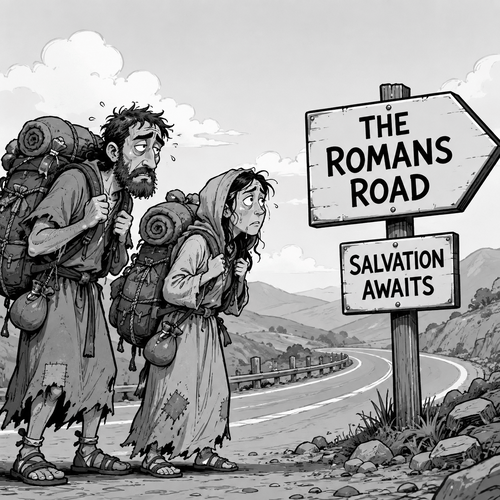
That chain is called the Romans Road. For most of the last century it has been printed on tracts, taught in Sunday school, and used at hospital bedsides. Millions have heard the gospel through it.
But one thing is worth saying at the start. Paul didn’t write Romans as an evangelistic tract. He wrote it to a church he’d never visited, partly to heal a rift between Jewish and Gentile believers, and partly to raise support for a mission to Spain (Romans 15:24). It doesn’t end with an appeal to decide. It ends with a list of names—Phoebe, Priscilla, Aquila, Mary—a real congregation.
So the question isn’t whether the Romans Road is true. It is. The question is whether 6 verses can carry 16 chapters—and what happens when the parts left out are the parts holding the rest together.
First, what exactly is the Romans Road?
It’s a sequence of verses from Romans, arranged so each one answers the question raised by the one before it. There’s no official version, but the common form runs like this.
| VERSE | WORDS | THE POINT BEING MADE |
|---|---|---|
| Romans 3:23 | all have sinned and fall short of the glory of God | The bad news first: everyone has a problem. No one is exempted |
| Romans 6:23 | the wages of sin is death, but the free gift of God is eternal life in Christ Jesus our Lord | The bad news gets worse: the problem is fatal. But wait, there’s good news for those who care: the answer is a gift |
| Romans 5:8 | while we were still sinners, Christ died for us | God acted first, before we improved |
| Romans 10:9 | if you confess with your mouth that Jesus is Lord and believe in your heart that God raised him from the dead, you will be saved | How the gift is received |
| Romans 10:13 | everyone who calls on the name of the Lord will be saved | The invitation is genuinely open |
| Romans 5:1 or 8:1 | we have peace with God; there is therefore now no condemnation | What the believer now has |
Some versions begin earlier, at Romans 1:20, to establish that nobody has an excuse. Others add Romans 3:10—none is righteous, no, not one—or finish with Romans 8:38–39.
The name and method are modern, belonging to 20th-century American evangelism—tract societies, mass campaigns, door-to-door visitation.
What the Romans Road gets right
Four things about it are genuinely excellent.
- It’s Scripture, not sentiment. The whole presentation is God’s words, not a moving story, not a personal testimony, not an appeal to felt needs. That is rarer than it should be.
- It follows Paul’s own order. Paul really does move from human guilt (Romans 1:18–3:20) to God’s remedy in Christ (3:21–5:21). The Road is not imposing a shape on the letter; it is borrowing one.
- It defines sin correctly. Falling short of the glory of God—not of our potential, not of our values, not of society’s standards. Sin is measured against God. Most modern definitions never get that far.
- It’s portable. An ordinary believer with no training can carry it in memory and use it on a train. No criticism below should be read as taking that away.
The full stop that isn’t there
The sharpest problem with the Road hides in its most famous verse. Romans 3:23 isn’t a sentence. Read it in any Bible and you’ll see Paul doesn’t stop. The words run straight on into the next breath:
Romans 3:23–25
for all have sinned and fall short of the glory of God, and are justified by his grace as a gift, through the redemption that is in Christ Jesus, whom God put forward as a propitiation by his blood, to be received by faith.
The Road quotes the first half of that sentence and moves on. What it leaves behind, mid-clause, is the densest statement of the gospel in the Bible. Two of its words need explaining, because they’re the heart of everything.
- Redemption means a purchase that sets a captive free. It’s slave-market language. Somebody paid, and somebody walked out.
- Propitiation means a sacrifice that turns away wrath. Not merely a covering-over of sin, but the absorbing of God’s settled anger against it, so that God can forgive without ceasing to be just.
Leon Morris, whose life’s work was the study of this vocabulary, called Romans 3:21–26 possibly the most important single paragraph ever written. The Road quotes the verse immediately before it and changes the subject.
This is more than a tidiness complaint. Without propitiation, the cross becomes a demonstration of love with no explanation of why it was needed—and a death only shows love if it accomplished something. A man who drowns to save nobody isn’t a hero; he’s a tragedy. Take out 3:25 and Romans 5:8 quietly loses its logic.
Sin, flattened into underperformance
Fall short is a gentle phrase in English. It sounds like an arrow landing just below the target, or a student two marks off a pass. On its own it lets hearers conclude they’re basically decent and slightly short.
Paul has already spent two and a half chapters making sure nobody can think that. In Romans 1 people don’t merely fall short—they suppress the truth, they exchange the glory of God for images, and three times God gave them up to what they wanted. In Romans 8:7 the diagnosis reaches its worst point: the mind set on the flesh does not submit to God’s law; indeed, it cannot.
That last word changes the conversation. Cannot. Older writers called this total inability—not that people are as wicked as they could possibly be, but that sin has reached the will itself, so no part of us is left neutral and able to choose God unaided.
If sin is underperformance, the gospel is coaching. If sin is death and rebellion, the gospel must be resurrection.
The missing keystone: two men, two verdicts
Between Romans 5:8 and Romans 6:23—two stops on the Road—sits Romans 5:12–21, the passage on which Paul’s whole argument balances. His claim is that the human race stands under two representative men. Adam acted, and all who are in him share his guilt and death. Christ acted, and all who are in Him share His righteousness and life.
| IN ADAM | IN CHRIST | |
|---|---|---|
| The act | One trespass | One act of righteousness |
| The result | Condemnation for all in him | Justification and life for all in him |
| The verdict | Made sinners | Made righteous |
| What is transferred | Guilt and death | Righteousness and life |
This is what theologians mean by imputation—a legal crediting of someone else’s record to your account. It answers the question the Road never quite raises: how can a just God declare a guilty person righteous without lying? Our sin was credited to Christ; His obedience is credited to us. Justification isn’t God pretending. It’s a real transfer.
Drop Romans 5:12–21 and all have sinned gets read as individuals adding up their own failures. Paul means something deeper: we’re born into a condemned family, and salvation means transfer into another one.
The chapter that’s quoted and then ignored
The Road takes Romans 6:23 and leaves the other 22 verses on the shelf—a striking thing to do, because Romans 6 exists for exactly the reason the Road exists.
Paul has just said that where sin increased, grace abounded all the more. He knows how that sounds, so he opens chapter 6 by voicing the objection himself: What shall we say then? Are we to continue in sin that grace may abound?
A TEST WORTH APPLYING
Martyn Lloyd-Jones made a searching observation about this verse. If our presentation of the gospel never provokes anyone to ask whether we’re giving people a licence to sin, we’ve probably not preached grace at all—we’ve preached something safer and smaller, with conditions quietly attached.
Paul’s answer isn’t “try harder”. It’s that a Christian has died to his old self—been baptised into Christ’s death, raised to walk in newness of life, no longer a slave to sin but a slave to righteousness. This is union with Christ: we’re not merely given things by Jesus but joined to Him, so that His death and resurrection become ours.
John Murray called union with Christ the central truth of the whole doctrine of salvation, the thread on which every other blessing is strung. Leave it out and the gospel becomes a transaction: a debt cleared, a customer free to go. Include it and salvation becomes what it is—a person receiving a person.
Where assurance actually comes from
The Road usually ends with a prayer and a friendly assurance: you prayed it, so you’re in. Romans grounds assurance somewhere quite different.
- Adoption. You have received the Spirit of adoption as sons, by whom we cry, “Abba! Father!” (8:15). We’re not merely acquitted—we’re brought into the family.
- The Spirit’s witness. The Spirit Himself bears witness with our spirit that we are children of God (8:16). Assurance is something God keeps giving, not something we recall having felt once.
- The unbreakable chain. Salvation is entirely God’s work, from start to finish. Foreknown, predestined, called, justified, glorified (8:29–30). Every link holds because God holds it, and nobody drops out between one link and the next.
The pastoral difference is enormous. Assurance built on a remembered prayer collapses the first time life goes badly. Assurance built on God’s purpose and the Spirit’s present witness survives.
Romans 10, read where it actually sits
If you confess with your mouth that Jesus is Lord… is the Road’s hinge, and it’s usually quoted as a standalone offer. In the letter it sits inside Paul’s anguish over Israel—chapters 9 to 11—where he explains why people who had the promises are missing the Messiah. Two details get lost in the extraction.
First, confessing Jesus is Lord wasn’t a private formula in the first century. Kyrios was Caesar’s word. To say it of a crucified Galilean was a costly, public, dangerous act.
Second, Paul doesn’t stop at verse 13. He immediately asks: How then will they call on him in whom they have not believed? And how are they to believe in him of whom they have never heard? And how are they to hear without someone preaching? The Road quotes the promise and drops the commission attached to it. This passage isn’t only about how a person is saved. It’s about why somebody has to be sent.
The missing word, and the prayer at the end
Repentance doesn’t appear on the Road, though it appears in Romans: God’s kindness is meant to lead you to repentance (2:4). Faith without repentance is a half gospel, asking people to trust Christ without turning from anything.
Then there’s the prayer. Where did the practice of ending a gospel conversation by leading someone in a prayer and then declaring them saved on that basis come from? Not from the apostles. Its ancestry runs through Charles Finney and the 19th-century “new measures”—the anxious bench, the public decision, the immediate assurance. Iain Murray has traced how that hardened into the decisionism most of us grew up with.
THE DANGER
No one is more difficult to reach than people who’re certain they’re already saved because of something they did at 15, and who’ve shown no fruit since. A prayer can inoculate. Having had a mild dose of the gospel, they become resistant to the real thing.
None of which makes praying wrong. Romans 10:13 promises those who call on the Lord will be saved, and calling out to God is exactly what a convicted sinner should do. The error isn’t the prayer. It’s treating the prayer as the mechanism, and its recital as proof.
If God chooses, why bother knocking on doors?
If salvation depends on God’s choice rather than the persuasiveness of our presentation, does evangelism still matter?
It matters more, not less. God ordains the end and the means together, and Romans 10 says the means is a preacher being sent. JI Packer argued God’s sovereignty isn’t the enemy of evangelism but the only solid ground for it—if conversion depended on our skill, every conversation would rest on us; because it depends on God, we can speak plainly to anyone and hope for anyone.
The command to believe goes to everybody without exception; the ability to believe comes from the Spirit. Those two facts never needed reconciling in Paul’s mind, and they need not trouble ours.
A fuller road through Romans
So keep the Road—but widen it. This route follows the same letter and leaves the load-bearing walls in place.
- Romans 1:16–18 The gospel is God’s power to save; both his righteousness and his wrath are revealed.
- Romans 1:21–23 Sin is not underperformance but idolatry: exchanging God for substitutes.
- Romans 3:10–12, 19–20 Nobody is righteous; every mouth is stopped.
- Romans 3:23–26 All have sinned and are justified freely, through the blood of Christ, who bore the wrath sin deserved.
- Romans 5:1, 8–11 Justified, therefore peace; enemies, therefore reconciled.
- Romans 5:12–19 Two Adams, two verdicts, one transfer.
- Romans 6:1–4, 23 United to Christ in his death and resurrection; wages versus gift.
- Romans 8:1–4, 15–16 No condemnation, adoption, the Spirit’s witness.
- Romans 10:9–15 Confess, believe, call—and therefore send.
- Romans 11:33–36 Doxology. The road ends in worship, not in a signature.
So what really is it?
The Romans Road is a summary, and summaries are good things. Nobody objects to a map for being smaller than the country.
The danger comes when the map is mistaken for the terrain—when six verses become the gospel rather than a doorway into it, when fall short is heard as a small gap, when the cross is love without propitiation, when assurance rests on a remembered prayer, and when the whole thing ends in a decision rather than a disciple.
John Calvin wrote whoever gains a true understanding of Romans has a door opened to the most hidden treasures of Scripture. That’s a promise about the letter, not about six of its verses. Use the Road, by all means. Then take the person who walked it back to the beginning of Romans and read the whole thing together.
Tough Questions, Honest Answers
Is the sinner’s prayer found anywhere in the Bible?
Not as a set form of words, and not as a step to be administered at the end of a gospel presentation. What the Bible does contain is people crying out to God in real distress—the tax collector beating his breast, the thief on the cross, Peter sinking in the water. Those are prayers of genuine need, not scripts repeated after somebody else. So praying is entirely right, and a person under conviction should certainly call on God. What Scripture never does is treat the prayer as the moment of transaction, or use its recital as evidence that someone is converted. The evidence Scripture offers is a changed life over time (Romans 6), not a remembered sentence.
Is it right to tell an unbeliever “Christ died for you”?
Many careful preachers avoid that exact phrasing, not because they doubt the offer is genuine, but because it says more than we can know about the person in front of us. What we can say without hesitation is that Christ died for sinners, that the invitation is real and open to anyone, and that whoever comes to Him will never be cast out. That’s how the apostles preached—Peter at Pentecost and Paul at Athens both proclaimed the crucified and risen Christ and called their hearers to repent. The offer of the gospel is universal and sincere; its saving effect belongs to those who believe. You can urge Christ on anyone with complete confidence without needing to make a claim about the eternal state of a stranger.
At what age can a child meaningfully walk the Romans Road?
Children can genuinely understand and believe the gospel, sometimes very early, and nothing here should discourage teaching it to them. The caution is about how easily a young child will agree with a trusted adult and repeat whatever is asked. A five-year-old saying yes to a kind grandmother isn’t proof of conversion, and treating it as proof can do real harm later. The wiser approach is to teach the whole gospel patiently, pray with them freely, and let assurance grow as understanding and fruit grow.
What about those who never hear the gospel—does Romans 1:20 condemn them?
Romans 1 teaches creation reveals God’s eternal power and divine nature clearly enough that nobody has an excuse. But general revelation of that kind shows people God exists and that they’re accountable; it doesn’t tell them about Christ, and it saves nobody. That’s precisely why Romans 10 moves so urgently from calling on the Lord to the necessity of sending preachers. Nobody perishes unjustly, and God isn’t obliged to save anyone. The right response to this question isn’t speculation about the unreached but obedience to the commission—and gratitude that someone once brought the gospel to us.
How does the Romans Road compare with the Four Spiritual Laws or the Bridge illustration?
The Romans Road has one clear advantage: it is entirely Scripture, and it broadly follows Paul’s own argument. The Four Spiritual Laws opens with God’s wonderful plan for your life, which starts the gospel with human happiness rather than divine holiness, and reaches sin only in the second step. The Bridge illustration is visually memorable and does show the gulf and the cross spanning it, but it can suggest that the sinner does the crossing under his own power. All three share the same weakness—each ends with a decision to be made rather than a Saviour to be received, and each tends to close with a prayer treated as the point of transfer. Any of them can be used well by someone who knows what the outline leaves out.
Someone prayed the prayer years ago but shows no fruit—were they ever saved?
Scripture is honest that some professions aren’t genuine: the seed on rocky ground springs up quickly and withers, and John writes of those who went out from us because they were never truly of us. So the possibility must be faced. But this is a matter for careful pastoral care, not a verdict to be announced. The right approach is to preach the gospel to them again as though for the first time, without referring to the earlier prayer at all, and to look for the marks Scripture actually names—hatred of sin, love for Christ and his people, perseverance. Genuine faith may be weak and may go through long cold seasons, so patience is essential. What mustn’t happen is reassuring someone on the basis of a prayer alone.
How do I mark and memorise the Romans Road verses in my own Bible?
The traditional method is simple: write the next reference in the margin beside each verse, so that one turn leads to the next without hunting. If you use the fuller route above, do the same with those ten stops. Underline the whole of Romans 3:23–26 rather than 3:23 alone, so you never quote half a sentence again. It also helps to learn one summarising verse by heart for each stage—guilt, atonement, faith, union, assurance—so that you can speak naturally rather than reciting. Best of all, read Romans straight through often enough that the verses come with their context attached.
Related Reads
- God Helps Those Who Help Themselves: Is It in the Bible?
- Fool’s Paradise: Is My Assurance of Salvation Real or False?
- Assurance of Salvation: How Can I Know I’m Truly Saved?
- Salvation: By Faith Alone or by Works? The Biblical Answer
- What Can The Ethiopian Eunuch Teach Us About True Conversion?
- Did Jesus Preach Works? Examining the Hardest Passages