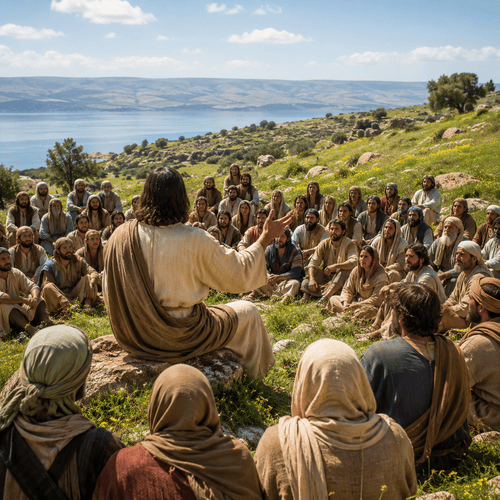
“You cannot put new wine into old wineskins.” The line has travelled a long way from the place where Jesus first said it. It turns up in business seminars about innovation. In leadership books about staying open to change. And in churches wanting a reason to swap the organ for a guitar. Somewhere along the way, it’s become a proverb about flexibility.
But Jesus wasn’t talking about flexibility. He was answering a specific question, on a specific day, from people honestly puzzled by the behaviour of His followers. And His answer was one of the boldest claims about Himself he had yet made.
The question that started it
Now John’s disciples and the Pharisees were fasting. And people came and said to him, “Why do John’s disciples and the disciples of the Pharisees fast, but your disciples do not fast?” (Mark 2:18)
Fasting means going without food for a set period as an act of sorrow, repentance, or serious prayer. It was a normal part of Jewish devotion, and the people asking weren’t being difficult. John the Baptist’s followers fasted. The Pharisees fasted. Jesus’ followers ate.
Here’s the detail most discussions skip. The law of Moses commanded exactly one fast day in the year: the Day of Atonement, when Israel was told to afflict yourselves (Leviticus 16:29–31). One day. Everything else in the fasting calendar of first-century Judaism had been added later, by custom and by rules built on top of rules. The strictest Pharisees fasted twice a week (Luke 18:12).
So when Jesus talks about something old that cannot hold something new, He isn’t attacking the Old Testament or Moses. He is speaking into a religious system that had grown up around the law and, in places, buried it.
WHERE THIS SITS IN MARK
Mark 2:1–3:6 is a run of five clashes with the religious authorities. They escalate steadily, and they end badly.
| PASSAGE | THE CLASH | THE CHARGE |
|---|---|---|
| Mark 2:1–12 | Jesus forgives a paralysed man’s sins | Blasphemy |
| Mark 2:13–17 | Jesus eats with tax collectors and sinners | Bad company |
| Mark 2:18–22 | Jesus’ disciples do not fast | Neglecting piety |
| Mark 2:23–28 | Disciples pluck grain on the Sabbath | Sabbath-breaking |
| Mark 3:1–6 | Jesus heals a withered hand on the Sabbath | Sabbath-breaking |
The final verse of that sequence is chilling: The Pharisees went out and immediately held counsel with the Herodians against Him, how to destroy Him (Mark 3:6). Our passage isn’t a gentle discussion about religious habits. It’s a step on the road to the cross.
The bridegroom has arrived
Jesus answers with a picture: Can the wedding guests fast while the bridegroom is with them? As long as they have the bridegroom with them, they cannot fast (Mark 2:19).
A Jewish wedding wasn’t an afternoon. Celebrations could run over a week, and guests were released from certain religious duties for the duration, because the joy of the occasion took priority. Fasting at a wedding would be like arriving at a birthday party dressed for a funeral—not wicked, simply the wrong response to what’s happening.
That alone would be a good answer. But something far larger is hidden inside it. Who is the bridegroom?
In the Old Testament, that role belongs to one person only. For your Maker is your husband, the LORD of hosts is his name (Isaiah 54:5). As the bridegroom rejoices over the bride, so shall your God rejoice over you (Isaiah 62:5). Hosea builds a whole book on it, and Ezekiel 16 tells Israel’s history as a marriage. The bridegroom of Israel is the LORD himself.
So Jesus is saying: the wedding you’ve been waiting for has begun, and I’m the groom. The banquet God promised—a feast of rich food, a feast of well-aged wine (Isaiah 25:6)—is being served. That’s why nobody is fasting. You don’t mourn during the ceremony.
Then, without warning, the music changes key.
The days will come when the bridegroom is taken away from them, and then they will fast in that day (Mark 2:20).
The Greek verb translated taken away isn’t a gentle word for departing. It carries the sense of being seized, snatched, removed by force, and may deliberately echo the Greek version of Isaiah 53:8, where the suffering servant is taken away by oppression and judgement. This is the first shadow of the cross in Mark’s Gospel—six chapters before Jesus tells His disciples plainly the Son of Man must suffer and be killed (Mark 8:31). At the wedding, in the middle of the joy, the groom quietly says He will soon be taken.
Two pictures, one argument
Jesus then adds two short parables. They’re usually treated as separate sayings about newness, but are better read as one argument that gets more serious as it goes.
The patch
No one sews a piece of unshrunk cloth on an old garment. If he does, the patch tears away from it, the new from the old, and a worse tear is made (Mark 2:21).
Newly woven cloth hadn’t yet been washed, and washing made it shrink. Sew a piece of it onto an old garment—already washed, already shrunk to its final size—and the first soaking pulls the patch tight. It contracts, drags at the surrounding fabric, and rips free. The hole you were trying to fix is now bigger than when you started.
Mark’s word for that tear is schisma, the word behind our English “schism.” The new material doesn’t gently improve the old garment. It splits it.
The skins
And no one puts new wine into old wineskins. If he does, the wine will burst the skins—and the wine is destroyed, and so are the skins. But new wine is for fresh wineskins (Mark 2:22).
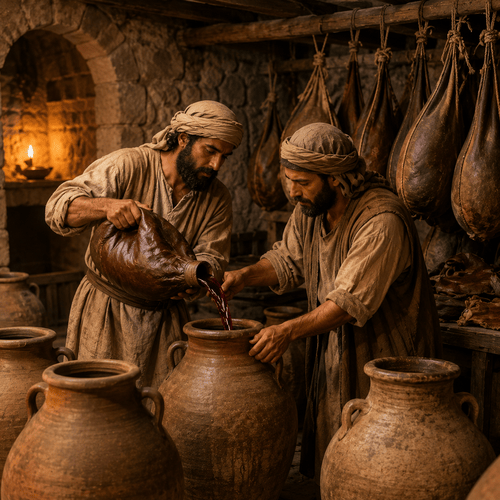
A wineskin was a container made from the whole hide of a goat or sheep, sewn shut with the neck left as an opening. New wine here means freshly pressed juice that’s still fermenting. Fermentation produces gas, and gas produces pressure. A fresh skin is supple and stretches to absorb the strain. A skin that has already held one fermentation has stretched as far as it can and gone hard and brittle. Pour fermenting wine into it and it splits at the seams.
Notice the cost. In the first picture you damage a garment. In the second you lose everything—the wine soaks into the ground and the skin is ruined too.
A DETAIL WORTH KNOWING: TWO GREEK WORDS FOR “NEW”
English hides something here. Jesus uses two different words, and the difference is deliberate.
| GREEK WORD | WHAT IT MEANS | USED OF |
|---|---|---|
| neos | New in time—recent, young, freshly made | the wine |
| kainos | New in kind—fresh, unprecedented, of a different order | the wineskins |
That second word matters enormously. Kainos is the great word of the last days in the New Testament. The new covenant (Luke 22:20). The new creation—if anyone is in Christ, he is a new creation (2 Corinthians 5:17). The new commandment. The new heavens and the new earth. The new Jerusalem. And at the very end: Behold, I am making all things new (Revelation 21:5).
Jesus isn’t saying religion needs updating from time to time. He is using the vocabulary of the end of the world. Something has arrived that belongs to the age to come, and the containers of this age cannot hold it.
So what is the old, and what is the new?
This is where the passage is most often mishandled. The crude reading says: old garment and old skins equal Judaism and the Old Testament; new wine equals Christianity. On that view Jesus came to scrap the Scriptures he grew up on and start again. That reading has a long and unhappy history, and it collapses on contact with Jesus’ own words: Do not think that I have come to abolish the Law or the Prophets; I have not come to abolish them but to fulfil them (Matthew 5:17).
The Bible presents one plan of salvation running from Genesis to Revelation. Abraham wasn’t saved by a different mechanism from Paul. There’s one covenant of grace, administered differently at different stages of history. The Westminster Confession puts it carefully: under the gospel that same covenant is dispensed “with more fullness, evidence, and spiritual efficacy” than before (7.6). Not a different salvation, but the same grace poured out in fulfilled measure.
That’s the new wine. Not a new God, not a new way of being forgiven, but the promise itself arriving in person, with the Spirit poured out and the sacrifice about to be made once for all.
So what burst?
WHAT THE OLD WINESKINS WERE—AND WERE NOT
They Were Not: the Old Testament, the law of God, the moral commandments, or the faith of Abraham, Moses and David. Those are fulfilled in Christ, not discarded.
They Were: the ceremonial system whose work was finished, the human traditions built on top of it, and the instinct underneath both—that standing before God is something we accumulate by performance.
Take those in turn. The sacrifices, food laws and festivals were a shadow of the things to come, but the substance belongs to Christ (Colossians 2:17). A shadow does its job by pointing forward; when the body arrives, the shadow has finished. Hebrews says it bluntly: In speaking of a new covenant, he makes the first one obsolete (Hebrews 8:13). That is not contempt for the old, but the retirement of something that worked exactly as designed.
The traditions were a different matter. Of these Jesus said, You leave the commandment of God and hold to the tradition of men (Mark 7:8). Twice-weekly fasting was one of them. Beneath them sat the deepest problem of all: a religion of measurement, in which a man could count his fasts and know where he stood.
You cannot patch grace onto that. It’s not that grace is too weak for the old system; it’s that grace destroys it. Herman Ridderbos argued that what Jesus brings is not the reform of an existing religious order but the arrival of the kingdom itself, breaking in with a fullness the structures of contemporary Judaism were never built to contain. Geerhardus Vos made the same point from another angle: the newness of the New Testament isn’t chronological but eschatological—the powers of the age to come have entered the present. James Edwards observes the conflicts of these chapters widen until they become a plot to kill Jesus, precisely because He could not be absorbed as one more teacher within the system.
John Calvin adds a pastoral note that’s easy to miss. Commenting on the parallel passage in Matthew, he takes the old garment and the worn skins to refer at least in part to the disciples themselves—still weak, still in training—and reads Jesus as warning against loading severe austerities onto people not yet strong enough to carry them. Zeal that outruns strength does not build people up. It tears them.
Four ways this passage gets misused
Because the image is so vivid, it gets borrowed for causes Jesus never mentioned. Four are worth naming.
| THE MISREADING | WHY IT FAILS |
|---|---|
| “New wineskins” means the church must constantly reinvent itself. | The parable makes one unrepeatable claim about one moment in history—the arrival of Christ. It is not a rolling licence for novelty. Christ himself appointed the containers his people are to use: the preached word, baptism and the Lord’s Supper, prayer, and loving discipline. |
| New wine means freedom from God’s law. | The same Jesus intensified the commandments rather than relaxing them (Matthew 5:21–48). What ended was the ceremonial shadow and the merit system, not God’s moral will. |
| The Old Testament is discarded packaging. | Jesus read it, quoted it, and said it testified about him (John 5:39). Paul warns Gentile believers specifically against arrogance towards the root that supports them (Romans 11:18). |
| “Be a flexible wineskin”—stay open, stay teachable. | A fine sentiment, but it shrinks a claim about the arrival of God’s kingdom into a tip about personality. |
There is a quieter opposite error: the settled preference for what we have always done, simply because we have always done it. Old skins are comfortable. They’re shaped to us. That is exactly the problem.
Should Christians fast today?
Verse 20 has already answered this, and the answer is yes.
The bridegroom was taken away. He rose, He ascended, and He is present with His people by His Spirit—but not bodily, and the feast has not yet been served. The church lives in the gap between the announcement and the celebration, awaiting the marriage supper of the Lamb (Revelation 19:7–9).
So both things are true at once, and Christian practice reflects it.
- The calendar of obligatory fasts is gone. No day of the week, no season of the year, binds the conscience. Nobody may impose fasting as a measure of spiritual seriousness.
- Fasting itself remains. Jesus assumed His followers would do it: When you fast, do not look gloomy (Matthew 6:16)—when, not if. The early church fasted before sending out missionaries and appointing elders (Acts 13:2–3; 14:23).
- It belongs in the church’s life. The Westminster Confession lists “solemn fastings” among the ordinary parts of religious worship (21.5), tied to particular occasions rather than a calendar.
The difference between old fasting and new isn’t the practice but the direction of travel. The old sort tried to build a standing before God. The new flows out of a standing already given—a way of saying, with the stomach as well as the mouth, that we want Him more than we want dinner.
The wine has not finished being poured
There’s one more cup in Mark’s Gospel, and it ties everything together. On the night before He died, Jesus said: Truly, I say to you, I will not drink again of the fruit of the vine until that day when I drink it new in the kingdom of God (Mark 14:25).
There’s the same word for ‘new’ again—kainos. New in kind. The wine that couldn’t be poured into old skins in Mark 2 is the wine He will drink with His people at the end. There are two cups, then, and between them stand the cross, where the bridegroom was taken away, and the empty tomb, where He came back.
So this passage does not ask us whether the new wine is good. The cross settled that. It asks something harder. Are we still trying to hold that wine in a container that cannot take the pressure? A faith built on performance. A habit of measuring ourselves against others. A set of familiar forms we love simply because they’re ours. If so, Jesus isn’t offering to patch any of that up. He never was.
He is offering the wine. He has already given us the skins.
Tough Questions, Honest Answers
What does Luke mean by adding, “The old is good”?
Luke’s version ends with a line Mark leaves out: And no one after drinking old wine desires new, for he says, “The old is good” (Luke 5:39). Jesus is not praising the old here; he is diagnosing why people reject the new. Aged wine was genuinely preferred to fresh must, and the comparison lands as a piece of gentle irony—once the palate is trained to what is familiar, anything unfamiliar tastes wrong. That is precisely what happened to many who heard him. Luke, writing to a largely Gentile readership, seems to include the line to explain the resistance Jesus met from sincerely religious people. It is a warning still worth heeding: comfort with the old can feel exactly like discernment.
Were wineskins really made from whole animals, and how did they actually burst?
Yes. The hide of a goat or sheep was removed largely intact, tanned, turned inside out so the hair faced in, and sewn shut at the legs and neck, leaving one opening tied with cord. Freshly pressed juice continues to ferment, releasing carbon dioxide, and the pressure has to go somewhere. A new skin is elastic and expands with it. An older skin has already been stretched by one fermentation and has dried and hardened, so it splits—usually along a seam. Old skins weren’t useless; they were perfectly good for water, oil, or wine that had already finished fermenting. The parable turns on using the right container for the right stage, which is exactly the point Jesus is making about the moment in redemptive history that had arrived.
Does this passage mean churches should replace traditional worship with contemporary styles?
It doesn’t follow from the text, though it’s probably the most common interpretation. Jesus is describing a single, unrepeatable event—the arrival of the kingdom in His own person—not establishing a principle that religious forms should rotate every generation. If anything, the passage cuts the other way, because the new containers were not left to human invention: Christ appointed the preaching of the word, baptism and the Lord’s Supper, prayer, and church discipline. Questions of musical style, service order and language are real, and should be decided by what genuinely serves the gathered church in a particular place. But they should be argued on their own merits, not by borrowing the authority of a parable about the coming of Christ.
Is the new wine here connected to the wine Jesus made at Cana?
The two passages illuminate each other beautifully. At Cana Jesus takes six stone jars set aside for the Jewish rites of purification (John 2:6) and fills them with wine—the vessels of the old ceremonial order become the source of the celebration. The master of the feast then says the best wine has been kept until last, which is a comment on the whole shape of redemptive history. Mark 2 makes the point from the other side: the old containers cannot hold what is now arriving. John shows the abundance of the new; Mark shows its pressure. Both are describing the same moment, and both use a wedding to do it.
Is the “new wine” the Holy Spirit, as at Pentecost?
The connection is often made, but the two passages are doing different things. At Pentecost the mockers sneer that the disciples are filled with new wine (Acts 2:13), which is an accusation of drunkenness, not a theological statement—though Peter’s reply turns it into one by pointing to Joel’s prophecy of the outpoured Spirit. In Mark 2 the new wine stands for the whole reality that Jesus brings: the kingdom present in his person, the covenant about to be sealed in his blood, and the fullness that follows. The Spirit is certainly part of that, since Pentecost is one of the ways the new wine is poured out. But it is more accurate to say the Spirit brings and applies the new wine than to say he is it.
Was the wine alcoholic, and does this passage say anything about drinking?
The wine in view was fermenting, so yes, alcohol is assumed by the illustration—fermentation is the very thing that generates the pressure. That is a fact about first-century agriculture rather than a teaching about Christian conduct, and the parable is not addressing the subject at all. Scripture as a whole treats wine as a gift that gladdens the heart (Psalm 104:15) while condemning drunkenness without qualification (Ephesians 5:18). Believers may in good conscience drink or abstain, and Paul is firm that neither group should look down on the other or press its conscience on the other (Romans 14:1–4, 21). Reading a doctrine of total abstinence out of this parable asks it to answer a question it was never posed.
Why do Matthew, Mark and Luke tell this slightly differently?
All three record the same episode, and the small differences are the ordinary marks of eyewitness testimony reported by different writers for different readers, not contradictions. Matthew closes with and so both are preserved (Matthew 9:17), a note of preservation that fits his concern to show Jesus fulfilling rather than destroying what came before. Luke adds the remark about preferring old wine, which explains the resistance Jesus faced. Mark, characteristically the most compressed of the three, gives the starkest version with no softening at either end. Reading them together gives a fuller picture than any one alone—which is one good reason God gave us more than one Gospel.
Related Reads
- Jesus and the Sabbath: Did He Break It or Fulfil It?
- ‘My Yoke is Easy and My Burden Light’: What Did Jesus Really Mean?
- Upon This Rock I Will Build: What Rock Did Jesus Mean?
- ‘Where Two or Three Are Gathered’: What Does Matthew 18:20 Mean?
- ‘Judge Not, Lest…’: Making Sense of Jesus’ Dire Warning
- Legalism Vs. Disobedience: How Can We Avoid Both Traps?