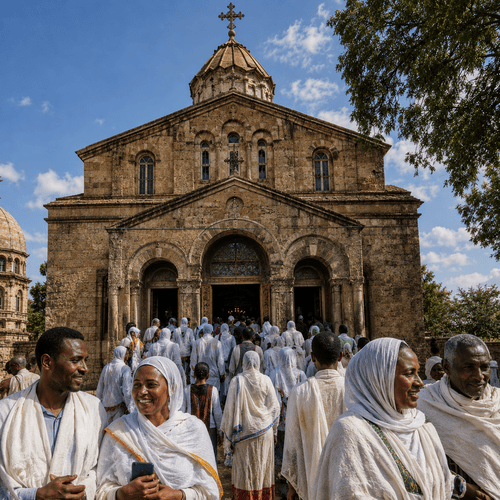
It’s a confidently repeated claim on the internet: Ethiopia had the world’s first church.
Sure, Ethiopian Christianity is genuinely ancient, genuinely African, and genuinely remarkable. That’s a claim any honest account of church history will concede.
But is it the “world’s first church”? That’s a specific historical claim, and specific claims can be tested. So let’s test it carefully, and then ask a question that matters far more than which church is the oldest.
What could “first church” even mean?
Part of the confusion, perhaps, is that the phrase carries at least four different meanings, and people slide between them without noticing.
| IF “FIRST CHURCH” MEANS… | THEN THE ANSWER IS… |
|---|---|
| The first congregation of believers anywhere | Jerusalem, on the day of Pentecost, around AD 30 (Acts 2) |
| The first place believers were called Christians | Antioch in Syria (Acts 11:26) |
| The first nation to adopt Christianity officially | Armenia, around AD 301—about a generation before Ethiopia |
| One of the oldest continuously functioning churches on earth | Ethiopia—and this is entirely true, and worth honouring |
Notice what happens. The strongest true statement about Ethiopia is the fourth one. The claim that gets shared online is the first one. Between the two lies a very large gap.
The first church is in the Bible, and it isn’t in Ethiopia
Let’s start where Scripture starts.
The church didn’t begin in a national capital or a monastery. It began in an upper room in Jerusalem, when the Spirit was poured out and Peter preached, and there were added that day about three thousand souls (Acts 2:41).
Everything else in church history is downstream of that morning.
From Jerusalem the gospel moved outward exactly as Christ said it would—in Jerusalem and in all Judea and Samaria, and to the end of the earth (Acts 1:8). Antioch became the first great multi-ethnic congregation, and it was there that the disciples were first called Christians (Acts 11:26).
So the question “which church is first?” already has the Bible’s answer. And every other church in the world—Ethiopian, Greek, Roman, Indian, Scottish—is a daughter of that first congregation, not a rival to it.
The Ethiopian eunuch: a beautiful story with a geography problem
The strongest scriptural argument for Ethiopian priority is the eunuch of Acts 8, and it is genuinely moving. A high official is riding home from Jerusalem, reading Isaiah aloud in his chariot. Philip is sent to run alongside. The man asks who the suffering servant is, Philip told him the good news about Jesus (Acts 8:35), and by the roadside he is baptised and goes on his way rejoicing.
Here’s the difficulty. Luke tells us the man was a court official of Candace, queen of the Ethiopians (Acts 8:27). But in Greek usage, “Ethiopia” wasn’t the modern country of that name. It was a broad term for the lands south of Egypt. Candace wasn’t a personal name at all but a royal title used by the queens of Kush, whose capital was Meroe—in what’s northern Sudan today. And it’s several hundred miles north-west of the Axumite kingdom that later became Christian Ethiopia.
Being Fair to Both Sides
- What we can say: the eunuch was more likely a Nubian official from the Kushite kingdom of Meroe, rather than from Axum.
- What we cannot say: that this rules out any early Christian presence further south. Traders and travellers moved constantly along the Red Sea coast.
- What Scripture actually emphasises: not a national foundation story, but that the gospel reached a court official from beyond the empire before it reached most of Europe. Luke’s point is the reach of grace, rather than an attempt to rank churches.
The Ethiopian tradition honours the eunuch. And it’s a fine thing to honour him. But a tradition isn’t a chain of evidence: there’s no record of a continuing Axumite church between the first century and the fourth.
How Ethiopia actually became Christian
The story is better documented than most.
In the early 4th century two young Christian brothers from Tyre, Frumentius and Aedesius, were shipwrecked on the Red Sea coast and taken to the royal court at Axum. They rose to positions of trust and were permitted to gather the Christian traders in the city for worship. Frumentius later travelled to Alexandria and asked the great Athanasius to appoint a bishop for Axum. Athanasius appointed Frumentius himself. Frumentius thus returned as the first bishop of Ethiopia. He’s remembered there as Abba Selama—the Revealer of Light.
The king of the period was Ezana, and here the evidence becomes wonderfully solid, because it is stamped in metal.
Ezana’s early coins carry the crescent and disc of the older Axumite religion. His later coins carry the cross. That change, struck into currency and circulated through international trade, is about as hard as ancient evidence gets.
So the founding of the Ethiopian church can be dated with real confidence to the middle decades of the fourth century, roughly AD 330–350. Note also what this means: the Ethiopian church was founded by a bishop consecrated in Alexandria, which is why for the next 16 centuries it would remain formally under the Egyptian church.
Was Ethiopia at least the first Christian nation?
This is the strongest version of the claim we started with. And it doesn’t quite hold either.
| APPROXIMATE DATE | EVENT |
|---|---|
| AD 30 | The church is born at Pentecost in Jerusalem |
| AD 40s–60s | Congregations planted across Syria, Asia Minor, Greece and Rome |
| AD 301 | Armenia adopts Christianity as its state religion under King Tiridates III |
| AD 330–350 | Frumentius consecrated by Athanasius; King Ezana of Axum comes to faith. |
| AD 380 | Christianity becomes the official religion of the Roman Empire |
| AD 451 | The Council of Chalcedon meets; Ethiopia and the Copts reject its definition |
Armenia is generally reckoned the first Christian state, by roughly a generation. Ethiopia is usually and rightly reckoned second—which is still an extraordinary thing to be. After all, it still places Ethiopia’s conversion decades ahead of Rome’s and centuries ahead of Britain’s, Germany’s or Scandinavia’s.
That’s the honest headline, and Ethiopia’s Christians should be able to say it without embarrassment: they’re not the first Christian nation, but they’re a close second.
The word “Tewahedo”, and why it matters
The church’s full name is the Ethiopian Orthodox Tewahedo Church. Tewahedo is a Ge’ez word meaning “made one” or “unified”, and it refers to how the church understands the person of Christ. To understand the difference this makes, we need one short piece of doctrine explained plainly.
The question the ancient church wrestled with was this: how can Jesus be fully God and fully man at the same time, without being two people, and without the two sides blurring into a third thing that’s neither?
At the Council of Chalcedon in AD 451, the answer given was that Christ is one person in two natures, divine and human, and that these natures are united without confusion, without change, without division and without separation. The Westminster Confession states the same doctrine: two whole, perfect and distinct natures inseparably joined together in one person, without conversion, composition or confusion.
The Ethiopian church, together with the Coptic, Syriac and Armenian churches, didn’t accept the Chalcedonian wording. They teach instead that after the incarnation Christ has one united nature—the position scholars call miaphysite, from the Greek for “one nature”.
The difference is easy to see if we notice what both sides agree on. Both say Christ is one person. Both say He is fully God and fully man. Both reject the idea that His humanity was swallowed up or watered down.
The disagreement is about what we may still count after the union. Chalcedon says the divine and human remain two natures, perfectly joined in one person but never blended, so that Christ is one person in two natures. The Tewahedo position says the two came together so completely that they now form one united nature—Christ is one person out of two natures.
Why does the counting matter? Because our salvation depends on Christ’s humanity staying fully and permanently human. He must be truly man to stand in our place, and truly God for that standing to save us. Keeping the two natures distinct is how the church has guarded both halves of that sentence at once.
Let’s Be Careful and Fair Here
- What Tewahedo Christians don’t teach. They explicitly reject the view of Eutyches, who taught that Christ’s humanity was swallowed up by His divinity. They insist Christ is fully God and fully man.
- Why the dispute may be smaller than it looks. In modern theological dialogues, representatives of the Eastern Orthodox and Oriental Orthodox churches have concluded that much of the ancient quarrel turned on Greek words being used in different senses.
- Why the wording still matters. Our salvation depends on the humanity of Christ remaining fully and permanently human. He must be truly man to stand in our place, and truly God for that standing to save. Chalcedon’s careful “two natures” guards that from both directions.
An ancient church—but not an independent one until 1959
Here is a fact that quietly complicates the “first and independent church” picture.
Because Frumentius was consecrated in Alexandria, the Ethiopian church spent more than 1600 years under the Coptic Patriarch of Alexandria. Its senior bishop was, for most of that time, an Egyptian appointed in Egypt. Ethiopia didn’t receive its own Patriarch until 1959.
That doesn’t make the church less genuine or less faithful. It does mean the popular picture of an unbroken, self-governing Ethiopian church stretching back to the apostles needs adjusting. What actually stretches back is something arguably more impressive: a church that held on, under foreign oversight and eventually under Islamic encirclement, for 16 centuries without giving up.
The Ark, the Kebra Nagast and the tabot
No discussion of Ethiopian Christianity survives long without the Ark of the Covenant cropping up.
The claim rests on a Ge’ez work called the Kebra Nagast, the Glory of Kings, compiled in its present form in the early 14th century. It tells how the Queen of Sheba visited Solomon, bore him a son, Menelik, who later carried the Ark from Jerusalem to Axum, where it has remained ever since. The Church of Our Lady Mary of Zion in Axum claims to hold it, guarded by a single monk who alone may see it.
- The book comes far too late. The Ark story is not found in Scripture or in any early source. It appears in the Kebra Nagast, written down around AD 1320—roughly 2,300 years after Solomon. It appeared at the exact moment a new Ethiopian dynasty needed to prove it descended from Solomon. A story that first shows up when someone needs it, and that serves the needs of the people telling it, has to be treated with care.
- The Queen of Sheba was probably not Ethiopian. Scripture places her in Sheba (1 Kings 10), which most scholars identify as the kingdom of Saba in south-western Arabia, in modern Yemen. Sabaean traders certainly crossed the Red Sea, so an Ethiopian link is not impossible—but the Bible never says she was Ethiopian, and it never mentions a son. The whole Menelik story rests on details that lack Scripture’s backing.
- Nobody is allowed to check. The Ark is said to be kept in Axum, guarded by one monk who alone may see it. No historian, archaeologist or church leader from outside has ever been permitted to look. Nobody can prove it false, but nobody can test it either—and a claim nobody can test is a claim nobody can rest on.
The practice points backwards. Every Ethiopian church contains a tabot, a consecrated replica of the tablets of the Law. It is the tabot, not the building, that makes the place a church, and it is the tabot that is carried in procession and honoured. So an Old Testament object still sits at the centre of worship. That is the real issue—not whether the Ark survives, but whether Christians should still be building their worship around it.
That last point leads somewhere important. Under the new covenant, the Ark is finished business. Jeremiah prophesied a day when people would no longer say “the ark of the covenant of the LORD”, nor miss it, nor make another (Jeremiah 3:16). The temple curtain was torn from top to bottom. Christ has entered once for all into the holy places (Hebrews 9:12). Searching for the Ark is looking for the shadow after the substance has arrived.
Sabbath, circumcision and food laws
Ethiopian Orthodox practice preserves a number of Old Testament observances that surprise visitors: a Saturday Sabbath kept alongside Sunday, the circumcision of infant boys, avoidance of pork and certain other foods, and long and demanding fasts.
Some of this is cultural and some of it is theological, and it should be discussed with respect. But the New Testament addresses these questions directly and at length, because the first church had to settle them before it could move a step further.
- The Jerusalem Council (Acts 15) refused to place the yoke of the law on Gentile believers, concluding that we believe that we will be saved through the grace of the Lord Jesus in exactly the same way they will.
- Paul on food and days. Therefore let no one pass judgment on you in questions of food and drink, or with regard to a festival or a new moon or a Sabbath. These are a shadow of the things to come, but the substance belongs to Christ (Colossians 2:16–17).
- Paul on circumcision. He is at his most severe here, warning the Galatians that if they receive circumcision as a requirement, Christ will be of no advantage to you (Galatians 5:2).
The issue isn’t whether a Christian may rest on Saturday or decline pork. The issue is whether such things are laid on the conscience as necessary. Where they are, the gospel itself is at stake—and that was true in Antioch long before it was true anywhere else.
Now, for the question that truly matters
Suppose, for a moment, Ethiopia were indeed first. What would it prove?
Very little—because Scripture never treats seniority as a test of truth. Paul was astonished at how quickly the Galatian churches abandoned the gospel, and those churches were as early as churches get. Error was there from the beginning, sitting in congregations founded by an apostle while the apostle was still alive to write to them.
So the Reformation asked a different question. Not “which church is oldest?” but “what makes a church a true church at all?” The Belgic Confession gives three marks.
The Marks of a True Church
- The pure preaching of the gospel. Is Christ crucified and risen actually proclaimed, as the only hope of sinners?
- The pure administration of the sacraments. Are baptism and the Lord’s Supper observed as Christ instituted them, without additions that obscure his finished work?
- The faithful exercise of church discipline. Is sin addressed, and are the wandering lovingly restored?
John Calvin put the first two even more simply: wherever we see the Word of God purely preached and heard, and the sacraments administered according to Christ’s institution, there a church of God exists. Not where the oldest building stands. Not where the longest lineage is claimed.
Michael Horton has described the church as creatura verbi—a creature of the Word. The church didn’t produce the gospel; the gospel produced the church. And what makes something is what keeps it. A church a thousand years old that has lost the Word is a ruin. A congregation five years old that preaches Christ crucified is the body of Christ.
What we honour without hesitation
It would be a poor kind of theology that could only criticise. So let us be specific about what deserves admiration.
- Endurance. From the 7th century onwards, Ethiopian Christianity was surrounded and cut off. It survived invasion, isolation and centuries without reinforcement from any other church. It’s one of the great survival stories in Christian history.
- Scholarship and preservation. Ethiopian scribes preserved works the rest of the world lost entirely. Whole ancient books exist today only because monks in Tigray kept copying them.
- Art. The Garima Gospels are among the oldest illustrated Christian books on earth, and they overturned a century of Western assumptions about African Christianity.
- A vernacular Scripture, early. Ethiopia had the Bible in its own liturgical language while much of Europe was still waiting.
No, Ethiopia’s Christian story isn’t finished. Alongside the Orthodox Church, there’s now one of the fastest-growing evangelical populations anywhere in the world. The Ethiopian Evangelical Church Mekane Yesus is among the largest Lutheran bodies on earth, and the Kale Heywet Church—the name means Word of Life—counts millions of members. Millions of Ethiopians today hold the Scriptures in their own hands and preach Christ from them. That’s not a Western import. That’s Ethiopian Christianity in its own next chapter.
So, which church is the oldest?
The oldest church is the one Christ founded, and He told us who builds it: I will build my church, and the gates of hell shall not prevail against it (Matthew 16:18). It began in Jerusalem, it spread through Antioch and Alexandria and Rome and Axum, and it’s still being built this morning in places we may not have heard of.
Ethiopia holds an honoured seat in that story. Very few nations can claim 17 unbroken centuries of Christian confession. But the seat isn’t the throne. The question God will ask of any church—Ethiopian, Roman, Anglican, Presbyterian or a room of 12 people meeting in a house—is not “how long have you been here?” It is what have you done with my Son?
Answer that rightly, and it doesn’t matter whether our church is 17 centuries old or 17 weeks. Answer it wrongly, and no amount of antiquity will help.
Tough Questions, Honest Answers
What is the difference between the Ethiopian and Eritrean Orthodox Churches?
They’re the same tradition, separated by politics rather than doctrine. When Eritrea became independent from Ethiopia in 1993, the Eritrean Orthodox Tewahedo Church was granted its own patriarch, with the agreement of the Coptic Church of Alexandria. The two churches share the same liturgy, the same Ge’ez heritage, the same canon and the same Christology. The split is a reminder of something worth noticing: church structures follow national borders far more often than anyone likes to admit, and that’s true in the West as much as in the Horn of Africa. Institutional divisions aren’t always doctrinal ones, and we mustn’t treat them as if they were.
How does the Ethiopian church differ from the Coptic Church of Egypt?
They’re close relatives and, until 1959, the Ethiopian church was formally under the Coptic Patriarch of Alexandria. Both are Oriental Orthodox and share the same position on Chalcedon. The main differences are that Ethiopia worships in Ge’ez rather than Coptic, has a much larger scriptural canon including Enoch and Jubilees, and preserves distinctly Judaic practices such as the tabot and Saturday Sabbath observance that the Copts do not share. Ethiopia also developed its own monastic tradition, its own sacred music and its own liturgical dance. It is best described as a daughter church that grew into something quite distinct.
Should a confessional Protestant attend an Ethiopian Orthodox service?
Attending as a guest, to observe and to understand, is a good and respectful thing to do, and it may deepen your love for a family of believers you’d never otherwise meet. Participating is a different matter. The liturgy includes prayers addressed to Mary and the saints, and a doctrine of the Eucharist that Reformed churches cannot affirm. The principle is Paul’s: love your brother, honour his conscience, but don’t act against your own (Romans 14:23). Go, listen, learn, ask questions afterwards over coffee—and be honest about where you cannot join in and why.
Why do Ethiopian Christians fast so much, and is fasting wrong?
The Ethiopian Orthodox calendar includes around two hundred fasting days a year, and clergy and devout laypeople observe most of them. Fasting itself is thoroughly biblical: Jesus assumed his disciples would fast (Matthew 6:16), and the early church fasted before major decisions (Acts 13:2–3). The question is what the fasting is thought to accomplish. Where it expresses dependence on God and sharpens prayer, it is a gift. Where it becomes a system by which merit is accumulated or sin is worked off, it quietly competes with the finished work of Christ. Reformed churches have often fasted too little, and should be slow to sneer at those who fast much.
Did Ethiopia’s never being colonised affect its church?
Enormously, and it’s one of the most interesting things about Ethiopian Christianity. Because Ethiopia was never permanently colonised, its Christianity was never bundled together with foreign rule in the way it was elsewhere in Africa. No one there needed to ask whether the faith was the coloniser’s religion, because it had been theirs since long before Europe was Christian. The cost of that isolation was that Ethiopia missed the great renewal movements of other centuries, including the Reformation, and developed with very little outside challenge. Independence preserved much and insulated much, and both effects are still visible.
What is happening in the Ethiopian Orthodox Church today?
The church has passed through significant turbulence in recent years, including tensions along ethnic and linguistic lines and disputes over the appointment of bishops and the language of worship. Ethiopian church affairs move quickly, so anyone wanting current detail should check recent reporting rather than rely on a general account. The underlying issue, however, is old and universal: when a church is bound tightly to national and ethnic identity, political fracture tends to become ecclesial fracture. Christians of every tradition should pray for their Ethiopian brothers and sisters in this, and examine their own churches for the same weakness.
If Ethiopia was Christian so early, why do missionaries work there?
Because being surrounded by Christian buildings is not the same as knowing Christ. Ethiopian Orthodox worship is conducted largely in Ge’ez, an ancient language most ordinary believers do not speak, so many devout people have participated faithfully for a lifetime without ever hearing Scripture in a language they understand. That is precisely the situation the Reformation addressed in Europe. Most evangelical work in Ethiopia today is led by Ethiopians, not foreigners, and much of it is simply Bible translation, literacy and preaching in Amharic, Oromo and other mother tongues. The aim isn’t to import a new religion but to open the Scriptures to people who’ve honoured them for 17 centuries without being able to read them.
Related Reads
- Is the Ethiopian Bible the Oldest and Most Complete Bible?
- The Council of Nicaea: Uncovering Its History and Impact
- What Are the Marks of a True Church?
- What Does “One Holy Catholic Church” Mean?
- What Can The Ethiopian Eunuch Teach Us About True Conversion?
- The Filioque Clause: Why Reformed Circles Support the Addition
- Is Apostolic Succession Biblical?