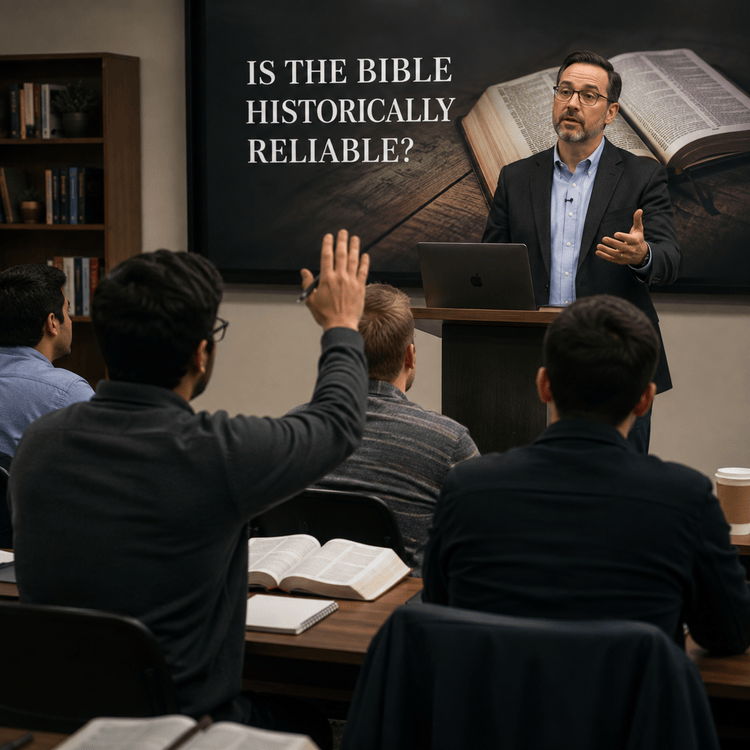
A student at the back of the hall asks the question everybody in the room has been thinking. “How do we know any of it actually happened? Somebody wrote those stories down a long time ago. People change stories. Why should we trust them?”
This article puts the four Gospels—Matthew, Mark, Luke and John—on the table and tests them the way a historian would test any ancient document. How early were they written? Who stood behind them? Do the small details hold up? And what do we do with the places where the accounts differ? We shall be honest about the hard parts, because a case that hides its weak points isn’t a case at all.
The Question Behind the Question
Before we test anything, let’s be sure what we’re testing for. When people ask whether the Gospels are “reliable”, they’re usually asking two completely different questions.
Two Questions People Often Mix Up
Question one: Did the writers tell the truth? Were they close enough to the events to know? Did they have any reason to lie? Did they get the world of first-century Palestine right?
Question two: Has what they wrote reached us in one piece? Copies were made by hand for over a thousand years. Do we still have what they originally wrote, or a badly damaged version of it?
These are separate problems needing separate evidence. A book can be truthfully written yet badly copied. A book may be beautifully copied and yet be full of invented stories. Most of this article deals with the first question; we will come back to the second one later.
One more thing before we start. Nobody approaches this question from nowhere. The historian who says in advance that miracles cannot happen has not discovered that the Gospels are unreliable—he decided it before opening the book. Cornelius Van Til pressed this point hard: there are no “brute facts”, no pieces of evidence floating free of somebody’s view of the world. Everyone brings a set of assumptions to the table. Being aware of our own is simple honesty; noticing other people’s is not rudeness.
How Close Were the Writers to the Events?
Legends need time. A story needs room to grow, and it grows best when the people who were actually there have died. So the first question a historian asks is simple: how big is the gap between the event and the written record?
For the Gospels, the gap is remarkably small.
A rough timeline
- AD 30–33: the crucifixion and the claimed resurrection. Everything else dates from here.
- Within three to five years we have the earliest written summary of the message. Paul quotes it in 1 Corinthians 15:3–8—a short, fixed, memorised statement that Christ died, was buried, was raised and appeared to named witnesses. Paul says he received it, meaning it was already in circulation before he wrote it down. Even scholars who reject the resurrection, including Gerd Lüdemann and Bart Ehrman, date this summary to within a handful of years of the events.
- AD 50s: Paul’s letters. These are earlier than the Gospels and already assume the basic story—a real man, publicly executed, publicly claimed to be risen.
- AD 60s: probably Mark, and then Luke and Acts. More on the reason for this dating below.
- AD 70: Jerusalem and its temple is destroyed by Rome. A catastrophe for the Jewish world. Note carefully: none of the Gospels describes it as something that has already happened.
- AD 80s–90s: John, on most estimates. Still within the lifetime of people who’d been young adults in the AD 30s.
The dating of Luke and Acts turns on one striking silence. Acts is the second half of Luke’s work, and it ends with Paul alive, under house arrest in Rome, still preaching. It says nothing of Paul’s death (around AD 64–67), nothing of Nero’s violent persecution of Christians, nothing of the fall of Jerusalem. Luke has spent chapters on the deaths of Stephen and James, so he clearly thinks such things worth reporting. The natural explanation for the silence is that none of it had happened yet. And if Luke is that early, Mark, which Luke seems to have used, is earlier still.
A Note on How Dating Arguments Work
Many scholars date Mark after AD 70 because in Mark 13 Jesus predicts the temple’s destruction—and, they reason, a description that accurate must have been written afterwards.
Notice what has happened there. The argument doesn’t rest on a manuscript, an inscription or a dated reference. It rests on the prior belief that no one can genuinely predict the future. That may be true or false, but it’s a philosophical claim, not a historical discovery. It should be labelled as such.
And even on the latest dates anyone seriously proposes, the gap is small by ancient standards. Historians work happily with far worse.
| Figure | Lived | Earliest Surviving Full Accounts | Gap |
|---|---|---|---|
| Alexander the Great | 356–323 BC | Arrian; Plutarch | About 400 years |
| Tiberius Caesar | 42 BC – AD 37 | Tacitus; Suetonius | About 80 years |
| Buddha | c. 5th century BC | Pali Canon written down | About 400 years |
| Jesus of Nazareth | c. 4 BC – AD 33 | Mark, Matthew, Luke, John | About 30–60 years |
AN Sherwin-White, a Roman historian at Oxford with no religious interest in the outcome, put it plainly: in the ancient world, two generations is simply too short a time for legend to wipe out a solid historical core.
Whose Testimony Are We Reading?
Who stands behind these documents? Here we encounter a genuine complication: the Gospels don’t name their authors. Matthew doesn’t begin “I, Matthew, write this.” In that formal sense they’re anonymous.
- No copy has ever turned up without a title. Simon Gathercole has gone carefully through the old handwritten copies of the Gospels. In every case where the top or the bottom of a copy has survived—the places where a title would be written—the name is there. We have never found a stage where these books were passed around with no author attached to them.
- The names never compete. Ancient books that were falsely attributed usually leave a mess behind—different regions claiming different authors. Here, from Egypt to Gaul, the four names are the same four names. Martin Hengel argued that this is exactly what we should expect: the moment a congregation owned more than one Gospel, it needed a way to tell the scrolls apart on the shelf.
- Early witnesses say the same thing. Papias, writing early in the second century and quoted later by Eusebius, describes Mark as the man who wrote down Peter’s preaching accurately, though not in order. Irenaeus, around AD 180, treats the four-fold Gospel as long settled.
- And the names are wrong for a forgery. This is the strongest point of all. If you’re inventing authority, you attach a famous name. The early Christians had wonderful options: Peter, Andrew, Mary Magdalene, Thomas. Later forgers used exactly those names. Instead the four Gospels are credited to Mark, a young assistant who once abandoned a mission trip; Luke, a Gentile doctor who never met Jesus; Matthew, a tax collector—a collaborator with the occupying power, socially despised; and John, along with Matthew the only two apostles in the list. Nobody invents that line-up.
The fingerprints in the names
Richard Bauckham, in Jesus and the Eyewitnesses, produced one of the quietly crucial pieces of evidence in modern New Testament study, and it comes from something nobody would think to fake. Tal Ilan compiled a lexicon of Jewish names from Palestine in this period, drawn from tombstones and legal documents. Names in any culture follow a distribution: a few are extremely common, most are rare. In first-century Jewish Palestine, Simon and Joseph dominated. In the Jewish communities of Egypt, the pattern was quite different.
Why This Matters
The names in the Gospels match the Palestinian pattern—including the awkward habit of adding a tag to distinguish people, because so many men shared a handful of names: Simon Peter, Simon the Zealot, Simon the leper, Simon of Cyrene.
A writer inventing stories in Rome or Alexandria in the second century had no way of knowing this. There were no statistics to consult. The only way to get the distribution right is to be reporting names that came from people who were actually there.
Bauckham also noticed a pattern he calls an inclusio—a bracket. In Mark, Peter is the first disciple named and the last disciple named, framing the whole book. In the ancient world this was a recognised way of signalling the main source behind a work.
Then there are the minor characters who are named for no literary reason at all. Bartimaeus the blind beggar. Jairus. Simon of Cyrene, identified as “the father of Alexander and Rufus”—two men the first readers apparently knew. Why name the sons of a man who carries a cross for two minutes and vanishes? The simplest answer is that these people were alive, in the churches, and could be asked.
The Details a Forger Would Fumble
There’s a difference between a story set in a place and a story written from a place. Fabricators polish the surface and then stumble over the furniture. Peter J. Williams, in Can We Trust the Gospels?, tests the Gospels exactly here—not on the miracles, but on the background scenery that no one had any reason to fake.
- Geography. The Gospels name a string of small, obscure villages in Galilee, and put them in the right relationship to one another. Later apocryphal gospels are almost entirely landscape-free.
- Plants, coins and customs. The right trees grow in the right regions. The coinage is right. Jewish burial practice, Sabbath disputes and purity rules are handled from the inside.
- Dead controversies. The arguments Jesus has with the Pharisees and Sadducees are live first-century Jewish arguments—several of which became irrelevant after AD 70 and were of no interest whatever to second-century Gentile Christians. Inventors do not manufacture debates nobody cares about.
Accidental agreements
The sharpest tool here is what William Paley called undesigned coincidences, recently brought back into use by Lydia McGrew. When two writers who are not copying each other fit together in a way neither of them notices or explains, you are almost certainly looking at independent reports of something real. Liars coordinate. Real witnesses interlock by accident.
| One Account Says… | Another Account Says… | The Accidental Fit |
|---|---|---|
| Matthew 14:2—Herod discusses Jesus with his servants, and his private opinion somehow becomes public knowledge. | Luke 8:3 mentions, in a list of women supporting Jesus, Joanna, the wife of Herod’s household manager. | Luke never links her to Matthew’s scene. But she is precisely the person who would know what was said inside Herod’s household. |
| John 6:5—faced with a hungry crowd, Jesus asks Philip where they can buy bread. | John 1:44 notes in passing that Philip was from Bethsaida, the nearest town to that spot. | John never joins the dots. Jesus asks the local man the local question. |
| Luke 23:4—Pilate is oddly desperate to release Jesus and repeatedly caves in to pressure. | Josephus and Philo record that Pilate had already been reported to Rome for provoking the Jewish population. | A governor on his final warning behaves exactly like this. Neither writer explains the other. |
Things you can dig up
For a long time, sceptics treated several Gospel details as obvious inventions. The spade, however, has proved the gospels right.
| Find | Date Found | What It Settled |
|---|---|---|
| Pilate inscription, Caesarea | 1961 | Pontius Pilate confirmed by name and office in stone. Previously known almost only from literary sources. |
| Ossuary of Caiaphas | 1990 | The bone-box of the high priestly family named in all four Gospels. |
| Heel bone of Yehohanan, Jerusalem | 1968 | A crucified man with an iron nail still through the heel—physical confirmation of the practice as described. |
| Pool of Bethesda, with five colonnades | 19th–20th c. | John 5:2 was long treated as symbolic invention. The five porticoes are there. |
| Pool of Siloam steps | 2004 | The location of John 9 identified. |
| Magdala synagogue | 2009 | A first-century Galilean synagogue of exactly the kind the Gospels describe Jesus teaching in. |
The same test can be run on Luke at industrial scale. Colin Hemer catalogued 84 details in Acts chapters 13 to 28 that can be checked against outside evidence—and Luke gets them right, including local officials’ titles, which were a minefield. Thessalonica had politarchs; Cyprus had a proconsul; the leading man of Malta had his own peculiar title. These varied from city to city and changed over time. Getting them right from a distance would be like a novelist naming the correct municipal office in a dozen countries without a reference book. The Gallio inscription from Delphi even lets us date Paul’s stay in Corinth (Acts 18) to around AD 51–52.
Sir William Ramsay began his career expecting to expose Luke as late and careless. He spent decades in Asia Minor and finished convinced that Luke belonged among the first rank of historians.
The Parts Nobody Would Invent
If you were building a movement from nothing, you’d edit. You would cut the embarrassing scenes, tidy up your leaders, and choose your witnesses carefully. The Gospels do none of this.
- Women find the empty tomb first. In that culture a woman’s testimony carried little weight in public settings. The pagan critic Celsus later mocked Christians for exactly this. If you’re constructing a proof, you don’t build it on witnesses your opponents will laugh at. You’d include them only if that’s indeed what happened.
- The disciples—the future leaders of the church—look terrible. They misunderstand almost everything, argue about who is greatest, fall asleep at the crucial moment, and run away. Peter, who becomes the central figure of the early church, swears he never knew Jesus.
- Jesus’ own family think he has lost his mind (Mark 3:21). His brothers do not believe in him (John 7:5).
- Hard sayings are left in. Why do you call me good? (Mark 10:18). My God, my God, why have you forsaken me? (Mark 15:34). But concerning that day or that hour, no one knows, not even the angels in heaven, nor the Son, but only the Father (Mark 13:32). Every one of these has caused work for theologians ever since. A tidy-minded editor would have quietly removed them.
The Principle in One Line
Documents don’t usually humiliate their own heroes, undermine their own witnesses, and preserve their own hardest problems—unless the writers felt they were not free to change what happened.
What People Outside the Church Said
Christianity was a small, suspect movement in a large empire. It’s not surprising Roman writers mention it rarely, and only when it caused trouble. What they do say is worth having, precisely because none of them was friendly.
| Source | Date | What It Confirms |
|---|---|---|
| Tacitus, Annals 15.44 | c. AD 116 | Roman historian, hostile. Records that “Christus” was executed under Pontius Pilate during the reign of Tiberius, and that the movement, checked for a moment, broke out again. |
| Josephus, Antiquities 20.200 | c. AD 93 | Refers to James as the brother of Jesus “who was called Christ”. This short passage is widely accepted as authentic. |
| Josephus, Antiquities 18.63 | c. AD 93 | The longer passage about Jesus. Its present wording almost certainly contains later Christian additions—we should say so openly. Most specialists still think an original core lies underneath. |
| Pliny the Younger, Letters 10.96 | c. AD 112 | A governor writes to the emperor about Christians who meet before dawn and sing to Christ “as to a god”. |
| Suetonius, Claudius 25 | c. AD 121 | Disturbances in the Jewish community of Rome connected with a name usually taken as a garbled “Christus”. |
None of this proves the resurrection, and we shouldn’t pretend it does. What it establishes is the frame: a real man, executed by a named Roman governor at a datable moment, followed within a generation by people who worshipped him as God. That frame is not in serious dispute among historians of any persuasion.
The Awkward Bits: Differences, and Two Disputed Endings
Now for the part most articles skip. Anyone who reads the four Gospels side by side notices they don’t always match. How many angels at the tomb? Did the centurion come himself, or send others? There are two bad responses: panic, or pretending the differences aren’t there. Neither is honest.
What kind of books are these?
Richard Burridge changed the discussion by asking what type of literature a Gospel actually is. His answer, now widely accepted, is that they belong to the ancient genre of bios—a life. That matters, because it tells us what the first readers expected. A bios was expected to tell the truth about a real person. It was not expected to follow strict chronological order, quote speeches word for word, or include every detail. Michael Licona has catalogued the recognised techniques: compression (squeezing events into a shorter span), spotlighting (naming one person in a scene where several were present), displacement (moving an episode for thematic reasons) and simplification. These aren’t errors but the ordinary grammar of ancient life-writing, and every reader of the time understood them.
Take the centurion whose servant is ill. In Matthew 8 he speaks to Jesus; in Luke 7 he sends Jewish elders. This looks like a flat contradiction until you notice a convention both Jewish and Roman readers took for granted: what a man does through his agents, he does himself. We still speak this way. “The Prime Minister signed the treaty” does not mean he personally carried the pen. Matthew compresses; Luke gives the mechanics.
And the differences are themselves evidence. Four accounts agreeing word for word would only tell us the writers had copied one another. Independent witnesses always differ in detail; police officers grow suspicious when statements match too perfectly.
Has the text reached us intact?
This is the second of our two questions, and here the situation is unusually good.
| Work | Approximate Greek Manuscripts | Earliest Copy |
|---|---|---|
| Caesar’s Gallic War | Around 250 (Latin) | About 900 years after writing |
| Tacitus, Annals | Around 30 (Latin) | About 800 years after writing |
| Homer, Iliad | Around 1,900 | Several centuries after writing |
| The New Testament | Around 5,800, plus thousands in other languages | Within roughly a century (P52, a fragment of John) |
People sometimes hear there are hundreds of thousands of variations between manuscripts and conclude the text is hopeless. The reasoning is backwards. The number of variants is high because the number of manuscripts is high. If we owned only two copies, we’d have almost no variants—and almost no ability to check anything. The abundance that produces the variants is the same abundance that lets us trace the wording back. The overwhelming majority are matters of spelling and word order that don’t change the sense in translation.
Two passages are genuinely disputed, and modern Bibles flag them in a footnote rather than hiding them:
- The longer ending of Mark (16:9–20) and
- The woman caught in adultery (John 7:53–8:11).
Evidence suggests neither was part of the original. Notice what that means in practice. The manuscript tradition did not conceal these problems; it preserved the very evidence that let us identify them. And no article of the Christian faith rests on either passage.
How the Confessions Put It
The Westminster Confession (1.8) says the Scriptures were “kept pure in all ages” by God’s “singular care and providence”.
That’s a claim about the whole manuscript tradition, not about any one copy being perfect. God didn’t preserve His word by miraculously stopping every scribe’s hand from slipping. He preserved it by multiplying copies across languages and continents so widely the original wording can be recovered. Providence worked through ordinary means—which is usually how providence works.
What History Cannot Do
Suppose a fair-minded reader agrees the Gospels are early, well-sourced, accurate in their details, honest about their own embarrassments and reliably transmitted. What follows? Less than we might hope—and here the historic Protestant confessions say something that keeps us from overselling our own case.
History deals in probability. A historian’s verdict is always provisional, open to revision when the next inscription is dug up. But faith isn’t a strong opinion about a probability. It’s trust in the living God, and we can’t build that on arguments that might be overturned next season.
John Calvin faced this directly in the Institutes. He argued Scripture is autopistos—self-authenticating. It doesn’t finally depend on the church, or on scholars, to certify it. It carries its own authority, and it’s the Holy Spirit who persuades the heart that this is God speaking. Calvin wasn’t anti-evidence; he lists the marks of Scripture’s excellence at length. But he refuses to make God’s word answerable to a human court.
The Westminster Confession (1.5) holds both things together, and the balance is worth watching. It lists the evidences—the heavenliness of the matter, the efficacy of the doctrine, the majesty of the style, the consent of all the parts—and says these are arguments by which Scripture “doth abundantly evidence itself” to be the word of God. Then it adds: notwithstanding, our full persuasion comes from the inward work of the Holy Spirit. Evidence, then persuasion. Both, in that order, and never confused.
A family disagreement worth knowing about
Within this same confessional tradition there has been a long conversation about how much weight historical evidence should carry.
- BB Warfield at Princeton argued Christianity is a religion that rests on facts, and that evidence genuinely persuades. He had no fear of the historian’s tools.
- Cornelius Van Til replied the argument runs deeper than facts. The sceptic isn’t neutral; his standard for judging evidence already assumes there’s no God who acts. Handing him the evidence and asking him to judge concedes the crucial point.
- John Frame offers the position most useful for ordinary conversation: gather the evidence, present it fully and honestly—but present it inside a Christian account of what knowledge is, rather than pretending we’re all standing on neutral ground. Evidence is God’s gift, not God’s judge.
Michael Kruger makes a similar observation about how we know Scripture is Scripture: God’s word carries divine qualities that His people recognise, in something like the way sheep know a familiar voice. Investigation confirms; it doesn’t create.
So why does the historical work matter at all? Three things, and none of them small.
What the Evidence Actually Accomplishes
It removes obstacles. Many people aren’t resisting Christ; they’re stuck on a bad argument they heard once—that the Gospels were written centuries later, or invented by an emperor. Clearing away rubble is real work.
It steadies believers. Christians face these questions from colleagues, classmates and the internet. Knowing our case is strong is genuine comfort in a wobbly moment.
It honours the shape of the faith. Christianity isn’t a set of timeless ideas that would survive if the events never occurred. Paul stakes everything on a public claim: if Christ has not been raised, your faith is futile (1 Corinthians 15:17). A faith that makes historical claims should be willing to have them examined.
The Verdict
Put the pieces together. Sources written within living memory. Names matching the local pattern in a way no outsider could fake. Geography, custom and coinage that hold up. Officials’ titles right across a dozen jurisdictions. Details that quietly interlock without any writer noticing. Stories that embarrass the movement’s own leaders. Confirmation from hostile outsiders. A text preserved in more copies, earlier, than any other work of the ancient world. Tested as history, the four Gospels come through well—and anyone who claims otherwise is usually working from an assumption smuggled in before the evidence was consulted.
But we should end where the confessions end. All of that clears the ground; it doesn’t open the heart. A person can grant every point in this article and walk away unchanged, because the problem was never a shortage of information. The Gospels aren’t asking to be assessed and filed. They’re handing us a summons.
History can remove the obstacles. Only God can give sight. And that, in the end, is why we can put these documents under the hardest scrutiny available without any anxiety at all: our confidence never rested on winning the argument in the first place.
Tough Questions, Honest Answers
Why are there four Gospels, not one?
The early church could easily have merged them—and in the second century Tatian tried exactly that with his Diatessaron, which never displaced the four. The refusal to merge tells us something important: the church treated these books as received testimony rather than raw material to be edited. Four accounts also serve us better than one would. Each writer selects and arranges for a different readership, so we see the same Christ from four angles, as four portraits rather than four photographs of the same pose. And four independent witnesses give us the cross-checking that this article has depended on throughout. Irenaeus already speaks of the four-fold Gospel as an established fact around AD 180.
Did Constantine or the Council of Nicaea decide which books got into the Bible?
No. This claim is enormously popular and has no basis in the historical record. The Council of Nicaea in AD 325 dealt with the deity of Christ in response to Arius; the canon was not on its agenda, and no ancient account of the council says otherwise. Lists and citations show the four Gospels functioning as authoritative Scripture long before Constantine was born—Irenaeus around AD 180 is only one witness among several. The historic Protestant position is that the church did not create the canon but recognised it, in the same way a person recognises a familiar voice rather than granting it authority. Books were received because they carried the marks of God’s word, not because a committee voted.
What about the Gospel of Thomas and the other “lost gospels”?
They are real documents and worth studying, but they are not rivals in the way popular books suggest. Almost all of them are second-century or later, which puts them a century or more further from the events than the four. They are strikingly detached from the world they claim to describe: little geography, few named places, almost no Jewish texture—precisely the failure we would expect from writers who were never there. Their theology is also different in kind, generally presenting salvation as secret knowledge for insiders rather than as God acting publicly in history. They were not suppressed by a conspiracy; they were read, weighed and found wanting.
Did Jesus even exist? Some people say He’s a myth.
This view has almost no support among professional historians, including those who aren’t religious at all. Bart Ehrman, who isn’t a believer, has written against it directly. The evidence is simply too broad: Paul’s letters within 25 years and his personal acquaintance with Jesus’ brother James, four Gospels within living memory, and non-Christian references in Tacitus and Josephus. A crucified Messiah is also the last thing a movement would invent, since in that culture crucifixion marked a man as cursed and defeated—which is why Paul calls the message a stumbling block. Groups don’t manufacture a founder whose fate is their greatest public embarrassment.
Why does Paul never quote the Gospels if they were already circulating?
Mostly because he was writing earlier, in the AD 50s, when the message was carried by preaching rather than by books, and because his letters address specific church problems rather than retelling the story his readers already knew. But he does draw on the tradition more than people notice. In 1 Corinthians 11:23–25 he passes on the words of the Last Supper. In 1 Corinthians 15:3–8 he provides an even earlier summary of the death, burial and resurrection, and in 1 Corinthians 7:10 he distinguishes a command from the Lord from his own judgement. In 1 Timothy 5:18 a saying found in Luke 10:7 is set alongside a quotation from Deuteronomy and both are called Scripture. Paul assumes the story rather than repeating it, which is what we’d expect from letters written to people who’d already been taught.
Why do Matthew and Luke give different family trees for Jesus?
Both lists are selective, as ancient genealogies routinely were—Matthew openly arranges his into three groups of fourteen, which requires leaving names out. Two explanations have long been offered: that Matthew traces Joseph’s legal line through Solomon while Luke traces Mary’s line, or that one follows biological descent and the other the royal succession, in which an heir could be counted as a legal son. We cannot be certain which is correct, and it is better to say so. What is clear is the purpose of each: Matthew opens with Abraham and David to present Jesus as Israel’s promised king, while Luke runs back to Adam to present him as the second man in whom the whole human race is renewed. The theology of each list is unmistakable even where the mechanics remain debated.
Jesus spoke Aramaic, but the Gospels are in Greek. Does translation weaken their accuracy?
Translation is normal to the Christian faith rather than a threat to it—God chose to have his Son’s words carried into a second language from the very beginning, which is a striking endorsement of the whole missionary enterprise of translation. The Gospel writers were bilingual and working in a bilingual region, and they occasionally leave the Aramaic in place and translate it for us: Talitha cumi, Ephphatha, Abba, Eloi, Eloi, lema sabachthani. Those retained words are themselves evidence of a genuine Aramaic memory underneath the Greek. Meaning, not sound, is what Scripture preserves, and the same principle allows your own Bible in your own language to be genuinely God’s word. It is also worth remembering that Galilee was multilingual, so Jesus himself may well have taught in Greek at times.
Related Reads
- Are the Gospels Eyewitness Accounts? The Mounting Evidence
- Oral Tradition and the Gospels: How Was Jesus’ Story Kept Safe?
- Undesigned Coincidences: Subtle Details That Validate Bible Truth
- The Study of Names: Surprising Support for Bible Reliability
- Ancient Non-Christian Writings on Jesus: Validating Historicity
- The Longer Ending of Mark: Does It Undermine Bible Reliability?
- Caught in Adultery: How Reliable Is the John 8 Story?
- The Truth About Apocryphal Books: Why They’re Not in the Bible
- The Council of Nicaea: Uncovering Its History and Impact
- When Were the Gospels Written? The Evidence for Early Dates
- The Jesus Seminar: Are Their Views Biblical?