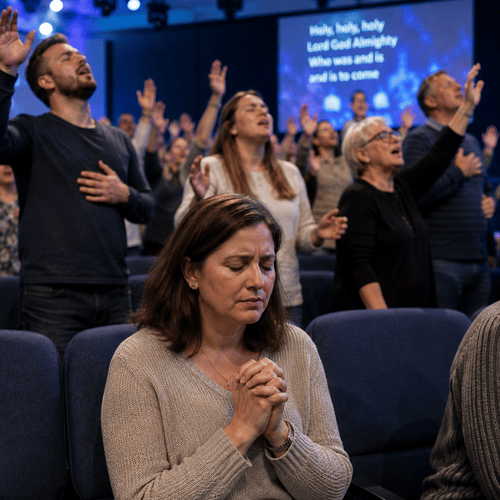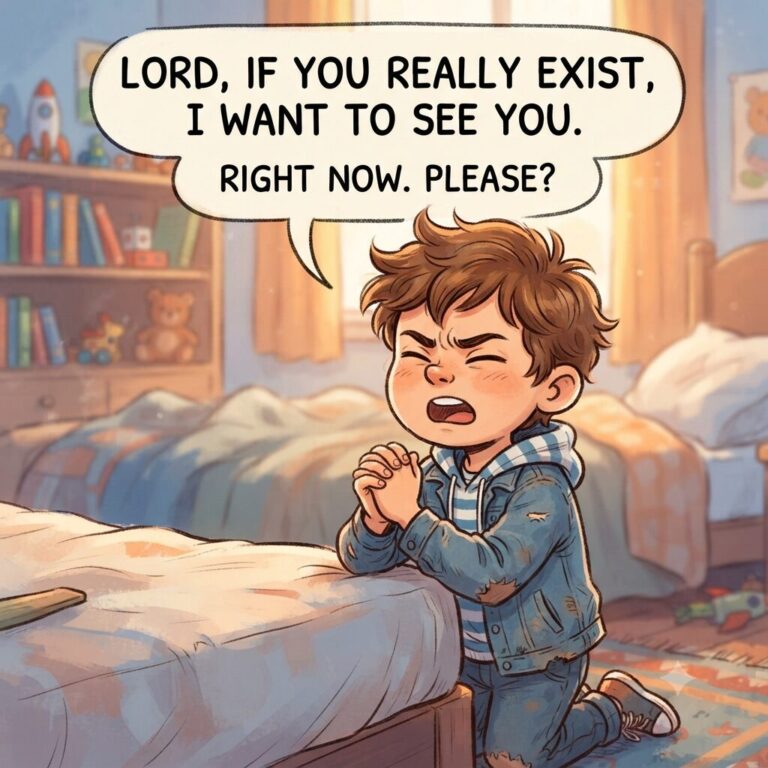

Try to remember the last time you really prayed. Not the quick word of thanks before food. Not the sentences we say out loud when somebody at church asks us to close the meeting. A real prayer—the kind where we actually speak to God and mean it.
For many Christians, that memory is a long way back. Prayer became short, then rare, then almost nothing at all. And here’s the strange part. The less we pray, the more guilty we feel. The more guilty we feel, the harder it becomes to begin again. Guilt doesn’t push us back towards God. It pushes us further away.
Older writers had a word for this settled condition: prayerlessness. It rarely travels alone. Its usual companion is spiritual dryness—the flat, tired feeling that God is distant, that Bible reading has become homework, and that nothing you do seems to reach Him. This article asks one question. Does Scripture offer a real remedy? It does. But the remedy is almost never the one we expect.
The Bible Calls It Sin—and That’s Very Good News
Kind friends will tell us not to be hard on ourselves. It’s only a season, they say. It will pass. But the Bible speaks more plainly than that. When prophet Samuel handed over leadership to Israel’s new king, he said something remarkable about the people who’d just rejected his advice:
Moreover, as for me, far be it from me that I should sin against the LORD by ceasing to pray for you, and I will instruct you in the good and the right way.
1 Samuel 12:23
Notice Samuel doesn’t call prayerlessness a weakness, a personality problem, or a busy phase of life. He calls it sin against the LORD.
That sounds crushing. In fact it’s the most liberating sentence in this whole article, and here’s why. If our prayerlessness is only a mood, we must wait for the mood to lift, and nobody can tell us when that will be. If it’s only a personality type, we’re stuck with it for life. But if it’s sin, then it has a remedy, and the remedy is available today—not next month, not after we have improved.
Why Naming It Matters
A vague sadness has no cure. Sin does. The gospel has nothing to say to “a difficult season”, but it has everything to say to a sinner who confesses. Calling prayerlessness what it is opens the only door that actually leads out.
Notice too what Samuel doesn’t say. He doesn’t say the people are beyond hope, or that God has finished with them. He simply names the failure and then promises to keep teaching them the good and right way. Honesty and hope belong together.
Why Prayer Stops: Five Causes Worth Telling Apart
Not every dry season has the same cause. This matters, because the wrong medicine will not heal the illness, it may make it worse.
- Shame and hiding. This is the oldest reaction in the Bible. When Adam and Eve sinned, they hid themselves from the presence of the LORD God among the trees of the garden (Genesis 3:8). We do exactly the same. There’s a sin we have not dealt with, so we avoid the One who sees it. We don’t decide to stop praying; we simply keep finding reasons not to start.
- Sorrow and exhaustion. In Gethsemane, Jesus found His closest friends asleep—and Luke tells us why. They were sleeping for sorrow (Luke 22:45). Grief is physically tiring. So is illness, night work, a new baby, unemployment, and depression. Jesus’ verdict was diagnosis, not contempt: The spirit indeed is willing, but the flesh is weak (Matthew 26:41).
- Quiet self-sufficiency. Sometimes prayer dies because life is going well. Moses warned Israel full stomachs and good houses would make them forget the God who fed them (Deuteronomy 8:11–14). When we can manage without help, prayer starts to feel like an extra rather than a lifeline.
- Disappointment with God. We asked for years. The marriage didn’t heal. The illness didn’t lift. The prodigal didn’t return. So we stopped asking, because asking hurt. This one is rarely admitted out loud, but it’s the most common of all.
- Never really taught. Some Christians have simply never learned how to pray, and are too embarrassed to say so. They’re in good company. The disciples had watched Jesus pray for months before one of them finally asked, Lord, teach us to pray (Luke 11:1).
When We Cannot Open the Bible Either
Ask anyone who has stopped praying whether they’re still reading Scripture, and the answer is almost always no. That’s no coincidence. Prayer and Bible reading aren’t two separate duties that happen to fail at the same time. They’re two halves of one conversation.
| One Conversation | God’s Half | Our Half |
|---|---|---|
| What happens | God speaks to us in His Word | We answer Him in prayer |
| If it stops | We stop hearing His voice and start hearing our own | We stop bringing anything to Him and carry it alone |
| Result | God feels distant and unreal | Faith feels like a memory, not a relationship |
That’s why the two collapse together. Stop listening, and we soon have nothing to say. Stop speaking, and listening quickly feels pointless.
Isaiah puts his finger on the exact feeling. Speaking for God to a people who had drifted, he says:
Yet you did not call upon me, O Jacob; but you have been weary of me, O Israel!
Isaiah 43:22
Weary of me. Not weary of religion, or of church, or of duty—weary of God Himself. If we’ve ever looked at our Bibles and felt nothing but tiredness, Scripture has already described us. But read on three verses, because the answer God gives isn’t a lecture: I, I am He who blots out your transgressions for my own sake, and I will not remember your sins (Isaiah 43:25). Weariness of God is answered by free pardon.
This also explains why neglect is so serious. The Westminster Shorter Catechism, written in the 1640s, asks what the outward means are by which Christ gives us the benefits of salvation. Its answer is the Word, the sacraments, and prayer—what Christians have long called the means of grace: the ordinary channels through which God feeds His people. To stop praying and reading is therefore not merely to fail a duty. It’s to stop eating.
How It Happened Without Your Ever Deciding
Nobody wakes up and resolves to abandon prayer. That’s precisely the danger. John Owen, an English pastor of the 17th century, wrote at length about what he called indwelling sin—the sin that remains inside a believer even after conversion, weakened but not yet dead. Owen’s great insight was that sin rarely begins with a dramatic fall. Its first move is far quieter: it draws the mind away from duty, little by little, until the duty is gone and we never noticed it going.
The drift usually follows a pattern:
- Stage 1: Distraction. Prayer still happens, but the mind is elsewhere. The phone is nearby. The day has already begun in our heads.
- Stage 2: Shortening. Ten minutes becomes two. The prayer list gets shorter. Only urgent things are mentioned.
- Stage 3: Skipping. A missed morning becomes a missed week. Each miss makes the next miss easier.
- Stage 4: Silence. Prayer is now something we believe in rather than something we do. Guilt takes over the space it used to occupy.
The risen Christ addresses exactly this drift in a letter to a hard-working, doctrinally careful church at Ephesus. They’d endured, they’d tested false teachers, and yet:
But I have this against you, that you have abandoned the love you had at first. Remember therefore from where you have fallen; repent, and do the works you did at first.
Revelation 2:4–5
Three words, in order: remember, repent, return. Remember what it was like. Repent honestly. Then simply do again what you used to do—before you feel like it.
Someone Is Praying Who Never Stopped
Now we come to the heart of it, and to the truth that changes everything for the believer who has stopped praying.
Consequently, He is able to save to the uttermost those who draw near to God through Him, since He always lives to make intercession for them.
Hebrews 7:25
To intercede means to plead on someone else’s behalf. The verse says Jesus, alive at the Father’s right hand, is doing this constantly for His people. Not occasionally. Not when they deserve it. Always.
Consider what that means on the worst night of Peter’s life. Before Peter denied Him three times, Jesus told Him:
But I have prayed for you that your faith may not fail. And when you have turned again, strengthen your brothers.
Luke 22:32
Peter’s prayer life collapsed completely that night. He slept when he should have prayed, then swore he’d never met Jesus. Christ’s prayer life didn’t collapse. And notice: Jesus doesn’t say “if you turn again”, but “when”. Peter’s recovery was already secured by a prayer he didn’t pray.
The Point to Hold on To
The believer’s standing before God has never rested on the quality of their prayer life. It rests on His. Paul says the same in Romans 8:34: Christ is at God’s right hand and is interceding for us. On the days we say nothing at all, we’re still being prayed for—by name, without a break, by someone the Father always hears.
The Spirit Prays Inside the Silence
There’s a second comfort for the believer. And it works from the inside rather than from heaven.
Likewise the Spirit helps us in our weakness. For we do not know what to pray for as we ought, but the Spirit himself intercedes for us with groanings too deep for words.
Romans 8:26
Read that again slowly. Paul assumes Christians will reach a point where they don’t know what to pray. He doesn’t treat this as failure; he treats it as normal. And into that exact gap the Holy Spirit comes—not to scold, but to turn our wordless groans into prayer the Father understands perfectly.
So the sigh we breathe out at two in the morning, with no sentence attached to it, isn’t disqualified. It may be the truest prayer we’ve offered in months. John Bunyan put it memorably: “In prayer it is better to have a heart without words than words without a heart.”
This is also why a believer’s appetite for prayer can be buried but never finally killed. Paul says that because you are sons, God has sent the Spirit of his Son into our hearts, crying, “Abba! Father!” (Galatians 4:6). Abba is the ordinary family word a child used for a father. That cry is the instinct of adoption, planted by God himself. It can be smothered. It cannot be removed.
Begin by Praying About the Prayerlessness
Here’s the trap that keeps most people silent for years: I must sort myself out first, and then I may come back to God. It feels humble. It’s actually a denial of the gospel, because it makes our repair work the ground of our welcome rather than Christ’s finished work.
Sinclair Ferguson presses a point worth sitting with: our deepest spiritual problems usually trace back to a wrong picture of God’s character—an idea that He is reluctant, stingy, or waiting to be persuaded. Fix the picture, and the door opens. Hebrews puts it as plainly as possible:
Let us then with confidence draw near to the throne of grace, that we may receive mercy and find grace to help in time of need.
Hebrews 4:16
In the time of need—not after we have recovered from it. We’re invited to come empty-handed, and there’s no other way to come.
So the first prayer isn’t a good prayer. It’s this one, or something like it: “Lord, I have not prayed. I don’t even want to pray. Help me.” That’s a real prayer, and it has good biblical precedent. David, at his lowest, couldn’t even start: O Lord, open my lips, and my mouth will declare your praise (Psalm 51:15). He asks God to supply the very words he owes Him. We may pray the same sentence tonight.
Borrow Words Until Your Own Come Back
When people cannot pray, they usually assume the problem is sincerity. More often the problem is simply that we’ve run out of words. God has already provided for this.
He gave His people a book of prayers. John Calvin, introducing his commentary on the Psalms, famously described the book as “an anatomy of all the parts of the soul”. By this he meant every emotion a human being can feel is already there, put into words God’s willing to hear. Fear, rage, guilt, boredom, betrayal, and joy all have a psalm. When we cannot speak for ourselves, let’s read one aloud and let it speak for us.
Jesus did the same thing. When His disciples asked for help, He didn’t tell them to be more spontaneous. He gave them a form of words to use (Matthew 6:9–13). Written prayers aren’t a sign of weak faith; they’re training wheels given by the Lord Himself.
Three practical ways to borrow words:
- Pray the passage you’ve just read. Read three or four verses. Then turn them straight back to God—thank Him for what they show, confess where you fall short, ask for what they promise. This single habit heals both problems at once, because it makes Bible reading and prayer the same activity again.
- Work slowly through a psalm. Psalms 42, 63, 88 and 130 were written by people in exactly this condition. Take one line at a time and add your own sentence to it.
- Use a written guide. Matthew Henry compiled A Method for Prayer, which is simply Scripture arranged so it can be prayed. Many modern collections do the same. There’s no shame in reading your prayers until your own voice returns.
Ordinary Means, Honestly Small
Before any practical advice, one warning. These habits are vessels, not engines. They don’t create grace; they’re simply the places where God has promised to meet His people. Calvin, having laid down careful rules for prayer in his Institutes, adds that God mercifully pardons us when we fail to keep them. This is exactly the balance we need. Structure without grace becomes law. Grace without structure usually becomes nothing at all.
- Fix a time even if you keep it badly. Daniel prayed three times a day even when it was illegal (Daniel 6:10). Jesus rose very early in the morning, while it was still dark (Mark 1:35). David said, Evening and morning and at noon I utter my complaint (Psalm 55:17). A time we keep imperfectly beats an intention we never fix.
- Choose short and frequent over long and rare. Two honest minutes, three times a day, will rebuild what one heroic hour every fortnight never will.
- Start with thanks. Thanksgiving is the easiest door back in, because it asks for nothing and only requires us to notice. Name three things before you name any request.
- Take your body seriously. When Elijah collapsed and asked to die, God’s first provision was sleep and a hot meal (1 Kings 19:5–8). Zack Eswine, writing about Charles Spurgeon’s long battle with depression, makes the point that Spurgeon never treated his sorrow as merely a spiritual failure. Exhaustion isn’t repented of. It’s rested from.
- Tell one other person. James 5:16 tells us to confess to one another and pray for one another. Say the words out loud to a trusted believer: “I have stopped praying.” Secrecy is what keeps the condition alive.
- Keep going to public worship while you feel cold. Don’t wait until you feel like it. Sit under preaching, sing with others, and let the church pray on your behalf until you can join in again.
- Pray briefly with your family, out loud. 30 seconds at a meal counts. Praying where others can hear you rebuilds the habit faster than private resolve.
What Not to Expect, and What Not to Try
Two warnings before we finish.
Don’t expect your feelings back immediately
God hasn’t promised warmth on demand. Psalm 88 is the darkest psalm in the Bible, and its final word is darkness—no resolution, no sunrise. God put it in Scripture anyway, which tells us He isn’t embarrassed by believers who pray in the dark. Continuing to pray without feeling anything isn’t hypocrisy. It’s faith. Feeling is a gift, not the goal.
It also helps to know that not all dryness is our fault. Consider the possibilities honestly:
| Possible Cause | What It Looks Like | What Helps |
|---|---|---|
| Unconfessed sin | You avoid God and know exactly why | Specific confession and, where needed, restitution |
| Fatherly discipline | A loving correction, not punishment (Hebrews 12:6) | Ask what He is teaching; keep drawing near |
| Testing and growth | Faith is being stretched, not withdrawn | Persevere; look back later, not now |
| Body and mind | Exhaustion, illness, grief, depression | Sleep, medical help, patient friends, lowered targets |
| Spiritual opposition | Sudden accusation and hopelessness | Stand on promises; refuse to fight alone |
Don’t reach for the shortcuts
Wherever there’s genuine hunger, someone will sell a counterfeit. These four are worth naming:
| The Shortcut | Why It Fails |
|---|---|
| Streaks, apps and scorekeeping | Turns a relationship into a performance, so one missed day feels like collapse |
| A technique that guarantees results | Treats God as a machine that responds to correct input rather than a Father who answers wisely |
| Waiting for one dramatic experience | Scripture points us to ordinary, repeated means, not to a single event that fixes everything |
| Declaring or claiming words to force answers | Makes prayer a tool for controlling God rather than submitting to him—the opposite of “your will be done” |
The Smallest Honest Prayer Is Still Prayer
If you’ve read this far, you probably came looking for a method. What Scripture offers instead is a person. Christ is praying for you right now, and hasn’t missed a day. The Spirit is ready to carry groans we cannot put into words. The Father isn’t reluctant, and there’s no waiting period before we’re allowed back.
So don’t aim at recovering the prayer life you had five years ago. Aim at one sentence, today, exactly as you are. Tell God you’re sorry you stopped, that you cannot start, and that you need Him to do in you what you cannot do in yourself.
That prayer is heard. And it’s already the beginning of the answer.
Tough Questions, Honest Answers
Does prayerlessness mean I was never really a Christian?
Not necessarily, and we should be very slow to draw that conclusion while we’re in the dark. Peter denied Christ outright and was still Christ’s; Judas kept up appearances and wasn’t. The better question is “what does the loss of it do to me?”, not “how strong is my prayer life?”. If the silence troubles us, that trouble is itself a sign of spiritual life, because a dead heart doesn’t grieve over distance from God. Real assurance rests on Christ’s finished work and His promise never to lose one of His own, not on our performance in the last six months.
Does unconfessed sin stop God from hearing my prayers?
Scripture is honest that sin affects prayer. The psalmist says if he had cherished iniquity in his heart, the Lord would not have listened (Psalm 66:18), and Peter warns husbands that mistreating their wives can hinder their prayers (1 Peter 3:7). But notice the word “cherished”—the issue is sin we’re holding on to and refusing to let go, not sin that grieves us. God has never refused a prayer of genuine confession; that’s the one prayer He is always waiting for. So if sin is blocking the line, the answer isn’t to stay away until you’re better, but to bring that exact sin to Him first and say so plainly.
Is it wrong to use written prayers instead of my own words?
No. Jesus Himself gave the disciples a set form of words when they asked Him how to pray (Matthew 6:9–13), and the Psalms are a God-given prayer book that His people have used for 3000 years. The warning in Matthew 6:7 about heaping up empty phrases isn’t aimed at written prayers but at the idea that God is impressed by volume and repetition. A borrowed prayer prayed from the heart is worth more than a spontaneous one prayed from habit. Many mature Christians use both, and there’s no ranking of the two in Scripture.
How long should I pray each day? Is there a biblical minimum?
The Bible gives no required length, which is itself significant. It shows us Daniel prayed three times daily, Jesus prayed through the night before choosing His apostles, and Nehemiah shot up a prayer of a few seconds in the middle of a conversation with a king (Nehemiah 2:4). All of these are commended. Setting a demanding target is one of the quickest ways to give up entirely, because the day we miss it we feel like a failure. Let’s start with what we will actually do—five minutes isn’t too small—and let it grow naturally rather than by force.
My mind wanders constantly when I pray. Is that prayer wasted?
It’s not wasted, and you’re not unusual. Even the most disciplined believers in church history complained bitterly about wandering thoughts; the problem is a symptom of our remaining sinfulness and of ordinary human tiredness, not proof of insincerity. Practical helps are surprisingly effective: pray out loud, pray with an open Bible, write your prayers down, walk while you pray, or keep a short list in front of you. When you notice your mind has wandered, simply return without spending five minutes scolding yourself—the scolding wastes more time than the wandering. Our Father isn’t offended by a distracted child who keeps coming back.
Is spiritual dryness the same as the “dark night of the soul”?
They overlap, but they come from different traditions and shouldn’t be confused. The phrase “dark night of the soul” comes from the 16th-century mystic John of the Cross and describes a stage on a mystical path towards union with God. Protestant writers have used a different category—desertion, or the temporary withdrawal of a sense of God’s presence—and the Westminster Confession discusses this openly, noting that God may allow believers to walk in darkness for a time without their salvation being in danger. The practical difference is important: the Protestant approach does not treat darkness as a higher spiritual level to be pursued, but as a trial to be endured with the ordinary means of Word, prayer, sacrament and fellowship. Do not aim at the dark. Aim at Christ, and trust him in the dark if it comes.
Can I pray when I am angry at God?
Yes—and Scripture gives you the words. Roughly a third of the Psalms are laments, and several accuse God of forgetting, sleeping, or hiding his face; Psalm 13 opens by asking how long God will forget the writer. Jeremiah, Job and Habakkuk all complain directly and are not rebuked for it. There’s a difference between bringing your anger to God and turning away from him in anger: the first is faith speaking honestly, the second is unbelief going silent. God can handle your complaint far better than he can be reached by your silence, so say it to his face and let the psalms teach you how.
Related Reads
- Praying in the Spirit: How the Holy Ghost Empowers Our Prayer Life
- If God Is Sovereign, Why Bother Praying?
- The Paradox of Prayer: Why Ask When God Already Knows?
- “Our Father in Heaven”: What the Lord’s Prayer Really Means
- What Does ‘Pray In Secret’ Mean?
- Is It Sin to Be Angry With God?
- The Problem of Divine Absence: How Do Believers Cope?
- What Do We Do When God Seems Distant and Silent?