Pick up any book in any language. Every word on every page is built from the same small set of letters. English uses 26. The letters repeat again and again, from the first page to the last.
Now here’s a question. When you find the letter “a” on page 3, and the same letter again on page 300, do you conclude the second one is descended from the first? Of course not. You conclude that one author wrote one book in one language.
Keep that picture in mind, because it’s the picture our own confession uses. The Belgic Confession, written in 1561, says creation is before our eyes “as a most elegant book”, in which all creatures, great and small, are like so many letters leading us to see the invisible things of God.
This matters, because living things really are built from a shared alphabet. Every living creature on earth, from pond scum to poets, uses the same four-letter genetic code. Nearly every one uses the same 20 amino acids to build proteins. Nearly every one runs on a tiny rotary motor called ATP synthase, which spins to make the cell’s fuel. Bacteria have it. Bishops have it.
Nobody disputes that unity. The argument is about what it means. Is life one because everything alive is physically descended from a single ancestor? Or is life one because one Author wrote it all in one language?
This post lays out the question honestly, gives the other side its strongest case, and then shows why we believe the evidence points to a common Designer rather than a common ancestor.
1. Three claims hiding inside one word
Most confusion about evolution comes from treating the word as if it meant only one thing. “Evolution” carries at least three separate claims.
| CLAIM | WHAT IT SAYS | WHAT KIND OF CLAIM IS IT? | DO WE ACCEPT IT? |
|---|---|---|---|
| 1. Similarity | Living things share deep resemblance in body plan, biochemistry and DNA. | Observation. You can measure it. | Yes, fully. This is data, not theory. |
| 2. Ancestry | That similarity exists because everything alive inherited it from one single ancestor. | A claim about history, which nobody watched. | Not proven. The evidence allows another—even better—reading. |
| 3. Mechanism | The whole process needed no mind, no plan and no purpose: random mutation plus natural selection did it all. | A claim about cause, and partly a claim about philosophy. | No. This is where the real disagreement lies. |
Here is our thesis in one sentence:
- Claim 1 is a fact
- Claim 2 is under-determined by the evidence, and
- Claim 2 only looks certain because Claim 3 has already been assumed before anyone looks at the data.
“Under-determined” simply means the evidence doesn’t settle it. More than one explanation fits. If an intelligent Creator is allowed on the table, shared features have two live explanations, not one: inheritance from a common ancestor, or reuse by a common Designer. Ruling the Designer out beforehand isn’t a discovery of biology. It’s a house rule.
2. The other side at its strongest
A case is only worth trusting if it faces the best arguments against it. Here are the four strongest reasons scientists give for universal common ancestry.
THE BEST CASE FOR COMMON DESCENT
The tree keeps matching itself. Sort animals by their bones and we get a branching pattern. Sort them again by their genes and we often get much the same pattern. Charles Darwin leaned heavily on this agreement, and biologists such as Douglas Theobald have argued it statistically. Independent lines of evidence agreeing is powerful.
Shared mistakes, not just shared features. Some stretches of DNA look like damage. Endogenous retroviruses (ERVs) are leftovers of ancient virus infections parked in the genome. Humans and chimpanzees have many of them at the same addresses. Pseudogenes are genes that appear broken; humans and other primates share a broken vitamin C gene called GULO, with overlapping damage. In a plagiarism case, we don’t prove copying by shared correct sentences. We prove it by shared typing errors.
Fossils in sequence. For certain groups such as whales, or the reptile-to-mammal transition, the fossils do line up in a suggestive order.
Human and chimp DNA is very close. The familiar figure is 98-99%. (Count insertions, deletions and large-scale rearrangements and the number falls, but the closeness is real.)
They’re serious arguments. Now let’s look at what they actually prove.
3. Similarity isn’t the same as ancestry
The word “homology” was borrowed, not discovered
Biologists use the word homology for the same structure appearing in different creatures: the same bones, in the same relative positions, in a human arm, a bat wing, a whale flipper and a horse leg.
Here’s the part most textbooks skip. The man who defined homology was Richard Owen, and he did it in 1848, more than a decade before Darwin published. Owen had no theory of common ancestry at all. He explained the pattern by an archetype: a single underlying blueprint, expressed in many variations.
So Darwin didn’t discover homology. He re-interpreted it. And modern textbooks now define homology as “similarity due to common descent”, which quietly puts the conclusion inside the evidence. If homology means descent by definition, of course homology proves descent. That’s not an argument. It’s a circle.
Designers reuse. Constantly.
Think about how intelligent agents actually build things. A carmaker doesn’t invent a new bolt thread for every model. A software company reuses the same code libraries across a dozen products. Reuse of standard parts is a mark of design, not a mark against it.
The same logic applies to modular parts in living things. Shared components are exactly what you’d expect from one engineer working across many projects.
The “broken” parts keep turning out to work
The shared-mistakes argument depends on those shared sequences really being mistakes. That assumption has been quietly collapsing.
- Syncytin, the gene that lets a mammal form a placenta, is a retroviral gene. Without this piece of supposed viral junk, we wouldn’t have been born.
- Many ERVs act as switches and control elements, telling other genes when to turn on.
- A growing number of pseudogenes have documented regulatory roles. “Broken” was a guess made before anyone knew what those regions did.
There’s a second point, and honesty requires stating its limits. Retroviruses don’t insert themselves completely at random; different families prefer certain regions, so some shared locations can arise independently. That explains some shared sites. It doesn’t by itself explain thousands.
A different model of the data
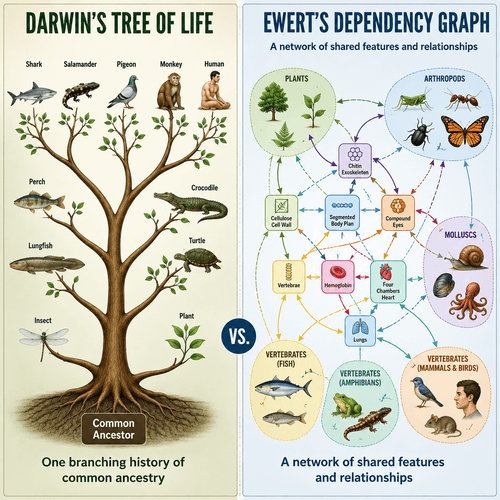
In 2018, computer scientist Winston Ewert tried something interesting. Instead of forcing gene distribution across some 1,700 genomes into a branching tree, he modelled it as a dependency graph: the structure software engineers use when many programmes draw on shared modules. On his analysis the dependency graph fitted the data enormously better than the tree.
The paper appeared in a design-friendly journal. But the point stands on its logic, and it’s testable: life’s gene distribution looks less like a family and more like a library.
4. Four cracks in the inference
Now we move from defence to attack. These aren’t creationist inventions. They’re strains that appear in mainstream biology’s own literature.
CRACK 1: CONVERGENCE, OR THE RULE THAT CANNOT FAIL
Some creatures share striking features that everyone agrees weren’t inherited from a shared ancestor.
The camera eye of a vertebrate and the camera eye of an octopus.
Echolocation in bats and dolphins, including similar changes in the very same hearing gene, prestin.
A form of photosynthesis called C4, which is said to have arisen independently dozens of times.
Placenta genes captured separately in different mammal groups.
These cases are called convergence. Notice the logic carefully. When similarity fits the expected tree, it is called homology and counted as proof of common ancestry. When the very same kind of similarity doesn’t fit the tree, it’s dubbed as convergence and set aside. A test that cannot fail isn’t testing anything. Both outcomes are absorbed, which means similarity by itself isn’t doing the evidential work it is claimed to do.
CRACK 2: THE TREES DISAGREE WITH EACH OTHER
The argument from congruence says different genes point to the same tree. Often they don’t. Different genes routinely yield conflicting family trees, and the conflicts are patched by proposing horizontal gene transfer, where genes jump sideways between unrelated organisms.
This is not a fringe worry. Carl Woese, who discovered a whole domain of life, and W Ford Doolittle both questioned whether a single tree is even the right shape for the history of microbial life.
CRACK 3: GENES FROM NOWHERE
Nearly every organism whose genome has been sequenced turns out to carry orphan genes: functional genes with no known counterpart in any other creature. They should not exist if everything is inherited with modification from something earlier.
Unity is real. But so is genuine novelty, and inheritance cannot supply what nothing had before.
CRACK 4: DESCENT NEVER EXPLAINS THE THING BEING SHARED
Push the tree back as far as it goes and you arrive at a supposed first universal ancestor. But that ancestor already possesses the genetic code, the ribosome (the cell’s protein factory) and the whole translation system.
Understand what that system is. DNA doesn’t build proteins by chemistry alone. It stores information in a code, and the link between a three-letter DNA word and the amino acid it specifies is arbitrary as far as chemistry is concerned, just as the link between the letters c-a-t and a small furry animal is arbitrary. The code has to be read by machinery whose own instructions are written in that same code.
Stephen Meyer has pressed this point for years: the origin of biological information isn’t a gap in the account, it’s the account’s foundation, and it’s missing. Common ancestry simply moves the question further back. It never answers it.
5. The rule that decides the game before it starts
Why, given all that, does common descent look so unanswerable in textbooks? Because of a rule agreed in advance.
The rule is called methodological naturalism: when doing science, only natural causes may be considered. Notice what that rule does to our question. If intelligence isn’t allowed to be an explanation, common descent isn’t the best explanation of life’s unity. It’s the only permitted explanation. It wins by walkover before the evidence is opened.
Geneticist Richard Lewontin said this out loud with rare candour. Writing in 1997, he admitted scientists accept explanations that go against common sense because they have a prior commitment to materialism, and because they cannot allow “a Divine Foot in the door”. That’s not a conclusion drawn from data. It’s a decision made before the data.
This is where Christian apologetics has something distinctive to say. Cornelius Van Til insisted there is no neutral ground: every person interprets the facts in the light of some ultimate commitment, and pretending otherwise simply hides whose commitment is running the show. John Frame puts it plainly: our thinking always serves a lord, and the only question is which one.
So when a Christian says “let us set the Bible aside and look at the evidence neutrally”, the trap has already closed. The evidence has already been defined as evidence-with-no-Designer-allowed. K Scott Oliphint and James N Anderson both make this same point from different angles: the believer’s job is not to borrow the unbeliever’s rules and hope to win by them, but to expose what those rules are quietly assuming.
6. What Scripture claims, and what it doesn’t
We must be as careful with the Bible as with the biology. Overclaiming helps nobody.
| PASSAGE | WHAT IT ACTUALLY SAYS | WHAT IT DOES NOT SAY |
|---|---|---|
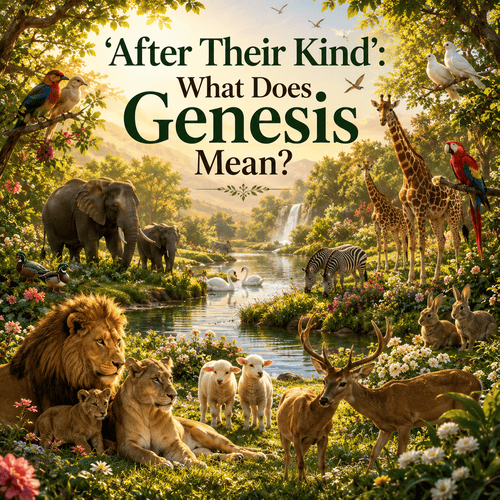
| Genesis 1:11-25, “according to their kinds” | God made creatures in distinct kinds, which reproduce within boundaries. | It doesn’t say species never vary or change. Variation and even new species within a kind aren’t a problem. |
| 1 Corinthians 15:39 | Paul says “not all flesh is the same”, distinguishing humans, animals, birds and fish. | It’s not a technical taxonomy, but it does assume real categories of creature. |
| Genesis 2:7, 21-22 | Adam formed from dust; Eve formed from Adam. | It doesn’t describe a population gradually crossing a line into humanity. |
| Colossians 1:16-17 | All things were created by Christ and hold together in Him. | It doesn’t tell us the age of the earth or the mechanism of variation. |
WHY ADAM IS NOT NEGOTIABLE
Some Christians accept full common descent including humanity and believe nothing important is lost. Something enormous is lost.
Paul doesn’t treat Adam as a picture or a symbol. He treats him as the head of the human race, and builds the gospel on the parallel: sin and death came through one man, righteousness and life come through one man (Romans 5:12-19; 1 Corinthians 15:45-49). Luke traces a real genealogy back to Adam. Paul argues church order from the order of Adam and Eve’s creation (1 Timothy 2:13).
Pull out the first Adam and the second Adam has nothing to answer. The imputation of sin and the imputation of Christ’s righteousness stand or fall together, because they run on the same beam: one man representing many.
This is not a side issue about science. It’s the architecture of salvation. RC Sproul was blunt about it: what is at stake in Genesis isn’t merely a theory of origins but the credibility of the biblical account on which the gospel rests.
And there is a discontinuity no percentage can dissolve. Genesis 1:26-27 says man is made in the image of God. Genetic similarity measures the material a creature is made from. It says nothing about status before God. Two paintings can use identical pigments while only one is a portrait of the king.
7. What about “bad design”?
A common objection: if life was designed, why is so much of it clumsy? Why is the vertebrate retina apparently wired backwards? Why does a nerve in the giraffe take a long detour down the neck and back up?
Two answers.
First, these are theological arguments wearing a lab coat. To say a structure is badly designed, you must know what a good design would have been, which means claiming to know what God would have done and why. That is a large claim. In several famous cases it has simply been wrong: the inverted retina turns out to serve real optical and metabolic purposes, and biologists now describe it as an elegant solution rather than a blunder.
Second, the Bible never says creation is currently in mint condition. Romans 8:20-22 says creation was subjected to futility and groans in bondage to decay. We are looking at a masterpiece under a curse. Decay, damage and loss are exactly what the Christian expects to find, and finding them is not evidence against original design any more than a cracked cathedral wall is evidence that no architect drew the plans.
8. The positive case: a world we can actually study
Common design is not merely a defensive fallback. It explains something evolution takes for granted.
Why does medicine work? Because a drug tested in a mouse tells us something about a man. Why did insulin taken from pigs keep human diabetics alive for decades? Why can one biochemistry textbook serve the entire living world? Because life shares a common toolkit.
That shared toolkit is the precondition of biology as a science and medicine as a practice. And it is precisely what you would expect if the world was made intelligible for creatures commissioned to understand it and to exercise dominion over it (Genesis 1:28).
Note carefully: God doesn’t reuse parts because He is short of ideas or saving effort. Reuse serves revelation. One language across all of life makes creation legible, like one alphabet across all the pages of a book. “O LORD, how manifold are your works! In wisdom have you made them all” (Psalm 104:24). Unity displays the oneness of the Author; diversity displays the wealth of his wisdom.
9. Putting the two views side by side
Both views must be allowed to make predictions and be measured by them. Here is how they compare on four questions.
| QUESTION | COMMON DESCENT EXPECTS | COMMON DESIGN EXPECTS |
|---|---|---|
| Non-coding DNA | Mostly leftover junk from a long unguided history. | Widespread function, because designed systems carry control layers. |
| Do gene trees agree? | Different genes should converge on one consistent tree. | Modules reused across boundaries, producing conflicting trees. |
| Where does novelty come from? | Gradual modification of what already existed. | Abrupt appearance of new information; orphan genes; the Cambrian pattern. |
| How far can change go? | Unlimited, given enough time. | Real but bounded variation within created kinds. |
On the first three, the surprises of the last twenty years have run in one direction. Function keeps being found where junk was predicted. Tree conflicts keep multiplying. Novelty keeps appearing suddenly, most famously in the Cambrian rocks, where major body plans show up without the long line of ancestors the theory requires.
Honesty cuts both ways here, and we should say so. Todd Wood, a creationist biologist, has been openly candid that the genetic evidence for common descent is substantial and that pretending otherwise is dishonest. We agree with his candour, and we still hold that the inference from that evidence to universal ancestry rests on a rule about explanations, not on the evidence alone.
10. Where the argument ends and the gospel begins
Suppose the case above is completely persuasive. What have you got?
You have a reason to believe life looks designed. That is genuinely something. Romans 1:19-20 says the creation leaves people without excuse. The Belgic Confession’s “elegant book” is real, and its letters really do spell something.
But read on in the confession. Article 2 says God makes himself known more clearly and fully by his holy and divine Word. The book of nature tells you that there is an Author. It does not tell you his name, his character, or what he has done about your sin. John Calvin said we need Scripture as spectacles, without which even a clear-sighted man reads the world wrongly.
So design arguments are servants, not masters. They can clear away a false confidence. They can show an honest sceptic that his certainty was borrowed rather than earned. They cannot give anyone a new heart. Only the Spirit does that, through the Word.
Life is one because one Author wrote it. And that Author has spoken, not only in the letters of the genetic code, but in a Son.
Frequently Asked Questions
Is intelligent design just creationism with a new label?
No, though the two are often allies. Intelligent design argues only that certain features of the universe and of life are better explained by intelligence than by undirected causes; it does not identify the designer, and it does not begin with Genesis. Creationism, including our own position, begins with Scripture and builds a fuller account of history from it. The two overlap in conclusions but differ in starting points and scope. As Reformed Christians we do not treat design arguments as a substitute for revelation; we treat them as one useful tool that can never do what only the Word can do.
Is intelligent design science or religion? What did the Dover trial settle?
In 2005 a United States federal court ruled in the Dover case that teaching intelligent design in public school science classes was unconstitutional. It is worth being clear about what that decided: a legal question about American public schooling, not the truth of the matter. Courts do not settle scientific questions, and the definition of “science” used in such rulings usually assumes methodological naturalism, which is exactly the point in dispute. A Reformed apologist should not be rattled by this, because we never expected the state to arbitrate on ultimate questions. The argument is won or lost on evidence and consistency, not verdicts.
Do you have to be a young-earth creationist to accept common design?
No. The design inference itself is separate from the age of the earth, and there are old-earth Christians who argue for common design vigorously. That said, we should be honest that the questions are connected: how you read Genesis 1 shapes what you expect the history of life to look like. Our own position at Truths To Die For takes the days of Genesis 1 as ordinary days and the earth as young, and we hold that this reading best fits the text and the genealogies. But a brother who differs on the age of the earth and still confesses a historical Adam has not abandoned the gospel, and should be treated as a brother.
Do you deny natural selection? What about antibiotic resistance?
We deny none of it. Natural selection is real, observable and uncontroversial; bacteria really do develop resistance, finches really do change beak size, and viruses really do adapt. Notice what these examples involve, though. Antibiotic resistance usually comes from losing or degrading a function, borrowing a gene that already existed elsewhere, or slightly altering an existing protein. That is variation within a kind, and it is exactly what a designed system with built-in adaptability would show. The question is not whether living things change, but whether that kind of change, extended over time, can build new information and new body plans.
Is the distinction between microevolution and macroevolution legitimate?
Critics say it is an artificial line, and that macroevolution is simply microevolution accumulated over a long time. That claim, however, is the very thing being argued about, so it cannot be assumed. Small changes within an existing body plan and the origin of a new body plan are not obviously the same kind of event, any more than editing a sentence and writing a new book are the same kind of task. Work on protein structure by Douglas Axe and on molecular machines by Michael Behe argues the search space for genuinely new functional structures is far too large to be crossed by chance in the time available. Until that gap is answered, extrapolating from beak size to body plans is a promise, not a proof.
Were Neanderthals human? Did they have souls?
The evidence increasingly says yes to the first question. Neanderthals buried their dead, made tools and pigments, and, most decisively, interbred with other humans, leaving traces in modern genomes. Interbreeding is the classic mark of one kind. We take them to be descendants of Adam living in a harsh post-Flood world, physically distinct in the way people groups can be, but fully human and fully image-bearers. The old museum picture of a shambling half-ape has been quietly abandoned by researchers, though it lingers in popular imagination.
Did Darwin himself think design was ruled out?
Darwin was more troubled than his followers. He famously admitted that the thought of the eye forming by natural selection seemed absurd “in the highest possible degree”, before arguing that the difficulty could be overcome. He also confessed that a mind developed from lower animals raised doubts about whether such a mind could be trusted, a worry later Christian thinkers have pressed hard. This is not a gotcha, since Darwin answered his own objections to his own satisfaction. It is a reminder that the design intuition is not stupidity to be educated away; it was strong enough to trouble the theory’s own author.
Related Reads
- Does Similarity Prove Common Ancestry? The Homology Problem
- When Similarity Proves Nothing: Convergent Evolution and the Case for Common Design
- Irreducible Complexity: A Compelling Case for Intelligent Design
- DNA Evidence for Intelligent Design: New Challenges for Evolution
- Is Intelligent Design Biblical? Addressing Christian Concerns
- How the Grand Canyon Challenges Evolution’s Deep Time
- Is the Blood Clotting Cascade Irreducibly Complex?
- Dependency Graph of Life: Why Genes Don’t Fit Darwin’s Tree
- The Cambrian Explosion: Why the Fossil Record Runs Top-Down
- Can Random Mutations Create New Genes?
- "After Their Kind": What Genesis Does and Doesn't Claim
- What Does the Church Lose By Reading Genesis Wrong?