Vienna, 1847. Ignaz Semmelweis, a young Hungarian doctor, is working in a maternity hospital, and he cannot sleep. Women are dying. In one ward, roughly one mother in six is dying of childbed fever after giving birth. In another ward, staffed by midwives instead of doctors, far fewer die.
Semmelweis works out why. The doctors begin their mornings dissecting the bodies of women who died the day before. Then they walk down the corridor, wipe their hands on their coats, and deliver babies. He orders them to wash their hands in a chlorine solution first. The death rate collapses.
His colleagues are furious. Gentlemen’s hands are clean, they insist. Semmelweis is pushed out of his post, ridiculed for years, and dies in 1865 in an asylum, aged 47. Germ theory would be proved right within a decade of his death.
Now here’s the part that should stop us in our tracks. Roughly 3000 years earlier, the book of Numbers had already commanded exactly that—washing after contact with the dead, not once but twice over a 7-day period, in running water. And it sits alongside Leviticus, which contains what is almost certainly the oldest written quarantine protocol in human history.
This post walks through that material carefully: what the text actually says, what modern medicine confirms, and—just as importantly—what we shouldn’t claim.
First, let’s be clear about what these laws are
Leviticus isn’t a health manual. It never mentions germs, bacteria, viruses or infection, and gives no medical reason for anything it commands.
The stated purpose is holiness. God has come to dwell in the midst of His people, in the tabernacle at the centre of camp. And everything in the ceremonial law is organised around that one fact.
“For I am the LORD your God. Consecrate yourselves therefore, and be holy, for I am holy.” (Leviticus 11:44)
Old Testament scholar Gordon Wenham, in his standard commentary on Leviticus, argues this firmly: the clean and unclean categories work as a picture of life against death. Flaking skin, leaking bodies, corpses, mould eating through a wall—these are pictures of death encroaching on life. The laws teach us lessons about God by making us act it out on our own bodies and in our own homes.
We accept that entirely. But it leaves our question open: given that these laws were written for covenantal reasons, why do they work so well as public health? The answer isn’t complicated. The God who gave the law also made the microbes. He wasn’t guessing.
Leviticus 13: a clinical examination, written down in the Bronze Age
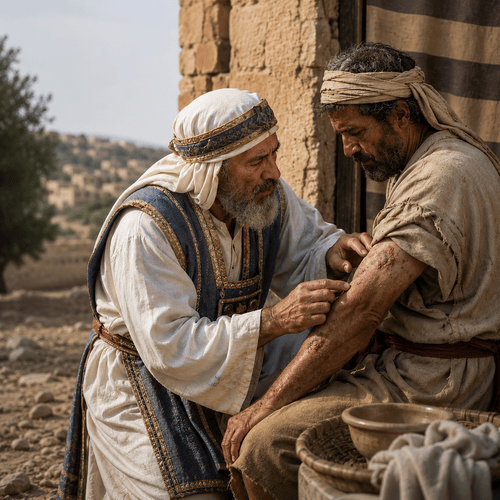
Read Leviticus 13 slowly and it stops sounding like religion and starts sounding like a hospital procedure. There’s an examiner, a set of criteria, a waiting period, a re-examination and a recorded verdict. The examiner is the priest, but what he does is recognisably clinical.
“But if the spot is white in the skin of his body and appears no deeper than the skin, and the hair in it has not turned white, the priest shall shut up the diseased person for seven days. And the priest shall examine him on the seventh day, and if in his eyes the disease is checked and the disease has not spread in the skin, then the priest shall shut him up for another seven days.” (Leviticus 13:4-5)
Notice what the priest is told to look at. Is the mark deeper than the surrounding skin? Has the hair inside it turned white? Has it spread since last week? Depth, pigmentation change and progression over time—these are exactly the questions a dermatologist would ask today.
Table 1: The Leviticus 13 protocol beside its modern equivalent
| STEP IN LEVITICUS 13 | WHAT THE TEXT SAYS | WHAT WE CALL IT TODAY |
|---|---|---|
| 1. Reporting | The person with a suspicious mark is brought to the priest (v.2) | Presenting to a clinician; notification of a suspected case |
| 2. First examination | The priest inspects depth, hair colour and appearance (vv.3-4) | Initial clinical assessment against defined criteria |
| 3. First isolation | Shut up for seven days (v.4) | Quarantine for one observation period |
| 4. Re-examination | The priest looks again on the seventh day (v.5) | Follow-up review at a fixed interval |
| 5. Second isolation | If unresolved, shut up a further seven days (v.5) | Extended quarantine when the result is inconclusive |
| 6. Verdict | Declared clean, or declared unclean (vv.6-8) | Diagnosis; discharge or ongoing isolation |
| 7. Re-entry | Washes clothes, is declared clean, returns (v.6) | Clearance and return to the community |
That structure—observe, wait a fixed period, observe again, decide—is the skeleton of every quarantine system ever built. Disease doesn’t announce itself immediately; a mark that looks harmless today may spread by next week, and only time reveals which is which. Leviticus builds its whole procedure around a waiting period, which is exactly what an incubation period demands.
Two further details show this isn’t simply fear of anything unusual.
- The default verdict is clean. If the mark has faded, the person washes his clothes and goes home (Leviticus 13:6). The law protects the healthy man from being wrongly excluded just as much as it protects the camp from the sick one.
- A whole-body case is declared clean. If the condition has covered the person completely and turned white all over, he is pronounced clean (Leviticus 13:12-13). This is baffling as hygiene, and tells us plainly that categories aren’t entirely medical. It is honest to say so.
The chapter then extends the same procedure to clothing and leather with a spreading greenish or reddish mark (Leviticus 13:47-59): shut away seven days, washed, shut away again, burned if it persists. Any modern conservator would identify that as fungal growth and reach the same verdict.
Outside the camp: isolation, signalling and something very like a mask
Once a case is confirmed, Leviticus gives a striking verse on this subject.
“The leprous person who has the disease shall wear torn clothes and let the hair of his head hang loose, and he shall cover his upper lip and cry out, ‘Unclean, unclean.’ He shall remain unclean as long as he has the disease. He is unclean. He shall live alone. His dwelling shall be outside the camp.” (Leviticus 13:45-46)
Pull that apart and you find four separate control measures stacked on top of one another.
FOUR TRANSMISSION CONTROLS IN A SINGLE VERSE
Live alone: source isolation. The infected person is removed from close daily contact with everyone else.
Outside the camp: spatial separation. Not just apart from family, but outside the dense settlement altogether.
Torn clothes and loose hair: visible signalling. Anyone approaching can identify the situation from a distance, before contact.
Cover the upper lip and cry out: audible warning plus a covering over the mouth and nose area—the same two things a modern hospital does with a sign on the door and a face mask.
Every single one of these appears in 21st century infection control guidance. They appear here roughly 3200 years earlier.
It’s worth pausing on the cost. Leviticus 13:46 is a lonely verse: separation from family, worship and livelihood. But the law does not abandon the person. Leviticus 14:2-3 requires the priest to go out to him, outside the camp, to examine him for recovery—someone must walk out and check. And a full ceremony of restoration waits on the other side, with washing, sacrifice and a public declaration of cleanness.
Then, centuries later, a man with this very condition came to Jesus. Mark records Jesus stretched out His hand and touched him. Under the law, touching an unclean man made you unclean. Here the flow ran the other way: the uncleanness didn’t spread to Christ, the cleansing spread from Him. We shall come back to that, because that’s the point of the whole system.
The house with mould in the walls: the passage nobody quotes
If Leviticus 13 is impressive, Leviticus 14:33-53 is astonishing—and most people have never read it. God tells Israel that when they enter Canaan, a house may develop a spreading contamination in its walls. What follows is a step-by-step decontamination procedure. Read it beside a modern mould remediation guide and the overlap is uncomfortable.
“Then the priest shall go out of the house to the door of the house and shut up the house seven days. And the priest shall come again on the seventh day and look. If the disease has spread in the walls of the house, then the priest shall command that they take out the stones in which is the disease and throw them into an unclean place outside the city.” (Leviticus 14:38-40)
Table 2: House decontamination in Leviticus 14 beside modern mould remediation
| Leviticus 14 instruction | Verse | Modern remediation practice |
|---|---|---|
| Empty the house of its contents before the priest inspects, so that nothing in it becomes unclean | v.36 | Remove and protect contents before works begin, to prevent cross-contamination of belongings |
| Report the problem to the priest rather than dealing with it privately | v.35 | Assessment by a qualified inspector before any disturbance of the growth |
| Shut up the house for seven days | v.38 | Seal off the affected area; containment during the assessment period |
| Re-inspect on the seventh day to see whether it has spread | v.39 | Follow-up inspection to determine whether growth is active |
| Remove the affected stones and dispose of them outside the city | v.40 | Cut out and remove contaminated material; dispose of it off site, not in the building |
| Scrape the plaster from the whole inside of the house, not only the visible patch | v.41 | Treat the wider affected zone, because growth extends past the visible edge |
| Replace with new stones and fresh plaster | v.42 | Rebuild with clean, dry, uncontaminated materials |
| Anyone who enters or sleeps or eats in the shut-up house must wash | vv.46-47 | Personal decontamination and laundering after exposure |
| If it returns after all this, demolish the house and carry the rubble outside the city | v.45 | Condemn and demolish a property where contamination cannot be cleared |
Three details are worth a second look. In verse 36 the house is emptied before the priest even rules, so the family’s possessions leave the building before anyone starts scraping walls and raising dust. In verse 41 the plaster is scraped off all around, not merely where the mark shows—because what’s visible on the surface is never the full extent of what’s growing behind it. And verse 45 is the demolition clause: hard, but the only right answer when contamination keeps returning. Modern contractors and housing authorities do all three.
The health case isn’t speculative. The World Health Organization’s guidance on indoor air quality identifies damp and mould in buildings as a genuine risk to respiratory health, linked with asthma, wheezing, coughing and respiratory infections. Damp housing makes people ill, and a society with no means of dealing with a mouldy house carries an invisible drag on its health.
A CAUTION BEFORE WE GET CARRIED AWAY
Mould in a wall isn’t the same thing as an infectious disease, and Leviticus 14 isn’t describing an epidemic.
What we can say is this: a legal requirement to inspect, contain, strip out, replace and, if necessary, demolish a contaminated dwelling is a sensible public health measure by any standard. And there’s nothing remotely like it in the surviving law codes of Israel’s neighbours.
Numbers 19: the handwashing law that beat Semmelweis by three millennia
Now back to where we started. In the ancient world the most dangerous thing an ordinary person could handle was a dead body: decomposition breeds pathogens, and funeral customs across the ancient Near East involved close, prolonged contact with the dead. Numbers 19 addresses precisely this.
“Whoever touches the dead body of any person shall be unclean seven days. He shall cleanse himself with the water for impurity on the third day and on the seventh day, and so be clean. But if he does not cleanse himself on the third day and on the seventh day, he will not become clean.” (Numbers 19:11-12)
Later in the chapter, the person being cleansed also washes his clothes and bathes his whole body before he’s finally clean (Numbers 19:19). Three features stand out.
- It uses running water. The Hebrew of Numbers 19:17 speaks of fresh, living water—water from a flowing source, not standing water in a basin. Washing in a bowl of shared water is far less effective than washing under a flow. The law specifies the better method.
- It’s repeated. Not one wash but two, on day three and on day seven. Repeat decontamination at intervals is standard practice today, and it is what Semmelweis had to fight for.
- It has teeth. A person who skipped it stayed unclean and was cut off from the assembly (Numbers 19:20). This is an enforced rule with a real penalty, not a helpful suggestion.
The wider code carries the same instincts into ordinary life. Bodily discharges required washing and laundering (Leviticus 15). Deuteronomy 23:12-13 requires a latrine area outside the camp and a digging tool, so that human waste is buried rather than left near where people live and eat—a rule which, had the world followed it, would have prevented a fair share of the cholera outbreaks of the 19th century.
One detail in Leviticus 11 and 15 is easy to miss. A contaminated clay pot must be broken; a wooden or metal vessel is simply rinsed (Leviticus 15:12; 11:33). Porous clay absorbs and holds moisture, and everything living in it, and cannot be reliably cleaned. Hard surfaces can. The law draws the exact porous versus non-porous distinction taught on a modern food safety course.
Table 3: The Mosaic health provisions at a glance
| Provision | Where it is found | Modern public health parallel |
|---|---|---|
| Two-stage timed isolation with re-examination | Leviticus 13:4-6 | Quarantine built around an incubation period |
| Isolation outside the settlement, with warning signals | Leviticus 13:45-46 | Source isolation, signage, face covering |
| Contaminated fabric washed, re-checked, or burned | Leviticus 13:47-59 | Decontamination or destruction of soft furnishings |
| House inspection, containment, strip-out, demolition | Leviticus 14:33-53 | Building mould remediation and condemnation |
| Washing after contact with the dead, on days three and seven | Numbers 19:11-19 | Hand hygiene after handling infectious material |
| Washing and laundering after bodily discharges | Leviticus 15 | Standard precautions with body fluids |
| Porous clay vessels destroyed; hard vessels rinsed | Leviticus 11:33; 15:12 | Porous versus non-porous surface protocols |
| Human waste buried outside the camp | Deuteronomy 23:12-13 | Sanitation and safe disposal of sewage |
The 3000-year silence
What makes the contrast sharp isn’t merely that Israel had these rules, but that almost nobody else did—and that the wider world took an extraordinarily long time to arrive at them. Egyptian medicine, often praised as advanced, is preserved in documents such as the Ebers Papyrus, which sets genuine pharmacological knowledge beside remedies using animal dung on wounds and eyes. Mesopotamian codes regulate a surgeon’s fees and punish his failures, but legislate nothing about isolation, sanitation or decontamination. No ancient legal code outside Israel contains anything resembling Leviticus 13-15.
A very long timeline
1400 BC: Leviticus and Numbers set out isolation, re-examination, decontamination and repeated washing.
AD 400-1300: Medieval European leper houses and rules of separation are built directly on Leviticus 13. Scripture is the working manual.
1377: The city of Ragusa (modern Dubrovnik) orders arriving ships and travellers to be held in isolation before entering. Venice extends the period to forty days, and the word quarantine is born.
1546: Girolamo Fracastoro proposes that disease is spread by tiny seed-like particles. He is largely ignored.
1847: Ignaz Semmelweis introduces handwashing in Vienna and is driven out of the profession for it.
1854: John Snow traces a London cholera outbreak to a single water pump and removes its handle.
1861-1876: Louis Pasteur, Joseph Lister and Robert Koch establish germ theory and antiseptic practice. The world finally catches up.
Notice the middle of that list. When plague swept Europe, the response drew directly on Leviticus. The quarantine stations of the Mediterranean ports weren’t an independent invention that happened to match the Bible; they were partly an application of the Bible by people who read it as law. The Mosaic code didn’t merely anticipate quarantine—in the West, it supplied the pattern. And the gap between Numbers 19 and Ignaz Semmelweis isn’t a century or two. It’s roughly 3000 years, during which the best-educated physicians in the world walked from a corpse to a patient without washing, and mocked the man who told them to stop.
What we aren’t claiming
This is where Christian writing on the subject usually goes wrong, so let’s be blunt about the limits.
FIVE HONEST LIMITS ON THE ARGUMENT
The text never mentions germs. Not once. Any claim that Moses knew about micro-organisms goes beyond what is written. We’re looking at the effects of the law, not at a stated rationale.
These are covenant laws, not medicine. Their purpose is holiness before a holy God. Read them as a health code and you’ll be unable to explain why a man covered head to foot is declared clean, or why touching a corpse and touching a lizard land you in the same category.
Tzaraat isn’t simply leprosy. Hansen’s disease, the condition we now call leprosy, is in fact only mildly contagious and has a long incubation. The biblical condition affects skin, cloth and stone, which no single pathogen does. The old translation misleads.
Some popular books overreach. SI McMillen’s None of These Diseases made this argument famous, and also made specific medical claims—most notoriously about blood clotting and the 8th day of circumcision—that later scholarship has disputed.
This isn’t a knock-down proof of God. On its own it’s one line of evidence among many. It’s a strong one. But it isn’t the whole argument, and we shouldn’t pretend it is.
Strip all that away, though, and something solid remains. A body of law written for religious reasons in the 2nd millennium BC, by a people with no microscopes and no theory of infection, contains timed isolation, re-examination, decontamination of surfaces and fabrics, building remediation and demolition, repeated washing in running water after handling the dead, a porous-versus-non-porous distinction, and sanitation rules for waste. Every one of those is still in the toolkit today. That needs explaining.
Why a Christian expects to find exactly this
For a Christian, none of this is an awkward coincidence to be explained away. It’s what our doctrine of God and Scripture predicts.
God is the author of both the world and the Word
The Belgic Confession says we come to know God by two means: the creation and preservation of the universe, which stands before our eyes like a most elegant book, and God’s holy Word. Two books, one Author. So when careful study of the first keeps confirming the practical wisdom of the second, that is precisely the harmony the confession leads us to expect.
Vern Sheridan Poythress—a mathematician by training and a professor at Westminster Theological Seminary—presses this further in Redeeming Science. The laws of nature, he argues, are not impersonal forces running independently of God but the faithful, ongoing speech of God governing his creation. Science works because God is consistent. A law given by God will therefore never clash with a world made by God, whether or not the reason is disclosed to us.
God legislates for our good, whether or not he explains himself
Moses states the principle directly: the LORD commanded us to keep all these statutes for our good always (Deuteronomy 6:24). A father who tells a small child not to touch the cooker does not first deliver a lecture on thermal conductivity, and the reason is real even when the child cannot follow it. This is why we need not be embarrassed that Leviticus gives no germ theory. Obedience did not require understanding. It required trust—and it worked.
Common grace explains why others got there eventually
The Reformed doctrine of common grace holds that God gives real insight and skill to people who do not know him. Pasteur, Snow, Koch and Lister were not writing Scripture; they were made in God’s image, studying God’s world, and God let them find what was there. So we do not claim Israel was cleverer than everyone else. Israel was not cleverer. Israel was told.
Where all of this was always pointing
There’s a reason the Bible spends so long on contagion, and it isn’t primarily about health. The whole clean and unclean system trains Israel to grasp one terrible fact: uncleanness spreads by contact, and cleanness doesn’t. Touch the unclean thing and we become unclean; it never runs the other way. Corruption is contagious, purity isn’t—and anyone who has watched bitterness spread through a church knows this is true of far more than skin disease.
Then Jesus of Nazareth meets a man with tzaraat, a man who by law must live alone and cry out a warning. And Jesus touches him.
“Moved with pity, he stretched out his hand and touched him and said to him, ‘I will; be clean.’” (Mark 1:41)
The direction of flow reverses. Christ doesn’t catch the man’s uncleanness; the man catches Christ’s cleanness. That’s the gospel in a single gesture.
And where did Jesus finally go? Hebrews makes the link explicit: He suffered outside the gate to sanctify the people by His own blood, and we are called to go out to Him, outside the camp (Hebrews 13:12-13). The place of the unclean man became the place of the Son of God. He took the isolation that belonged to us. The quarantine laws were a shadow; Christ is the substance. Their medical wisdom is real and remarkable, but it’s the smaller half of the story.
Drawing the threads together
So what should we make of the Mosaic health code? Not that Leviticus is a science textbook—it is not, and treating it as one dishonours it. Not that Moses secretly knew about bacteria; nothing in the text suggests he did.
But this much stands. 3000 years ago a small nation was given a body of law requiring timed isolation with follow-up examination, separation and warning signals for infectious cases, washing in running water after contact with the dead, destruction of porous contaminated vessels, burial of human waste away from dwellings, and a full inspection-and-remediation procedure for a contaminated building, demolition included. The nations around them had nothing comparable, and European medicine did not reach the core of it until the middle of the nineteenth century—and then only after ridiculing the man who suggested it.
The most reasonable explanation is the one the text itself offers. These laws didn’t come from human trial and error. They came from the One who made the body, the water, the walls, and the organisms nobody would see for another 3000 years.
“The law of the LORD is perfect, reviving the soul; the testimony of the LORD is sure, making wise the simple.” (Psalm 19:7)
Making wise the simple. That’s exactly what happened. A people who couldn’t have explained why were made wise about things the experts would not grasp for three millennia. Their God knew, and told them what to do.
Frequently Asked Questions
Do Christians have to keep these laws today?
No, and this matters. The ceremonial laws of Israel were a shadow pointing forward to Christ, and Christ has fulfilled them. Mark records that Jesus declared all foods clean (Mark 7:19), and Peter’s vision in Acts 10 makes the same point about people, not merely food. The Westminster Confession expresses the standard Reformed position: the ceremonial laws are now abrogated, while the moral law remains binding. So a Christian is not under obligation to isolate for seven days or avoid a mouldy wall on religious grounds. But we may still learn wisdom from these laws, in the same way we learn wisdom from Proverbs without treating it as legislation.
Did other ancient nations have similar hygiene rules?
Not in any comparable form. Egyptian medical papyri, such as the Ebers Papyrus, contain real pharmacological knowledge sitting alongside remedies using animal dung. Mesopotamian codes such as Hammurabi’s regulate a surgeon’s payment and punishment but say nothing about isolation, decontamination or sanitation. Some cultures had washing rituals, but these were about ceremonial purity before the gods with no systematic public health effect. The combination found in Leviticus—timed isolation, re-examination, surface and building decontamination, and waste disposal, all enforced by law—is genuinely without parallel in the surviving records of the ancient Near East.
If God knew about germs, why did he not just tell them?
Because knowledge without infrastructure would have been useless, and possibly harmful. Telling a Bronze Age shepherd about bacteria gives him no microscope, no antibiotics, no sterilisation equipment and no way to test the claim. What he needs is a set of actions that work. God gave the behaviour, not the theory. There is also a deeper reason: these laws were teaching Israel about holiness and about the spread of corruption, and a biology lesson would have obscured that. God generally reveals what his people need for obedience, not everything he knows.
Was tzaraat actually contagious?
Probably some forms of it were and some were not, which is precisely why the two-stage examination existed. The Hebrew term covers a range of conditions, and the modern disease we call leprosy (Hansen’s disease) is in fact only mildly contagious and has a very long incubation period. Some cases in Leviticus 13 are almost certainly conditions like psoriasis or fungal infections, which are not dangerous to others at all. This is why the honest form of our argument does not depend on identifying the disease. The point is the structure of the response—observe, isolate, re-examine, decide—which is sound regardless of which condition triggered it.
Why did Jesus touch a man he was forbidden to touch?
Because he is the Lord of the law, not its subject. The purity laws taught that uncleanness passes to the clean person by contact; Jesus reverses the flow, and the man is cleansed rather than Jesus being defiled (Mark 1:41-42). Notice too that Jesus then tells the man to go and show himself to the priest and make the offering Moses commanded. He does not abolish the procedure; he satisfies it. The episode is a deliberate sign that the one greater than the temple has arrived, and that the deepest uncleanness—sin—has finally met its cure.
Were the food laws about health as well?
This is a popular claim and we would urge caution. Pork carries a real parasite risk when undercooked and shellfish can concentrate toxins, so there are health arguments to be made. But the same lists forbid animals that pose no obvious health risk at all, such as camels and rabbits, and permit locusts. If health were the organising principle, the lists would look different. The better explanation is the one Leviticus gives: these laws marked Israel out as a people set apart from the nations, which is why they were lifted when the gospel went to those nations.
Is this just a God-of-the-gaps argument?
No, because we are not appealing to a gap in scientific knowledge. A God-of-the-gaps argument says that because science cannot yet explain something, God must have done it—and it collapses when science catches up. Our argument runs the other way round. Modern science has explained these things very well indeed, and that explanation is exactly what makes the ancient text remarkable. We are not pointing at what science cannot account for; we are pointing at what it has confirmed.
What about SI McMillen’s book None of These Diseases?
It was hugely influential in bringing this subject to a popular audience, and it deserves credit for that. But several of its specific medical claims have not held up, most famously the argument that circumcision on the eighth day was timed to coincide with a peak in blood clotting factors. The underlying physiology is considerably more complicated than the book suggests, and careful Christian writers have stopped repeating it. Our approach is to build only on what the biblical text plainly says and on parallels that are securely established in modern medicine. An argument for Scripture should never need shaky evidence, and Scripture is not honoured by claims that will not survive scrutiny.
Can we prove Israel was actually healthier as a result?
Not with hard data, and we should say so plainly. We have no ancient mortality statistics for Israel compared with its neighbours, and any claim to the contrary is guesswork. What we can say is that the measures prescribed are the same measures that demonstrably reduce disease transmission today, and that a society practising them would very likely fare better than one that did not. The argument rests on the content of the laws and their agreement with established modern practice, not on statistics we do not possess.
What should churches take from this during an epidemic?
Three things, held together. First, that separating the sick from the well is not a failure of faith but a biblical instinct—Leviticus commands it. Second, that isolation must never mean abandonment: the priest was required to go out to the man outside the camp, and the church must find ways to go to the isolated. Third, that our ultimate hope is not in hygiene. Every measure in Leviticus delays death; only Christ defeats it. A church that gets the precautions right and the gospel wrong has missed the point of the very chapters it is quoting.
Related Reads
- What Psalm 139 Knew About Embryology and Life in the Womb
- Bible Verses About Science: 15 Claims That Stood the Test of Time
- The Weight of Wind: Job 38’s Strange Physics
- The DNA Clock: 3 Surprising Clues That Support a Young Earth
- 1 Kings 7:23: Did God Get His Math Wrong?
- Does the Bible Say the Earth is Flat?
- Quantum Entanglement: The Hidden Code That Points to God’s Design