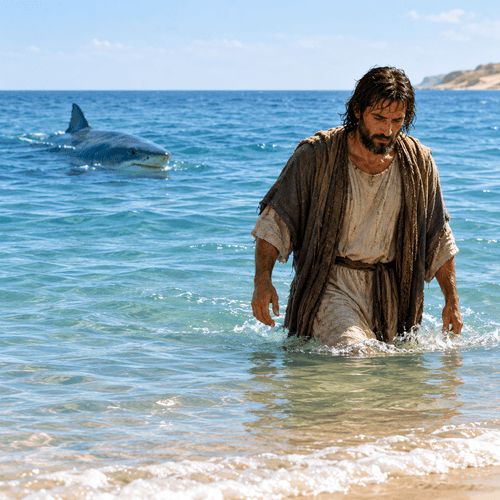
In February 1977, a small submarine, Alvin, sank slowly into the dark waters of the Pacific, near the Galápagos Islands. Three men were folded inside a sphere barely two metres wide. Their plan was to go down about 2.5 kilometres—far below the reach of sunlight. They expected to find what everyone expected to find down there: cold mud, and almost nothing alive.
That isn’t what they found.
Through the tiny window they saw warm water shimmering up out of cracks in the sea floor, like heat rising off a road in summer. Around those cracks was a crowd of living things nobody had ever seen—white crabs, giant tube worms taller than a man, clams the size of dinner plates. Springs were flowing on the bottom of the ocean. Two years later, in a different stretch of the Pacific, scientists found the hotter version: chimneys of rock pumping out black, mineral-loaded water at temperatures well above 300°C.
It was one of the great surprises in the history of science. And thousands of years earlier, a book had put a question to a grieving man that assumed those springs were there.
“Have you entered into the springs of the sea, or walked in the recesses of the deep?” Job 38:16
This post is about four questions in the book of Job—four questions about the natural world that nobody could have answered for another two or three thousand years. But before we look at them, we need to be very clear about why they’re there. Get that wrong, and the whole post becomes a party trick. Get it right, and it becomes one of the most humbling passages in the Bible.
First: this chapter is an exam, not a lecture
The book of Job is about a good man who loses everything—his wealth, his ten children, his health—for no reason he can see. For 35 chapters he argues with three friends who insist he must be hiding some secret sin. Job keeps saying he’s innocent, and keeps asking God for a hearing.
In Chapter 38, God finally speaks. But He doesn’t answer a single one of Job’s questions. Instead, he asks about 70 of his own.
“Who is this that darkens counsel by words without knowledge? Dress for action like a man; I will question you, and you make it known to me.” Job 38:2–3
Where were you when I laid the foundations of the earth? Have you commanded the morning? Can you bind the Pleiades? Do you know when the mountain goats give birth? Question after question, and Job can answer none of them. This is a test Job is meant to fail—and knowing he will fail is the entire point.
So God isn’t teaching Job meteorology. He is showing Job the extent of the gap between them. But here’s what makes the passage remarkable: the questions aren’t vague. God doesn’t simply say, “There’s a lot you don’t know.” He names specific features of the natural world—and several of those features turned out to be real, particular, physical things nobody would confirm for millennia.
Here are the four questions we shall look at, side by side.
| THE TEXT | WHAT GOD ASKS | WHAT THE ANCIENT WORLD ASSUMED | WHAT WE NOW KNOW |
|---|---|---|---|
| Job 38:16 | Have you entered the springs of the sea, or walked in the recesses of the deep? | The deep sea is a bottomless, lifeless chaos. Nobody can go there. Springs belong on land. | The sea floor is a landscape with hot and cold springs flowing from it, surrounded by dense life. First seen in 1977. |
| Job 28:25 | He gave to the wind its weight, and apportioned the waters by measure. | Wind is breath or spirit—the very picture of something with no substance and no weight. | Air has mass. It presses on us at roughly one kilogram per square centimetre. Weather forecasting is built on weighing and measuring air and water. |
| Job 38:22–23 | Have you entered the storehouses of the snow, or seen the storehouses of the hail? | Snow and hail are hurled down from heaven by divine anger, on the spot. | Snow and hail are formed and held aloft inside cloud systems—literally stored—before release. |
| Job 38:35 | Can you send forth lightning, that they may go and say to you, “Here we are”? | Lightning is a weapon thrown in rage by a storm-god: unpredictable and personal. | Lightning is an electrical discharge that follows a path formed step by step, and can be studied, predicted and safely conducted to earth. |
1. Springs on the floor of the sea (Job 38:16)
Two things in this verse are strange. The first is the word translated “springs.” The Hebrew word here, nebek, appears nowhere else in the entire Old Testament. It means a source, the place where water wells up from below. The second strange thing is the verb: walked. God asks if Job has walked in the recesses of the deep. The picture is of a floor down there—a surface we could put our feet on, with features worth exploring.
That’s not how the ancient world pictured the sea. In the mythology surrounding Israel, the deep was a monster or a chaos—something to be defeated, not surveyed. It had no map, no geography, no plumbing. It was the opposite of ordered land.
Job’s question assumes the opposite. It assumes the deep has an interior, a floor, and water sources of its own. Genesis uses the same instinct when it speaks of “all the fountains of the great deep” bursting open (Genesis 7:11). The Bible keeps treating the sea floor as a place with structure.
What the 1977 dive actually found
Warm springs. Sea water sinks through cracks in the crust, is heated by magma below, and rises back out through vents—exactly like a spring on land, only under two and a half kilometres of ocean.
An ecosystem with no sunlight. The animals around the vents do not depend on plants or light. Bacteria at the base of the food chain live on chemicals in the vent water. Before 1977, textbooks said all life ultimately runs on sunlight.
A whole hidden geography. Vent fields have since been found along mid-ocean ridges around the world, along with cold seeps and even freshwater springs rising through the sea bed.
The honest limit: a handful of freshwater springs bubble up close to shore in places like the eastern Mediterranean, and ancient sailors did know about some of them. So the idea of water rising from under the sea wasn’t literally unthinkable. But Job 38:16 isn’t talking about a coastal curiosity. It’s talking about the recesses—the far, deep, inner places—and no human being entered those until the 20th century.
2. The weight of the wind (Job 28:25)
This line comes from Job 28, the great poem about where wisdom is found. It precedes God’s speech in the book, but it belongs to the same argument: God knows the workings of the world from the inside, and we don’t.
“When he gave to the wind its weight and apportioned the waters by measure…” Job 28:25
Read that slowly. It’s a very odd sentence for the ancient world to produce. The Hebrew word behind “weight” is mishqal—the ordinary word for a weight on a set of scales, the kind merchants used. And the word behind “measure” is the ordinary word for a measuring vessel. The verse pictures God running the weather the way a careful trader runs a shop: weighing out the air, pouring out the water by volume.
Now consider what wind meant to almost everyone else. The Hebrew word for wind, ruach, also means breath and spirit. So does the Greek pneuma, and the Latin spiritus. Across the ancient world, wind was the standard example of something real but weightless—invisible, untouchable, the very picture of the immaterial. To say wind has a weight was to say something almost self-contradictory.
And yet it’s exactly right. Air has mass. We couldn’t prove it until Evangelista Torricelli built the first barometer in 1643, and Blaise Pascal sent his brother-in-law up the Puy-de-Dôme mountain in 1648 to show the column of mercury dropped as you climbed—because there was less air overhead to press down. In 1654 Otto von Guericke pumped the air out of two metal hemispheres in Magdeburg and teams of horses could not pull them apart. Air, it turned out, is heavy.
HOW MUCH DOES THE AIR IN OUR ROOMS WEIGH?
Air at sea level weighs about 1.2 kilograms per cubic metre. So:
A small bedroom, 4m × 3m × 2.5m, holds 30 cubic metres of air—about 36 kg, roughly the weight of a ten-year-old child.
The atmosphere presses down on every square centimetre of our skin with about one kilogram of force. We don’t feel it because the pressure inside our body pushes back equally.
Modern weather forecasting is, at heart, an enormous accounting exercise in exactly the terms of Job 28:25—tracking how much mass of air and how much mass of water vapour is moving where.
Why this matters: the verse doesn’t merely say God controls the wind. Every ancient religion said that. It says the wind is the kind of thing that has a quantity. That’s not a religious claim about power. It’s a physical claim about substance—and it’s correct.
3. The storehouses of snow and hail (Job 38:22–23)
“Have you entered the storehouses of the snow, or have you seen the storehouses of the hail, which I have reserved for the time of trouble, for the day of battle and war?” Job 38:22–23
Let’s be honest about this one first, because honesty is what makes an argument strong. “Storehouse” is royal imagery. Kings kept armouries stocked for war, and verse 23 makes the military picture explicit. The writer isn’t sketching a diagram of a cloud.
But look at what the image actually claims. It doesn’t say snow and hail are made on the spot and thrown. It says they’re formed in advance, held in reserve, and released at the right moment. That’s a claim about how precipitation works—and it’s a surprisingly good one.
HOW A HAILSTONE IS ACTUALLY BUILT
Inside a tall storm cloud, air rushes upwards. In big storms these updraughts can exceed 100 kilometres an hour.
Step 1—supercooled water. High in the cloud, water droplets stay liquid even below 0°C. This is called supercooled water: cold enough to freeze, but with nothing to freeze onto.
Step 2—a seed. A tiny particle of ice or dust becomes a core. Supercooled droplets hit it and freeze instantly onto its surface.
Step 3—the lift. The updraught carries the growing stone back up. It falls, gathers more water, is lifted again. Cut a large hailstone in half and you can see the layers, like the rings of an onion—one for each trip.
Step 4—release. The stone falls only when it grows too heavy for the updraught to hold. Until that moment it is, in the plainest sense, being stored.
The scale of the store: a large storm cloud can hold several thousands of tonnes of water aloft before any of it reaches the ground. “Storehouse” isn’t a bad word for that. It’s a very good one.
There’s a second layer here too. Verse 23 says these stores are “reserved for the time of trouble.” Later in the Bible, that’s exactly what happens: hail falls on Egypt as judgement (Exodus 9:22–26) and on Israel’s enemies at Beth-horon (Joshua 10:11). The weather isn’t neutral machinery. It’s a stocked armoury under the command of a King.
4. Lightning that reports for duty (Job 38:35)
“Can you send forth lightnings, that they may go and say to you, ‘Here we are’?” Job 38:35
This is perhaps the strangest picture of the four. Lightning is spoken to like a servant. It’s sent, it goes, and it reports back—“Here we are.” 10 verses earlier the same passage asks who “has cleft a channel for the torrents of rain, and a way for the thunderbolt” (Job 38:25). Lightning has a way—a route, cut in advance.
Compare that with how Israel’s neighbours pictured the same flash of light. In the Baal Cycle from Ugarit, Baal is the storm-god who holds lightning as a spear. In Greece, Zeus hurls thunderbolts. In Mesopotamia, the storm-god Adad does the same. The pattern is identical everywhere: lightning is a weapon thrown in anger. It’s personal, arbitrary and unpredictable—which means it also can’t be studied.
Job 38 keeps lightning fully under God’s command, but the relationship is completely different. It isn’t rage. It is orders. Lightning is dispatched, follows a prepared channel, and answers for itself. That’s the language of a chain of command in an ordered world.
| QUESTION | THE STORM-GOD MYTHS | JOB 38 | MODERN PHYSICS |
|---|---|---|---|
| What is lightning? | A weapon—a spear or bolt in a god’s hand. | A servant that is sent out and reports back. | An electrical discharge between charged regions. |
| Does it have a path? | No. It goes where it is thrown. | Yes—God “clefts a way for the thunderbolt” (38:25). | Yes. A “stepped leader” moves down in roughly 50-metre jumps, branching as it seeks the easiest route, until it meets an upward streamer from the ground. |
| Can it be studied? | No. Divine mood is not a research subject. | Yes in principle—though not by Job, and that is his problem. | Yes. The return stroke heats the channel to around 30,000°C, five times hotter than the surface of the sun. |
| Can we work with it? | Only by appeasing the god. | Only under the Creator’s permission and design. | Yes. Benjamin Franklin’s lightning rod (1752) works by giving the discharge an easier path to earth—steering it rather than stopping it. |
We shouldn’t press poetry into a physics paper. Job 38:35 isn’t describing a stepped leader in lightning. But look at which of the three columns above best fits the picture in the Bible. The Bible describes lightning as something God commands and that follows a path or “way.” That’s a world where lightning can be studied and understood. It’s very different from the idea that lightning is simply the result of a god’s anger or unpredictable behaviour.
This isn’t a small point. It’s one of the standard historical explanations for why modern science grew where it did. If nature is divine, we’d worship it. If nature is chaos, we’d fear it. If nature is the ordered work of a faithful, rational Creator who has appointed “the ordinances of the heavens” (Job 38:33), we can go and look—and even expect to find something coherent when we get there.
What we aren’t claiming
A strong argument names its own limits. So here’s the fence around this post.
| WHAT WE ARE NOT SAYING | WHAT WE ARE SAYING |
|---|---|
| Job is a science textbook in disguise. | Job is Hebrew wisdom poetry. It is doing theology, not physics—and it happens to describe the physical world with unusual accuracy while doing so. |
| The author of Job secretly understood hydrothermal vents, air pressure and electrical discharge. | The human author almost certainly understood none of these. That is precisely why the accuracy is worth noticing. The questions came from Someone who did. |
| These verses prove the Bible is true. | These verses are consistent with the Bible’s own claim about itself. Nobody is argued into faith by a footnote about deep-sea springs. But an honest person should notice that the pattern runs the right way. |
| Every “the Bible predicted science” claim you have heard is sound. | Many of them are not, and Christians should stop repeating the weak ones. A bad argument for a true conclusion is still a bad argument, and it costs us credibility we cannot spare. |
| We must match Scripture to the current scientific model. | We must not. Models change; the text does not. We are pointing out where the text was never wrong, not tying it to a model that may be revised in fifty years. |
The same book that asks these questions also speaks of the “pillars” of the earth (Job 9:6), “doors” for the sea (38:8–10) and the sky spread out like a mirror (37:18). Those are pictures—the language of a person standing on the ground and describing what he sees, exactly as we still say “the sun went down.” Reading poetry as though it were a technical manual is not a high view of Scripture. It is a careless one.
What Christian scientists and scholars say about this
Some of the clearest thinking on how to read passages like this comes from Christians who work in the sciences themselves.
THREE VOICES WORTH HEARING
Vern Poythress argues that what we call “laws of nature” aren’t impersonal machinery sitting between God and the world. They’re God’s own faithful, personal government of His creation—His word, holding everything in place, every second. On that view there’s no tension at all between Job 38:35 and a physics textbook. “Commanded” and “law-governed” describe the same event from two directions.
John Lennox makes a point that guts the usual objection. Explaining how something works never removes the who. Understanding how a jet engine works doesn’t make Frank Whittle redundant. God isn’t a rival explanation sitting alongside physics; He’s the reason there’s any physics to find.
Christopher Ash, in his major commentary on Job, notes God’s speech is a guided tour of a world Job neither made nor manages—much of it wild, most of it useless to human beings, all of it under God’s tender and detailed care. The tour doesn’t answer Job’s question. It changes the person asking it.
Behind all of them stands John Calvin, who wrote 159 sermons on Job. Calvin’s constant theme was that God speaks to us the way a nurse speaks to an infant—stooping to our level, yet never lying to us. That’s why we can hold both things at once: the Bible isn’t written in the language of the laboratory, and the Bible is never wrong.
The part that actually matters: Job’s answer
If you’ve read thus far, here’s the sentence to take away. Job never gets an answer.
We, the readers, know what happened in Chapters 1 and 2—the heavenly court, the accusation, the permission. Job never learns any of it. Not in Chapter 38, not in Chapter 42. Not ever. God asks him about 70 questions about springs and snow and stars and wild goats, and never once explains why a good man lost his 10 children.
And Job’s reply isn’t “now I understand.”
“Behold, I am of small account; what shall I answer you? I lay my hand on my mouth. I have spoken once, and I will not answer; twice, but I will proceed no further.” Job 40:4–5
A hand over the mouth. That’s the response of a man who has stopped talking, not a man who has been given data. And then, at the end:
“I had heard of you by the hearing of the ear, but now my eye sees you; therefore I despise myself, and repent in dust and ashes.” Job 42:5–6
Notice the exchange. Job trades hearing about God for seeing God. He doesn’t get an explanation; he gets an encounter. The questions about the sea floor and the storehouses of hail were never meant to fill a gap in his knowledge. They were meant to move him—from the position of a man cross-examining God to the position of a creature in the presence of his Maker.
That’s the difference between information and worship, and it’s the whole point of the chapter.
God answered Job out of the whirlwind. Centuries later, four frightened men were in a boat on the Sea of Galilee in a storm that was filling it with water, and the one person who could weigh the wind was asleep on a cushion. He stood up and spoke to the wind and the sea the way Job 38 speaks to lightning—as a master addressing a servant—and the sea went flat calm.
“Who then is this, that even the wind and the sea obey him?” Mark 4:41
That, then, is Job 38’s question with a name attached. The God who weighs the wind and keeps the storehouses of snow didn’t stay in the whirlwind. He came into the storm with us, and He took the worst of it Himself. Job never learned why he suffered. But he did meet the One who’d one day suffer for him—and it was enough.
Tough Questions, Honest Answers
When was the book of Job written, and does the date weaken this argument?
Scholars disagree sharply. The setting of the story looks very early—Job’s wealth is measured in livestock, he offers sacrifices himself as head of the family with no priesthood in sight, and he lives an extraordinarily long life. That fits the world of the patriarchs. The written form may be considerably later. But the date does not really affect the argument. Whether the book was composed around 2000 BC or around 500 BC, nobody in either century had entered the deep sea, weighed air, or traced the path of a lightning discharge. The gap between the text and the discovery is measured in thousands of years either way.
Job also mentions the “pillars of the earth” and “doors” for the sea. Doesn’t that show the book is scientifically wrong?
It shows the book is poetry, which we already knew. Pillars, doors, storehouses, foundations and swaddling bands are all images drawn from ordinary human life: buildings, gates, warehouses, babies. We use the same kind of language constantly without deceiving anyone—“the sun came up,” “the temperature is climbing,” “the car died.” The Reformed doctrine of accommodation says God speaks in the language of the people he is speaking to, which means we must read each passage according to what it is actually doing. Insisting that Job 9:6 teaches architectural geology is as odd as insisting that Job 38:35 teaches electrical engineering. The claim of this post is narrower and firmer: where the text does describe the physical world, it never had to be corrected.
Isn’t this just a “God of the gaps” argument—putting God wherever science has not reached yet?
No, and it is worth seeing why not. A God-of-the-gaps argument says: science cannot explain X, therefore God did X. This post says the opposite. Science has explained these things—we know how hailstones form and how lightning finds its path—and the explanations turn out to fit what the text said all along. We are not hiding God in the shrinking dark. We are pointing to the lit room and noting that the description matches. In Reformed theology God is not one cause among many, filling in where nature runs out; he is the reason nature runs at all, including every process we have successfully explained.
Did other ancient cultures make similar lucky guesses about nature?
They made a great many claims about nature, and that is exactly the comparison worth making. Ancient literature is full of confident cosmology—the sky held up by a god’s body, the world made from a slain sea-monster, the sun rowed across the water in a boat each night. Some ancient thinkers, particularly among the Greeks, got real things right by careful observation, and Christians should say so gladly. What is unusual about Job is not that it contains a lucky hit but that it contains several, in a book that never had to be quietly corrected on the physical world. The comparison is not “the Bible guessed and others did not.” It is “look at the overall record of each.”
Are Behemoth and Leviathan in Job 40–41 dinosaurs?
Christians who take Genesis at face value differ on this, and we should be relaxed about the disagreement. Some point to Behemoth’s tail, “stiff like a cedar” (Job 40:17), and argue that no hippopotamus or elephant fits, so a large extinct reptile is the better candidate. Others read both creatures as real animals described in heightened poetic language, with Leviathan carrying deliberate echoes of the chaos-monster of surrounding mythology—now presented as a mere creature God made and can handle. What matters for the argument of this post is that the point of these chapters does not depend on the identification. Whatever they are, Job cannot leash them, and God can. That is the entire function of the passage.
God never tells Job why he suffered. Isn’t that a non-answer to the problem of evil?
It is not the answer we would have written, which is a point in its favour. If the book were human invention, we would expect a tidy explanation at the end. Instead God gives Job himself. The Reformed reading takes this seriously: God is under no obligation to justify his government to his creatures, and Job’s demand for a hearing was itself part of what needed correcting. But it is not cold. God shows up, in person, and speaks at length to a man who has been shouting at him for thirty-five chapters. And Christians read Job in the light of the cross, where the question “why have you forsaken me?” was asked by God’s own Son. We are not told why we suffer. We are shown that God does not stand outside it.
Should I use these verses with a sceptical friend?
Yes—carefully, and never as a knockout blow. Lead with the honest version: “I find it interesting that…” rather than “this proves…” Sceptics have usually met Christians who overclaim, and one exaggeration will cost you the whole conversation. Check any claim before repeating it; several popular “the Bible predicted this” stories that circulate in sermons and social media do not survive checking, including some famous ones about ocean currents and the shape of the earth. And keep the real goal in view. Nobody has ever been argued into the kingdom by a fact about hydrothermal vents. What these verses can do is unsettle the assumption that the Bible is primitive—and an unsettled assumption is often where a real conversation begins.
Related Reads
- What Psalm 139 Knew About Embryology and Life in the Womb
- Bible Verses About Science: 15 Claims That Stood the Test of Time
- Long Before Germ Theory: The Quarantine Laws of Leviticus
- Did the Universe Have a Beginning? Why Science Says Yes
- Quantum Entanglement: The Hidden Code That Points to God’s Design
- Did the Universe Create Itself? The Laws of Thermodynamics Cry No
- Order in Chaos: What the Hadron Collider Shows Us About the Universe
- Big Problems for the Big Bang: What Recent Finds Show