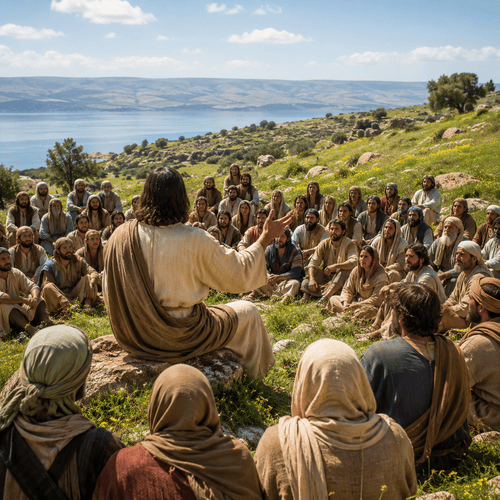
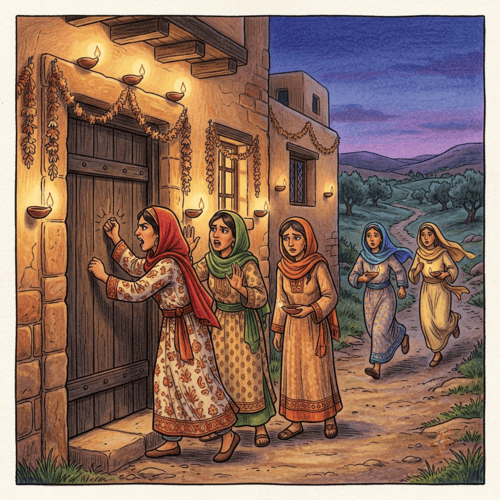
Picture 10 young women waiting outside a door as the sun goes down. They’re attending the same wedding party. They’re dressed for the evening. And each holds a lamp. They’re waiting for the same man.
Before the night is over, five will be inside the wedding feast. And five will find themselves outside the locked door. The latter hear words that stop us in our tracks: “Truly, I say to you, I do not know you” (Matthew 25:12).
What separates the first 5 from the second? That’s the point of the story: and it’s why this parable still troubles readers 2000 years later.
A parable is a short story told to teach a truth by comparison. It’s a picture, not a puzzle. And this particular picture is painted for people who’re quite sure they’re safe.
Where This Story Sits in the Bible
Matthew 25:1-13 isn’t a standalone story. It belongs to a long teaching session—the Olivet Discourse (Matthew 24-25)—Jesus gave on the Mount of Olives a few days before He died.
After describing the destruction of the temple and His own return, Jesus tells four stories in a row. Reading them together tells us what kind of story the ten virgins is.
| THE “GET READY” STORIES | WHERE THEY’RE FOUND | THE FAILURE THEY EXPOSE |
|---|---|---|
| The faithful and wise servant | Matthew 24:45-51 | Using the master’s delay as an excuse to behave badly |
| The ten virgins | Matthew 25:1-13 | Not being prepared for a wait that runs long |
| The talents | Matthew 25:14-30 | Doing nothing with what the master entrusted to you |
| The sheep and the goats | Matthew 25:31-46 | A life that produced no fruit at all |
WHAT THE FOUR STORIES HAVE IN COMMON
- The master, bridegroom or king goes away.
- He takes far longer to return than folks expected.
- He comes back suddenly, at an hour nobody chose.
- Some are ready. Some aren’t.
- The separation at the end can’t be undone.
Read together, the four stories aren’t a timetable for the future. They’re a warning about the present.
The Wedding Behind the Story
Weddings in first-century Israel weren’t like ours. A couple were first betrothed. Betrothal could last a long time. Then, on the wedding night, the bridegroom would come with his friends to collect his bride and bring her to his own home, where the feast would begin and might carry on for days.
The procession usually happened after dark, lit by lamps and torches. And the bridegroom was often late. Nobody in Jesus’ audience would have found the delay strange. That’s exactly why He built the story around it.
A WORD ABOUT “ANCIENT JEWISH WEDDING CUSTOMS”
Many websites and videos describe the ancient Jewish wedding in remarkable detail, then use those details to unlock supposed secrets in this parable. Treat such claims with care.
Most of that detail comes from Jewish writings collected between ADs 200 and 600, some even from the Middle Ages. It may well preserve older practice, but we can’t prove it does.
When someone’s main argument rests on a wedding detail Jesus never mentions, that’s a warning sign. Not crucial insight.
What we can say with confidence comes from Scripture itself. God repeatedly pictures His relationship with his people as a marriage (Hosea 2:19-20; Isaiah 54:5; Ezekiel 16). John the Baptist called Jesus the bridegroom (John 3:29). Paul told the Corinthians he’d betrothed them to one husband (2 Corinthians 11:2). And the last book of the Bible ends with a wedding: “Blessed are those who are invited to the marriage supper of the Lamb” (Revelation 19:9). That’s the imagery Jesus is drawing on—not a reconstructed ceremony, but a thread running through the whole Bible.
Walking Through the Story
10 young women take their lamps and go out to greet the groom (verse 1). Five are called wise and five foolish. The Greek words are phronimos, meaning sensible or prudent, and moros, meaning foolish—the same pair Jesus used of the two builders in Matthew 7:24-27. Remember that; we shall come back to it.
The foolish take their lamps but no oil with them. The wise take flasks of oil along with their lamps (verses 3-4). That’s the whole difference, and Jesus states it in two short sentences.
The bridegroom is delayed. All 10 are drowsy and fall asleep (verse 5). At midnight a shout goes up: “Here’s the bridegroom! Come out to meet him” (verse 6).
Now the difference shows. All ten trim their lamps, but the foolish find theirs going out. Notice the tense carefully: their lamps are going out, which means they’d been alight till then. They had a flame. They simply had nothing to keep it burning.
They ask the wise for oil. The wise refuse—not out of spite, but because there isn’t enough for both groups. Go to the dealers and buy, they say (verse 9). While the foolish are away, the bridegroom arrives. Those who were ready go in with him to the feast. “And the door was shut” (verse 10).
Then comes the knocking, and the cry, “Lord, lord, open to us.” And the answer: “Truly, I say to you, I do not know you” (verses 11-12).
Jesus then adds one line of application: “Watch therefore, for you know neither the day nor the hour” (verse 13). He interprets His own parable. Let’s pay close attention.
A NOTE ON THE LAMPS
The Greek word lampas can mean a small clay oil lamp held in the hand, or a torch—a pole wrapped in oil-soaked rags. Torches burned out roughly every quarter of an hour, which would make spare oil urgently important.
We can’t be certain which Jesus meant. Happily, the lesson is identical either way.
What All Ten Women Had in Common
Most sermons rush straight to the difference between the two groups. But the parable spends far more effort on what they shared. Look at how much these women had in common.
| WHAT EVERY ONE OF THE TEN HAD | WHAT IT STANDS FOR IN REAL LIFE |
|---|---|
| The title “virgin” | A respected place in the religious community |
| A lamp | A visible profession of faith-others could see their light |
| The invitation | Real membership in the wedding party, not gatecrashing |
| Belief that the bridegroom was coming | Genuine expectation of Christ’s return |
| A journey out to meet him | Active commitment that cost them effort |
| Drowsiness and sleep | Ordinary life carrying on through a long wait |
| The midnight cry | The same summons reached every one of them |
One thing separated them, and it was a thing few could see: a flask of oil held in reserve. It made all the difference since the wait ran long.
This is the most uncomfortable claim in the parable. On the evening in question, no observer could have picked out the five who’d be shut out. Neither, could the five themselves.
So What Is the Oil?
This is the question everyone asks, and the answers vary widely.
| THE VIEW | THE CASE FOR IT | WHERE IT BREAKS DOWN |
|---|---|---|
| The oil is the Holy Spirit | Oil is used for anointing throughout the Old Testament (1 Samuel 16:13; Zechariah 4), and the Spirit is called a seal and a guarantee (Ephesians 1:13-14). | It makes the wise women refuse to share the Holy Spirit, and it turns “go and buy” into purchasing the Spirit with money—the very sin condemned in Acts 8:20. |
| The oil is good works | John Chrysostom, preaching in the fourth century, took the oil to mean acts of mercy towards the poor. | It makes entry into the feast depend on a quantity of good deeds, which contradicts salvation by grace through faith (Ephesians 2:8-9). |
| The oil is saving faith | It fits the contrast between faith that lasts and faith that fades (Matthew 13:20-21). | Close to the mark, but it still treats one object in the story as a code word for one doctrine. |
| The oil is simply readiness | John Calvin, commenting on this passage, discouraged the hunt for a hidden meaning behind each object and read the lamps and oil together as a picture of the whole. | Correct as far as it goes, but pressed too hard it flattens the story until it says very little. |
There’s a better way to frame the question. Instead of hunting for the one thing the oil “really is”, let the story tell us what the oil does. Jesus gives it four clear properties, and those properties are the teaching.
WHAT THE OIL DOES IN THE STORY
It’s invisible from the outside. Nobody could tell who had it until the crisis came.
It can’t be lent or borrowed. It isn’t transferable, however willing the owner may be.
It can’t be obtained at the last moment. By midnight it’s far too late to go shopping.
It’s what keeps a light burning when the wait proves much longer than expected.
Now ask the obvious question: what’s true of a person that has all four of those properties? Not church membership—that is visible. Not baptism—that is public. Not a good reputation—that too can be seen. Not knowledge of doctrine, which can be borrowed from a friend in an afternoon.
Only one thing fits. The oil stands for real, inward, God-given grace that produces endurance: the life in the soul that God alone gives, that nobody can hand to another, that cannot be manufactured in a hurry, and that keeps a person’s light burning when believing becomes costly and the return of Christ seems very far away.
That reading needs no secret key. It’s simply what the story says.
SHOULD WE DECODE EVERY SINGLE DETAIL
Early preachers sometimes pressed the details very hard. Augustine of Hippo took the five virgins as a picture of the five senses. In the 19th century Adolf Jülicher reacted strongly in the opposite direction, arguing that a parable makes only one point and that nothing else in it means anything at all.
Both extremes are unhelpful. Craig Blomberg has proposed the sensible middle path: a parable usually makes roughly one point for each main character. Applied here, that gives three points, all of them drawn from the text:
From the bridegroom: Christ will certainly come, even if it’s later than we expect.
From the wise: readiness isn’t something we manufacture in ourselves. The oil had to be obtained before the night began, and it had to be obtained from someone who had it to give. The lesson is to go and receive this grace from God now, while it’s still freely on offer.
From the foolish: those who arrive at the end without that grace are shut outside. And nothing can reverse it afterwards.
Three lessons. No code required.
Why the Sleeping Wasn’t the Sin
Countless sermons have been preached on the danger of falling asleep spiritually, using this parable as the text. It’s a fine subject. It’s simply not what this passage is saying.
Read Matthew 25:5 again: “As the bridegroom was delayed, they all became drowsy and slept.” All ten. The wise included. And Jesus doesn’t criticise them for it. Not one word of blame is attached to the sleeping.
This matters far more than it may seem. If sleep were the sin, the command in Matthew 25:13 would mean “never rest, never relax, live in a state of permanent alarm”. That’s not Christianity; it’s anxiety with a Bible verse attached to it. The five wise women slept soundly, and they were right to. They’d made their preparations. Their sleep was the sleep of people who had done what needed doing.
Paul makes exactly the same move. He urges the Thessalonians to keep awake and be sober, and then adds that Christ died for us “so that whether we are awake or asleep we might live with him” (1 Thessalonians 5:10). The wakefulness he commands isn’t literal sleeplessness. It’s a settled readiness that holds good even while you’re asleep.
Why the Wise Women Wouldn’t Share
The refusal in Matthew 25:9 strikes many readers as ungenerous. Should the wise not have shared? Isn’t this the opposite of Christian love?
No. Their answer isn’t a comment on generosity. It’s a comment on the kind of thing oil is: “there will not be enough for us and for you.”
Some things genuinely can’t be shared. Ezekiel put it plainly: “the righteousness of the righteous shall be upon himself” (Ezekiel 18:20). The psalmist agrees: “Truly no man can ransom another” (Psalm 49:7).
This is among the most neglected lessons in the parable, and among the most needed. A great many people are quietly counting on somebody else’s oil.
“Go and Buy”—The Saddest Line in the Story
The advice sounds practical. It’s in fact a tragedy.
Notice first that the Bible’s usual invitation is the opposite of commercial: “Come, everyone who thirsts, come to the waters; and he who has no money, come, buy and eat!” (Isaiah 55:1). Grace has never carried a price tag.
So Matthew 25:9 isn’t teaching that salvation can be purchased. It’s showing us a door that has, for all practical purposes, already closed. The foolish women obey the instruction, and obedience at that hour costs them everything: they’re absent at the very moment the bridegroom arrives.
What was impossible at midnight had been perfectly possible at noon. The oil was available all day, cheaply, to anyone who wanted it. The tragedy isn’t that grace was scarce. It’s that they did not go for it while the shops were open.
The Door Was Shut
Four words, and they’re among the heaviest in the New Testament.
Jesus has just been speaking about Noah (Matthew 24:37-39). Any reader who knew Genesis would remember one detail of that account: when the family had gone into the ark, “the LORD shut him in” (Genesis 7:16). The door of the ark was not closed by Noah. It was closed by God. And once it was closed, no amount of knocking from outside made the slightest difference.
Luke records Jesus using the same picture on another occasion, with almost the same dialogue: the master of the house rises and shuts the door, and those outside plead. They’re told he does not know where they come from (Luke 13:25).
We instinctively assume there will be another opportunity. This parable exists to remove that assumption.
“I Do Not Know You”—and the Bookends of Matthew
Here’s something most treatments of the parable miss entirely.
Matthew’s Gospel contains five great blocks of Jesus’ teaching. The first is the Sermon on the Mount. Look at how it ends. Jesus describes people who call him “Lord, Lord”, who prophesy and cast out demons in His name, and He tells them, “I never knew you; depart from me” (Matthew 7:23). He then compares two builders, one wise and one foolish.
Now look at the last block of teaching. Five wise women and five foolish. People crying “Lord, lord”. And the verdict: “I do not know you.” The Greek words for wise and foolish are the same words in both places.
| THE BOOKENDS | MATTHEW 7:21-27 (END OF THE FIRST BLOCK) | MATTHEW 25:1-13 (NEAR THE END OF THE LAST) |
|---|---|---|
| Who is speaking | People who cry “Lord, Lord” | People who cry “Lord, lord” |
| The word for wise | phronimos—the wise builder | phronimoi—the five wise women |
| The word for foolish | moros—the foolish builder | morai—the five foolish women |
| What was missing | A foundation on rock | Oil held in reserve |
| The verdict | “I never knew you; depart from me” | “Truly, I say to you, I do not know you” |
Matthew has framed the entire teaching ministry of Jesus with the same warning at both ends. Confident religious profession that isn’t rooted in real grace won’t survive the last day. When a theme stands at the beginning and end of a book, the author isn’t hinting. He’s shouting.
What does “I do not know you” mean? Not that Jesus lacks information. In the Bible, to “know” a person often means to be in a committed relationship with them. God says to Israel, “You only have I known of all the families of the earth” (Amos 3:2)—which plainly does not mean he was unaware of anyone else. Jesus says, “I know my own and my own know me” (John 10:14). Paul writes, “The Lord knows those who are his” (2 Timothy 2:19).
So the sentence isn’t an insult. It’s a statement of fact about a relationship that never existed.
Had they lost something they once had?
A natural first reading is that the five foolish women were true believers who fell away. After all, their lamps had genuinely been burning.
But look closely at the wording. Verse 3 says they “took no oil with them”—not that they took oil and lost it. Their lamps failed for want of a reserve they’d never possessed. And the verdict is “I do not know you”, not “I no longer know you”.
John Calvin had a category for this. He called it temporary faith: a real experience of light, and even of joy, which is nevertheless not the enduring faith of those who truly belong to Christ. Jesus described exactly this in the parable of the sower, where the rocky ground receives the word with joy, endures for a while, and then falls away when trouble comes (Matthew 13:20-21). The apostle John gives the settled explanation: “They went out from us, but they were not of us” (1 John 2:19).
This is why the church has always distinguished between the visible church—everyone who professes faith and belongs to a congregation—and the invisible church, meaning all those actually united to Christ. Jesus taught the same thing in His parables of the wheat and the weeds and of the net full of good and bad fish (Matthew 13:24-30, 47-50). The two circles overlap. They’re not identical. And the sorting happens at the end, not now.
JC Ryle spent much of his ministry warning that a congregation can be crowded with people who possess the name of Christianity without the thing itself. In our own day Michael Horton has written at length about how easily churches keep the vocabulary of the faith while quietly losing its substance. The ten virgins is that warning in story form, and it came first from Jesus.
Are There Hidden Codes in the Details?
Search online for this parable and you’ll likely find a great deal of confident decoding. The number 10 unlocks something. The number 5 means something else. The midnight cry is really a particular Jewish festival. The lamps and flasks map onto stages of a future timetable. Somebody has even calculated what the oil would have cost.
Some of this comes from sincere people who love the Bible. It should still be refused, for three reasons.
- Jesus supplies the meaning Himself. Verse 13 is His own application: “Watch therefore, for you know neither the day nor the hour.” When the author of a story tells you what it means, a decoder is unnecessary.
- The Bible’s saving message is clear enough for ordinary readers. A meaning that becomes available only to those holding a numerical key is, by definition, not that.
- The method cannot be checked. Different decoders produce different and flatly contradictory schemes from the same 13 verses, and there is no way to test who is right. A method that can never be shown to be wrong is not a method.
There’s a bitter irony in this. Every scheme built on decoding the parable has been proved wrong. The parable’s own stated meaning—that we don’t know the day or the hour—has never once been proved wrong.
Other Readings, Weighed
Several other interpretations circulate widely. Each contains something worth hearing, and each finally fails on the wording of the text.
| THE READING | WHAT IT CLAIMS | WHAT IT MISSES |
|---|---|---|
| They lost their salvation | The foolish were true believers who fell away and were finally lost. | The text says they never took oil, not that they lost it. And the verdict is “I do not know you”, not “I no longer know you”. 1 John 2:19 explains such cases as people who were never truly of us. |
| They only lost rewards | The foolish are real Christians who forfeit rewards but are still saved. | “I do not know you” is the language of exclusion, not of a smaller prize. In the very next parable the unfaithful servant is cast into outer darkness (Matthew 25:30). And Scripture knows no Christian without the Spirit (Romans 8:9). |
| They were left behind | The wise are taken away and the foolish remain for the period of tribulation. | The door is shut permanently, and no second chance appears anywhere in the story. A two-stage return has to be carried into the passage from elsewhere; it cannot be drawn out of it. |
| It all happened in AD 70 | The whole discourse was completed with the fall of Jerusalem. | Much of Matthew 24 does concern that catastrophe, and Christians differ honestly about how much. But this parable stands immediately before the final judgement scene of Matthew 25:31-46, and a shut door and a wedding feast are the language of the end, not of a siege. |
| You must earn your oil | You must build up enough good works to qualify for entry. | Salvation is by grace through faith and not by works (Ephesians 2:8-9). Endurance is the evidence of real faith, never the price of it. The oil was not something the wise earned; it was something they’d been given and had carried with them. |
So What Does “Watch” Actually Mean?
We can now answer the question the parable itself raises.
The Greek word in verse 13 does mean “stay awake”. But we’ve already seen the wise women slept and weren’t blamed for it. So Jesus can’t be commanding literal sleeplessness. He is using a vivid word for something deeper. To watch, in this parable, means:
- To make provision now for a wait that may be far longer than you expect.
- To assume the return of Christ will come at an inconvenient hour, and to live so that the hour does not matter.
- To stop relying on anything that can be seen from the outside.
- To go and get oil while the shops are open—that is, to seek God today in His Word, in prayer, and in the worship and fellowship of His people.
Notice what watching is not. It’s not date-setting; Matthew 25:13 forbids that outright. It’s not nervous scanning of the news. It’s not living in a permanent state of emergency. It’s the calm, sensible foresight of someone who packs a torch—and oil—before setting out at night.
A Closing Word—Especially for the Anxious
A parable like this does two very different things to two very different readers.
To those who’re comfortable—who have been in church for years, who know the songs and the arguments, and who’ve never once seriously asked whether they belong to Christ—it should be deeply unsettling. That’s precisely what it was designed to be. Peter’s instruction stands: “be all the more diligent to confirm your calling and election” (2 Peter 1:10). Paul’s is blunter still: “Examine yourselves, to see whether you are in the faith” (2 Corinthians 13:5).
But to the reader who has already been troubled for months, who reads all this and thinks, “I am certain I am one of the foolish ones”—hear this carefully. The five foolish women were not anxious. They were confident. They discovered the problem only at midnight, and they were astonished. Fear of being without oil is not a symptom of being without oil. Far more often it is the mark of a heart that God has already made tender.
And if you are still unsure, the parable itself tells you exactly what to do. Go and buy. Not at midnight—now, while the shops are open and the price is nothing at all. “Come, everyone who thirsts, come to the waters; and he who has no money, come, buy and eat!” (Isaiah 55:1).
The door in the story was shut. Today, it is not.
Tough Questions, Honest Answers
Why does Jesus call them “virgins”, and why do some Bibles say “bridesmaids”?
The Greek word means unmarried young women, and here it describes their role in the wedding party rather than a moral achievement. That’s why some modern translations render it “bridesmaids”. The choice is reasonable, though it loses a sharp irony: even the honourable title is shared by the five who end up outside. Nothing in the parable turns on sexual purity, and it’s a mistake to preach it that way. The whole force of the story depends on the two groups being indistinguishable—titles included.
Where’s the bride? Why is she missing from the story?
She is simply not there, and a few later manuscripts added “and the bride” at verse 1 because copyists felt the gap. Parables don’t need to fill every role; they’re pictures, not photographs. Some interpreters have built elaborate schemes on her absence, arguing the ten virgins must therefore be a different group from the church. That reasoning requires the parable to be an allegory in which every element carries a separate meaning, which is exactly the method Jesus’ own conclusion in verse 13 discourages. The missing bride is a gap in the furniture, not a clue.
Is there significance in the number 10?
10 was a familiar round number in Jewish life, and it appears throughout Scripture as a figure of completeness. But the parable never comments on it, and Jesus draws nothing from it. The far more likely reason for 10 is practical: it divides neatly into two equal halves, and a story about 2 groups needs an even number. Reading a hidden meaning into it adds nothing the text supports.
Is the midnight cry the same as the last trumpet in 1 Thessalonians 4?
Both point to the same event—the return of Christ—but they’re different images, and neither should be used to decode the other. The cry in the parable is a herald announcing the bridegroom has arrived; the trumpet in Paul’s letters is a royal summons. Treating the parable’s midnight as a technical marker has a poor history, as the Millerite movement of the 1840s demonstrated at great cost. Jesus supplied His own interpretation in Matthew 25:13, and it points firmly away from calculation.
How is this different from the wedding feast parable in Matthew 22?
The two parables warn about different failures, which is why Jesus told both. In Matthew 22 the invited guests refuse to come at all, and one man who does come is thrown out for lacking the proper garment. In Matthew 25 everyone accepts, everyone comes, and everyone wants in—yet five cannot last the wait. Matthew 22 addresses the person who never really answers the call. Matthew 25 addresses the person who answers it enthusiastically and has nothing to sustain them. Together the two close both exits.
Does this parable help us work out when Christ will return?
It does the exact opposite, and says so in its final sentence: “you know neither the day nor the hour” (Matthew 25:13). The whole story depends on the arrival being unpredictable; if the timing could be worked out, the foolish women would simply have bought their oil at half past eleven. Jesus states elsewhere that even the Son, in his humanity, did not know that day (Matthew 24:36). Any scheme that uses this parable to date the return must contradict the parable in order to do so. Its purpose is to make date-setting unnecessary by making readiness permanent.
Is the parable about Israel or about the church?
Jesus spoke it to his disciples about everyone who waits for the Son of Man, and its principle applies to any community gathered around the promise of his coming. Some readers assign the virgins to a different group—Israel, or believers of some future period—so that the warning lands somewhere other than on themselves. That instinct is worth resisting, because deflection is the one response this parable cannot survive. Every congregation in every age contains people who look ready and are not. The right question is never “who are these five?” but “which am I?”
Related Reads
- Assurance of Salvation: How Can I Know I’m Truly Saved?
- Fool’s Paradise: Is My Assurance of Salvation Real or False?
- Predicting When Jesus Will Return: Why the Bible Forbids It
- Christ’s Return: A Primer on the Four Millennial Views
- The Second Coming of Jesus: Why Hasn’t He Returned Yet?
- Parable of the Shrewd Manager: Was Jesus Commending Dishonesty?