Twice in its long history, the city of Sardis was captured at night. Both times the city was believed to be impossible to attack. Both times, the men on the walls were asleep.
That’s the story sitting underneath the 5th of the 7 letters the risen Jesus Christ sends to the churches of Asia Minor in Revelation 2 and 3. The letter to the church in Sardis is short—all of 6 verses—and it’s the hardest of the 7 to read about ourselves. The Christians at Sardis aren’t accused of false teaching. They’re not accused of immorality. Nobody’s persecuting them. Their problem is simpler and far more frightening than any of that. They look completely fine, yet they aren’t.
“I know your works. You have the reputation of being alive, but you are dead.” (Revelation 3:1)
This post walks through Revelation 3:1–6 slowly: the strange city behind the imagery, the way Jesus introduces Himself, the diagnosis, the five commands, the warning about the thief, the faithful few in white, and the promise about the book of life that has caused more argument than almost any other line in Revelation.
A city that lived on its reputation
We can’t really understand what Christ says to the church at Sardis without knowing something about the city itself. Almost every phrase in the letter is a local reference. The people who first heard it read aloud would have recognised their own streets, their own trade and their own embarrassing history.
- Rich beyond imagining. Sardis was once the capital of the kingdom of Lydia, and its most famous king was Croesus—so wealthy that English still says “as rich as Croesus”. Archaeologists have uncovered the workshops beside the Pactolus stream where his craftsmen separated gold from silver, among the earliest gold refining known anywhere.
- Apparently impossible to capture. The old city sat on a spur of Mount Tmolus, roughly 1,500 feet above the valley of the river Hermus, with sheer cliffs on three sides and only one narrow approach. Sardis felt safe in a way few ancient cities ever did.
- Captured anyway—twice. See the table below. Neither fall came from a frontal attack. Both came from a single climber and a sleeping guard.
- Flattened by an earthquake. In AD 17 a violent earthquake destroyed the city. Emperor Tiberius cancelled its taxes and sent relief money, and Sardis was rebuilt. But the new Roman town lived largely off the memory of the old Lydian one.
- Famous for wool and dye. Sardis was a textile centre, known across the region for dyed woollen cloth. Keep this in mind when the letter starts talking about stained clothing and white robes.
- Surrounded by tombs. Across the valley lay Bin Tepe, “the thousand hills”—a vast field of burial mounds. The living city looked out every day on a landscape of graves. Jesus tells this city that it is dead.
| WHEN | WHO TOOK THE CITY | HOW IT HAPPENED |
|---|---|---|
| 546 BC | Cyrus, king of Persia | A Persian soldier watched a defender climb down the cliff face to fetch a fallen helmet. That night, troops followed the same hidden path up and walked into an unguarded city. |
| 214 BC | Antiochus III of Syria | A Cretan soldier named Lagoras noticed the identical weak point in the defences and repeated the trick almost exactly, more than 300 years later. |
Sardis was never beaten in open battle. It was beaten twice by men who climbed up quietly while the watchmen slept. When Jesus says “I will come like a thief”, He is reading their own history back to them.
THE QUIET DANGER
Notice what’s absent from this letter. Smyrna and Philadelphia were suffering real persecution. Pergamum and Thyatira were fighting false teachers inside the congregation. Ephesus had grown cold but was still working hard.
Sardis had none of this. As far as we can tell, nobody was troubling the Christians of Sardis at all. Life was comfortable.
That’s precisely the point. This church wasn’t killed by opposition. It was killed by peace.
Who is speaking? The one who holds the Spirit
Every one of the 7 letters opens by describing Jesus in a way that matches exactly what that church needs. The description is never decoration. It’s already part of the answer.
“The words of Him who has the seven spirits of God and the seven stars.” (Revelation 3:1)
- “The seven spirits of God” doesn’t mean seven separate spirits. Throughout Revelation, 7 is the number of fullness and completeness. This is a picture of the one Holy Spirit in His full and perfect power. The same phrase appears in Revelation 1:4, 4:5 and 5:6, and it echoes Isaiah 11:2, where the Spirit resting on the Messiah is described in a sevenfold way.
- “The 7 stars” are explained for us in Revelation 1:20: they’re the messengers, or angels, of the 7 churches, and Revelation 1:16 says Jesus holds them in His right hand.
Put those two together and something quietly wonderful happens. To a church that’s spiritually dead, the very first thing Jesus says about Himself is that He holds the Spirit who gives life. He doesn’t open with the problem. He opens with the resource. And He speaks first to the messengers—the leadership. A congregation rarely goes to sleep on its own.
The diagnosis: a great name and no life
“I know your works,” Jesus says, and that short phrase does most of the damage. The congregation had an opinion about itself. The city had an opinion about it too. Both were wrong, and neither was the opinion that counted.
The word translated “reputation” in verse 1 is simply the ordinary Greek word for name. And once you see that, we notice “name” runs like a thread through all 6 verses of the letter.
| VERSE | WHERE “NAME” APPEARS | WHAT IT REFERS TO |
|---|---|---|
| 3:1 | You have the name of being alive | What the public says about you |
| 3:4 | You have still a few names in Sardis | Individual believers God knows personally |
| 3:5 | I will never blot his name out of the book of life | A citizenship that cannot be cancelled |
| 3:5 | I will confess his name before my Father | Christ’s own public verdict on a person |
The letter travels from a name given by the neighbourhood to a name spoken aloud by Christ in heaven. Reputation is the cheapest of the four; the last is the only one that lasts.
Of the 7 churches, only 2 receive no word of praise at all: Sardis and Laodicea. But notice how different Sardis is even from the other troubled congregations. There’s no heresy here to correct, no scandal to confront, no persecution to endure. There’s simply nothing there. This is respectability without life.
Then comes the sharpest line in the letter: “I haven’t found your works complete in the sight of my God” (Revelation 3:2). The Greek word means filled full, brought to completion. Their good works had been started and never finished. Something was going on at Sardis—meetings, activity, structure—but when God looked at it, nothing had been carried through.
This isn’t a claim that our works save us; Scripture is clear they don’t. It’s a claim that living faith always produces something, and that where nothing living is produced, we’re entitled to ask whether the faith is there at all.
TWO WORDS WORTH KNOWING: THE VISIBLE AND THE INVISIBLE CHURCH
Christians have long used a pair of phrases that explain exactly what’s happening at Sardis.
The visible church is the church you can see: the names on the membership roll, the people in the seats, the building, the budget, the programme.
The invisible church is the whole company of people God has actually made alive by his Spirit. He knows that list perfectly. We only ever see it partly.
The two overlap, but they aren’t identical. Augustine of Hippo taught this; John Calvin developed it; the Protestant confessions state it plainly. Sardis is the living proof. A congregation can be entirely visible and largely dead.
This church has its doctrine right. Correct teaching is a gift and a duty, and no church should ever trade it away. But correct teaching isn’t the same as spiritual life, and a congregation can hold the first while quietly losing the second. Michael Horton has argued that the greatest threat to comfortable Western churches is not open unbelief but a hollowed-out religion that keeps the Christian vocabulary while mislaying the Christian gospel. That’s a modern description of Sardis. Sinclair Ferguson adds a related point: decline almost never begins with a decision to abandon the gospel, but with a slow drift in which the gospel is assumed rather than treasured.
Five commands to a dying church
“Wake up, and strengthen what remains and is about to die, for I have not found your works complete in the sight of my God. Remember, then, what you received and heard. Keep it, and repent.” (Revelation 3:2–3)
Jesus gives Sardis 5 instructions. They’re worth taking one at a time.
- Wake up. The Greek is closer to “become watchful”—a continuing condition, not a single jolt. Jesus isn’t asking for one dramatic night of revival. He’s asking for a church that stays awake.
- Strengthen what remains. Notice: not “start again”. Something is still alive at Sardis, even if it’s nearly gone. For anyone serving a small, tired congregation, this is one of the most encouraging commands in the New Testament.
- Remember what you received and heard. The gospel they were first given, when the church was planted. Not a new idea. The old one.
- Keep it. Guard it, hold on to it, don’t let it slip through your fingers again.
- Repent. The word means to turn round—a change of mind that produces a change of direction. It’s not merely feeling sorry. It’s walking the other way.
NOTICE THE ORDER, AND NOTICE WHAT’S MISSING
Remembering comes before repenting. We cannot turn back towards something we’ve forgotten.
And look at what Jesus doesn’t give them. No new method. No new teaching. No new strategy. No new programme. Everything Sardis needs, Sardis already had and let go of.
The cure for a dying church isn’t invention. It is return.
“I will come like a thief”
“If you will not wake up, I will come like a thief, and you will not know at what hour I will come against you.” (Revelation 3:3)
For a city taken twice at night by a climber and a sleeping sentry, this wasn’t a general illustration. It was a wound being reopened on purpose.
The image appears right across the New Testament: Matthew 24:43, Luke 12:39, 1 Thessalonians 5:2, 2 Peter 3:10 and again in Revelation 16:15. But one detail here is easy to rush past. Jesus says He will come against you—against this particular church. Alongside His final return at the end of history, Scripture also speaks of God visiting a congregation in judgement within history; Ephesus is warned its lampstand can be removed (Revelation 2:5). A church can be judged long before the last day, and the shape of that judgement is usually simple. It stops existing, and hardly anybody notices.
Does this mean Christians should live in fear of being caught out? Paul answers directly: “But you are not in darkness, brothers, for that day to surprise you like a thief” (1 Thessalonians 5:4). A thief only surprises people who are asleep. Watchfulness and assurance aren’t rivals; being certain of Christ is exactly what keeps a believer awake.
How should we read the 7 letters?
Because these letters sit inside Revelation, how we read the book shapes how we read them. Four main approaches are on offer.
| APPROACH | READS THE SEVEN LETTERS AS… | THE DIFFICULTY WITH IT |
|---|---|---|
| Preterist | Messages to 7 real congregations in the 1st century, fulfilled in that era | Struggles to explain why the Spirit is still said to be speaking “to the churches” in every generation |
| Historicist | 7 successive ages of church history, with Sardis usually placed after the Reformation | The chart is brought to the text rather than drawn from it—and it ends up labelling the Reformation era “dead” |
| Futurist | Mainly a preview of a short final period just before Christ returns | Turns letters addressed to named towns into something their first readers could not have used |
| Idealist | 7 real first-century congregations whose spiritual conditions recur in every age | Must take care not to loosen the letters from their genuine historical setting |
Most careful Protestant commentators today—William Hendriksen, Gregory Beale, Vern Poythress and Dennis Johnson among them—hold the last approach while keeping a firm grip on the first-century setting. Hendriksen argued Revelation runs through the same span of history 7 times over, each time from a different angle. That’s the position taken here.
One detail settles it. Every letter ends the same way: “what the Spirit says to the churches”—plural. The letter to Sardis was read out in all 7 cities, and it’s read in ours. No congregation may treat it as somebody else’s file.
A few names in white
“Yet you have still a few names in Sardis, people who have not soiled their garments, and they will walk with me in white, for they are worthy.” (Revelation 3:4)
Even here, God hasn’t left Himself without witnesses. The Bible calls such a group a remnant—a small number left when the rest have gone. When the prophet Elijah was certain he was the only believer left in Israel, God told him that seven thousand remained (1 Kings 19:18). Paul picks up the same story and says that in his own day too there was “a remnant, chosen by grace” (Romans 11:5). God has never once lost his hold on a whole generation.
And notice the wording again: a few names. The congregation had a name that was worthless. These individuals have names God knows personally.
“Soiled garments” simply means dirty clothes. In the ancient world you did not approach a god in stained clothing—it was a recognised insult—and in a town living on dyed cloth the picture would have landed hard. Behind it stands one of the most striking scenes in the Old Testament: Zechariah sees Joshua the high priest standing before God in filthy clothes, and God commands that they be taken off him and pure garments put on instead (Zechariah 3:3–5). The dirt isn’t scrubbed. The clothes are replaced.
HOW CAN ANYONE BE CALLED “WORTHY”?
Verse 4 says these believers “are worthy”, and that word makes many readers uneasy. Does it mean they earned their place?
Look carefully at what happens next. Verse 4 says they’re worthy; verse 5 says the one who conquers “will be clothed in white garments”. Someone else does the dressing. The believer never weaves the robe.
Revelation says the same thing everywhere it mentions these garments. In Revelation 7:14 the robes are white because they’ve been washed in the blood of the Lamb. In Revelation 19:8 the bride wears fine linen because “it was granted her” to be clothed.
So “worthy” here describes people who’ve already been dressed by another. It’s a description of what grace has made them, not a receipt for what they paid.
Can a name be blotted out of the book of life?
“The one who conquers will be clothed thus in white garments, and I will never blot his name out of the book of life.” (Revelation 3:5)
If Jesus has to promise not to erase a name, does that prove a name can be erased? Many sincere Christians have concluded exactly that. We think the verse teaches the opposite, and here’s the case.
- The grammar is the language of reassurance. The Greek uses the strongest available way of saying “never”—a double negative attached to a future verb. It’s the sort of construction we use to steady frightened people, not to hint at a hidden danger. A father who tells his child “I will never, ever let go of your hand” isn’t warning the child that he might.
- The picture is a citizen list. Every ancient city kept a register of its citizens, and names were struck off it at death or after a serious crime. Sardis, of all places, was obsessed with status and standing. To such a city Christ promises a citizenship no authority can revoke. Paul uses the same civic image when he tells the Philippians their citizenship is in heaven (Philippians 3:20).
- Revelation itself tells us when the book was written. It is “the Lamb’s book of life”, and it was “written before the foundation of the world” (Revelation 13:8; also Revelation 17:8). A list completed before the world began isn’t a list being edited as history goes along. This single detail carries most of the weight of the argument.
- The Old Testament background points the same way. Moses pleads to be blotted out in place of Israel and is refused (Exodus 32:32–33); Daniel 12:1 promises deliverance to everyone “whose name shall be found written in the book”; Malachi 3:16 records a book of remembrance for those who fear the Lord. In every case the book records who truly belongs to God—not who is currently doing well.
- A warning is one of the ways God keeps His people. This is the part most often missed. A warning in Scripture isn’t evidence the promise might fail; it’s one of the tools God uses to make sure it doesn’t. John Piper has spent much of his ministry pressing this point: the New Testament warnings aren’t threats dangling over believers, but the very means by which God holds them fast.
- Those who fall away were never truly in. The apostle John states this as plainly as anyone could wish: “They went out from us, but they were not of us” (1 John 2:19). Departure does not erase a name. It reveals that the name was never written.
- “The one who conquers” describes; it doesn’t qualify. Overcoming is the mark of a real Christian, not the price of becoming one. The conquering is the evidence, not the entrance fee.
| WHAT GOD PROMISES | WHAT WE ARE TOLD TO DO |
|---|---|
| He keeps every single one of His own, and loses none of them. | We keep watching, remembering and repenting. |
| The citizenship he has granted cannot be cancelled by anyone. | We are told to wake up—and we wake up. |
| The white robe is washed, granted and given, never earned. | We refuse to soil the garment we have been given. |
These aren’t 2 rival truths that have to be balanced against each other. The right-hand column is the way God carries out the left-hand column. Certainty about the promise is what produces the effort, not what removes it.
The name he says out loud
“I will confess his name before my Father and before his angels.” (Revelation 3:5)
Jesus is quoting Himself here. During His ministry He had said, “everyone who acknowledges me before men, I also will acknowledge before my Father who is in heaven” (Matthew 10:32; see also Luke 12:8). And with that, the letter closes its circle. Sardis had an impressive name in front of the public and no name at all in front of God. The Christian who overcomes may have no reputation whatsoever—no platform, no following, nobody who knows what it cost—and Christ speaks that person’s name out loud, in front of the Father and the angels. The last word on any believer is not spoken by the neighbourhood. It is spoken by Him.
Stones, crosses and a man called Melito
Sardis has been excavated more or less continuously since 1958 by a joint Harvard and Cornell expedition. Visitors today can see the enormous temple of Artemis, a bath and gymnasium complex, a restored row of Roman shops, the gold refinery of the Lydian kings, and a synagogue among the largest known anywhere in the ancient Jewish world. Two points of honesty are worth making: no first-century church building has been identified at Sardis, and the surviving synagogue dates from long after John wrote. Archaeology gives us the world of this letter, not the congregation that received it.
But it does give us one striking image. Christian crosses are cut into the stone blocks of the temple of Artemis, and a small chapel was later built against one corner of the ruin. The gospel outlasted the shrine.
One final detail is worth knowing. Around AD 170, roughly a century after this letter was written, the bishop of Sardis was a man named Melito. He wrote On Pascha, one of the earliest complete Christian sermons to survive, and the historian Eusebius records that Melito drew up the earliest known Christian list of the Old Testament books. We cannot prove the warning was heeded. But the church told to wake up went on to produce one of the finest minds of the second century, and that is worth noticing.
The question this letter leaves with us
The letter to the church at Sardis doesn’t ask whether our church is busy, respected, well organised or well attended. Sardis was all of those things. It asks a harder question: is it alive?
And it isn’t a hopeless letter. It contains five commands and two promises, and every one of them comes from the lips of the one who holds the Spirit of God in His hand. A church that can still hear this letter is a church that isn’t yet finished. Neither, for that matter, is a Christian.
“He who has an ear, let him hear what the Spirit says to the churches.” (Revelation 3:6)
Tough Questions, Honest Answers
Where is Sardis today, and can you visit the ruins?
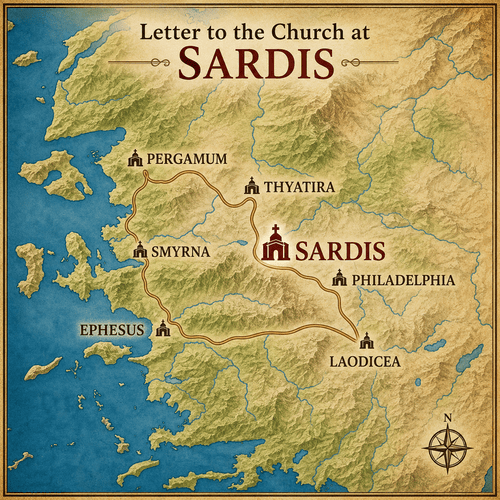
Sardis lies beside the modern village of Sart in Manisa Province in western Turkey, roughly 60 miles inland from Izmir. The site is open to visitors and is unusually rewarding, because so much of it has been reconstructed. The temple of Artemis still stands to a considerable height, the restored Roman shop row and the marble court of the bath and gymnasium complex are genuinely impressive, and the synagogue floor mosaics are largely intact. The acropolis that the sleeping sentries failed to guard rises steeply behind the site and can still be climbed. Christians visiting the 7 churches usually take Sardis together with Philadelphia and Thyatira, all of which lie within a short drive.
Why did Jesus write to the 7 churches and not to others?
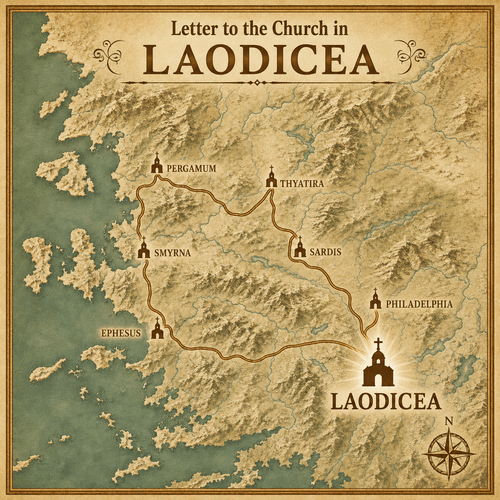
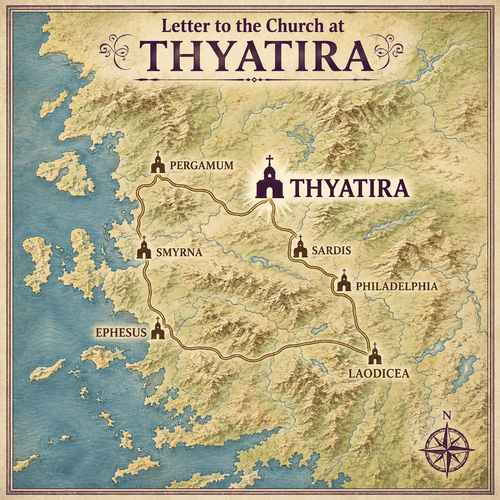
There were certainly more than 7 churches in the Roman province of Asia—Colossae and Hierapolis are both named elsewhere in the New Testament and neither receives a letter. The 7 cities that were chosen sit on a natural circular road running north from Ephesus, then inland and back down, in exactly the order the letters are given. A messenger carrying the scroll would have visited them in that sequence, and each city functioned as a postal and administrative centre for the region around it. Beyond the practical explanation, the number seven carries its usual biblical weight of completeness. These are seven real congregations, and together they stand for the whole church in every age, which is why the closing line of each letter is addressed to the churches in the plural.
Is the “angel of the church in Sardis” a real angel or the minister?
The Greek word means “messenger” and can refer to either. 4 main answers have been offered: a guardian angel over each congregation, a heavenly representative of the church, the human messenger carrying the letters, or the minister who would read the letter aloud to the assembled congregation. We think the last of these fits best. It’s difficult to see how an angel could be told to repent, and difficult to see why a letter would be posted to a heavenly being. Reading it as the minister also explains the sharpness of the address: the man responsible for keeping the congregation awake is held responsible for its sleep. That said, the letter is then immediately read to everyone, so no one in Sardis could hide behind the leadership.
Both Sardis and Laodicea receive no praise. Is one worse than the other?
They’re 2 different diseases rather than 2 degrees of the same one. Sardis is unaware—it genuinely believes it is alive, and the whole city agrees. Laodicea is self-satisfied, telling itself that it is rich and needs nothing (Revelation 3:17). Sardis is asleep; Laodicea is comfortable. There is one difference in tone worth noting: Sardis is told that a faithful few remain, while no such remnant is mentioned at Laodicea. But Laodicea receives the tenderest invitation of all seven letters, with Christ standing at the door and knocking. Neither church is written off, and neither is presented as beyond hope.
Is the “Lamb’s book of life” different from the “book of life”?
No—Revelation uses both expressions for the same register. The shorter form appears in Revelation 3:5 and 20:12–15; the fuller form, “the Lamb’s book of life”, appears in 13:8, 17:8 and 21:27. The longer title simply makes explicit whose book it is and how the names came to be there: it belongs to the Lamb who was slain, and the names were written in it before the foundation of the world. That is a significant detail, because it ties the register directly to the cross. This is not a list of people who performed well enough to stay on it, but a list of people the Lamb purchased. The variation in wording is emphasis, not a second book.
Does this letter apply to me personally, or only to a whole congregation?
Both, and in that order. The letter is addressed to a congregation, and its first application is corporate—churches, denominations and whole movements can carry an impressive name while the life has quietly drained out of them. But verse 4 turns to individuals: “a few names in Sardis”. God does not assess us as a block. A believer can be genuinely alive inside a dying church, and a person can be spiritually dead inside a thriving one. So the letter presses two questions rather than one. Paul gives the personal version of it plainly: examine yourselves, to see whether you are in the faith (2 Corinthians 13:5). That examination should send us to look at Christ, not to sink into endless anxious introspection—the point of the test is to drive us back to the one who gives life.
Is the gemstone “sardius” in the Bible named after Sardis?
Very possibly, though it can’t be proved. The sardius, also called carnelian or sard, is a reddish-orange stone that appears in the breastpiece of the high priest (Exodus 28:17), in the description of the one seated on the throne (Revelation 4:3), and among the foundation stones of the new Jerusalem (Revelation 21:20). Ancient writers, including Pliny the Elder, connected the name of the stone with the city, and the region certainly traded in it. Other scholars trace the word to a Persian root instead. It makes no difference to the meaning of any passage, but there is a quiet irony in it: a city that Christ calls dead lent its name, perhaps, to a stone set in the walls of the city that never dies.