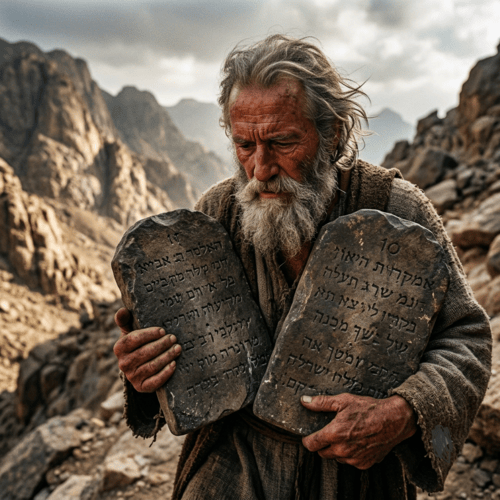
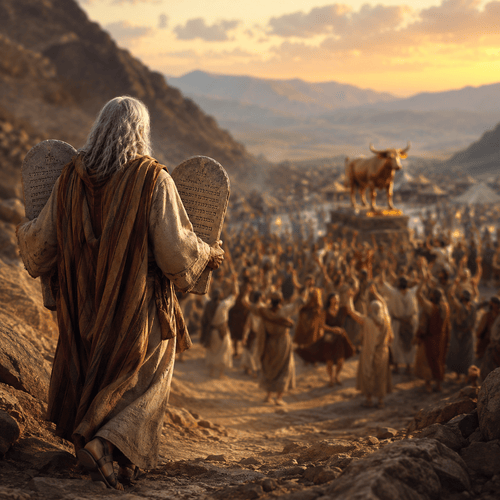
Israel had heard God speak at the mountain. Weeks later they were dancing round a golden calf—while Moses was still on the mountain. But here’s the detail most people miss: they hadn’t yet swapped God for a different god. Aaron looked at the calf and announced, “Tomorrow shall be a feast to the LORD” (Exodus 32:5). They still meant the God who had brought them out of Egypt.
And 3000 people died that day.
If they were worshipping the right God, why did it matter so much how they did it? That question is the second commandment.
“You shall not make for yourself a carved image, or any likeness of anything that is in heaven above, or that is on the earth beneath, or that is in the water under the earth. You shall not bow down to them or serve them, for I the LORD your God am a jealous God…” (Exodus 20:4–5)
1st and 2nd: Whom, and How
The 1st commandment and the 2nd are often blurred together, and blurring them costs us something important. The difference is simple once you see it.
| THE FIRST COMMANDMENT | THE SECOND COMMANDMENT | |
|---|---|---|
| The question it answers | Whom do we worship? | How do we worship? |
| What it forbids | Worshipping a false god | Worshipping the true God falsely |
| How it is broken | By turning to another god—money, power, a rival deity | By reducing the true God to something we have made |
| Test case | Israel serving the Baals in the book of Judges | Israel and the golden calf in Exodus 32 |
That’s why the golden calf is such a frightening story. It isn’t the story of a nation abandoning God. It’s the story of a nation trying to worship God on their own terms, using something they could see and manage. They kept the name. They changed the method. And God treated it as a catastrophe.
The details deepen the picture. The people asked for gods who’d “go before us” because Moses was delayed, and the announcement over the finished calf was plural: these are your gods who brought you up out of Egypt (Exodus 32:1, 4). Aaron’s later explanation to Moses is almost comic in its evasion—he threw the gold into the fire, he says, and out came this calf (Exodus 32:24). Psalm 106 gives the sober verdict centuries later: they exchanged the glory of God for the image of an ox that eats grass (Psalm 106:20). That’s what every image does. It trades something immeasurable for something that’s our own invention.
Philip Ryken makes the point sharply in his work on Exodus: the calf didn’t replace God in Israel’s stated intentions—it replaced Him in reality, because a God we can carry isn’t the God who carries us.
What the Words Actually Say
Three details in the text repay a slow reading.
“Carved image.” The Hebrew word is pesel, meaning something hewn or shaped—originally from stone or wood. It’s joined by a 2nd word, temunah, meaning a form or likeness. Between them the two words cover anything made to represent something else. This is deliberately broad language.
“Anything in heaven above, on the earth beneath, or in the water under the earth.” This is a sweep of the entire created order in three parts: sky, land and sea. John Currid observes in his commentary on Exodus the phrasing deliberately leaves no category out. There’s nothing anywhere in creation that may serve as a representation of the Creator, because everything anywhere in creation is smaller than He is.
“For yourself.” This small phrase does a great deal of work, and missing it leads to confusion. The commandment forbids making an image for yourself—that is, for religious use, as a way of approaching God. It isn’t a blanket ban on sculpture, drawing, photography or design.
DOES THE SECOND COMMANDMENT FORBID ALL ART?
No—and the Bible settles this for us, because God Himself commanded religious art.
The tabernacle was to have two golden cherubim over the ark, and its curtains were woven with cherubim (Exodus 25:18–22).
The temple was decorated with carved palm trees, open flowers, lions and oxen (1 Kings 6:29; 7:25–29).
The bronze serpent was made at God’s own command, and people who looked at it were healed (Numbers 21:8–9).
God can’t have forbidden in Exodus 20 what He commanded in Exodus 25. So the commandment isn’t aimed at craftsmanship.
But watch what happened to the bronze serpent. Centuries later, King Hezekiah smashed it—because Israel had begun burning incense to it (2 Kings 18:4). The object was fine for 700 years. The moment it was worshipped, it had to go.
The line isn’t between art and no art. It’s between art and worship.
Why Does God Take This Seriously?
3 reasons, and the 3rd is the one we least expect.
1. Because every image tells a lie about God
God gives His own reason for this commandment, and He’s unusually explicit about it.
“Therefore watch yourselves very carefully. Since you saw no form on the day that the LORD spoke to you at Horeb out of the midst of the fire, beware lest you act corruptly by making a carved image for yourselves, in the form of any figure…” (Deuteronomy 4:15–16)
Read that carefully. The reason given is that there was nothing to see. God came in fire and voice, and He gave Israel words rather than a shape. That wasn’t an accident of the occasion. It was the point of it.
Any image of God must be made of something. Something with edges, a size, a colour, a location. And God has none of those things. So every image, however skilled, necessarily says something untrue about Him—that He’s limited, that He’s local, that He’s the kind of thing that can be looked at. Herman Bavinck argues the moment we picture God we’ve already begun to shrink Him, because a picture can only show what is finite.
There’s a historical detail here that makes the commandment even more striking. In the ancient world, an image wasn’t thought of as a mere reminder. Temples across Egypt, Mesopotamia and Canaan performed rituals to make a statue the place where the god became present and could be fed, washed and consulted. A temple with no image in it would have seemed to a visitor like a house with nobody living in it.
Now consider Israel’s most holy place. Behind the curtain sat the ark, with two cherubim facing each other and their wings spread over it. Between them—nothing. God is repeatedly described as enthroned above the cherubim, and the throne is visibly empty. Every other nation put a statue at the centre of its worship. Israel put a space, a box of words, and a voice.
2. Because an image puts us in charge
This is the reason people rarely think of, and yet arguably, it’s the deepest one.
An image can be handled. It can be placed where we want it, carried where we’re going. It can be housed, fed, cleaned and covered over. It doesn’t interrupt. It never says anything we didn’t expect. It never makes a demand at an inconvenient hour.
A God who speaks can’t be managed like that. Michael Horton makes this point repeatedly in his writing on worship: the difference between the God of the Bible and an idol isn’t chiefly that one is visible and the other isn’t. Rather, it’s that one addresses us and the other does not. Idolatry looks like devotion, but underneath it’s a bid for control.
The golden calf makes perfect sense once we see this. Moses was up on the mountain, gone longer than expected, and the people wanted a God they could locate. So they made one. It wasn’t rebellion in their own minds. It was religious anxiety, solved by taking charge.
3. Because we become like what we worship
We met this principle in the 1st commandment, and it applies with equal force here. Psalm 115 says those who make idols become like them. GK Beale traced this thread across the whole Bible in We Become What We Worship.
So a God we’ve shaped will shape us in return. Worship a God we can manage, and we’ll slowly become people who expect to manage him. And we’re surprised when he doesn’t cooperate. And offended when he doesn’t behave as the picture in our head suggested he would.
The Hard Part of the Text
We mustn’t skip past the words that follow, because honest readers stumble over them.
“…visiting the iniquity of the fathers on the children to the 3rd and the 4th generation of those who hate me, but showing steadfast love to thousands of those who love me and keep my commandments.” (Exodus 20:5–6)
Does God punish children for what their parents did? Three things need saying.
| THE CONCERN | THE ANSWER |
|---|---|
| Is guilt transferred from father to son? | No. Scripture is explicit elsewhere: “The son shall not suffer for the iniquity of the father” (Ezekiel 18:20). Nobody is condemned for someone else’s sin. |
| Then what does the phrase mean? | Notice the qualifier: “of those who hate me”. The judgement falls on later generations who continue in the same hostility. It describes a family carrying on a rebellion, not an innocent child punished for an ancestor. |
| Why mention generations at all then? | Because idolatry is transmitted. Children learn worship from parents—what’s treated as ultimate, what’s quietly assumed, what’s never questioned. False worship runs in households, and God is warning parents their choices land on people they love. |
| Is the threat the main point? | No, and the maths says so. Judgement reaches 3 or 4 generations. Steadfast love reaches thousands. The 2 halves aren’t balanced. They were never meant to be. |
How We Break It Today, Without a Chisel
Most of our readers have never carved anything. That doesn’t put us outside this commandment.
3 WAYS WE BREAK THE 2ND COMMANDMENT—EVEN WITHOUT MAKING A STATUE
The God of our imagination. JI Packer argued in Knowing God this commandment is aimed at the mind as much as at the workshop. A picture of God built inside our heads out of preference or assumption is still a manufactured image—and it’s more dangerous than a statue, because we can’t see it sitting there.
The God we prefer. Any sentence beginning “the God I believe in would never…” should be examined carefully. Sometimes it reflects Scripture. Often it reflects taste. Selecting the attributes of God we find agreeable and quietly setting the rest aside is image-making with better manners.
Worship designed to work on us. When the question governing a service becomes what will move the room rather than what God has appointed, we’ve started shaping the encounter ourselves. That’s the golden-calf instinct in a modern setting.
The test in every case is the same: did God give us this, or did we make it?
What about pictures of Jesus?
This is the question readers actually want answered, and it deserves a straight reply rather than a careful dodge.
One view is that the 2nd commandment forbids images made to be worshipped, not images used to illustrate and teach. The 2 verbs in the text belong together: you shall not make a carved image, and you shall not bow down to them or serve them. The making that’s forbidden is making for yourself—for religious use, as a way of approaching God. That’s why God could forbid images in Exodus 20 and command cherubim in Exodus 25 without contradicting Himself.
John Frame has made the case for this reading as carefully as anyone. He points out Scripture itself is full of pictures of Jesus. The Gospels describe Him sleeping in a boat, weeping at a grave, writing in the dust, hanging on a cross. Those descriptions produce images in the mind of every reader, and they are meant to. If picturing Jesus were forbidden in principle, the Gospels would be an odd way to tell us so.
Two objections are usually raised, and both deserve an answer rather than a shrug.
“A picture can only show His human nature.” Christ is one person with two natures, and an image showing His humanity necessarily leaves out His deity. But the same objection would rule out words, too: No sentence captures the deity of Christ either. When Isaiah says He had no form or majesty that we should look at Him, or when John says the Word became flesh and we have seen His glory, we’re being given a human picture and asked to believe more than the picture shows. That’s how all revelation of the incarnate Son works. If depicting the visible without exhausting the invisible were idolatry, Scripture would be guilty of it on nearly every page.
“We don’t know what He looked like.” This is true, and it’s a real limit—but it’s a limit on precision, not a moral prohibition. Every translator, every preacher describing a scene, every parent telling the story at bedtime supplies detail the text doesn’t give. The honest response is modesty about the detail, not silence about the event. It’s worth adding the Gospels’ silence about His appearance is itself instructive: it tells us what He looked like was never the point, which is a good reason to keep faces out of the foreground.
Sure, many Reformed brethren would disagree with us. The Heidelberg Catechism and the Westminster Larger Catechism take the stricter line, and they do so for a serious reason: they’d watched what happens when pictures become the focus of devotion rather than the servant of instruction. We take that warning seriously even though we don’t draw the line where they drew it. This is an argument among friends who share the same commandment, not a test of who belongs to Christ.
A Wider Principle: Worship on Whose Terms?
If the 2nd commandment is about the manner of worship, it’s about more than just images. It raises a question every church must answer: who decides how God is approached?
| TWO APPROACHES | WHAT EACH ONE HOLDS |
|---|---|
| The normative principle | In worship, we may do whatever Scripture doesn’t forbid. If God hasn’t ruled it out, the church is free to include it. |
| The regulative principle | In worship, we do what Scripture positively directs. The elements of worship—reading, preaching, prayer, singing, the sacraments, giving—are those God has appointed. |
Reformed churches have held the 2nd view, and the 2nd commandment is the main reason why. The argument isn’t that everything must be spelled out in detail—the time of the service and the tune of the hymn are matters of ordinary wisdom. The argument is that God alone has the right to say how He is to be approached, and history shows what happens when that right is assumed by us.
It’s worth saying this principle is often heard as restrictive. In practice it’s freeing. A church that has to invent an experience each week is under enormous pressure. A church that has been told what to do can get on with it.
What the Commandment Requires
Following the rule we set out at the start of the series: where a sin is forbidden, the opposite duty is commanded.
| WHAT IT FORBIDS | WHAT IT THEREFORE REQUIRES |
|---|---|
| Making any representation of God for worship | Receiving God as He has described Himself in Scripture |
| Bowing to or serving such an image | Worshipping in ways God has appointed |
| Approaching God by methods we’ve invented | Letting Scripture govern how we come to Him |
| Entertaining a private, preferred picture of God | Guarding the imagination—correcting our mental picture by what God has said about Himself |
| Careless or self-designed worship in the home | Teaching children the God who speaks, in His own words |
But Wait for It: God Did Give Us an Image
Here’s the turn that makes this commandment good news rather than merely restrictive.
The second commandment doesn’t leave us with a God we can never see. It forbids the images we make, and it does so partly because God intended to give one Himself.
“He is the image of the invisible God, the firstborn of all creation.” (Colossians 1:15)
Hebrews says the same thing in different words: the Son is the radiance of God’s glory and the exact imprint of His nature (Hebrews 1:3). When Philip asked to be shown the Father, Jesus answered whoever had seen Him had seen the Father (John 14:9).
So the pattern isn’t: God is invisible, therefore make do. The pattern is: stop carving, because God has revealed Himself in a Person. And notice how that Person now reaches us. Not through paint or stone, but through the apostles’ written testimony—words, which is exactly what God gave at Sinai and exactly what He has gone on giving.
Sinclair Ferguson observes Christians in every age have wanted something to look at, and that God keeps returning us to something to listen to. The second commandment isn’t God withholding Himself. It’s God insisting on showing us the real thing.
So How Are We to Keep This Commandment?
Not by scanning the house for objects, though occasionally that may be needed. It’s kept by letting God do the describing.
Every one of us carries a picture of God in our heads, assembled over years from sermons, hardships, parents and imagination. Nobody is neutral here. The only question is whether that picture is being corrected.
So let’s read the passages where God speaks about Himself and let them argue with us. When Scripture describes a God who’s more holy, more patient, more severe or more tender than the one we’d assumed, that’s the second commandment doing its work—chipping away at an image we didn’t know we’d made.
And there’s a comfort at the end of it. The commandment isn’t God’s permanent policy of hiddenness. Scripture says faith comes by hearing (Romans 10:17), and that for now we walk by faith and not by sight (2 Corinthians 5:7). Yet it also says when Christ appears we shall see Him as He is (1 John 3:2). We’re not forbidden ever to look at God. We’re asked to wait, and in the meantime to listen, because what we’d make for ourselves now would only get in the way of what we will actually see then.
Next in this series: the 3rd commandment. If the 1st tells us whom to worship and the 2nd how, the 3rd addresses something we use every day without thinking—His name.
Tough Questions, Honest Answers
Why do some churches seem to have no second commandment at all?
They have the same text; they only number it differently. Roman Catholic and Lutheran tradition follows Augustine in treating “no other gods” and “no carved image” as one commandment, and then splits coveting into 2 to reach 10. Reformed, Anglican and Orthodox churches follow an older division, found in Philo and Josephus, that keeps the image commandment separate. Nothing has been removed from any Bible, and the accusation that Catholics deleted a commandment is unfair and shouldn’t be repeated. But the practical effect is real: a commandment that appears as a clause inside another is more easily overlooked than one that stands on its own, and that’s one reason we hold the older division.
Is it wrong to keep a cross, a nativity set, or Christian art in my home?
A cross isn’t an image of God; it’s a symbol of an event, and Scripture nowhere forbids it. The distinction that matters is between decoration and devotion. An empty cross on a wall, a painting of a Bible scene, or a nativity set that helps children learn the story is in a different category from an object that’s bowed to, prayed before, kissed, or treated as carrying a blessing. Two honest questions settle most cases: is this object being used as a way of approaching God, and would I be uneasy if it were removed? If the answer to either is yes, it has stopped being decoration.
What about Orthodox icons—did a church council not settle this long ago?
The 2nd Council of Nicaea in 787 approved the veneration of icons, drawing a distinction between veneration offered to images and worship offered to God alone. Reformed churches don’t accept that ruling, for 2 reasons. We don’t think a council can permit what a commandment forbids, however ancient and however carefully argued. And second, we’re not persuaded the distinction survives contact with real people—it asks worshippers to sustain a fine mental separation in the middle of an act of devotion. The Orthodox argument that the incarnation changes what may be depicted is a serious one and deserves a serious answer rather than mockery, but we believe it proves too much, since Christ’s deity was no more visible to a 1st-century eye than it is to a painter today.
When the Bible speaks of God’s hand, eyes or arm, is that not making an image of Him?
These are called anthropomorphisms—descriptions of God in human terms so human beings can understand Him. The crucial difference is who is doing the describing. God uses such language about Himself, in words, and each expression conveys something true: His hand means His power, His eyes mean His knowledge, His arm means His ability to save. A carved image does the opposite, presenting a fixed and finite form that cannot be qualified or corrected. Words can say “God is a rock” and immediately add He’s not made of stone; a statue cannot.
What did Jesus mean by worshipping “in spirit and truth”?
Speaking to a Samaritan woman about a long-running dispute over which mountain was the right place to worship, Jesus said the hour had come when true worshippers would worship the Father in spirit and truth (John 4:23–24). He was not dismissing the question of how God is worshipped; He was announcing that the location had changed. Worship would no longer be tied to a temple, because it would be tied to a Person. “In truth” is the phrase people usually skip, and it is the one that touches this commandment: worship must correspond to who God actually is, not to what we find moving. Sincerity isn’t the standard—the golden calf was worshipped very sincerely.
Is it wrong to bow to elders, to a flag, or to a photograph of a departed relative?
Bowing is a gesture, and gestures mean what a culture takes them to mean. In many parts of the world, bowing to a parent, teacher or elder is simple courtesy and carries no religious content at all—Scripture itself records people bowing to kings and to one another without any hint of idolatry. The commandment addresses bowing that is worship: acknowledging something as a source of blessing, protection or spiritual power. That is why standing respectfully at a national ceremony is one thing, and garlanding a photograph, offering incense, or asking a departed relative for help is another. Where a gesture is genuinely ambiguous, it is worth explaining kindly in advance rather than causing offence in the moment.
I’m a new Christian and my family keeps idols at home. What should I do?
Begin by distinguishing what’s yours from what’s not. Anything belonging to you can go, and should. Destroying property that belongs to your parents or relatives isn’t obedience; it’s theft. And it will close the door on the very people you long to reach. Be clear and calm about what you’ll no longer do—the offerings, the bowing, the rituals—and say it early rather than in the middle of a family occasion, so it’s understood as conviction rather than insult. Expect this to cost something, because Jesus said plainly following Him would divide households (Matthew 10:34–37), and expect your steady honesty over years to speak louder than any single confrontation. Don’t attempt this alone: tell your church, and ask specific people to pray with you and stand alongside you.
CONTINUE THE SERIES: THE TEN COMMANDMENTS
This post is part of our series working through the Ten Commandments. It follows the series introduction, Why God Gave the Ten Commandments—And Why These Ten?, and The First Commandment: Why Does God Demand Exclusive Worship?.
Related Reads
- Why God Gave the 10 Commandments—And Why These 10?
- The First Commandment: Why Does God Demand Exclusive Worship?
- Why Is God Jealous? Does That Make Him Evil?
- What Did Jesus Really Look Like? The Face Behind the Myth
- Is Jehovah a Copy of Other Ancient Gods?
- Exodus 34:14: What Does It Mean that God’s Name is Jealous?