
Israel’s greatest king slept with another man’s wife. Then he had her husband killed to hide it.
And yet God made this man a promise so big it’s still coming true today.
That promise is the key to 2 Samuel. It’s also one of the clearest places in the Old Testament where we can see Jesus Christ. This post shows you where Jesus appears in 2 Samuel—and why this isn’t mere wishful thinking. The New Testament itself points us here.
Jesus in the Old Testament — Book 10 of 39
This post is the tenth instalment in our series tracing Christ through every book of the Old Testament. See the full series index.
Can We Really See Jesus in 2 Samuel?
Some people say Christians read Jesus into the Old Testament, like seeing faces in the clouds. That is a fair question. Here are five reasons why this is not guesswork.
- Jesus said the Old Testament is about Him. ‘Beginning with Moses and all the Prophets, he interpreted to them in all the Scriptures the things concerning himself’ (Luke 24:27).
- The New Testament quotes 2 Samuel about Jesus. The apostles didn’t just hint at links (see the table below).
- The Old Testament looks beyond David. Even after David’s family lost the throne, the prophets still expected a king from his line (Isaiah 9:7; Ezekiel 37:24–25).
- Jews read it this way before Christians did. A Dead Sea Scroll written before Jesus was born (known as 4Q174) applies 2 Samuel 7 to a coming ‘Branch of David’.
- A forever-king must rise from the dead. Peter says David ‘both died and was buried, and his tomb is with us to this day’ (Acts 2:29). So the promised King had to be someone else.
Where the New Testament Quotes 2 Samuel About Jesus
| 2 SAMUEL | WHAT GOD SAID | APPLIED TO JESUS IN |
|---|---|---|
| 7:12–13 | ‘I will raise up your offspring… and I will establish the throne of his kingdom forever.’ | Luke 1:32–33; Acts 2:30 |
| 7:14 | ‘I will be to him a father, and he shall be to me a son.’ | Hebrews 1:5 |
| 5:2 | ‘You shall be shepherd of my people Israel.’ | Matthew 2:6 |
| 22:3 | ‘The horn of my salvation’ | Luke 1:69 |
| 22:50 | ‘I will praise you, O LORD, among the nations.’ | Romans 15:9 |
HOW DO WE AVOID READING TOO MUCH INTO THE TEXT?
Sidney Greidanus, in Preaching Christ from the Old Testament, shows there are several proper roads from the Old Testament to Christ—but not all are equally strong. So we sort each link in this post into one of four levels:
- Level 1—Direct promise: God openly promises a coming king (chapter 7).
- Level 2—A type the New Testament confirms: David as shepherd-king.
- Level 3—A clear pattern in the text: matching words, places or events.
- Level 4—A picture of the gospel: a story that shows grace without being a prophecy.
As the Westminster Confession of Faith (7.5) says, God’s promises and types were ‘all fore-signifying Christ to come’—that is, pointing ahead to him.
2 Samuel at a Glance
David reigned for about 40 years, around 1010–970 BC. Here is the story in brief.
Timeline: David’s Reign in 2 Samuel
- Chapters 1–4—Saul is dead: David becomes king over Judah at Hebron.
- Chapter 5—King over all Israel: David captures Jerusalem.
- Chapter 6—The ark comes home: The sign of God’s presence enters Jerusalem.
- Chapter 7—God’s great promise: A royal family and a throne forever.
- Chapters 8–10—Victory and kindness: Wars won; mercy to Saul’s grandson.
- Chapters 11–12—The king falls: Adultery, murder and forgiveness.
- Chapters 13–20—Trouble at home: Rebellion led by David’s son Absalom.
- Chapters 21–24—Final words: Songs, heroes and a judgement that ends at an altar.
The Shepherd-King Anointed Three Times
David was anointed king three times: first by Samuel (1 Samuel 16), then by Judah (2 Samuel 2:4), then by all Israel (5:3). He was chosen long before everyone accepted him. Jesus’ story has the same shape. He was marked out at his baptism, took his throne when he rose and ascended, and one day every knee will bow to him (Philippians 2:10).
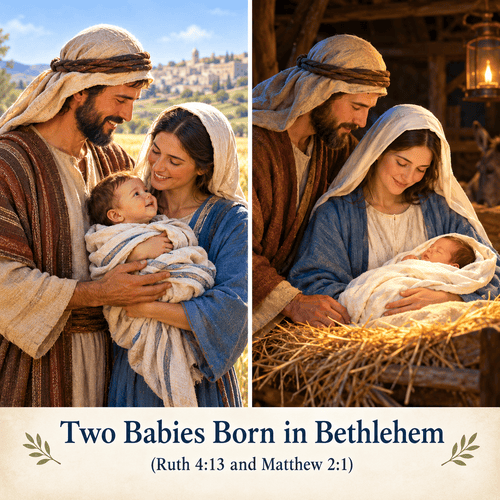
God told David, ‘You shall be shepherd of my people Israel’ (5:2). Matthew joins these very words to Micah’s prophecy about Bethlehem, saying a ruler will come ‘who will shepherd my people Israel’ (Matthew 2:6). Jesus is the true shepherd-king.
The tribes also told David, ‘we are your bone and flesh’ (5:1). Their king was one of them. In the same way, Jesus became fully human to rescue us (Hebrews 2:14).
The Priest-King Who Brought the Ark Home
The ark of the covenant was a gold-covered box that showed God lived among his people. When David brought it to Jerusalem, he ‘was wearing a linen ephod’ (6:14)—a priest’s garment. He offered sacrifices and ‘blessed the people in the name of the LORD of hosts’ (6:18).
Israel’s kings were not normally priests. But long before, Melchizedek was king and priest in Salem, the old name for Jerusalem (Genesis 14:18). David later wrote that God’s coming King would be ‘a priest forever after the order of Melchizedek’ (Psalm 110:4). Hebrews 7 says this is Jesus. Richard Belcher Jr., in Prophet, Priest, and King, shows how these offices, kept apart in Israel, meet in one person: Jesus.
The Promise at the Heart of 2 Samuel
Chapter 7 is the main pillar of the book. David, settled in his palace, felt uneasy: ‘I dwell in a house of cedar, but the ark of God dwells in a tent’ (7:2). So he wanted to build God a house—a temple.
God turned the idea upside down: ‘the LORD will make you a house’ (7:11). In Hebrew, as in English, ‘house’ can mean a building or a royal family, like ‘the House of Windsor’. David offered God a building. God promised David a family line that would never end.
What God Promised David
- A son: ‘I will raise up your offspring after you, who shall come from your body’ (7:12).
- A Father-and-Son bond: ‘I will be to him a father, and he shall be to me a son’ (7:14).
- Love that will not leave: ‘my steadfast love will not depart from him’ (7:15). ‘Steadfast love’ translates hesed, God’s loyal covenant love.
- A throne forever: ‘Your throne shall be established forever’ (7:16).
David prayed, ‘this is instruction for mankind, O Lord GOD!’ (7:19). Walter Kaiser famously called it a ‘charter for humanity’—God’s plan for the whole world. O. Palmer Robertson, in The Christ of the Covenants, calls it ‘the covenant of the kingdom’, because God here ties his rule over the world to David’s throne.
Why Solomon Was Not the Final Answer
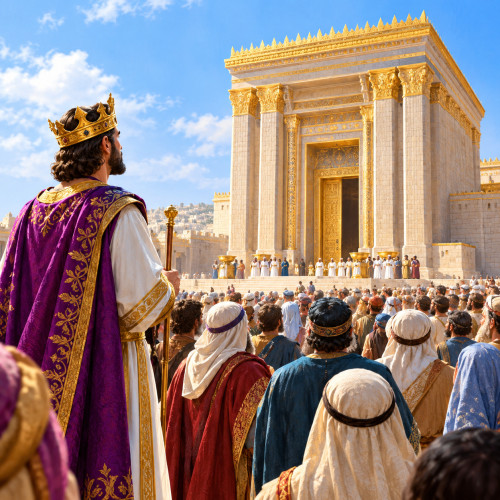
David’s son Solomon built the temple, but he later worshipped other gods (1 Kings 11). The kingdom split, and in 586 BC Babylon destroyed Jerusalem. No son of David sat on the throne. Yet God had said ‘forever’. So faithful Jews kept waiting—until the angel Gabriel told Mary that God would give her son ‘the throne of his father David… and of his kingdom there will be no end’ (Luke 1:32–33).
DOESN’T ‘FOREVER’ JUST MEAN ‘A LONG TIME’?
The Hebrew word olam can sometimes mean a very long time. But the Bible makes the meaning clear here:
- Psalm 89:36: David’s throne will last ‘as long as the sun’.
- Luke 1:33: ‘of his kingdom there will be no end’.
A throne that lasts as long as the sun needs a king who never dies. Only the risen Jesus fits.
A Lame Man at the King’s Table
New kings often killed the old king’s family. So Mephibosheth, Saul’s grandson, ‘lame in both his feet’ (9:13), had every reason to fear. But David said, ‘I will show you kindness for the sake of your father Jonathan’ (9:7). And ‘Mephibosheth ate at David’s table, like one of the king’s sons’ (9:11).
This is a level 4 link: a picture, not a prophecy. But what a picture! We come to God as enemies who cannot walk to him. We are welcomed for the sake of another—Jesus—and seated at the King’s table as his children (Revelation 19:9).
When the King Falls
This is where our opening story comes from. David took Bathsheba and had her husband Uriah killed. ‘But the thing that David had done displeased the LORD’ (11:27). The prophet Nathan confronted him: ‘You are the man!’ (12:7). David confessed, and Nathan replied, ‘The LORD also has put away your sin; you shall not die’ (12:13).
- By contrast: Even Israel’s best king needed a Saviour. God’s people needed a king who never sinned—and Jesus was tempted ‘in every respect… yet without sin’ (Hebrews 4:15).
- By grace: How could a holy God simply put away David’s sin? Because one day his greater Son would carry it: ‘the LORD has laid on him the iniquity of us all’ (Isaiah 53:6).
Matthew’s list of Jesus’ ancestors does not hide the shame. David was the father of Solomon ‘by the wife of Uriah’ (Matthew 1:6). Dale Ralph Davis, in 2 Samuel: Out of Every Adversity, keeps turning our eyes from David’s greatness to God’s faithfulness. God keeps his promise even when his king fails.
The Rejected King on the Mount of Olives
Years later, David’s son Absalom made himself king, and David fled Jerusalem. This table compares what happened to David with what happened to Jesus a thousand years later.
David and Jesus: Two Kings Rejected by Their Own People
| WHAT HAPPENED | KING DAVID | JESUS |
|---|---|---|
| Crossed the Kidron Valley | ‘the king crossed the brook Kidron’ (2 Samuel 15:23) | ‘across the brook Kidron’ (John 18:1) |
| Went up the Mount of Olives in sorrow | ‘weeping as he went’ (15:30) | Prayed in anguish there (Luke 22:39–44) |
| Betrayed by a trusted friend | His adviser Ahithophel (15:31) | Judas (Matthew 26:14–16) |
| The betrayer took his own life | Ahithophel ‘hanged himself’ (17:23) | Judas ‘hanged himself’ (Matthew 27:5) |
| Refused to fight with the sword | ‘Leave him alone, and let him curse’ (16:11) | ‘Put your sword into its sheath’ (John 18:11) |
| Came back to reign | Returned to Jerusalem as king (19:15) | Rose and now reigns (Acts 2:32–36) |
When Absalom was killed, David wept: ‘O my son Absalom, my son, my son Absalom! Would I had died instead of you’ (18:33). David wished he could die for his rebel son. He could not. Jesus did: ‘while we were still sinners, Christ died for us’ (Romans 5:8).
A THOUGHT TO PONDER
Edmund Clowney, in The Unfolding Mystery, shows that the failures of Old Testament heroes are there on purpose. Each broken leader makes us long for the perfect Saviour God promised. When David weeps over Absalom, the Bible is teaching us to look for a better King.
A Song for the Nations and David’s Last Words
In David’s song of praise (also found as Psalm 18), he calls God ‘the horn of my salvation’ (22:3). A horn was a symbol of strength. When John the Baptist was born, his father praised God for ‘a horn of salvation for us in the house of his servant David’ (Luke 1:69). He meant Jesus. The song ends, ‘I will praise you, O LORD, among the nations’ (22:50), and Paul uses it to show that Christ came so that every nation would praise God (Romans 15:9).
In his last words, David describes the perfect ruler, who ‘dawns on them like the morning light’ (23:4). David knew he was not that ruler. But he trusted God’s ‘everlasting covenant, ordered in all things and secure’ (23:5). Centuries later, Jesus called himself ‘the root and the descendant of David, the bright morning star’ (Revelation 22:16). The morning had come.
The Altar Where Judgement Stopped
The book ends in a surprising place. David proudly counted his army, and God sent a plague. At a threshing floor—a flat place where farmers separated grain from husks—God told the angel, ‘It is enough; now stay your hand’ (24:16).
David cried, ‘Please let your hand be against me and against my father’s house’ (24:17). The shepherd asked to suffer in place of his sheep, just as ‘the good shepherd lays down his life for the sheep’ (John 10:11). David bought the site, refusing to offer anything ‘that cost me nothing’ (24:24). When the sacrifice was made, the plague stopped.
Here is the amazing part. Solomon later built the temple on this very spot, Mount Moriah (2 Chronicles 3:1)—where Abraham once offered Isaac and God provided a ram (Genesis 22). Sacrifices were offered there for centuries, until Jesus, just outside the same city, gave the one sacrifice that ended them all (Hebrews 10:12).
WHY DOES 2 SAMUEL END AT AN ALTAR?
- Not on a throne: The book closes with a sinful king at an altar, pleading for his people.
- The lesson: Even the best king cannot save his people just by ruling well. A sacrifice is needed.
- The answer: King Jesus came not only to reign, but also to die.
Answering the Doubters
- ’Solomon fulfilled the promise.’ Only in part. He fell into idol worship, and his kingdom broke apart. Augustine of Hippo argued in The City of God that the promise was far too great for Solomon.
- ’God said the son would sin, but Jesus never sinned.’ 2 Samuel 7:14 says, ‘When he commits iniquity, I will discipline him.’ This covers David’s sons in general. Hebrews 1:5 quotes only the first half about Jesus. And the sinless Son did take discipline—for our sin, not his own: ‘upon him was the chastisement that brought us peace’ (Isaiah 53:5).
- ’The Messiah is just a human king.’ Jesus asked, ‘If then David calls him Lord, how is he his son?’ (Matthew 22:45). The King is both David’s son and David’s Lord.
Seeing Jesus in 2 Samuel: Why It Matters Today
2 Samuel asks us the question Israel faced: will you follow the king God has chosen? The Westminster Shorter Catechism (Q. 26) describes what this King does:
‘Christ executeth the office of a king, in subduing us to himself, in ruling and defending us, and in restraining and conquering all his and our enemies.’
In simple words, King Jesus wins our hearts, rules and protects us, and defeats every enemy—even death. John Calvin, who preached through 2 Samuel in Geneva, taught in his Institutes (2.15) that Christ’s kingdom is spiritual and eternal, given to guard his church.
- If you feel like a failure, remember David. Your hope rests not on your record, but on Jesus.
- If you feel far from God, remember Mephibosheth. The King is calling you to his table.
- If the world feels out of control, remember that the Son of David already reigns (Acts 2:34–36).
Israel’s greatest king was a sinner who needed grace. But God kept his word. The King whose throne lasts forever has come. His name is Jesus.
Tough Questions, Honest Answers
Was David and Jonathan’s relationship romantic?
No. Some people read 2 Samuel 1:26, ‘your love to me was extraordinary, surpassing the love of women’, as proof of a sexual relationship. But this verse comes from a lament—a sad poem—for a friend and fellow soldier who died in battle. In the ancient world, men often described loyal friendship in strong, warm words with no sexual meaning. The Bible never describes David and Jonathan in a sexual way, and the Law that David loved forbade sexual relations between men (Leviticus 18:22). Jonathan’s love was covenant loyalty: he gave up his own right to the throne for David’s sake (1 Samuel 18:3–4; 23:17). Deep, pure friendship between men is a gift from God, not something to be suspicious of.
How can Jesus be the ‘Son of David’ if Joseph wasn’t His biological father?
Matthew traces Jesus’ legal line through Joseph. In Jewish law, a son who was adopted and named by his father had the full rights of an heir, and Joseph did exactly this (Matthew 1:20–25). Many scholars also believe Luke’s list traces Mary’s family, which goes back to David through his son Nathan (Luke 3:31). Paul says Jesus ‘was descended from David according to the flesh’ (Romans 1:3), which points to real physical descent through Mary. This also solves a puzzle. Joseph came from the family line of King Jeconiah, and God had said that none of Jeconiah’s descendants would ever sit on David’s throne (Jeremiah 22:30; Matthew 1:12). Because Joseph wasn’t Jesus’ biological father, this judgement didn’t pass to Jesus, yet as Joseph’s legal son, He still received the full right to David’s throne.
Is the Davidic covenant conditional or unconditional?
In an important sense, it’s both. The promise itself is unconditional: God said his steadfast love would never be taken away from David’s line (2 Samuel 7:15–16). But each king had to obey God, or he would be disciplined and lose blessings (Psalm 132:12; 1 Kings 9:4–7). That’s why David’s family lost the throne for a time, and yet the promise never died. Both sides meet in Jesus. He’s the obedient Son who kept every condition perfectly, so the unconditional promise is now secure for everyone who belongs to him.
Is Jesus reigning on David’s throne now, or only in a future millennium?
Some Christians believe Jesus will sit on David’s throne only in a future 1,000-year kingdom on earth. But the New Testament teaches that his reign has already begun. On the day of Pentecost, Peter said David foresaw the resurrection, and that God has now made Jesus ‘both Lord and Christ’ (Acts 2:30–36). James taught that God was already rebuilding ‘the tent of David’ as non-Jews came to faith (Acts 15:14–17). Jesus now rules from God’s right hand until all his enemies are defeated (1 Corinthians 15:25). When He returns, the whole world will see his kingdom in its full glory.
Why did God strike Uzzah dead for touching the ark?
At first it seems harsh. But God had given clear rules. The ark was to be carried on poles by Levites, and no one was to touch the holy things, ‘lest they die’ (Numbers 4:15). Instead, David put the ark on a new cart, just as the pagan Philistines had done (1 Samuel 6:7). Uzzah’s touch treated God’s holy presence like ordinary cargo. Afterwards, David carried the ark God’s way, on the Levites’ shoulders, with joy (1 Chronicles 15:13–15). The lesson for us is that we can come near a holy God only in the way he provides—and that way is Jesus.
Why wasn’t David put to death for adultery and murder?
Under the Law of Moses, both adultery and murder deserved death (Leviticus 20:10; Numbers 35:31). David knew there was no sacrifice in the Law that could pay for what he had done (Psalm 51:16). So his forgiveness was pure grace, not something he earned. God didn’t ignore the sin: David’s baby died, and violence never left his family (2 Samuel 12:10–14). But how could God be fair and still forgive? Paul explains that God ‘passed over former sins’ because he would punish them in Christ on the cross (Romans 3:25–26). David’s pardon was paid for a thousand years later by his greater Son.
Who made David take the census—God or Satan?
2 Samuel 24:1 says the LORD ‘incited David’, while 1 Chronicles 21:1 says ‘Satan… incited David’. This is not a contradiction. The Bible often shows God ruling over even evil actions and using them for his good purposes, while the evil itself comes from those who do it. God allowed Satan to tempt David as a judgement on Israel, and David freely chose to trust in the size of his army. We see the same pattern at the cross, where wicked men did evil, yet Jesus was delivered up ‘according to the definite plan and foreknowledge of God’ (Acts 2:23). God is never the author of sin, but nothing is outside his control.