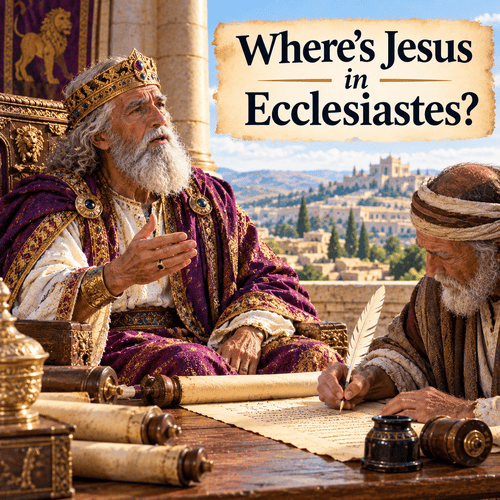
One book in the Bible sounds, at first, like it was written by a man who has given up on life. It says wise people die just like fools. It says hard work comes to nothing. It says there’s “nothing new under the sun”. And again and again it repeats one sad word: vanity.
Vanity of vanities, says the Preacher, vanity of vanities! All is vanity. (Ecclesiastes 1:2, ESV)
That book is Ecclesiastes. Most people think it’s the last place in the Bible to look for Jesus. There are no clear promises of a Messiah, no sacrifices, no prophets. Yet here’s the claim of this article: this gloomy-sounding book is one of the clearest signposts to Jesus in the whole Old Testament. Ecclesiastes asks the biggest question in life—“What is the point?”—and then leaves room for only one answer.
Jesus in the Old Testament — Book 21 of 39
This post is the twenty-first instalment in our series tracing Christ through every book of the Old Testament. See the full series index.
Key terms in this article
- Ecclesiastes: The Greek name of the book. It means “one who speaks to the assembly”.
- The Preacher (Qoheleth): The Hebrew title of the book’s speaker. It means someone who gathers people together to teach them.
- Vanity (hebel): The book’s key Hebrew word. It literally means “vapour” or “breath”—something real, but short-lived and impossible to hold.
- Under the sun: Life seen only from earth, without looking up to God.
- Typology: When a person or event in the Old Testament is a real picture that points forward to Christ.
Why Ecclesiastes Seems the Hardest Book to Find Jesus In
Ecclesiastes never uses God’s covenant name, the LORD (Yahweh). It only calls Him “God”. The speaker tried pleasure, building, money, wisdom and work, and called all of it “a striving after wind” (Ecclesiastes 2:11).
So who is this Preacher? Careful Bible teachers read him in 2 main ways.
2 ways to read the Preacher. Both views are held by scholars who trust the Bible. We lean towards the second view.
| VIEW | WHO HOLDS IT | WHAT IT SAYS ABOUT THE PREACHER |
|---|---|---|
| The searching sceptic | Tremper Longman III | The Preacher is a man trying to find meaning without God, and he fails. A second voice at the end of the book (12:9–14) corrects him and points us back to God. |
| The honest believer | Derek Kidner, Iain Provan, Philip Graham Ryken | The Preacher is a believer being brutally honest about life in a broken world. He isn’t rejecting faith. He’s rejecting false hopes. |
Here’s the key point: either way, the road ends in the same place. If the Preacher is a sceptic, his failure shows we can’t find meaning by ourselves. If he’s an honest believer, his honesty shows this world alone can’t satisfy us. Derek Kidner saw the book as clearing the ground—pulling down every false hope so that God’s answer has room to stand.
How to Find Christ in a Wisdom Book (Without Making Things Up)
Some people fear “seeing Jesus in the Old Testament” means reading things into the text. That’s a fair worry. So we use 3 clear tests. A link to Christ must come from at least one of these:
- Jesus’s own teaching. After His resurrection, Jesus explained “in all the Scriptures the things concerning himself” (Luke 24:27). He named “the Law of Moses and the Prophets and the Psalms” (Luke 24:44). “The Psalms” was a name for the whole third part of the Hebrew Bible—the Writings—and Ecclesiastes sits in that part.
- The New Testament’s own use. Where the apostles pick up the words and ideas of Ecclesiastes, we follow their lead.
- The Bible’s big storyline. Ecclesiastes is wisdom literature, and the New Testament says Christ is God’s wisdom: “in whom are hidden all the treasures of wisdom and knowledge” (Colossians 2:3).
Sidney Greidanus wrote a whole book on this subject: Preaching Christ from Ecclesiastes (2010). He describes several “roads” from the Old Testament to Christ, including typology, promise and fulfilment, and contrast. Contrast matters most here. Ecclesiastes shows us a dark room so that we notice when the light is switched on.
WHAT WE’RE NOT CLAIMING
- We don’t claim the Preacher knew the name “Jesus” or wrote about Him directly.
- We don’t turn every detail into a secret code. Some early writers, including Jerome, read the book’s “eat and drink” as a hidden picture of the Lord’s Supper. That goes beyond the text.
- We don’t ignore the book’s real message for its first readers. Christ fulfils that message; He doesn’t erase it.
What “Vanity” Really Means
The English word “vanity” can mislead us. Today it often means pride about our looks. But the Hebrew word hebel means “vapour” or “breath”. Think of your breath on a cold morning. You can see it. It’s real. But a second later it’s gone, and you can’t catch it. The Preacher uses this word about 38 times. His point isn’t that life is worthless. His point is that life is brief, fragile and impossible to control.
Here are two surprising links to Christ that start with this one word:
- Abel. The very first person in the Bible with this name is Abel, the son of Adam. In Hebrew his name is simply Hebel—”vapour”. His life was short and ended in murder (Genesis 4:8). The New Testament says Jesus’s blood “speaks a better word than the blood of Abel” (Hebrews 12:24). Abel’s blood cried for justice. Jesus’s blood brings forgiveness.
- Romans 8. The ancient Greek translation of the Old Testament (called the Septuagint) translated hebel with the Greek word mataiotēs, meaning “futility”. The apostle Paul uses this same word when he explains why the world is broken.
For the creation was subjected to futility, not willingly, but because of him who subjected it, in hope that the creation itself will be set free from its bondage to corruption. (Romans 8:20–21, ESV)
This is a huge key. Ecclesiastes describes the sickness: a world that slips through our fingers. Paul explains the cause (God’s curse after Adam’s sin) and the cure (the hope of a new creation through Christ). Ecclesiastes describes the frustration. Romans 8 promises it won’t last for ever.
The phrase “under the sun” (around 29 times) describes life seen only from below. Jesus comes from the other direction: “He who comes from above is above all” (John 3:31).
7 Places Christ Shows Up in Ecclesiastes
How to read this table: The left column shows a problem or claim in Ecclesiastes. The middle column shows how Jesus answers it. The right column gives the New Testament verse that makes the link.
| WHAT ECCLESIASTES SAYS | HOW CHRIST ANSWERS IT | NEW TESTAMENT LINK |
|---|---|---|
| “The son of David, king in Jerusalem” (1:1) | Jesus is the greater Son of David and the perfect King | Matthew 12:42 |
| “All is vanity” (1:2) | Christ will set creation free from futility | Romans 8:20–21 |
| “What does man gain by all the toil?” (1:3) | Work done in Christ is never wasted | 1 Corinthians 15:58 |
| “Nothing new under the sun” (1:9) | Christ makes all things new | Revelation 21:5 |
| “Not a righteous man on earth who… never sins” (7:20) | Jesus is the one truly righteous Man | Romans 3:10; Hebrews 4:15 |
| Wise words “given by one Shepherd” (12:11) | Jesus is the Good Shepherd who speaks God’s wisdom | Ezekiel 34:23; John 10:11 |
| God will judge “every secret thing” (12:14) | God will judge the world through Christ | Romans 2:16 |
1 of these links is easy to miss.
The “one Shepherd”
Near the end of the book, the writer says wise words “are given by one Shepherd” (Ecclesiastes 12:11). In its first setting, this Shepherd is God Himself. But the Old Testament also promised God would send a shepherd from David’s family: “I will set up over them one shepherd, my servant David” (Ezekiel 34:23). Then Jesus stood up and said, “I am the good shepherd” (John 10:11). The Shepherd who gave wisdom to the Preacher became a man and spoke to us face to face.
The Greater Solomon: The King Who Didn’t Fail
Ecclesiastes speaks in the voice of “the son of David, king in Jerusalem” (1:1). It wants us to think of Solomon—and his life is a story of a great start and a sad ending.
Timeline: Solomon’s rise and fall
- About 970 BC—Crowned: Solomon becomes king after his father David (1 Kings 1–2).
- Early reign—Wisdom: He asks God for wisdom, and God gives it (1 Kings 3:9–12).
- About 966–959 BC—Temple: He builds the temple in Jerusalem over seven years (1 Kings 6:1, 38).
- Middle reign—Excess: He gathers huge amounts of gold, many horses and 700 wives (1 Kings 10–11).
- Old age—Drift: “His wives turned away his heart after other gods” (1 Kings 11:4).
- About 931 BC—Collapse: Solomon dies, and his kingdom splits in two (1 Kings 11:43–12:20).
God had warned Israel’s kings not to gather many horses, many wives or too much gold (Deuteronomy 17:16–17). In Ecclesiastes 2:4–8, the Preacher lists what he gathered—houses, gardens, silver, gold, singers and “many concubines”. It reads like a checklist of the very things God said not to do. The wisest man in the world still couldn’t keep God’s law.
That’s why Jesus’s words are so striking: “something greater than Solomon is here” (Matthew 12:42). Look at the contrast.
Solomon compared with Jesus. This table shows where Solomon fell short and how Jesus succeeds in the same area.
| AREA OF LIFE | SOLOMON | JESUS |
|---|---|---|
| Wisdom | Received wisdom, but lost his way | Is God’s wisdom in person (1 Corinthians 1:30) |
| Wealth | Gathered gold for himself (1 Kings 10:14) | “Though he was rich, yet for your sake he became poor” (2 Corinthians 8:9) |
| Love | Many wives turned his heart away | Loves one bride, the church, and gave Himself for her (Ephesians 5:25) |
| Temple | Built a temple of stone | His own body is the true temple (John 2:19–21) |
| Kingdom | Split in two after he died | Will never end (Luke 1:33) |
Solomon grabbed at everything and was left holding vapour. Jesus “did not count equality with God a thing to be grasped, but emptied himself” (Philippians 2:6–7).
Death, Judgement and the Resurrection Answer
The Preacher can’t stop talking about death. The wise man dies just like the fool (2:16). People die just like animals: “All are from the dust, and to dust all return” (3:20). Death is the great wall every life runs into. Under the sun, there’s no escape from it.
Then the Preacher tells a short story that sounds almost like a parable of the gospel.
There was a little city with few men in it, and a great king came against it and besieged it… But there was found in it a poor, wise man, and he by his wisdom delivered the city. Yet no one remembered that poor man. (Ecclesiastes 9:14–15, ESV)
A city under attack. A rescuer who’s poor. A rescue won by wisdom, not by weapons. And afterwards, the rescuer is forgotten. This is a picture—a type—of Christ. Jesus was poor. He saved His people not with an army but with the wisdom of the cross (1 Corinthians 1:24). And He “was despised and rejected by men” (Isaiah 53:3). But here the story changes. The poor man in Ecclesiastes stayed forgotten. Jesus was raised from the dead and given all authority.
That resurrection is the answer to the Preacher’s biggest question. He asked: “What does man gain by all the toil at which he toils under the sun?” (1:3). Paul ends his great chapter on the resurrection with the reply:
Therefore, my beloved brothers, be steadfast, immovable, always abounding in the work of the Lord, knowing that in the Lord your labour is not in vain. (1 Corinthians 15:58, ESV)
Because Jesus rose, death isn’t the last word. What we do for Him will last.
The book also ends with judgement: “God will bring every deed into judgement, with every secret thing, whether good or evil” (12:14). The Preacher knew judgement was coming. The New Testament tells us who will be the Judge. Paul speaks of the day “when… God judges the secrets of men by Christ Jesus” (Romans 2:16). This isn’t bad news for those who trust Him. The Judge is also the Saviour who took their judgement on the cross.
Joy That Isn’t Naïve: Enjoying Life in Christ
Here’s something many readers miss. Ecclesiastes isn’t only sad. Again and again, the Preacher tells us to enjoy life—to eat, drink, work and love with gladness (Proverbs 2:24; 3:12–13; 5:18; 8:15; 9:7–9). Good things are gifts from God’s hand, not gods to worship.
Martin Luther argued Ecclesiastes doesn’t condemn God’s good gifts. It condemns our restless, anxious grasping after them. The problem isn’t the bread and wine. The problem is expecting bread and wine to be our saviour.
Now read this verse slowly:
Go, eat your bread with joy, and drink your wine with a merry heart, for God has already approved what you do. (Ecclesiastes 9:7, ESV)
“God has already approved what you do.” How can a sinner ever say that with confidence? Only because of Christ. In Him, “there is therefore now no condemnation” (Romans 8:1). When we trust Jesus, God accepts us—not because of our work, but because of His. That’s the only safe ground for real joy.
The book’s final command is “Fear God and keep his commandments” (12:13). Only Jesus has done this perfectly, and He gives His perfect record to all who believe.
The Preacher also said God “has put eternity into man’s heart” (3:11). We’re made for more than this world. Augustine of Hippo put it famously: “You have made us for yourself, and our heart is restless until it rests in you.” That rest has a name. It’s Jesus.
LIFE UNDER THE SUN VS LIFE IN THE SON
- Under the sun: Work feels pointless. In the Son: Work done for Him is “not in vain” (1 Corinthians 15:58).
- Under the sun: Death ends everything. In the Son: Death is defeated (John 11:25).
- Under the sun: Joy is fragile and brief. In the Son: Joy rests on God’s approval (Romans 8:1).
- Under the sun: Nothing is new. In the Son: All things are made new (Revelation 21:5).
The Son Above the Sun
Ecclesiastes isn’t a book without Jesus. It shows us exactly why we need Him. It takes away our false hopes one by one—pleasure, money, success, even wisdom—until our hands are empty and ready to receive Him.
The New Testament completes the picture. The world is vapour, but Christ will make it new. Death is certain, but Christ has risen. Judgement is coming, but the Judge is the Saviour. Life under the sun is vapour. Life in the Son isn’t.
Tough Questions, Honest Answers
Who wrote Ecclesiastes—was it really Solomon?
The book calls its speaker “the son of David, king in Jerusalem” (1:1), and for most of church history Christians believed Solomon wrote it. Some scholars today think a later writer spoke in Solomon’s voice, pointing to certain Hebrew words that look later in date. Faithful Bible teachers hold both views. What matters most is that the book is God’s inspired Word, whoever held the pen. Its message stands either way.
Does Ecclesiastes teach that there is no life after death?
Some verses sound like it, such as “the dead know nothing” (9:5). But the Preacher is describing death as it looks “under the sun”—from the human side. The same book says that at death “the spirit returns to God who gave it” (12:7) and that God will judge every deed (12:14). Judgement only makes sense if people exist after death. The fuller light of the New Testament shows clearly that there is life beyond the grave (2 Timothy 1:10).
Why was Ecclesiastes almost left out of the Bible?
Some ancient Jewish teachers questioned the book because parts of it seemed gloomy or seemed to contradict other Scriptures. The Mishnah, an early collection of Jewish teaching, records a debate about it (Yadayim 3:5). In the end, the book was accepted by the Jewish people and by Jesus and the apostles as part of the Scriptures. Its closing verses, which call us to fear God and keep His commandments, were a key reason. The church has always received it as God’s Word.
Does Ecclesiastes contradict Proverbs?
Proverbs often shows how life usually works: hard work brings reward, and foolishness brings trouble. Ecclesiastes shows the exceptions: sometimes the wicked prosper and the good suffer. These are not contradictions. They are two sides of true wisdom. Proverbs itself shows this balance when it tells us both to answer and not to answer a fool (Proverbs 26:4–5). Together, the two books teach us to trust God’s ways even when we cannot fully understand them.
What does “Be not overly righteous” (Ecclesiastes 7:16) mean?
This verse does not tell us to sin a little. It warns against a proud, show-off kind of goodness—the religion of people who think they are better than others. Jesus warned against the same thing in the Pharisees (Luke 18:9–14). The very next verses warn against being “overly wicked” too (7:17). The answer is not balance between sin and goodness, but the fear of God (7:18). True righteousness is humble and comes as a gift through Christ.
Is the “threefold cord” (Ecclesiastes 4:12) about the Trinity or marriage?
The verse says, “a threefold cord is not quickly broken.” It’s often read at weddings, and some people see the Trinity in it. But in context, the Preacher is simply praising friendship and teamwork: two people are better than one, and three are stronger still. It’s fine to apply this to marriage with God at the centre, as long as we know this is an application, not the main meaning. We should be careful not to read hidden codes into the text.
Does “a time for everything” (Ecclesiastes 3:1–8) mean everything is predetermined?
The famous poem says there is “a time to be born, and a time to die”. The point is that God is in control of every season of life, even when we cannot see His plan (3:11). The Bible teaches that God “works all things according to the counsel of his will” (Ephesians 1:11). Yet this does not make us robots. We still make real choices and are responsible for them. God’s control is not a cage but a comfort: our times are in His hands (Psalm 31:15).