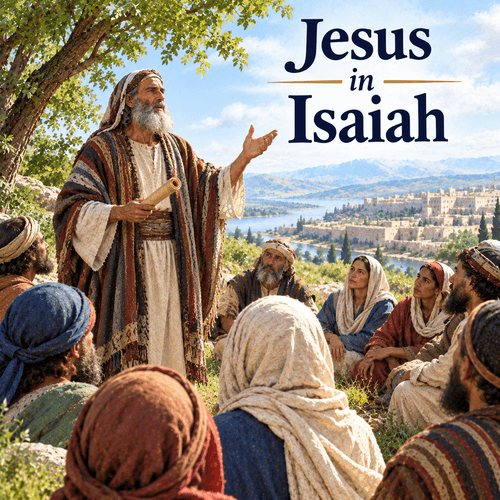
700 years before Jesus was born, a man in Jerusalem wrote down the details of His death.
He wrote Jesus would be beaten until He no longer looked human. That He’d stay silent at His own trial. That He’d be killed alongside criminals, yet be buried in a rich man’s grave. And then, strangest of all, that after dying He’d see His children and live a long life.
Sceptics have a quick answer to this: Christians made it all up afterwards and slipped it into the Bible.
There’s one problem with that answer. In 1947, a shepherd boy found a jar in a cave near the Dead Sea. Inside was a complete copy of Isaiah, written out roughly a 100 years before Jesus was born. Every line was already there. So the words are old.
Jesus in the Old Testament — Book 23 of 39
This post is the twenty-third instalment in our series tracing Christ through every book of the Old Testament. See the full series index.
Why Isaiah Is Called the Fifth Gospel
The Bible has 4 Gospels: Matthew, Mark, Luke and John. The word “gospel” simply means “good news”—the announcement of who Jesus is and what He has done.
Isaiah isn’t a fifth one. It was written centuries earlier, by a prophet. But the nickname stuck for 3 reasons.
- The early church noticed it. Jerome, who translated the Bible into Latin in the fourth century, said Isaiah should be called an evangelist rather than a prophet, because he describes Christ so fully that he seems to be writing history rather than prophecy.
- The apostles leaned on it. Isaiah is quoted in the New Testament around 60 times—more than any other book except Psalms—and echoed hundreds of times more.
- The first recorded conversion outside Israel began there. In Acts 8, an official from Ethiopia is reading Isaiah 53 in his chariot. Philip climbs in, and “beginning with this Scripture he told him the good news about Jesus” (Acts 8:35).
The Key That Unlocks the Whole Book
First, let’s settle a question of method: are we allowed to look for Jesus in Isaiah?
Jesus answered that Himself. On the Sunday He rose from the dead, He walked with two confused disciples and gave them a Bible study. Luke records it: “And beginning with Moses and all the Prophets, He interpreted to them in all the Scriptures the things concerning Himself” (Luke 24:27).
This was no one-off. Earlier He had told His critics the Scriptures bear witness about Him (John 5:39), and that if they really believed Moses, they’d believe Him, for Moses wrote of Him (John 5:46).
READ THIS CAREFULLY
Finding Christ in the Old Testament isn’t a clever trick invented by Christians. It’s the reading method Jesus taught His own disciples, and the one the apostles used in every sermon recorded in Acts.
That doesn’t mean every verse is secretly about Jesus. It means the book has a direction, and towards Christ is where it’s pointing.
The Clue Hidden in Isaiah’s Own Name
Start with the author’s name. In Hebrew it is Yesha‘yahu, and it means “the LORD saves”. The name Jesus, in Hebrew Yeshua, comes from the same root and means the same thing.
That’s no coincidence dressed up as evidence. It’s the thesis of the book. Isaiah writes: “Behold, God is my salvation; I will trust, and will not be afraid; for the LORD GOD is my strength and my song, and He has become my salvation” (Isaiah 12:2).
God declares: “I, I am the LORD, and besides me there is no saviour” (Isaiah 43:11). God insists He will do the rescuing Himself, personally, and that He will share that honour with no one.
Yet the same book promises a child, a king, a servant and a conqueror who will do the rescuing. So who is He?
Isaiah spends 66 chapters closing that gap. The New Testament says the gap closes on one person.
Part One: The King God Promises (Isaiah 1–39)
Isaiah preached during a terrifying stretch of history. Understanding the pressure he lived under makes his promises land harder.
Isaiah’s world: a short timeline
- About 740 BC—Isaiah sees God on His throne and is sent to a nation that will not listen (Isaiah 6).
- 722 BC—the northern kingdom of Israel is destroyed by Assyria, the superpower of the day.
- 701 BC—the Assyrian army surrounds Jerusalem. The city survives only because God intervenes.
- 586 BC—Babylon burns Jerusalem, more than a century after Isaiah spoke. He had already warned of it, and already promised what lay beyond it.
Into that fear, Isaiah keeps promising a coming King. Here are the clearest examples, and what the New Testament writers do with them.
| WHAT ISAIAH PROMISES | WHERE | HOW THE NEW TESTAMENT USES IT |
|---|---|---|
| A virgin will bear a son named Immanuel, “God with us” | Isaiah 7:14 | Matthew applies it directly to the birth of Jesus (Matthew 1:22–23) |
| A great light will shine on despised Galilee | Isaiah 9:1–2 | Matthew says it was fulfilled when Jesus started preaching there (Matthew 4:14–16) |
| A child is born who is called Mighty God, Everlasting Father, Prince of Peace, ruling David’s throne for ever | Isaiah 9:6–7 | The angel tells Mary her son will receive David’s throne and reign for ever (Luke 1:32–33) |
| A fresh shoot grows from the cut stump of Jesse, David’s father, and the nations come to Him | Isaiah 11:1–10 | Paul quotes it to show that the nations now hope in Christ (Romans 15:12) |
| God swallows up death for ever and wipes away tears | Isaiah 25:6–9 | Paul quotes it about the resurrection of the body (1 Corinthians 15:54) |
| God lays a tested, precious cornerstone in Zion | Isaiah 28:16 | Peter and Paul both say that stone is Jesus (1 Peter 2:6; Romans 9:33) |
| The blind see, the deaf hear, the lame leap | Isaiah 35:5–6 | Jesus points to exactly these miracles when asked if He is the one (Matthew 11:4–5) |
The strange chapters in the middle
Chapters 36–39 break the pattern. Suddenly we’re reading history: King Hezekiah, a siege, a prayer, a rescue, and then a bad decision that guarantees Babylon will one day carry his sons away.
Why put that here? Because Hezekiah is the best king left, and he’s still not enough. He’s godly, even prayerful. God answers—and Hezekiah still fails, and still dies. The throne is still empty.
WHY CHAPTERS 36–39 SIT IN THE MIDDLE OF THE BOOK
These four chapters are the hinge. Chapters 1–39 ask, “Where’s the king who will not let us down?” Hezekiah answers, “Not me.”
That question is what Chapters 40–66 exist to answer.
Part Two: The Servant God Sends (Isaiah 40–55)
Chapter 40 changes the tone completely. The shouting stops and the comfort begins.
It opens with a herald: “In the wilderness prepare the way of the LORD; make straight in the desert a highway for our God” (Isaiah 40:3). Hold on to that verse—we’ll come back to it, because it carries more weight than any other single line in this post.
Then comes the figure who dominates these chapters: the Servant. Four passages, usually called the Servant Songs, describe someone God chooses, fills with His Spirit, and sends to bring justice to the nations—and who is rejected, beaten and killed doing it.
- Isaiah 42:1–9—the chosen Servant who will not break a bruised reed.
- Isaiah 49:1–13—the Servant sent not only to Israel but as a light for the nations.
- Isaiah 50:4–9—the Servant who gives His back to those who strike Him.
- Isaiah 52:13–53:12—the Servant who is “pierced for our transgressions” and “crushed for our iniquities” (Isaiah 53:5), bearing the punishment others deserved.
We’ve treated these two subjects in detail elsewhere, so here we’ll simply note the conclusion: the Servant suffers in the place of guilty people, which is what the Bible calls substitution—one person taking the penalty owed by another. Then Isaiah says something impossible for a dead man: “he shall see his offspring; he shall prolong his days” (Isaiah 53:10).
The detail almost everyone misses
Watch the grammar. Through Chapters 42 to 53, the Servant is always singular—one person. Then, from Isaiah 54:17 onwards, the word turns plural: “the heritage of the servants of the LORD”. It stays plural for the rest of the book (Isaiah 65:8–9; Isaiah 66:14).
One Servant dies. Many servants appear. Isaiah’s own text moves from Christ to the people who belong to Him, and the link between the two is His death. Those servants are the “offspring” of Isaiah 53:10—the family a dying man couldn’t otherwise have.
ONE SERVANT, MANY SERVANTS
Isaiah 42–53: the Servant (singular)—one man, chosen, obedient, killed.
Isaiah 54–66: the servants (plural)—a whole people who inherit what He earned.
The turning point is His death. Christians aren’t simply people who admire the Servant. They’re the family He purchased with His death.
Part Three: The Conqueror God Is (Isaiah 56–66)
The last section adds something the earlier chapters only hinted at. The Servant doesn’t stay a victim.
In Isaiah 59, God looks for someone who can put things right and finds no one, so He acts Himself: He puts on righteousness like body armour and a helmet of salvation, and a Redeemer comes to Zion (59:16–20). Paul quotes that promise in Romans 11:26, and borrows the armour picture in Ephesians 6.
In Isaiah 63, a figure comes from Bozrah in clothing stained red, treading the winepress of God’s judgement alone. John sees the same figure in Revelation 19:13—Christ returning, His robe dipped in blood.
And the book ends where the Bible ends: “For behold, I create new heavens and a new earth” (Isaiah 65:17), quoted in 2 Peter 3:13 and pictured in Revelation 21.
The most famous comma in the Bible
Between those two pictures sits Isaiah 61. The speaker says: “The Spirit of the Lord GOD is upon me, because the LORD has anointed me to bring good news to the poor” (Isaiah 61:1). He is sent to bind up broken hearts, free prisoners, and proclaim “the year of the LORD’s favour, and the day of vengeance of our God” (61:2).
In Luke 4, Jesus stands up in His home town, reads this passage aloud—and stops. He stops in the middle of verse 2, after “the year of the LORD’s favour”, before “the day of vengeance”. He rolls up the scroll, sits down, and says: “Today this Scripture has been fulfilled in your hearing” (Luke 4:21).
WHAT JESUS WAS CLAIMING AT NAZARETH
By stopping mid-sentence, Jesus made 2 claims at once.
- I am the anointed figure Isaiah described.
- I have come, this time, to bring favour—not yet vengeance.
Isaiah wrote 1 sentence. Jesus divided it into 2 comings, separated so far by 2000 years.
The Strongest Evidence: Isaiah’s God Is Jesus
So far we’ve looked at predictions. This next argument is different, and it’s the one that makes the case watertight.
New Testament writers repeatedly take passages where Isaiah is talking about the LORD—God Himself, using His personal covenant name—and apply them to Jesus without blinking.
| WHAT ISAIAH SAYS ABOUT THE LORD | WHAT THE NEW TESTAMENT SAYS ABOUT JESUS |
|---|---|
| Isaiah sees the LORD on His throne, and cries out that he is ruined (6:1–5) | John states that Isaiah “saw his glory and spoke of him”—meaning Christ (John 12:41) |
| A voice cries: prepare the way of the LORD (40:3) | All four Gospels say the voice was John the Baptist, and the one he prepared for was Jesus (Mark 1:2–4) |
| To the LORD alone “every knee shall bow”, and He gives His glory to no other (45:23; 42:8) | At the name of Jesus “every knee should bow”, and every tongue confesses He is Lord (Philippians 2:10–11) |
| “I am the first and I am the last; besides me there is no god” (44:6) | The risen Christ says: “I am the first and the last” (Revelation 1:17) |
| “The LORD of hosts, him you shall regard as holy”—and He becomes a stone of stumbling (8:13–14) | “In your hearts honor Christ the Lord as holy”—and He is the stone men trip over (1 Peter 3:15; 2:8) |
Notice who is doing this. Peter, Paul and John were Jewish men taught to say daily the LORD our God is one. They’d have died rather than give God’s honour to a created being—and many of them did die rather than deny what they were saying about Jesus.
BB Warfield pointed out the titles in Isaiah 9:6 aren’t flattery for a good king; “Mighty God” is used of the LORD Himself two chapters later (Isaiah 10:21). Richard Bauckham has argued the New Testament doesn’t slowly promote Jesus towards deity over time—it places Him inside the identity of the God of Israel from the beginning, exactly as Isaiah 40–55 defines the identity.
So the case doesn’t rest on a handful of predictions that might be coincidence. It rests on this: the God Isaiah saw, and the man the apostles knew, are treated as the same person.
How Do We Know We’re Not Just Seeing Things?
The answer is a controlled method. We’re looking for types—real people, events or objects in the Old Testament that God designed in advance to point forward to Christ. A type isn’t a random resemblance. Geerhardus Vos described types as genuine anticipations planted by God in history, not decorations added later by clever readers.
John Calvin, who wrote a large commentary on Isaiah, was strict about this. He repeatedly warned against forcing meanings on to the text that the words themselves will not carry, and he had little patience for preachers who found hidden pictures everywhere. Edmund Clowney made the same point for modern readers: Christ must be found along the line of the text’s own promise, not smuggled in by imagination.
That gives us three simple tests before we claim a passage points to Jesus:
- Does the New Testament do it? Every connection in this post is one the apostles make first.
- Does it follow God’s promise line? The promise of a Saviour runs from Genesis 3 through Abraham and David to Christ. Types sit on that line.
- Does it come out of the text or out of our heads? Isaiah’s own words must support it—the flow, the images, the argument of the book.
WHERE POPULAR TEACHING GOES WRONG
Not every red object in the Old Testament is the blood of Christ. Not every piece of wood is the cross. Isaiah walking barefoot for three years (Isaiah 20) is a warning to Egypt, not a hidden picture of the humiliation of Jesus.
The case for Christ in Isaiah doesn’t need such readings—and it’s stronger without them.
Four Objections, Answered
“Isaiah 7:14 just means a young woman, not a virgin.”
The Hebrew word is ‘almah, which describes a young woman of marriageable age. Critics say it doesn’t have to mean virgin. But 3 things matter. First, Jewish translators—not Christians—rendered it with the Greek word parthenos, which does mean virgin, about two hundred years before Jesus was born. Second, the passage promises a sign, and an ordinary young woman having an ordinary baby isn’t a sign of anything. Third, the child is called Immanuel, “God with us”, which is a very large name for an ordinary baby. Edward Young argued the sign is addressed beyond King Ahaz to the whole house of David, which is why it can reach far past Ahaz’s lifetime.
“Christians read Jesus back into the text later.”
This would be a strong objection if Jewish readers before Christ had never read Isaiah as being about the Messiah. They had. The ancient Aramaic paraphrase of Isaiah, the Targum, actually inserts the word “Messiah” into Isaiah 52:13, where the Servant is introduced. Jewish readers saw a coming Messiah there long before any Christian did. What Christians added wasn’t the expectation—it was the identification.
“Isaiah had 2 or 3 different authors, so the ‘predictions’ were written afterwards.”
Many modern scholars split the book, mainly because Chapters 40–55 speak about the Babylonian exile as though it were present, and even name King Cyrus (44:28–45:1) roughly 150 years before his birth. The honest thing to say is this argument is mostly philosophical: it assumes in advance that no one can foretell a name. The textual evidence pulls the other way. The Dead Sea copy of Isaiah shows no break or seam at Chapter 40. And John 12 quotes Isaiah 53:1, then quotes Isaiah 6:10, and says Isaiah said both—treating the book as one man’s work and one man’s vision.
“The Servant in Isaiah 53 is the nation of Israel, not a person.”
This is the most serious objection, and it deserves more room than we can give it here. In short: the Servant is repeatedly distinguished from the nation—He suffers for “my people” (53:8), He is sinless while the nation is not (53:9), and He restores Israel rather than being Israel (49:5–6). We have answered this in full in a separate post.
READ OUR RELATED POSTS NEXT:
- “Who Is Isaiah 53’s Suffering Servant: The Messiah or Israel?”—the full answer to the objection above.
- “Isaiah’s Servant Songs: Why Are They Central to Messianic Prophecy?”—all four songs examined in order.
How to Read Isaiah for Yourself
If you want to see this with your own eyes rather than take our word for it, do 3 things.
- Read Isaiah 6, then John 12:37–41. Ask yourself whose glory Isaiah saw.
- Read Isaiah 40, then Mark 1:1–4. Ask who the highway was being built for, and who walked down it.
- Read Isaiah 61, then Luke 4:16–21. Ask why Jesus stopped reading in the middle of a sentence.
Isaiah isn’t a book of scattered predictions that happen to fit. It’s 1 long answer to 1 question: how can a holy God save an unholy people without ceasing to be holy?
The answer is a child who’s called Mighty God, a Servant who is punished for crimes He never committed, and a Conqueror who returns for the family His death created. Isaiah saw Him from 700 years away and called it good news.
That’s why the nickname fits. Not a fifth account added to four—but the same good news, told first.
Tough Questions, Honest Answers
How many prophecies about Jesus are there in Isaiah?
There’s no fixed number, and you should be careful of websites that give you one. Counts range from about 20 clear predictions to well over a 100 if you include types and echoes, simply because people count differently. What can be measured is how the apostles used the book: Isaiah is quoted roughly 60 times in the New Testament, more than any book except Psalms. The stronger point isn’t the size of the list but the shape of the book—Isaiah isn’t a scrapbook of predictions, it’s one argument that arrives at one person.
How long before Jesus did Isaiah live?
Isaiah preached roughly from 740 BC to around 680 BC, so about 700 years before the birth of Christ. The obvious question is whether the text really is that old, and here we have unusually good evidence: the complete Isaiah scroll found at Qumran in 1947 was copied around 125 BC, well before Jesus was born. Whatever anyone concludes about the meaning, the words were not written after the events.
Does Isaiah’s own name have anything to do with the name Jesus?
Yes, and it’s no coincidence. Isaiah’s Hebrew name, Yesha‘yahu, means “the LORD saves”. The name Jesus, in Hebrew Yeshua, comes from the same root and carries the same meaning. That is why the angel tells Joseph to call the child Jesus, “for he will save his people from their sins” (Matthew 1:21). The prophet spent 66 chapters saying that the LORD saves; the child was given a name that says it in one word.
Which passage from Isaiah did Jesus quote most often?
Isaiah 6:9–10, the warning that people will hear without understanding. It’s one of the very few Old Testament passages quoted in all 4 Gospels, and Paul uses it as the closing word of Acts 28. That’s striking, because it’s not a comfortable verse—Jesus used Isaiah to explain why He was being rejected, not only to prove who He was. He also read Isaiah 61 at Nazareth, quoted Isaiah 56:7 when He cleared the temple, and threw Isaiah 29:13 at the Pharisees. Isaiah was clearly a book He knew intimately.
Is Isaiah 14 about Satan, or about the king of Babylon?
Read in context, it’s a taunt song aimed at the king of Babylon, mocking a proud ruler who’s about to be brought down to the grave. The famous name “Lucifer” isn’t in the Hebrew at all; it’s a Latin word meaning “morning star”, which entered English through older translations. Many Christians have felt the passage gives a glimpse of the pride behind all rebellion against God, and Jesus does describe seeing Satan fall like lightning (Luke 10:18). It’s fair to see the pattern, but unwise to build a biography of Satan out of a poem about Babylon. The plain sense comes first, always.
When will Isaiah 11:6 happen—the wolf living with the lamb?
That picture belongs to the reign of the Messiah described in the same chapter, so it began when Christ came and will be completed when He returns. Isaiah himself ties it to the new heavens and new earth he describes later (65:17–25), which the New Testament places after Christ’s return (2 Peter 3:13; Revelation 21). It is poetry, and we should not press it into a nature documentary, but it is not merely poetry either—Paul says creation itself is groaning and waiting to be set free (Romans 8:19–21). Something really will be healed, not just imagined.
Does the Great Isaiah Scroll prove the prophecies came before Jesus?
It proves they were written before Him, which is a different and more modest claim. The scroll, usually labelled 1QIsaᵃ, was found at Qumran in 1947, dates to roughly 125 BC, contains the whole book, and is remarkably close to the Hebrew text used for our modern Bibles a thousand years later. That removes the easiest objection—that Christians edited the predictions in afterwards. It can’t by itself prove Jesus is the Messiah, because dating a text and interpreting it are 2 different tasks. But it does mean the debate has to be about meaning, not about tampering.
Related Reads
- Jesus in the Old Testament: Where He Appears In All 39 Books
- Jesus in the Song of Songs: The Bridegroom Who Loves His Bride
- Who Is Isaiah 53’s Suffering Servant: The Messiah or Israel?
- Isaiah’s Servant Songs: Why Are They Central to Messianic Prophecy?
- Isaiah 7:14 and the Virgin Birth: How the Prophecy Points to Jesus
- Is Isaiah 9:6 Really About Jesus? Can We Be Certain?