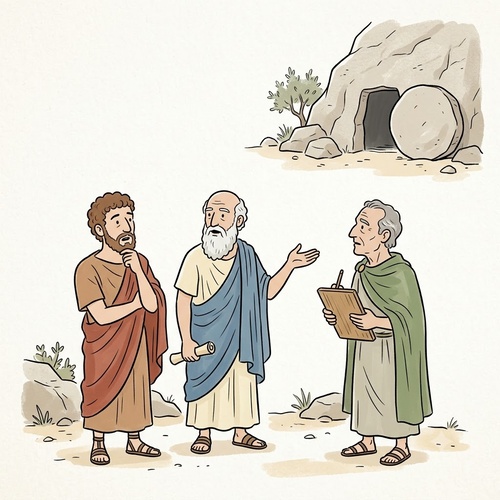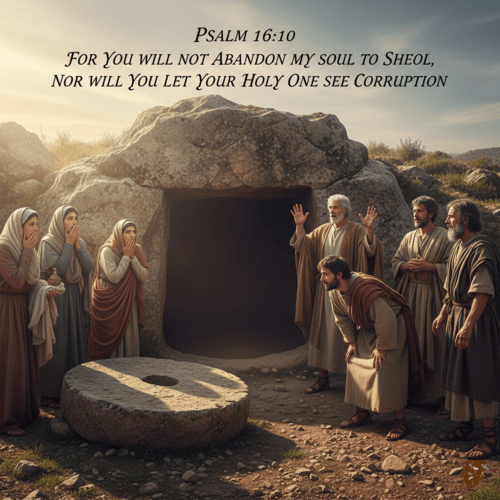
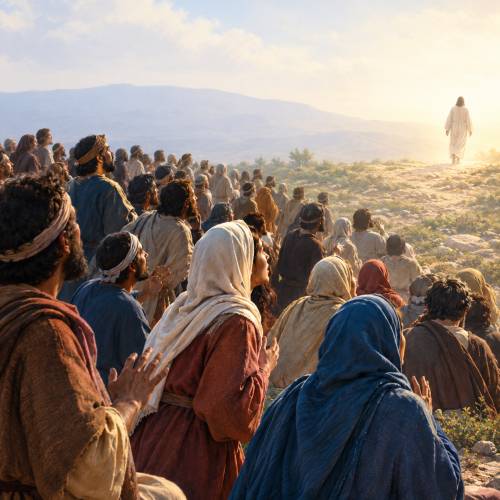
500 people saw a dead man walk and talk. Not one of them left us a single written word.
If you’re a sceptic, that sounds like the end of the story. The apostle Paul says more than 500 people saw the risen Jesus after His death. So where is their testimony?
It’s a fair question, and deserves a straight answer. In this post we shall look closely at the 500 witnesses to the resurrection. Their testimony didn’t vanish. It was spoken, checked, passed on and written down. You may already be holding it.
What Paul Actually Claimed
Around AD 53–55, Paul wrote a letter to the church in Corinth, a busy port city in Greece. In 1 Corinthians 15, he reminds believers of the heart of the Christian message:
For I delivered to you as of first importance what I also received: that Christ died for our sins in accordance with the Scriptures, that he was buried, that he was raised on the third day in accordance with the Scriptures, and that he appeared to Cephas, then to the twelve. Then he appeared to more than five hundred brothers at one time, most of whom are still alive, though some have fallen asleep. Then he appeared to James, then to all the apostles. Last of all, as to one untimely born, he appeared also to me.
1 Corinthians 15:3–8 (ESV)
Paul didn’t invent this list. He ‘received’ it and ‘delivered’ it. Jewish teachers used these words for handing on teaching carefully, like passing a precious jar from one pair of hands to the next. Scholars call this short summary a creed.
Key words in Paul’s list
| WORD | WHAT IT MEANS |
|---|---|
| Creed | A short summary of belief, easy to learn by heart. |
| Cephas | Peter’s name in Aramaic, the everyday language of Jesus. |
| The 12 | Jesus’ inner group of apostles, still called ‘the twelve’ after Judas died. |
| Brothers | Fellow believers in Jesus, not blood relatives. |
| Fallen asleep | A gentle way of saying ‘died’. Believers will one day wake up. |
| Untimely born | Paul’s humble way of saying he met Jesus last of all. |
Then comes the key line: ‘most of whom are still alive’. Paul isn’t talking about people who died long ago. He’s pointing to people who were alive when he wrote.
How Early Is the Claim?
Historians follow a simple rule: the closer a report is to the event, the harder it is for a legend to grow. A legend is a made-up story that grows over many generations. So how close is Paul’s list to the events?
Timeline: From the Cross to Corinth
- AD 30 or 33: Jesus is crucified in Jerusalem and rises on the third day.
- AD 31–35: Paul, who is attacking the church, meets the risen Jesus on the road to Damascus.
- About AD 34–37: Paul stays 15 days with Peter in Jerusalem and meets James, Jesus’ brother (Galatians 1:18–19). This is very likely where he ‘received’ the creed.
- About AD 50–51: Paul starts the church in Corinth.
- About AD 53–55: Paul writes 1 Corinthians and repeats the creed in writing.
Even sceptical scholars agree that this creed is very early. The German scholar Gerd Lüdemann dated it to within 2 or 3 years of the crucifixion. The British scholar James Dunn thought it took shape within months.
That’s far too soon for a legend to grow. The witnesses were still walking the streets of Jerusalem and the villages of Galilee.
Theologian John Gresham Machen saw why this matters. In 1923 he wrote:
‘Christ died’—that is history; ‘Christ died for our sins’—that is doctrine. Without these two elements, joined in an absolutely indissoluble union, there is no Christianity.
John Gresham Machen, Christianity and Liberalism
Why ‘Still Alive’ Is a Challenge, Not a Footnote
Why would Paul bother to say most of the 500 were still alive? British scholar Charles Harold Dodd gave a simple answer. Paul was saying, in effect, ‘the witnesses are there to be questioned’.
And remember: Paul was writing to doubters.
Now if Christ is proclaimed as raised from the dead, how can some of you say that there is no resurrection of the dead?
1 Corinthians 15:12 (ESV)
If the 500 didn’t exist, these doubters could easily find out:
- Travel was common. Roman roads and sea routes linked Corinth to Judea, and travellers moved between the churches all the time.
- Peter was known in Corinth. Some believers there said, ‘I follow Cephas’ (1 Corinthians 1:12).
- Messengers were going to Jerusalem. Paul was collecting a gift for poor believers there (1 Corinthians 16:1–4). Those who carried it would come back with news.
- Leaders could be named. Paul gave the names of Peter and James. Anyone could go and ask them.
A liar doesn’t hand his readers a list of people who could expose him. As Paul told King Agrippa, ‘this has not been done in a corner’ (Acts 26:26).
THINK ABOUT IT
If someone claimed 500 people in your town saw an amazing event 20 years ago, and that most are still alive, you could check it in a week. So could Paul’s readers. Nobody makes a claim like that unless they are sure.
A World of Voices, Not Memoirs
So why did the 500 not write their own accounts? Most of them couldn’t. Historian William Harris estimated that only about 1 person in 10 in the ancient world could read and write well, and among Galilean farmers and fishermen probably fewer. Asking 500 villagers for memoirs is like asking a village today to publish 500 books.
But they were far from silent. The ancient world was an oral world: news, history and teaching were passed on by word of mouth. And the early Christians actually preferred a living witness to a book.
Papias, a church leader who lived from about AD 60 to 130, searched out what Jesus’ first followers had said. He wrote that books helped him less than ‘a living and abiding voice’. The church historian Eusebius kept his words for us (Church History 3.39.4).
Around AD 125, another writer, Quadratus, told the Roman emperor Hadrian some people Jesus had healed or raised from the dead had lived on into his own lifetime (Church History 4.3.2).
Where did the testimony of the 500 go?
| WHERE IT WENT | WHAT THAT LOOKED LIKE |
|---|---|
| Into the churches | Witnesses told their story at meals, prayer meetings and gatherings across Judea and Galilee. |
| Into the creed | Their sighting was written into the summary that new believers learned by heart (1 Corinthians 15:6). |
| Into the Gospels and Acts | Writers like Luke gathered reports from ‘those who from the beginning were eyewitnesses’ (Luke 1:2). |
| Into changed lives | A small, frightened group became a movement that spread across the Roman Empire. |
Even written works vanished. Most ancient writing is lost. Roman historian Livy wrote 142 books of history, and only 35 survive. Papias’s own 5 books survive only as small quotations. Silence today doesn’t mean silence then.
What We’d Expect If Paul Invented It
Let’s test the sceptic’s idea fairly. If Paul made up the 500, what would we expect to find? And what do we actually find?
Invention or real event? Testing the evidence
| IF PAUL MADE IT UP, WE’D EXPECT… | WHAT WE ACTUALLY FIND |
|---|---|
| Witnesses who were far away or long dead | ‘Most of whom are still alive’: the witnesses could be found |
| A late claim, made after the eyewitnesses had gone | A creed from within a few years of the cross |
| Readers who already agreed with Paul | A church where some denied the resurrection (1 Corinthians 15:12) |
| Enemies quickly exposing the lie | No early opponent claims the appearances were invented |
| A list that makes Paul look important | Paul calls himself ‘the least of the apostles’ (1 Corinthians 15:9) |
| The movement fading once the lie was known | The church grew in Jerusalem, the very city where Jesus died |
Named Witnesses and the Sceptic’s Double Standard
Sceptics say, ‘We do not even know the names of the 500.’ That is true, but it misses the point. Paul’s list works like a witness list in court. It names the leaders who could speak for the group: Peter, James and the apostles. The 500 show that this was not a private experience of a few close friends. A crowd saw Him.
And many witnesses do have names. The Gospels and Acts give them to us:
- Mary Magdalene, Joanna and Mary the mother of James found the empty tomb (Luke 24:10).
- Cleopas walked to Emmaus with the risen Jesus (Luke 24:18).
- Thomas was invited to touch Jesus’ wounds (John 20:27).
- Joseph Barsabbas and Matthias had both seen the risen Lord (Acts 1:21–23).
- James had not believed in his brother before the cross (John 7:5).
The British scholar Richard Bauckham argues in Jesus and the Eyewitnesses that these names work like footnotes. They tell the reader: this person was there, and you can ask them. Mark even calls Simon of Cyrene ‘the father of Alexander and Rufus’ (Mark 15:21), men his first readers knew.
Paul’s creed also leaves out the women at the tomb, though they saw Jesus first. Why? Josephus wrote that women’s testimony should not be admitted in court (Antiquities 4.219). The creed was shaped like an official list for a doubting world. That makes it more like a legal record, not less.
The Gospels don’t describe the 500 because they never meant to record everything (John 20:30).
Nobody demands 500 written statements before believing that Alexander the Great conquered Persia. Compare the evidence:
How the resurrection compares with other ancient events
| EVENT | MAIN WRITTEN SOURCES | WRITTEN HOW LONG AFTER? |
|---|---|---|
| Alexander the Great’s conquests (died 323 BC) | Arrian and Plutarch | About 400 years |
| Reign of Emperor Tiberius (AD 14–37) | Velleius Paterculus, Tacitus, Suetonius, Cassius Dio | From his lifetime to about 200 years |
| Resurrection of Jesus (AD 30 or 33) | The early creed, Paul’s letters, four Gospels and Acts | From a few years to about 60 years |
Apply the sceptic’s test to all of history and we would lose most of what we know about the ancient world. The problem is not the evidence. It is the standard.
Could 500 People Hallucinate?
Some sceptics say the witnesses had a hallucination: seeing or hearing something that is not really there, often caused by illness, grief or drugs. That idea fails:
- Hallucinations are private. They happen inside one mind. Five hundred people do not share one hallucination.
- The appearances were physical. Jesus ate fish in front of His disciples (Luke 24:42–43). He told them, ‘Touch me, and see’ (Luke 24:39).
- They happened many times and in many places. Indoors and outdoors, to one person and to groups, to men and to women, over forty days (Acts 1:3).
- Sceptics were changed. James did not believe in his brother. Paul hated the church. Neither was grieving for Jesus or hoping to see Him.
- The tomb was empty. A hallucination cannot move a body. Jesus’ enemies paid soldiers to say the disciples ‘stole him away’ (Matthew 28:13). That story admits the tomb was empty.
The American scholar Dale Allison fairly notes that we know little about the 500, and that groups sometimes report shared visions, such as sightings of Mary. But people in those crowds describe different things, and nobody eats a meal with a vision. The 500 are also one strand in a strong rope, with the empty tomb, the other appearances and the sudden birth of the church.
The Testimony You Hold Today
So where is the testimony of the 500? It is in the message of the church, and that message is now written down in the New Testament. God chose to make the resurrection known through witnesses. Peter told a Roman officer:
God raised him on the third day and made him to appear, not to all the people but to us who had been chosen by God as witnesses, who ate and drank with him after he rose from the dead.
Acts 10:40–41 (ESV)
This is God’s way. The Old Testament law said, ‘Only on the evidence of two witnesses or of three witnesses shall a charge be established’ (Deuteronomy 19:15). At the resurrection, God gave hundreds. Then He gave His apostles the task of writing that witness down. The church is ‘built on the foundation of the apostles and prophets’ (Ephesians 2:20). The apostle John put it like this:
That which was from the beginning, which we have heard, which we have seen with our eyes, which we looked upon and have touched with our hands… that which we have seen and heard we proclaim also to you.
1 John 1:1, 3 (ESV)
So when you read the New Testament, you are reading the eyewitnesses. The Princeton theologian Benjamin Breckinridge Warfield wrote an 1884 essay whose title says it all: ‘The Resurrection of Christ an Historical Fact, Evinced by Eye-Witnesses’. (Evinced is an old word for ‘proved’.) The resurrection can be tested like any other fact of history: by witnesses.
The theologian Richard Gaffin adds a beautiful thought. Paul calls the risen Christ ‘the firstfruits of those who have fallen asleep’ (1 Corinthians 15:20). Firstfruits were the first part of a harvest, offered to God as a promise that the rest was coming. The 500 saw the first sign of God’s new creation. The raising of every believer is still to come.
WHY EVIDENCE ALONE ISN’T ENOUGH
Jesus said, ‘If they do not hear Moses and the Prophets, neither will they be convinced if someone should rise from the dead’ (Luke 16:31). The real problem is a heart that will not bow to a risen King (Romans 1:18). The thinker Cornelius Van Til taught that there are no ‘brute facts’: we always read facts through what we already believe. Someone sure that the dead cannot rise will explain away even 500 witnesses.
That is why the reformer John Calvin taught that we need more than arguments:
For as God alone can properly bear witness to his own words, so these words will not obtain full credit in the hearts of men, until they are sealed by the inward testimony of the Spirit.
John Calvin, Institutes of the Christian Religion 1.7.4
The Westminster Confession of Faith (1646) agrees. Our full assurance comes ‘from the inward work of the Holy Spirit, bearing witness by and with the Word in our hearts’ (1.5). The evidence is real and good to use. But it is God’s Spirit who opens blind eyes to see that it is true.
Five hundred people saw Jesus alive. Their testimony was not lost. It was carried across the world, and today it has reached you. The only question left is what you will do with it.
Tough Questions, Honest Answers
Where did Jesus appear to the 500?
The Bible doesn’t tell us for certain. Many Bible teachers think it was the meeting on a mountain in Galilee described in Matthew 28:16–17. Before His death and again after rising, Jesus told His followers to go to Galilee, where they would see Him (Matthew 26:32; 28:10). That gave time for a large crowd to gather. Matthew also says that when they saw Him, ‘some doubted’, which fits a bigger group than the eleven apostles. Galilee was home for most of Jesus’ followers, so it makes sense that hundreds came. Wherever it happened, Scripture gives us what we truly need: He appeared, and the witnesses were known.
Were women among the 500 witnesses?
Very probably. Paul uses the Greek word adelphoi, which means ‘brothers’ but was often used for a mixed group of believers, both men and women. That’s why the ESV footnote offers ‘brothers and sisters’. Some think Paul may have counted only the men, as Matthew did at the feeding of the 5,000, ‘besides women and children’ (Matthew 14:21). If so, the crowd was even bigger than 500. Either way, women stand at the centre of the resurrection story. They found the empty tomb first, and Mary Magdalene was the first to see the risen Lord (John 20:14–18).
Why didn’t Jesus appear to Pilate or the Jewish leaders?
God chose to spread the good news through preaching, not by putting on a show for His enemies. Paul writes that ‘it pleased God through the folly of what we preach to save those who believe’ (1 Corinthians 1:21). The Jewish leaders had already seen Lazarus raised from the dead, and their response was to plan his death too (John 12:10). Seeing does not change a hard heart; only God’s grace does. And Jesus did appear to one enemy: Saul, who became the apostle Paul. That shows His appearances were about calling and grace, not about winning an argument.
How many times did Jesus appear after He rose?
The New Testament records about 10 to 12 separate appearances. They include Mary Magdalene, the other women, Peter, 2 disciples on the road to Emmaus, the disciples in a locked room (twice), 7 disciples by the Sea of Galilee, the 500, James, the apostles at His ascension and, later, Paul. Luke says the appearances took place ‘during forty days’ (Acts 1:3). They happened in a garden, a house, on a road, on a beach and on a mountain, in both Jerusalem and Galilee. This variety matters. It shows the appearances were not one strange moment, but many meetings with a real, living person.
Did any of the 500 die for their testimony?
We don’t know the names of most of the 500, so we cannot say what happened to each one. But we do know that key witnesses suffered and died. King Herod killed James the brother of John ‘with the sword’ (Acts 12:2). Josephus records that James the brother of Jesus was stoned around AD 62 (Antiquities 20.200). Early Christian writers tell us that Peter and Paul died in Rome under the emperor Nero, and Sean McDowell concludes in The Fate of the Apostles that these deaths are very likely historical. People sometimes die for a lie they think is true. These men died for what they said they had seen with their own eyes, and liars make poor martyrs.
Is Jesus’ resurrection mentioned outside the Bible?
Partly, yes. Around AD 116, the Roman historian Tacitus wrote that Christ was executed under Pontius Pilate, and that the Christian ‘superstition’ was stopped for a moment but then broke out again (Annals 15.44). Many see this as a hint of the resurrection preaching. Around AD 112, the Roman governor Pliny the Younger reported that Christians met to sing to Christ ‘as to a god’. A tenth-century Arabic version of a passage in Josephus also says that Jesus’ disciples reported He appeared to them alive 3 days after His crucifixion. These writers weren’t believers, but they confirm the Bible’s picture: a crucified man, and a movement that would not die because His followers said He was alive.
Why should I believe without seeing, as the 500 did?
Thomas asked for proof too, and Jesus gave it. But then He said, ‘Blessed are those who have not seen and yet have believed’ (John 20:29). Most Christians in history have believed the resurrection not by seeing, but by hearing the word of those who did. Paul explains that ‘faith comes from hearing, and hearing through the word of Christ’ (Romans 10:17). This isn’t blind faith but trust in reliable witnesses, written in a reliable book. The Holy Spirit then makes that truth certain in your heart. We’re not asked to believe with less evidence than the 500 had, but to receive their evidence.
Related Reads
- Where Did Luke Get His Gospel Details? The Case for Mary
- Did Jesus Rise from the Dead? The Historical Case for the Resurrection
- Evidence for the Resurrection Outside the Bible: 12 Ancient Witnesses
- Mass Hallucination: Does This Explain Resurrection Appearances?
- The Empty Tomb: Did the Disciples Steal Jesus’ Body?
- Women at Jesus’ Tomb: Answers to Sceptics’ Toughest Objections
- Oral Tradition and the Gospels: How Was Jesus’ Story Kept Safe?
- Are the Gospels Eyewitness Accounts? The Mounting Evidence
- Ten Evidences for the Resurrection in Luke 24: What One Chapter Proves