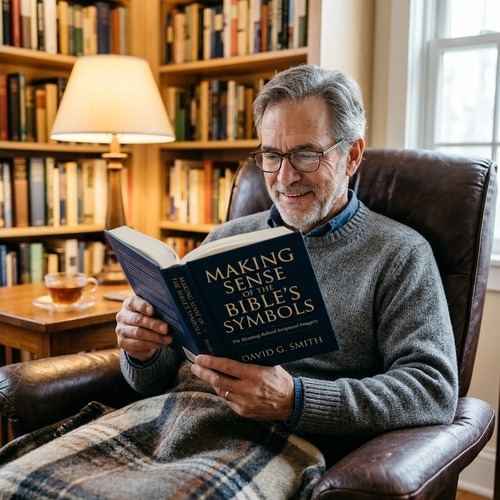
Does God have feathers? Psalm 91:4 says, ‘He will cover you with his pinions, and under his wings you will find refuge.’ Read that word for word, and you end up with a God who has a bird’s body. Now try the opposite. Call everything in the Bible ‘just a symbol’, and soon Adam, Jonah and even the empty tomb melt into nice stories with a moral.
Both mistakes are real. Both are common. And both come from the same problem: we’ve not learned to read the Bible the way the Bible itself teaches us to read it.
The Bible is full of symbols—lambs and lions, lampstands and beasts, numbers, colours and dreams. Some readers love them; others skip to the ‘easy’ parts. The good news is that God hasn’t left us to guess. Let’s see what symbolism is, why God uses it, and how to recognise it and read it right.
What’s Symbolism? Some Simple Terms
A symbol is something that stands for something bigger than itself. A wedding ring is a small piece of metal, but it stands for a lifelong promise. The table explains the Bible’s main kinds of picture-language.
| TERM | WHAT IT MEANS IN SIMPLE WORDS | BIBLE EXAMPLE |
|---|---|---|
| Metaphor | Calls one thing another thing to show how they are alike | ‘The LORD is my rock’ (Psalm 18:2) |
| Simile | Compares two things using ‘like’ or ‘as’ | ‘Though your sins are like scarlet’ (Isaiah 1:18) |
| Symbol | An object, number or picture that stands for a bigger idea | Seven lampstands stand for seven churches (Revelation 1:20) |
| Type | A real person, event or thing in history that God used to point ahead to Christ | Adam, ‘a type of the one who was to come’ (Romans 5:14) |
| Allegory | A story in which many parts stand for something else | Sarah and Hagar picture two covenants (Galatians 4:24) |
| Parable | A short, everyday story that teaches one main truth | The sower and the seed (Mark 4:1–20) |
| Apocalyptic vision | A dream-like vision, full of symbols, that shows God’s plan for history | Daniel 7; the book of Revelation |
KEY IDEA: ‘LITERAL’ DOES NOT MEAN ‘WORD FOR WORD’
When the Reformers spoke of the literal sense, they meant the sense the writer intended. English scholar William Whitaker (1548–1595) taught that if a writer uses a picture on purpose, the meaning of that picture is the literal sense. So ‘The LORD is my rock’ is literally true—God really is strong, safe and unchanging—even though He isn’t made of stone.
Why Does God Speak in Symbols?
Symbols are not a mistake, and they are not a secret code for clever people. They are God’s chosen way of speaking. He says so Himself:
‘I spoke to the prophets; it was I who multiplied visions, and through the prophets gave parables.’
Hosea 12:10
God also shows that He has more than one way of speaking. Of Moses He says, ‘With him I speak mouth to mouth, clearly, and not in riddles’ (Numbers 12:8). Plain speech and picture-speech both come from the same God. Why does He use pictures?
- They reveal and they hide. Jesus told His disciples, ‘To you has been given the secret of the kingdom of God, but for those outside everything is in parables’ (Mark 4:11). The same story opens the eyes of the humble and shuts the door on the proud.
- They stay in the memory. You may forget a lecture, but not a shepherd who leaves ninety-nine sheep to find one.
- They reach the heart. The word ‘Babylon’ in Revelation says far more than ‘a wicked world system’. It carries exile, pride and judgement.
- They point forward. The temple, the sacrifices and the priests were God’s picture-book, waiting for the real thing to arrive in Jesus.
5 Truths That Guide Us
How do we read symbols rightly? The Bible gives us five truths that guard us from guesswork.
1. The Bible Explains Its Own Symbols
Again and again, the Bible decodes its own pictures.
- Joseph’s dreams: ‘The seven good cows are seven years’ (Genesis 41:26).
- Daniel’s beasts: ‘These four great beasts are four kings who shall arise out of the earth’ (Daniel 7:17).
- John’s vision: ‘The seven stars are the angels of the seven churches, and the seven lampstands are the seven churches’ (Revelation 1:20).
Revelation even states its method in its first verse: God ‘made it known’ to John (Revelation 1:1). Gregory K Beale, a leading scholar of Revelation, notes that this Greek verb (sēmainō) means ‘to show by signs’. From line one, John warns us: expect pictures.
The Westminster Confession of Faith (1646) puts the principle in one famous line:
‘The infallible rule of interpretation of Scripture is the Scripture itself.’
Westminster Confession of Faith 1.9
‘Infallible’ simply means ‘cannot fail’. Our ideas can fail. Scripture explaining Scripture cannot.
2. Jesus Corrected Both Mistakes
Jesus corrected people who read Him too woodenly and people who refused to believe Him.
| MISTAKE | WHAT HAPPENED | HOW JESUS CORRECTED IT |
|---|---|---|
| Too literal | People thought Jesus meant Herod’s stone temple | ‘But he was speaking about the temple of his body’ (John 2:21) |
| Too literal | Nicodemus asked, ‘Can he enter a second time into his mother’s womb?’ (John 3:4) | Jesus explained new birth by the Spirit (John 3:5–8) |
| Too literal | The disciples thought ‘leaven’ meant bread | ‘I did not speak about bread’ (Matthew 16:11) |
| Unbelief | The Sadducees denied the resurrection | ‘You are wrong, because you know neither the Scriptures nor the power of God’ (Matthew 22:29) |
Notice also that Jesus expected His hearers to understand. ‘Do you not understand this parable? How then will you understand all the parables?’ (Mark 4:13).
3. Each Passage Has One True Meaning
In the Middle Ages, some teachers believed every verse had 4 layers of meaning. See how ‘Jerusalem’ was stretched 4 ways.
| MEDIEVAL ‘SENSE’ | WHAT IT LOOKED FOR | ‘JERUSALEM’ MEANT… |
|---|---|---|
| Literal | The plain, historical meaning | The city in Israel |
| Allegorical | A hidden doctrine | The church |
| Moral | A lesson for behaviour | The human soul |
| Anagogical | A heavenly or future meaning | Heaven |
Once a verse can mean 4 things, it can soon mean anything. The Reformers pushed back. The Westminster Confession says the true sense of any scripture ‘is not manifold, but one’ (1.9)—that is, not many, but one. Puritan preacher William Perkins (1558–1602) said:
‘There is one only sense, and the same is the literal.’
William Perkins, The Art of Prophesying
John Calvin (1509–1564) agreed. Writing on Galatians 4, where Paul does use an allegory, Calvin still insisted ‘the true meaning of Scripture is the natural and obvious meaning’. As Peter says, ‘no prophecy of Scripture comes from someone’s own interpretation’ (2 Peter 1:20).
4. Symbols Point to Christ
One true meaning isn’t a small meaning. Old Testament pictures grow as the Bible’s story unfolds, and all arrive at Jesus. On the road to Emmaus, ‘beginning with Moses and all the Prophets, He interpreted to them in all the Scriptures the things concerning Himself’ (Luke 24:27).
- Shadows: The law has ‘but a shadow of the good things to come’ (Hebrews 10:1).
- Substance: ‘These are a shadow of the things to come, but the substance belongs to Christ’ (Colossians 2:17).
Geerhardus Vos (1862–1949) compared God’s revelation to a tree growing from a seed: the seed already holds the whole tree. So the Passover lamb was always pointing to Christ, even before anyone saw it fully. Patrick Fairbairn (1805–1874) added a wise warning: a true type is a real thing God Himself designed to point forward—not anything we think looks like Jesus.
5. ‘Symbolic’ Doesn’t Mean ‘Not Real’
Many people say, ‘That story is just symbolic,’ when they mean, ‘That never happened.’ But a type needs a real event behind it.
- Adam was a real man, and also ‘a type of the one who was to come’ (Romans 5:14).
- The rock in the wilderness gave real water, and ‘the Rock was Christ’ (1 Corinthians 10:4).
- Jonah really spent three days in the fish, and Jesus built His own resurrection promise on it (Matthew 12:40).
Paul says these events ‘happened to them as an example, but they were written down for our instruction’ (1 Corinthians 10:11). First they happened; then they taught.
SYMBOL AND HISTORY ARE FRIENDS, NOT ENEMIES
The first Passover lamb was a real lamb, with real blood on real doorposts, on a real night in Egypt (Exodus 12). It was also a picture: ‘For Christ, our Passover lamb, has been sacrificed’ (1 Corinthians 5:7). Remove the event, and the picture loses its power. Remove the picture, and the event loses its point.
How to Recognise Symbolism: Seven Simple Tests
How can you tell when a passage uses symbols? Ask these seven questions.
| TEST | QUESTION TO ASK | EXAMPLE |
|---|---|---|
| 1. Explanation | Does the text itself explain the picture nearby? | Daniel 7:17; Revelation 1:20 |
| 2. Kind of writing | Is this a story, letter, poem, prophecy, parable or vision? | Acts (mostly plain) versus Revelation (mostly pictures) |
| 3. Signal words | Do I see words like ‘like’, ‘as’, ‘shadow’, ‘copy’, ‘type’ or ‘symbolic’? | ‘A copy and shadow’ (Hebrews 8:5); ‘symbolic for the present age’ (Hebrews 9:9) |
| 4. Clash with clear truth | Would a word-for-word reading contradict something the Bible plainly teaches? | God’s ‘wings’ (Psalm 91:4) versus ‘God is spirit’ (John 4:24) |
| 5. Old Testament echo | Have I seen this picture earlier in the Bible? | Lamb, temple, Babylon, the tree of life |
| 6. Apostles’ example | Does the New Testament treat this event or object as a picture? | 1 Corinthians 10:1–11 |
| 7. Fits the whole Bible | Does my reading agree with the Bible’s clear teaching elsewhere? | The ‘analogy of faith’ |
The last test has an old name: the analogy of faith. It means the Bible never contradicts itself, so clear parts guide how we read harder parts. When Jesus says, ‘I am the door’ (John 10:9), nobody looks for hinges.
CAREFUL: NOT EVERY DETAIL MEANS SOMETHING
Augustine (354–430) once read the parable of the Good Samaritan as a coded map of salvation. The wounded man was Adam, the inn was the church, and the innkeeper was the apostle Paul! Clever—but Jesus told the story to answer one question: ‘Who is my neighbour?’ (Luke 10:29).
John Calvin called a similar allegory of this parable ‘too absurd to deserve refutation’. The lesson: parables usually teach one main point. Many details are simply there to make the story real.
Five Wrong Turns to Avoid
Here are five wrong turns that mislead sincere readers.
- Turning everything into allegory. The early teacher Origen (around 185–254) found hidden meanings almost everywhere. He often forgot to ask what the writer meant.
- Hunting for number codes. Some numbers do carry meaning. Seven often speaks of completeness (God rested on the seventh day, Genesis 2:2–3). Twelve points to God’s people (twelve tribes, twelve apostles). Forty often marks a time of testing (the Flood, the wilderness, Jesus’ temptation). But ‘gematria’—adding up the number values of letters—and so-called ‘Bible codes’ are human inventions. Revelation 13:18 is a rare case where the text itself invites calculation, and even there it says, ‘This calls for wisdom’, not guesswork.
- Trusting colour and dream dictionaries. Only a few colours have a clear meaning in the Bible: white for purity and victory, scarlet for sin (Isaiah 1:18), and purple for royalty. Most online colour charts and dream dictionaries are made up.
- Reading every picture word for word. Some insist the locusts of Revelation 9 are insects with human faces. But the text says ‘their faces were like human faces’ (Revelation 9:7). The signal word is right there.
- Starting with ‘What does it mean to me?’ That is a good question—but it is the second question. First ask what God meant. The meaning is fixed; the application can be personal.
Putting It Together: The Lamb in Revelation 5
Let’s test our tools. In heaven, John weeps because no one can open God’s scroll. Then an elder says, ‘Weep no more; behold, the Lion of the tribe of Judah, the Root of David, has conquered’ (Revelation 5:5). John turns to see the Lion. Instead he sees this:
‘A Lamb standing, as though it had been slain, with seven horns and with seven eyes, which are the seven spirits of God sent out into all the earth.’
Revelation 5:6
- Kind of writing: This is a vision, so we expect pictures.
- Explanation: The text itself explains the 7 eyes: they are ‘the 7 spirits of God’, a picture of the Holy Spirit’s full presence everywhere.
- Old Testament echo: The Passover lamb (Exodus 12) and the servant led ‘like a lamb that is led to the slaughter’ (Isaiah 53:7).
- Apostles’ example: John the Baptist pointed to Jesus: ‘Behold, the Lamb of God, who takes away the sin of the world!’ (John 1:29).
- Horns and numbers: In Daniel, horns stand for kings and power (Daniel 7:24). 7 speaks of completeness. So 7 horns means complete power.
Now the meaning shines. The Lion wins as the Lamb. Jesus conquered by dying for His people, and now holds all power. Revelation doesn’t show us a strange animal. It shows us the real Christ, really crucified. And really risen and really reigning.
WHAT JUST HAPPENED?
- We didn’t guess. The Bible explained its own picture.
- We found one clear meaning, not many competing ones.
- The symbol led us straight to Christ.
- The symbol was about something that truly happened at the cross.
Conclusion: Symbols Are God’s Kindness
God didn’t fill His Word with pictures to confuse us. He made us people who see, imagine and remember. His symbols are windows: we don’t stare at the glass; we look through it.
So we read the Bible’s symbols with both confidence and humility. Confidence, because God has spoken clearly. As the Westminster Confession says, everything needed for salvation is ‘so clearly propounded and opened in some place of Scripture or other’ that ordinary believers can understand it (1.7). Humility, because some pictures are deep.
Above all, let every symbol lead us to the One it points to. The lamb, the rock, the temple and the door all have the same address: Jesus Christ.
Tough Questions, Honest Answers
Is the 144,000 in Revelation a literal number?
In Revelation 7, John hears the number of the sealed: 144,000 from the tribes of Israel (7:4). Then he turns and sees ‘a great multitude that no one could number, from every nation, from all tribes and peoples and languages’ (7:9). This is the same pattern as the Lion and the Lamb—what John hears is explained by what he sees. The number itself is built from twelve times twelve times a thousand: God’s people, complete and very large. So the 144,000 is not a limit on how many will be saved. It is a picture of the whole people of God, every one of them counted and kept safe.
Are the 1,000 years in Revelation 20 literal?
Revelation uses numbers as symbols throughout, and 1,000 (ten times ten times ten) is a natural picture of a long and complete period. Many Bible teachers through church history have read these thousand years as the whole time between Christ’s first and second comings. In this time Satan is ‘bound’ so that he cannot stop the gospel from reaching the nations—just as Jesus spoke of binding the strong man (Matthew 12:29). Other godly believers expect a future, literal 1,000-year reign on earth. Whatever view we hold, the main message is the same: Christ has already won, and His people are safe with Him.
Are the days of Genesis 1 symbolic?
Genesis 1 is written as history, in the form of a story, not as a dream or vision. Each day has a number and is marked by ‘evening and morning’, which is the normal way the Bible describes ordinary days. God’s command to rest on the seventh day is based on the creation week itself (Exodus 20:11). Jesus also treated creation as real history: ‘from the beginning of creation, “God made them male and female”’ (Mark 10:6). Some Christians read the days differently, but the signals in the text itself point to ordinary days.
Is the fire of hell literal or symbolic?
The Bible uses several pictures for hell: fire, ‘outer darkness’ (Matthew 25:30) and a worm that does not die (Mark 9:48). Fire and total darkness cannot both be literal in the ordinary sense, so some of this language is picture-language. John Calvin himself thought these expressions were figures meant to show us how terrible it is to be cut off from God (Institutes 3.25.12). But remember: a symbol never means ‘less real’. The reality is always greater than the picture. Jesus said plainly that the wicked ‘will go away into eternal punishment, but the righteous into eternal life’ (Matthew 25:46). The right response is not to argue about the flames but to run to Christ, who bore God’s judgement for all who trust Him.
Is the Song of Songs an allegory of Christ and the church?
For centuries, many Christians—including many Puritans—read the Song of Songs as a detailed allegory of Christ and His people. But first and foremost it is a real love poem that celebrates marriage between a man and a woman as God’s good gift. At the same time, Paul tells us that marriage itself points beyond itself: ‘This mystery is profound, and I am saying that it refers to Christ and the church’ (Ephesians 5:32). So we can read the Song first as a book about married love, and then let it lift our eyes to Christ’s greater love for His bride. What we should not do is invent a hidden meaning for every verse and detail.
Are the bread and wine in the Lord’s Supper only symbols?
The bread and wine are signs, but they are not empty signs. The Westminster Confession says that in every sacrament there is ‘a spiritual relation, or sacramental union, between the sign and the thing signified’ (27.2). The bread does not turn into Christ’s physical body, as Roman Catholic teaching claims. But neither is the Supper only a reminder. Believers who eat and drink in faith ‘spiritually receive, and feed upon, Christ crucified’ (29.7). The sign is real bread; the gift behind it is the real Christ, received by faith through the Holy Spirit.
Does God still speak to us through signs, symbols or dreams?
God rules over all things and is free to use any event in our lives to guide or humble us. But He has given us a finished Bible. ‘Long ago, at many times and in many ways, God spoke to our fathers by the prophets, but in these last days he has spoken to us by his Son’ (Hebrews 1:1–2). The Westminster Confession says that nothing is to be added to Scripture, ‘whether by new revelations of the Spirit, or traditions of men’ (1.6). Hunting for signs or decoding dreams often leads to fear and confusion rather than faith. If you want to hear God speak, open His Word—there He speaks clearly, and every word is true.
Related Reads
- Why Is Context Important in Interpreting Scripture?
- The Passover Lamb and Christ: Understanding Bible Typology
- Is Biblical Prophecy Always to Be Read Literally?
- Bible Interpretation 101: The Grammatical-Historical Method Explained
- Exegesis vs Eisegesis: What Do the Two Terms Really Mean?
- Bible Mystery: Who Are the 144,000 Really?
- Christ’s Return: A Primer on the Four Millennial Views
- Creation’s Clock: Defending the 24-Hour Day in Genesis 1
- When God Manifests in Fire: What Does the Symbolism Mean?
- Behemoth and Leviathan: Real Monsters or Symbolic Creatures?
- Jesus in the Song of Songs: The Bridegroom Who Loves His Bride
- Baptism and the Lord’s Supper: Why the Sacraments Truly Matter
- Understanding Perspicuity: What Does the Term Really Mean?