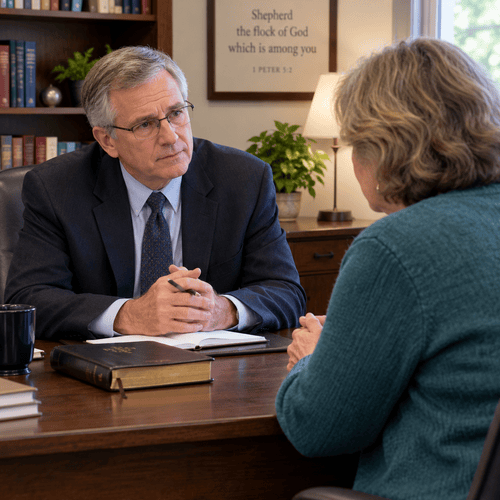
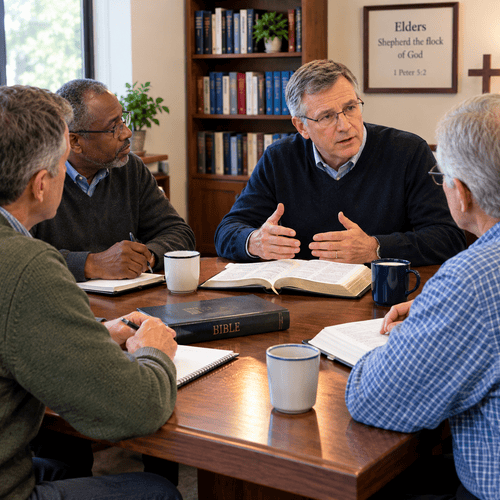
Here’s a question that might surprise some: who is the senior pastor of your church?
You probably thought of a name. Perhaps the man who preaches most Sundays. Perhaps the founder who started the church 30 years ago. But the Bible gives a different answer. The apostle Peter says the top shepherd of every true church is Jesus Christ Himself—‘the chief Shepherd’ (1 Peter 5:4). That job is already taken.
This matters. Many churches are built around one strong man. He preaches, decides and controls. When he falls into sin, burns out or dies, the whole church shakes. In recent years we’ve watched famous pastors fall, and whole churches with them.
So should a church be led by one pastor, or by a team of elders? We shall answer mainly from one short passage: 1 Peter 5:1–4. We shall discover the real question isn’t ‘pastor or elder?’ but ‘one pastor or many?’ And we will see that God’s design isn’t only right—it’s good for our joy.
OUR KEY TEXT: 1 PETER 5:1–4
‘So I exhort the elders among you, as a fellow elder and a witness of the sufferings of Christ, as well as a partaker in the glory that is going to be revealed: shepherd the flock of God that is among you, exercising oversight, not under compulsion, but willingly, as God would have you; not for shameful gain, but eagerly; not domineering over those in your charge, but being examples to the flock. And when the chief Shepherd appears, you will receive the unfading crown of glory.’
Keep this passage open as you read. Almost every point in this post grows out of it.
What Do “Pastor-Led” and “Elder-Led” Mean?
Church government (sometimes called polity) simply means how a church is organised and who makes the big decisions. Let us define our two terms.
A pastor-led church has one main leader, ‘the pastor’ or ‘senior pastor’, who holds the final spiritual authority. Deacons or a board may help, but mostly with practical matters.
An elder-led church is led by a team of elders, each meeting God’s standards in 1 Timothy 3:1–7 and Titus 1:5–9. Together they teach, care for and protect the church.
| QUESTION | PASTOR-LED CHURCH | ELDER-LED CHURCH |
|---|---|---|
| Who has final spiritual oversight? | One pastor | A team of qualified elders |
| Who usually preaches? | The pastor | One or more elders, often a lead pastor |
| Who can correct the leader if he goes wrong? | Often no one with real authority | His fellow elders |
| What do deacons do? | Often act as a board that runs the church | Serve practical needs, so elders can focus on the Word and prayer |
| What is the main danger? | One man’s sin or weakness affects everyone | Slow decisions if elders do not work well together |
A quick note: churches with elders still differ on how much say the members have. That is a separate question, which we explore in Congregational, Presbyterian, Episcopal: Forms of Church Government Compared. Here we focus on the main issue: one leader, or a team?
Pastor, Elder, Overseer: One Job, Three Names
Here is the key to this whole debate. Today we often think the pastor is the paid man who preaches, and the elders are men who help him. But the New Testament uses three words for the same leaders:
| GREEK WORD | ENGLISH WORD | WHAT THE WORD STRESSES |
|---|---|---|
| presbyteros | Elder | Maturity—a seasoned, trusted believer |
| episkopos | Overseer (sometimes ‘bishop’) | Responsibility—watching over the church |
| poimēn | Shepherd or pastor | Care—feeding and protecting the flock |
Now look at how Peter joins all three in our key text. He speaks to ‘the elders’ (verse 1). He tells them to ‘shepherd the flock’ (verse 2)—the action word behind ‘pastor’. And he tells them to keep ‘exercising oversight’ (verse 2)—the action word behind ‘overseer’. In one breath, the elders are the pastors and the overseers.
Paul does the same. He calls ‘the elders of the church’ at Ephesus (Acts 20:17), then tells these very men: ‘Pay careful attention to yourselves and to all the flock, in which the Holy Spirit has made you overseers, to care for the church of God’ (Acts 20:28). In Titus 1:5–7, the ‘elders’ of verse 5 become the ‘overseer’ of verse 7.
This is not a new idea. The French pastor John Calvin wrote in the 1500s that he called church leaders bishops, presbyters and pastors without distinction, ‘on the authority of Scripture, which uses the words as synonymous’ (Institutes 4.3.8). The English Bible scholar J. B. Lightfoot said this fact was accepted by scholars ‘of all shades of opinion’.
WHAT THIS MEANS
A pastor is an elder. An elder is a pastor. So the real question isn’t ‘Should our church be led by a pastor or by elders?’ It is ‘Should our church be led by one pastor or by several?’
Every New Testament Church Had More Than One Elder
So how many pastor-elders did each church have? Every time the New Testament speaks of the elders of a local church, the word is plural.
Start with our key text. Peter wrote to believers scattered across five regions of what is now Turkey (1 Peter 1:1). He does not write ‘to the pastor of each church’. He writes, ‘I exhort the elders among you’. Many churches, many elders. The rest of the New Testament shows the same pattern:
- Jerusalem: gifts were sent ‘to the elders’ (Acts 11:30), and ‘the apostles and the elders were gathered together’ to settle a big question (Acts 15:6).
- Southern Galatia: Paul and Barnabas ‘appointed elders for them in every church’ (Acts 14:23). Notice: elders (plural) in every church (singular).
- Ephesus: Paul ‘called the elders of the church’ (Acts 20:17).
- Philippi: Paul greets the church ‘with the overseers and deacons’ (Philippians 1:1).
- Crete: Titus must ‘appoint elders in every town’ (Titus 1:5).
- Thessalonica: believers must respect ‘those who labour among you and are over you in the Lord’ (1 Thessalonians 5:12).
- Jewish believers abroad: the sick should ‘call for the elders of the church’ (James 5:14), and readers must obey their ‘leaders’ (Hebrews 13:17).
Theologian Wayne Grudem puts it well: ‘no passage suggests that any church, no matter how small, had only one elder.’
What about ‘an overseer’ in the singular (1 Timothy 3:2)? Paul is describing what each overseer must be like, just as we might say, ‘A doctor must be careful’—without meaning a hospital has only one doctor. And when John calls himself ‘the elder’ (2 John 1), he is an apostle, not a pastor ruling one church alone.
Why Did God Design It This Way?
God does not give us patterns for no reason. Our key text points to at least five good reasons for a team of elders:
- Jesus is the only Senior Pastor. Peter calls Jesus ‘the chief Shepherd’ (verse 4). The Greek word, archipoimēn, means ‘head shepherd’. Every human pastor is an under-shepherd. A team of elders makes this plain: no single man becomes the head of the church. That place belongs to Christ alone, who ‘is the head of the body, the church’ (Colossians 1:18).
- Even apostles need partners. Peter walked with Jesus and was an apostle. Yet he calls himself ‘a fellow elder’ (verse 1). If Peter did not stand alone above other elders, no pastor today should.
- Power tempts every heart. Peter warns elders against ‘domineering over those in your charge’ (verse 3). John met a church leader called Diotrephes, ‘who likes to put himself first’ (3 John 9). When one man holds all the power, no one is close enough or strong enough to say, ‘Brother, you are wrong.’ Even Peter once needed Paul to correct him to his face (Galatians 2:11).
- Many counsellors bring safety. ‘Where there is no guidance, a people falls, but in an abundance of counsellors there is safety’ (Proverbs 11:14).
- The load is too heavy for one man. When Moses tried to judge all of Israel by himself, his father-in-law warned him: ‘You are not able to do it alone’ (Exodus 18:18). Caring for souls is heavy work. God never meant one man to carry it.
The Joy Factor: How Elders Serve Our Happiness in God
Here the Bible’s teaching on elders becomes truly beautiful. It is not just about structures. It is about joy.
Pastor and author John Piper made the phrase Christian Hedonism popular. It sounds strange, but the idea is simple. ‘Hedonism’ means chasing pleasure. Christian Hedonism says we should chase our deepest and longest-lasting pleasure in God Himself, because that is what honours Him most.
CHRISTIAN HEDONISM IN ONE SENTENCE
‘God is most glorified in us when we are most satisfied in him.’—John Piper
In other words, God’s glory and our joy are not enemies. They are friends. And good shepherds serve both.
Peter’s letter is full of this joy. He tells suffering believers that they ‘rejoice with joy that is inexpressible and filled with glory’ (1 Peter 1:8). That joy in Christ is the goal of all ministry. Then in chapter five, Peter shows how elders serve it:
- Elders must serve with glad hearts. Peter says shepherd ‘not under compulsion, but willingly… not for shameful gain, but eagerly’ (verse 2). God does not want tired, grumbling shepherds. He wants happy ones.
- The shepherds’ joy is good for the sheep. Leaders should do their work ‘with joy and not with groaning, for that would be of no advantage to you’ (Hebrews 13:17). A crushed, lonely pastor helps no one. A team shares the load and protects each man’s joy.
- Elders work for the church’s joy. Paul said, ‘we work with you for your joy’ (2 Corinthians 1:24). More shepherds means more people known by name, prayed for and visited.
- Elders look forward to a joyful reward. ‘When the chief Shepherd appears, you will receive the unfading crown of glory’ (verse 4). Elders serve now for a joy that will never fade.
Piper’s book for pastors, Brothers, We Are Not Professionals, argues that pastoring is not a career to manage but a calling lived in glad dependence on God. A one-man show slowly turns the pastor into a busy manager. A praying team keeps ministry spiritual—and joyful.
But What About…? Answering Common Objections
Here are the most common objections, with short answers:
| THE OBJECTION | A SHORT ANSWER | KEY TEXT |
|---|---|---|
| ‘Revelation 2–3 speaks to “the angel” of each church. Isn’t that the senior pastor?’ | Angelos usually means an angel. Either way, each letter speaks to the whole church: ‘hear what the Spirit says to the churches.’ | Revelation 2:7 |
| ‘James led the church in Jerusalem.’ | James was a respected leader, but decisions were made together: ‘it seemed good to the apostles and the elders, with the whole church.’ | Acts 15:22 |
| ‘Timothy and Titus led churches on their own.’ | They were Paul’s temporary helpers, sent to appoint elders (plural), not to become solo pastors. | Titus 1:5 |
| ‘Moses and David led God’s people alone.’ | Their unique roles point forward to Christ. Even Moses needed seventy elders to help. | Numbers 11:16–17 |
| ‘Teams are slow. A church needs one leader with vision.’ | A team can still have a gifted lead teacher. A slower, wiser decision is often safer than a fast, lonely one. | Proverbs 11:14 |
| ‘Our church is small. We have no qualified men.’ | Then elders are the goal to pray towards. Such a church is not false, but something is missing: Paul told Titus to ‘put what remained into order’. | Titus 1:5 |
Can an Elder-Led Church Have a Lead Pastor?
Yes. A team does not mean every elder does the same job. Paul writes: ‘Let the elders who rule well be considered worthy of double honour, especially those who labour in preaching and teaching’ (1 Timothy 5:17). Some elders preach more, and some serve full time.
So many churches call one elder the ‘lead pastor’ or ‘senior pastor’. This is fine, as long as he is first among equals—a leader within the team, not a boss above it. Remember, the great apostle Peter still called himself ‘a fellow elder’. Here is how to tell the difference:
| A HEALTHY LEAD PASTOR (FIRST AMONG EQUALS) | AN UNHEALTHY SOLO PASTOR (ONE-MAN RULE) |
|---|---|
| Can be corrected by his fellow elders | Answers to no one in practice |
| Shares decisions and the care of souls | Makes the key decisions alone |
| Trains and raises up other leaders | Keeps leadership in his own hands |
| The church carries on well if he leaves | The church struggles or splits if he leaves |
| Sees himself as an under-shepherd of Christ | Is treated as the face of the church |
What the Early Church Shows
Scripture, not history, is our final authority. But history shows a team of elders is the oldest pattern there is. One-man leadership was the later change.
Timeline: Elders Through Church History
- AD 50–90 (the apostles): New Testament churches are led by teams of elders, also called overseers.
- About AD 96 (Clement of Rome): writing to the church in Corinth, Clement uses ‘overseers’ and ‘elders’ for the same group of leaders.
- About AD 100 (the Didache): this early Christian handbook says, ‘Appoint, therefore, for yourselves, bishops and deacons worthy of the Lord.’
- About AD 110 (Ignatius of Antioch): for the first time we clearly see one ‘bishop’ set above the elders. This change came after the apostles, not from them.
- About AD 400 (Jerome): the great Bible translator noted that churches were first led by elders together, and that one man was later placed over the rest to stop quarrels.
- 1540s (John Calvin): Calvin brings back teams of elders in Geneva.
- 1640s–1689 (Puritans and Baptists): Presbyterian and Baptist statements of faith from this period teach that churches should be led by elders, with deacons serving alongside them.
How Can a Pastor-Led Church Move Towards Elders?
No elders yet? Do not panic—and do not rush. Here is a wise path:
- Teach first. Help the church see the pattern in Scripture before changing anything.
- Pray for men. Ask the Lord of the harvest to raise up workers (Luke 10:2).
- Train them. Entrust the truth ‘to faithful men, who will be able to teach others also’ (2 Timothy 2:2).
- Test them. Check each man’s life and teaching against 1 Timothy 3 and Titus 1.
- Change slowly. Update the church’s rules and constitution with patience, keeping the church united.
- Get help. Ask a like-minded sister church for support while you wait.
Back to the Chief Shepherd
So, who is the senior pastor of your church? If you belong to Christ, the answer is wonderful: Jesus is. He is ‘the good shepherd’ who ‘lays down his life for the sheep’ (John 10:11). And He is ‘the chief Shepherd’ who will one day appear (1 Peter 5:4).
Every pastor is only an under-shepherd. That is why God gives His church not one strongman, but a team of humble, joyful shepherds. They watch over us together, correct one another and share the load. And together they point us away from themselves to the only One who can truly satisfy our souls.
That is not just good church order. It is good news for our joy.
Tough Questions, Honest Answers
What is the difference between an elder and a deacon?
Elders lead the church spiritually. They teach, pray, care for souls and guard true teaching. Deacons serve the church in practical ways, such as caring for the poor, money and buildings. We see this pattern in Acts 6, where seven men were chosen to serve so the apostles could say, ‘we will devote ourselves to prayer and to the ministry of the word’ (Acts 6:4). Both offices need godly character (1 Timothy 3:1–13), but only elders must be ‘able to teach’ (1 Timothy 3:2).
Can women serve as elders?
We believe the Bible keeps the office of elder for qualified men. Paul writes, ‘I do not permit a woman to teach or to exercise authority over a man’ (1 Timothy 2:12), and he describes an elder as ‘the husband of one wife’ (1 Timothy 3:2). This is not because women are worth less or are less gifted. Women served richly in the early church—Phoebe, Priscilla and many others (Romans 16:1–3). God gives men and women equal worth and different roles.
Should elders be paid?
Some should be, if the church is able. Paul says elders who work hard at preaching and teaching deserve ‘double honour’, and explains, ‘The labourer deserves his wages’ (1 Timothy 5:17–18). Many churches have one or two paid elders who give all their time to ministry, and other elders who serve while working ordinary jobs. Both hold the same office.
How many elders should a church have?
The Bible gives no fixed number. It simply shows that churches had more than one. A small church may have two or three. A larger church will need more, so every member can be known and cared for. The key is not the number but the quality. It is better to wait for the right men than to fill seats in a hurry. Paul warns, ‘Do not be hasty in the laying on of hands’ (1 Timothy 5:22).
Who chooses the elders?
In the New Testament, the apostles and their helpers appointed elders (Acts 14:23; Titus 1:5). Yet the whole church also helped choose leaders, as when the believers were told to ‘pick out from among you seven men’ in Acts 6:3. Today churches differ on the details. Often the current elders test and suggest men, and the members then confirm them. Whatever the method, prayer, careful testing and the church’s trust are essential.
What is the difference between a teaching elder and a ruling elder?
Some churches, especially Presbyterian ones, use these terms. A ‘teaching elder’ is usually a trained minister who preaches. A ‘ruling elder’ shares in leading and caring for the church but does not usually preach. The idea comes from 1 Timothy 5:17, which honours elders ‘who rule well’, ‘especially those who labour in preaching and teaching’. Other churches see one office in which some elders simply focus more on teaching. Either way, every elder must be ‘able to teach’ (1 Timothy 3:2).
Does an elder have to be married with children?
Paul says an elder must be ‘the husband of one wife’ (1 Timothy 3:2) and ‘must manage his own household well’ (1 Timothy 3:4). Many Bible teachers understand ‘husband of one wife’ to mean a ‘one-woman man’—faithful in marriage. Paul himself was single. So the main point is character. If a man is married, he must be faithful to his wife. If he has children, he must lead his home well. A single man of proven godliness can also serve.
Related Reads
- Bi-Vocational Pastors: Is Such a Category Biblical?
- What Is the New Apostolic Reformation, and Is It Biblical?
- The Billy Graham Rule: Should a Pastor Avoid Being Alone with a Woman?
- Congregational, Presbyterian, Episcopal: Forms of Church Government Compared
- Reformed Church Eldership: The Role and its Qualifications
- The Priesthood of All Believers: What the Bible Really Teaches
- Is Apostolic Succession Biblical?
- Faithful to the Pattern: Why Paul Reserves Ordination for Men
- Do Unbelieving Kids Disqualify Church Leaders?
- Can Women Be Pastors and Deacons? What the Bible Says
- What Are the Marks of a True Church?
- What Is the Church? A Biblical Definition of Ekklesia
- How Can I Serve the Church Today? The Available Options
- Are House Churches Biblical? What the New Testament Prescribes