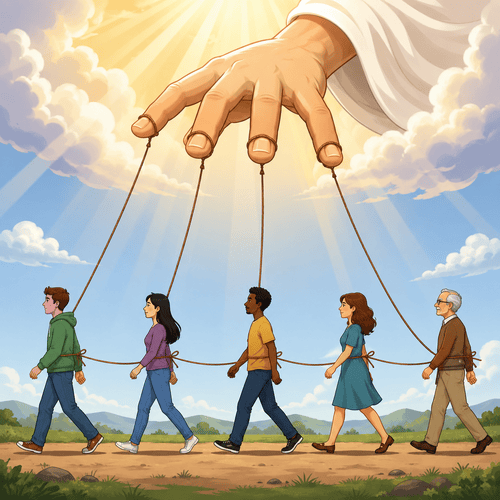
Here’s one of the most persistent misconceptions about Calvinism: that it abolishes human free will entirely, turning people into robots executing a divine programme. Ask a committed Calvinist whether they believe in free will and they will say—yes. But they mean something by it that’s probably different from what you’d expect. And understanding that difference is key.
The question of Calvinism and free will isn’t really one question. It’s two.
- First: are our choices genuinely ours, flowing from our own desires and character?
- Second: are we capable, in our natural fallen state, to turn to God?
Calvinism answers the first question with an emphatic yes—and the second with an equally emphatic no. Understanding why—and why that double answer is both scripturally faithful and intellectually coherent—is what this post is about.
Start with the Well—Then Revise It
A common analogy for salvation goes like this: we’re stuck in a deep well, unable to climb out. God throws down a rope and offers to pull us to safety—but we must choose to grab it. The picture affirms both God’s initiative and our free response. Many people find it intuitive and satisfying.
Reformed theology says: it’s not wrong, exactly—but it isn’t entirely right either.
The problem is the word “stuck.” Scripture doesn’t describe fallen humanity as merely stuck or incapacitated. It describes us as dead. “Even when we were dead in our trespasses, [God] made us alive together with Christ” (Ephesians 2:5). Dead people don’t grab ropes. They cannot respond to offers. They require resurrection, not assistance.
The Calvinist revision of the analogy runs like this: we’re not stuck in the well—we’re dead at the bottom of it. What we need isn’t a rope but a miracle. And the miracle must come first, before any response on our part is possible. God doesn’t lower the rope and wait; He descends, raises the dead, and then—in the life He has given—the response of faith arises. This isn’t a subtle theological adjustment. It changes the entire picture of what salvation is and who does the decisive work.
Two Questions in One: What “Free Will” Actually Means
Most debates about Calvinism and free will talk past each other because both sides are using the same phrase to mean different things. “Free will” can refer to at least three distinct capacities:
- Natural liberty—freedom from external coercion. We act without anyone forcing us at gunpoint. Calvinism affirms this fully.
- Spontaneity—acting according to our own strongest desires, preferences, and character without compulsion from outside. Calvinism affirms this fully too—and it’s central to how the Reformed tradition understands responsibility.
- Moral ability—the capacity, in our natural fallen state, to incline ourselves toward God, to seek Him, to choose spiritual good. This is what Calvinism firmly denies.
When critics say Calvinism “destroys free will,” they typically mean the third sense. When Calvinists say they believe in free will, they mean the first two. Neither side is lying. But if we don’t separate these three senses, the conversation goes nowhere. Calvinism’s claim is specific: the Fall did not destroy our capacity to make genuine, voluntary choices—it destroyed our ability to make those choices in the direction of God, apart from His intervening grace.
Total Depravity—Not What Most People Think
Total depravity is probably the most misunderstood doctrine in all of Reformed theology. The word “total” sounds like an extreme claim—that fallen humanity is as evil as it could possibly be, incapable of any good at all. But that’s not what it means.
“Total” here refers to scope, not intensity. It means every aspect of human nature—intellect, will, emotions, desires—has been touched and corrupted by sin. Not that every person sins as badly as possible, but that no faculty is untouched. We’re capable of what theologians call “civic righteousness”—being kind neighbours, honest businesspeople, loving parents. What we’re incapable of, apart from God’s grace, is seeking God spiritually.
Romans 3:10–12 puts it plainly: “None is righteous, no, not one; no one understands; no one seeks for God.” Not “few seek,” not “seeking is difficult”—no one seeks. Romans 8:7–8 adds: “The mind that is set on the flesh is hostile to God, for it does not submit to God’s law; indeed, it cannot.” And 1 Corinthians 2:14 confirms: “The natural person does not accept the things of the Spirit of God, for they are folly to him, and he is not able to understand them because they are spiritually discerned.”
This isn’t pessimism. It’s diagnosis. And a correct diagnosis is the beginning of cure.
The Bondage of the Will—Luther and Calvin’s Central Insight
In 1525, Martin Luther wrote what he himself considered his most important theological work: De Servo Arbitrio (On the Bondage of the Will). Written in direct response to Erasmus’s defence of free will, it became one of the Reformation’s defining documents.
Luther’s argument wasn’t that the will ceases to exist in fallen humanity. It was that the will, like every other faculty, is enslaved to its own fallen nature. We always choose according to our deepest desires—and our deepest desires, apart from regeneration, are curved in on ourselves and away from God. We’re free in the sense that no one forces us. We’re not free in the sense that we can spontaneously reverse our nature and incline toward what we find repellent.
Think of a fish. A fish is entirely “free” to live in water—that is its natural element, and it thrives. It is utterly incapable of choosing to live on land. Not because someone is stopping it, but because its nature doesn’t admit that choice. The issue is not coercion from outside; it’s the nature within. This is what Luther and Calvin meant by the bondage of the will.
Calvin himself was careful to insist this doesn’t mean our will is destroyed: “Man’s will is not destroyed by grace, but is rather repaired.” Grace does not bypass the will—it heals it, restores it, redirects it toward what it was always made to desire. John 8:34–36: “Truly, truly, I say to you, everyone who practices sin is a slave to sin… So if the Son sets you free, you will be free indeed.” The freedom Christ offers isn’t freedom from willing—it’s freedom within willing, freedom to will rightly at last.
Compatibilism—How Calvinism Holds Freedom and Sovereignty Together
The philosophical term for the Calvinist account of free will is compatibilism: the view that divine determination and genuine human responsibility are compatible—that they’re not competitors but operate at different levels.
Here’s the key insight, articulated with clarity by Jonathan Edwards in his 1754 masterwork The Freedom of the Will: every act of will has a cause. We always choose according to our strongest inclination—our deepest desire, our prevailing motive at the moment of decision. That inclination is shaped by our character, our history, our nature, and—in the case of believers—the regenerating work of the Spirit. Our choices are genuinely ours because they flow from us—from our real desires and authentic character.
This actually strengthens moral responsibility rather than undermining it. If my choices were causally undetermined—if, in exactly the same circumstances with exactly the same desires, I could randomly do otherwise—then my choices would not really express who I am. They would be arbitrary, more like a coin flip than a moral act. But because my choices flow from my character, I am genuinely responsible for them. The thief who steals isn’t absolved because God ordained it—he stole because he wanted to, and he is accountable for what he wanted.
The compatibilist picture is on every page of Scripture. In Genesis 50:20, Joseph tells his brothers: “You intended to harm me, but God intended it for good.” Both statements are true simultaneously. The brothers acted from their own malicious desires; God was working through those very desires to accomplish His purposes. Two levels of agency, one event. In Acts 2:23, the crucifixion was “the definite plan and foreknowledge of God”. And yet those who carried it out were “lawless men” held fully accountable.
The Biblical Evidence: God Works the Willing Itself
The compatibilist picture isn’t merely a philosophical solution to a conceptual puzzle. It’s what Scripture directly teaches about God’s relationship to human will.
Philippians 2:12–13 is decisive: “Work out your own salvation with fear and trembling, for it is God who works in you, both to will and to work for his good pleasure.” Notice: God doesn’t merely work alongside our willing, or merely create conditions in which we might will. He works the willing itself. The very act of willing that’s genuinely ours—our desire to believe, to repent, to seek God—is itself the fruit of God’s prior work in you.
Ezekiel 36:26–27 promises exactly this: “I will give you a new heart, and a new spirit I will put within you… And I will put my Spirit within you, and cause you to walk in my statutes.” Not “invite”—cause. Proverbs 21:1: “The king’s heart is a stream of water in the hand of the LORD; he turns it wherever he will.” Ezra 1:1 records that “the LORD stirred up the spirit of Cyrus” to issue his famous decree. Ezra 7:27 records Ezra’s astonished thanksgiving that God had “put such a thing as this into the heart of the king.”
In none of these cases does God merely observe what hearts are inclined to do and then work around them. He moves them. This isn’t a God constrained by pre-existing creaturely freedom; this is a God who shapes the very freedom of His creatures according to His sovereign purpose.
What About Pharaoh? Hardening and Human Responsibility
The hardening of Pharaoh is one of the most challenging passages in all of Scripture for any theology of the will. In Exodus 4:21, God says: “I will harden his heart, so that he will not let the people go.” In Romans 9:17–18, Paul quotes it approvingly: “So then he has mercy on whomever he wills, and he hardens whomever he wills.”
The objection is immediate: if God hardened Pharaoh’s heart, how can Pharaoh be blamed? Yet the Exodus narrative also records Pharaoh hardened his own heart (Exodus 8:15, 32)—the same event is attributed both to God’s sovereign act and to Pharaoh’s own moral choice. The narrative doesn’t see a contradiction here, and neither does Paul.
This is the compatibilist picture operating at full intensity. God’s sovereign hardening and Pharaoh’s own willful rebellion are both real, both true, and both operating at different levels. Paul anticipates the objection (“Why does he still find fault? For who can resist his will?”) and doesn’t resolve it with a philosophical explanation—he redirects it: “But who are you, O man, to answer back to God?” (Romans 9:20). The point isn’t that the tension disappears. The point is that God’s sovereignty does not negate human accountability—Scripture simply holds both.
Reformed theology is the only theological system that can honestly account for texts like these without either softening God’s sovereignty or evacuating human responsibility. Both are real. Both matter. The mystery lies not in the doctrine but in the infinite wisdom of the God who holds them together.
Calvinism Isn’t Fatalism
This distinction is so important it deserves its own section.
Fatalism says: whatever will happen, will happen, and our choices make no difference. If we’re going to survive the accident, we will survive it whether we wear a seatbelt or not. If we’re going to be saved, we will be saved whether anyone preaches the gospel to us or not. This is the popular view of “predestination” that most people have in mind when they criticise it.
Calvinism teaches something fundamentally different. God ordains not only the ends but also the means. He has decreed His elect will be saved, and He has decreed they will be saved through the preaching of the gospel, through the prayers of parents and friends, through the faithful witness of the church, through the reading of Scripture. Remove the means and we don’t arrive at the same end by a different route. We simply do not arrive.
This makes human choices and actions enormously significant. The evangelist who knocks on a door is not wasting her time because some people are elect; she may be precisely the means God has ordained to call His elect. The parent who prays for a prodigal isn’t doing something God has already accounted for as irrelevant—he may be participating in the very instrument of his child’s salvation. Calvinism doesn’t strip human agency of meaning. It gives it the most secure foundation possible: our actions are the means through which God’s sovereign purposes are accomplished.
Regeneration Precedes Faith—and Why It’s Critical
Here’s where Calvinism and Arminianism diverge most sharply in practice. The question is: in the order of salvation, what comes first—our faith or God’s regenerating work?
Arminianism says we believe, and then God regenerates us in response to our faith. Our free response to the gospel triggers the new birth.
Calvinism says God regenerates first—gives us the new heart, the new spirit, the new desires of Ezekiel 36—and then, from that new life, faith arises. We believe because we’ve been made alive. The initiative is entirely God’s.
The reason for this sequence is the diagnosis of total depravity. If we’re spiritually dead—if “no one seeks for God” and we “cannot” submit to His law , faith cannot precede regeneration. Dead people cannot believe. The life must come first, and then the believing. John 3:3: “Unless one is born again he cannot see the kingdom of God.” John 6:44: “No one can come to me unless the Father who sent me draws him.” John 1:13: believers were born “not of blood nor of the will of the flesh nor of the will of man, but of God.”
This matters enormously for assurance of salvation. If my faith is what triggers regeneration, my assurance depends partly on the quality or persistence of my faith—a notoriously unstable foundation. But if regeneration is God’s sovereign act which then produces faith, my assurance rests on God’s unchangeable purpose, not on the fluctuating strength of my believing. “Those whom He predestined He also called, and those whom He called He also justified, and those whom He justified He also glorified” (Romans 8:30). That chain begins in God and ends in God. It does not hinge on me.
Prayer, Evangelism, and the Christian Life
Rather than making the Christian life passive, the Calvinist understanding of the will gives every spiritual discipline its proper foundation.
Prayer is real and efficacious—not because it changes an otherwise fixed divine mind, but because God has ordained prayer as one of the means through which He accomplishes His purposes. He does not merely permit our prayers; He has decreed that His purposes will be worked out through them.
Evangelism is urgent and confident—not because we’re uncertain whether God will save anyone, but because God saves His people through the proclamation of the gospel. “All that the Father gives me will come to me” (John 6:37), and they come through the preached word. The Calvinist preacher isn’t attempting to swing an undecided vote; he is the instrument through which God effectually calls His elect.
Sanctification is serious and demanding but it rests on divine initiative. Philippians 1:6: “He who began a good work in you will bring it to completion at the day of Jesus Christ.” We pursue holiness not in order to secure our standing, but from within a standing that God has secured.
Conclusion
Calvinism doesn’t abolish human free will. It insists our choices are genuinely ours, they flow from our real desires and character, and that we’re fully accountable for them. What it denies is that fallen human nature has the moral ability, apart from divine grace, to incline itself toward God . And what it affirms is that this grace, when God sovereignly bestows it, doesn’t bypass the will but heals and renews it from within.
The result isn’t a system that diminishes humanity. It’s a system that magnifies grace—because grace is not merely assistance offered to a wounded will. It’s resurrection given to a dead one. And that’s precisely the God the Bible gives us: not a God who throws a rope and waits to see who grabs it, but a God who descends into the well, raises the dead, and draws His people to Himself with a love that will not let them go.
“I will give you a new heart,” He promises. Not “I will offer you a new heart if you are willing.” I will give you one (Ezekiel 36:26). The will to receive the gift is itself the gift.
Tough Questions, Honest Answers
If God sovereignly determines who will be saved, does that make Him responsible for those who are not?
Reformed theology distinguishes carefully between what God decrees and what God desires. God genuinely desires the repentance of all. The offer of the gospel is a sincere offer, not theatre. Yet He does not decree the salvation of all, and Scripture confirms this. The question “why not?” touches the deepest mysteries of divine wisdom, and Reformed theology does not pretend to have a complete answer. What it does insist is this: that God is not unjust. No one is condemned for failing to do what they were incapable of doing—they’re condemned for the sin they have freely committed and willingly loved. Grace isn’t owed to anyone; it’s bestowed in mercy.
What’s the difference between Calvinist “free will” and Arminian “free will”?
Arminian free will is typically libertarian—the genuine ability, in identical circumstances with identical desires, to have chosen otherwise. On this view, God’s foreknowledge of our choice doesn’t determine it; He simply foresees what we will freely do. Calvinist free will is compatibilist—we always choose according to our strongest inclination, and that inclination is itself shaped by our nature, character, and—for believers—God’s regenerating work. Both views affirm our choices are real and we’re responsible. They disagree about whether our choices are causally undetermined (Arminianism) or whether they flow from our character in a way that is compatible with God’s sovereignty (Calvinism).
If I cannot choose God without grace, how can I be blamed for not choosing Him?
Because inability and innocence aren’t the same thing. A chronic liar may genuinely be incapable, in a deep sense, of telling the truth consistently—but that incapacity has grown from his own choices and doesn’t excuse him. Our inability to seek God is not an external constraint imposed on an otherwise neutral will; it’s our will, expressing what we most deeply want. We don’t seek God because we don’t want to. We’re held accountable not for failing to do something we were forced to avoid, but for loving what we love—and loving it rather than God.
Does this mean some people have no chance of being saved?
Not exactly. Calvinism teaches the elect will certainly be saved—but it doesn’t teach that a particular individual is certainly not elect. This is a critical distinction. No one is ever turned away who comes to Christ; John 6:37 is clear: “Whoever comes to me I will never cast out.” The gospel is genuinely offered to all. The Calvinist cannot and does not say of any living person: “They are certainly reprobate—do not bother with them.” Only God knows His elect, and the means by which He calls them is the preached gospel extended to all.
Does Calvinism make evangelism pointless?
Quite the opposite. Calvinism gives evangelism its most secure foundation. We don’t preach hoping enough people will decide in our favour. We preach knowing God will call His own through the proclaimed word. “All that the Father gives me will come to me” (John 6:37)—and they come through the gospel. We’re not salespeople pitching a product to indifferent customers; we’re heralds proclaiming the King’s message, through which He effectually calls His people. That isn’t a reason to be passive. It’s a reason to be confident.
Can my prayers actually change anything if God has already ordained everything?
Yes, because God has ordained the means as well as the ends. Prayer is one of the means through which He accomplishes what He has purposed. He hasn’t merely permitted our prayers as an afterthought; He has decreed His purposes will be worked out through them. James 5:16 says “the prayer of a righteous person has great power as it is working.” That’s not language that suggests prayer is cosmetic. In the Calvinist framework, our prayers are the instrument of divine action, not a competing force against a fixed programme.
Is the Calvinist view harsh—doesn’t it make God seem cold and arbitrary?
Only if we approach it as an outsider looking at a system. From within the experience of saving grace, the sudden realisation that we were dead and have been made alive, that we did not choose God so much as find that God had already claimed us—it produces not coldness but overwhelming gratitude. Charles Spurgeon, the great 19th-century Calvinist preacher, put it well: “I looked at Christ and the dove of peace flew into my heart; I looked at my heart and the dove flew away.” Assurance built on God’s unconditional electing love is profoundly warmer and more stable than assurance built on the strength of our own choosing.
Related Reads
- What Does ‘Bondage of the Will’ Mean? Is It Biblical?
- Can God Be Truly Sovereign and Man Be Free? The Biblical Perspective
- The Calvinist–Arminian Debate
- Calvinism vs Molinism: Why Middle Knowledge Fails the Biblical Test
- Why Does God Choose Some and Not Others for Salvation?
- Biblical Compatibilism: God’s Sovereignty vs Human Choice