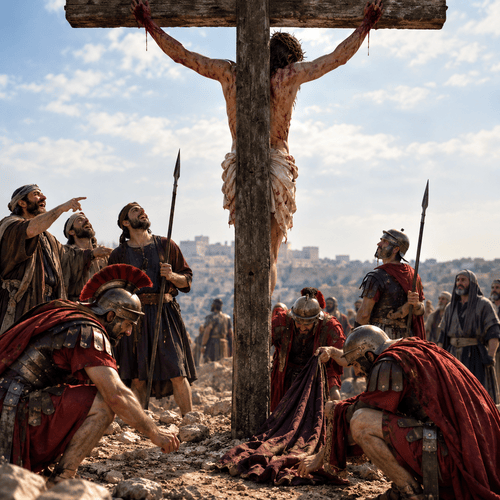

“Jesus died for you.”
It’s a famous sentence in modern evangelism. You see it on church signs, gospel tracts and car stickers.
But here’s a fact that may surprise you. Read the book of Acts from beginning to end. Look at every sermon the apostles preached to people who didn’t yet believe. Not once does Peter, Paul or anyone else say to an unbeliever, “Christ died for you.”
Not once.
Were the apostles holding back the best part of the good news? Or did they understand something we have forgotten? Let’s look at what they actually said, what the Bible means by “died for”, and what we can say—honestly and warmly—to everyone.
Why This Question Matters
This is not just a matter of words. The words we use in evangelism show what we believe about the cross, and they shape what a listener trusts.
Critics have noticed this. The Catholic writer Trent Horn has a popular talk called “Why Calvinists Can’t Say ‘Jesus Died for You’.” The British preacher RT Kendall has argued that if Christ died only for His people, no evangelist can honestly say “you” to anyone. They see this as a weakness in our view.
We believe the apostles’ way of speaking is both more honest and more powerful. First, a few key words.
KEY TERMS IN THIS POST
- Atonement: what Christ did on the cross to take away sin and bring sinners back to God.
- The elect: the people God chose, before the world began, to save in Christ.
- Particular redemption: the teaching that Christ died to actually save His people, not just to make salvation possible for everyone. Some call it “limited atonement”.
- The gospel offer: God’s free invitation to every person to come to Christ and be saved.
What the Apostles Actually Preached
The book of Acts records many sermons preached to unbelievers. The table below lists the main ones. Look at what each preacher said—and at what he did not say.
| WHERE IN ACTS | WHO WAS LISTENING | WHAT THE PREACHER TOLD THEM | DID HE SAY “CHRIST DIED FOR YOU”? |
|---|---|---|---|
| Acts 2:38–39 | Crowds in Jerusalem | “Repent and be baptised every one of you … for the forgiveness of your sins” | No |
| Acts 3:26 | People at the temple | God sent Jesus “to bless you by turning every one of you from your wickedness” | No |
| Acts 10:43 | Cornelius, a Roman officer, and his household | “everyone who believes in him receives forgiveness of sins through his name” | No |
| Acts 13:38–39 | Jews and Gentiles in a synagogue | “through this man forgiveness of sins is proclaimed to you, and by him everyone who believes is freed” | No |
| Acts 16:31 | A jailer in Philippi | “Believe in the Lord Jesus, and you will be saved” | No |
| Acts 17:30 | Thinkers in Athens | God “commands all people everywhere to repent” | No |
Do you see the pattern? The apostles gave everyone three things:
- A command: repent and believe. This is for every person, without exception.
- An offer: Christ Himself, freely held out to all.
- A promise: everyone who believes will be forgiven.
What they never did was tell a listener that his sins were already paid for.
Who Is “For You” Spoken To?
The New Testament does say Christ died “for you”, “for us” and “for me”. But look at who is speaking and who is listening.
- At the Last Supper: Jesus said, “This is my body, which is given for you” (Luke 22:19). He was speaking to His disciples, not to the crowds.
- In Romans 5: Paul says, “while we were still sinners, Christ died for us” (Romans 5:8). The “us” are people who “have been justified by faith” (Romans 5:1).
- In Galatians 2: Paul speaks of the Son of God “who loved me and gave himself for me” (Galatians 2:20). This is a believer giving thanks.
- In 1 Peter 2: Peter says Christ “bore our sins in his body on the tree” (1 Peter 2:24). He is writing “To those who are elect exiles” (1 Peter 1:1).
In other words, “Christ died for me” is the song of faith—what a believer sings to God, not what a preacher announces to unbelievers.
What Does “Died For” Mean in the Bible?
This is the heart of the matter. Many people take “Christ died for you” to mean something weak, like “Christ made salvation possible for you.” The Bible never uses it that way.
In Scripture, when Christ dies “for” someone, He dies in their place as their substitute (someone who takes another person’s place). And His death actually achieves its goal:
- He saves: “he will save his people from their sins” (Matthew 1:21).
- He secures: Christ entered heaven “by means of his own blood, thus securing an eternal redemption” (Hebrews 9:12).
- He guarantees everything else: “He who did not spare his own Son but gave him up for us all, how will he not also with him graciously give us all things?” (Romans 8:32).
Notice that last verse. Everyone Christ died for will also receive “all things” with Him—forgiveness, faith, eternal life and heaven.
So in the Bible’s language, “Christ died for you” is a promise of certain salvation. We do not know whom God has chosen, so we have no right to make that promise to a particular unbeliever.
Charles Spurgeon put it this way in his 1858 sermon “Particular Redemption”:
“We say Christ so died that he infallibly secured the salvation of a multitude that no man can number.”
(We set out the full biblical case for this in Limited Atonement: The Biblical Case for Particular Redemption.)
If Not “Jesus Died for You”, Then What Do We Offer?
Here we meet an old, helpful word: warrant, meaning the right to do something. The “warrant of faith” is what gives a sinner the right to come to Christ.
A sinner does not need to know whether he is chosen, or for whom Christ died, before he comes. His right to come rests on two things that are true for every human being:
- God’s command: God “commands all people everywhere to repent” (Acts 17:30). If God commands you to come, you are allowed to come.
- God’s promise: Jesus says, “whoever comes to me I will never cast out” (John 6:37). No one who comes will be turned away.
The Canons of Dort (1619)—a statement of faith agreed by a large meeting of Protestant churches in the Netherlands—says it clearly:
“the promise of the gospel is, that whosoever believeth in Christ crucified, shall not perish, but have everlasting life. This promise, together with the command to repent and believe, ought to be declared and published to all nations, and to all persons promiscuously and without distinction.”
Canons of Dort, Head II, Article 5
“Promiscuously” here simply means “to everyone, without picking and choosing.” The very churches that taught particular redemption demanded that the gospel be offered to all.
JI Packer, in his famous introduction to John Owen’s The Death of Death in the Death of Christ, wrote that the gospel is not “believe that Christ died for everybody’s sins, and therefore for yours,” any more than it is “believe that Christ died only for certain people’s sins, and so perhaps not for yours.” Instead, he said,
“our job is to point them to the living Christ, and summon them to trust in Him.”
What We Can Say to Everyone
We lose nothing by following the apostles. Every sentence below is true for every person on earth, so you can say it to anyone.
| YOU CAN SAY THIS TO ANYONE | WHERE THE BIBLE SAYS IT |
|---|---|
| “Christ Jesus came into the world to save sinners—and you are a sinner.” | 1 Timothy 1:15 |
| “Christ is offered to you freely, today.” | Isaiah 55:1; Revelation 22:17 |
| “God commands you to turn from your sin and trust Christ.” | Acts 17:30; Mark 1:15 |
| “If you come to Christ, He will never turn you away.” | John 6:37 |
| “Everyone who believes in Him receives forgiveness.” | Acts 10:43 |
| “His death is enough for any sinner, however bad.” | 1 Timothy 1:15–16 |
| “God takes no pleasure in your death. Turn and live.” | Ezekiel 33:11 |
| “Be reconciled to God.” | 2 Corinthians 5:20 |
A ONE-MINUTE GOSPEL YOU CAN USE WITH ANYONE
“God made you to know Him and love Him. But you, like all of us, have sinned against Him, and His judgement is coming. Yet God sent His Son, Jesus Christ. He lived a perfect life, died on the cross as a substitute for sinners, and rose again from the dead. Today God commands you to turn from your sin and trust Christ. And He promises that everyone who does will be forgiven and receive eternal life. Jesus says, ‘whoever comes to me I will never cast out’ (John 6:37). Will you come to Him?”
Every word is true for every listener.
Once You Believe, “For Me” Is Yours
The moment a sinner trusts Christ, everything changes. Now he can say with Paul, “he loved me and gave himself for me.” And because Christ’s death never fails, that “for me” can never be taken away (Romans 8:33–34).
So particular redemption does not take away the believer’s “for me”. It makes it unbreakable:
| QUESTION | IF CHRIST DIED FOR EVERYONE IN THE SAME WAY | IF CHRIST DIED TO SAVE HIS PEOPLE |
|---|---|---|
| Who can truly say “Christ died for me”? | Every person | Everyone who trusts Christ |
| Are there people in hell for whom Christ died? | Yes | No |
| What does “Christ died for me” guarantee? | Nothing certain—you may still be lost | Everything—forgiveness, faith and glory (Romans 8:32) |
Answering Common Objections
- “But Paul preached ‘Christ died for our sins’” (1 Corinthians 15:3). Yes—but look at who he is writing to. They are believers who “received” the gospel and “stand” in it (1 Corinthians 15:1). “Our” is the church confessing its faith. For how Paul spoke to unbelievers, read Acts 13:38–39 and 17:30.
- “Then the offer cannot be sincere.” It is completely sincere, because whoever comes will be received. Jesus wept over Jerusalem (Luke 19:41). The Canons of Dort say that when people refuse the gospel, the fault is wholly theirs—not any lack in Christ’s sacrifice (Head II, Article 6).
- “This will kill evangelism.” History says otherwise. George Whitefield, William Carey, David Brainerd, Adoniram Judson and Charles Spurgeon all believed that Christ died to save His people. As the theologian Jonathan Gibson notes, fruitful gospel preaching has never depended on the words “Christ died for you”.
- “The cross does some good to everyone, so ‘died for you’ is true in a sense.” The cross does bring real blessings even to people who are never saved (see Did Jesus Die for the Non-Elect? What the Cross Did for Them). But your listener will hear “my sins are paid”, not “I receive some general blessings”. So the phrase still misleads.
- “It’s just a matter of words.” Words shape faith. “Christ died for you, so just accept it” can make people think, “My debt is paid, so I am fine,” and never truly turn to Christ. Biblical faith is a needy sinner running to a living Saviour.
A Lesson from History
Timeline: How Christians Have Spoken About the Cross
- 1619—The Synod of Dort: Churches from across Europe teach particular redemption—and, in the same document, demand that the gospel be preached to all.
- 1645—The Marrow of Modern Divinity: Edward Fisher’s popular book tells preachers to say to every person, “Christ is dead for him.”
- 1718–1723—The Marrow Controversy: In Scotland, Thomas Boston and his friends defend the book, but explain “dead for him” as meaning a Saviour offered to all, not sins already paid. Sinclair Ferguson tells this story in The Whole Christ (2016).
- 1792—William Carey: A Baptist pastor who held particular redemption publishes his famous call to world mission. The next year he sails for India.
- 1858—Charles Spurgeon: Preaches “Particular Redemption” in London, while pleading with thousands to come to Christ.
The lesson? Even those who used the phrase had to explain it, which shows the plain words mislead. And the greatest evangelists never needed them.
A Word of Grace
Many dear Christians say “Jesus died for you” out of real love for the lost, and God has used their witness. We should never mock them. Paul rejoiced whenever Christ was preached (Philippians 1:18). Our aim is simply to speak as the apostles spoke.
Conclusion: Offer Christ to Everyone
So, is it biblical to tell everyone “Christ died for you”? Not in the way the Bible uses those words. But we have something better to give. We can offer every person Christ Himself, with God’s command to come and God’s promise that whoever comes will never be turned away.
If fear holds you back, read What Do We Do When We’re Afraid to Evangelise? Then go and tell everyone.
IN SHORT
- The apostles never told unbelievers, “Christ died for you.”
- In the Bible, “Christ died for you” means “Christ saved you.”
- A sinner’s right to come to Christ is God’s command and promise, not a secret fact about God’s plan.
- Once someone believes, “He died for me” is gloriously and forever true.
Tough Questions, Honest Answers
Can I tell an unbeliever “God loves you”?
Yes, in a true sense. God shows real kindness to all people: “he makes his sun rise on the evil and on the good” (Matthew 5:45). Jesus looked at a rich young man who later walked away from Him, “and loved him” (Mark 10:21). But the Bible also speaks of a special, saving love that God has for His people in Christ. So it is wise to explain what you mean: God is good to you, He is patient with you, and He offers you His Son today.
What should I say if an unbeliever asks whether Jesus died for them?
Be honest and warm. You might say, “I cannot see into God’s secret plans, but I can tell you this: Christ is offered to you right now, and He promises that whoever comes to Him will never be turned away.” Then show him Jesus’ words in John 6:37. The real question behind his question is usually, “Can I be saved?” The answer to that is yes—if you come to Christ. Once he trusts Christ, he will know that Christ died for him.
Someone told me “Jesus died for you” when I came to faith. Was my faith real?
Yes, if you truly trusted Christ. God often uses imperfect words to bring people to Himself, because His word “shall not return to me empty” (Isaiah 55:11). Saving faith does not depend on the exact sentence someone used. It rests on Christ Himself. If you are trusting Him today, you can say with Paul, “he loved me and gave himself for me.”
How should I share the gospel with a child?
Keep it simple and true. Tell children that God made them, that they have sinned, that Jesus died and rose again to save sinners, and that He welcomes everyone who comes to Him. Jesus Himself said, “Let the children come to me; do not hinder them” (Mark 10:14). Invite them to trust Jesus, and pray with them. You do not need difficult words, and you never need to say more than the Bible says.
Should our church sing songs or hand out tracts that say “Jesus died for everyone”?
This needs wisdom and charity. Many good songs are sung by believers about their own salvation, and “for me” is perfectly right on a believer’s lips. Tracts and songs aimed at unbelievers are different, because they shape what people think the gospel is. A church can gently choose words that offer Christ to all without saying more than Scripture says. Elders should lead in this patiently, not by attacking those who see it differently.
What is hyper-Calvinism, and how is this view different?
Hyper-Calvinism is an error that says we should not freely offer Christ to all people, or that sinners have no duty to believe. It may sound humble, but it is unbiblical, and it has made some churches cold towards evangelism. The view in this post is the opposite. We insist that Christ must be offered to every person, that every person is commanded to believe, and that every sinner who comes is welcome. We simply refuse to add words that the apostles did not use.
Did John Calvin teach that Christ died only for the elect?
Scholars disagree. RT Kendall, in Calvin and English Calvinism to 1649 (1979), argued that Calvin believed Christ died for all. Paul Helm replied in Calvin and the Calvinists (1982), showing that Calvin’s teaching fits particular redemption. In his comments on 1 John 2:2, Calvin said that “the whole world” there means believers scattered across the world, though he accepted that Christ’s death is sufficient for all. In the end, our question is not “What did Calvin say?” but “What does the Bible say?”
Related Reads
- Matthew 7:21 Meaning: Does It Teach Salvation by Works?
- Limited Atonement: The Biblical Case for Particular Redemption
- 4-Point Calvinism: Can I Be a Calvinist and Deny Limited Atonement?
- What Is Hyper-Calvinism—and Why Do Calvinists Reject It?
- Does the Cross Save or Only Make Salvation Possible?
- What Is TULIP Calvinism? The Five Points Explained
- Penal Substitutionary Atonement: The Heart of the Gospel Explained
- Did Jesus Teach Calvinism? John 6 and the Doctrines of Grace
- Do Altar Calls Help or Hurt Evangelism?
- What About Those Who’ve Never Heard the Gospel?…
- What Do We Do When We’re Afraid to Evangelise?
- What Do We Do When Our Evangelism Seems to Bear No Fruit?