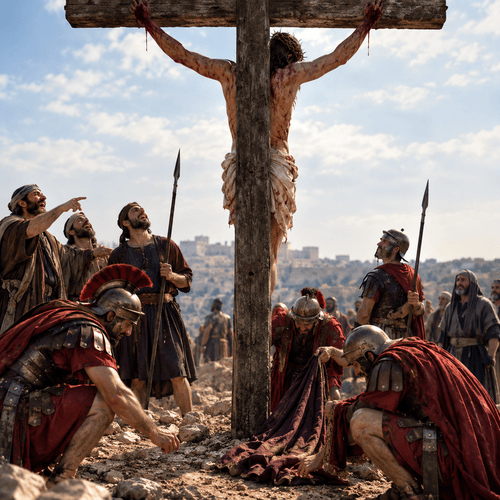
Here’s a sentence that makes some Christians angry: Jesus didn’t die to save every person who has ever lived.
Here’s another sentence that makes others just as angry: Jesus’ death did something for every person who has ever lived—even for those who will never be saved.
Can both sentences be true? We believe they are. More than that, we believe the Bible teaches both.
Perhaps we’ve asked this ourselves: ‘If Jesus died only for the elect, what did his death mean for everyone else?’ It’s a fair question. Did Jesus die for the non-elect in any sense at all? Let’s find the answer from Scripture.
First, What Are We Really Asking?
Let us start by making the big words simple.
Key Words and What They Mean
| Word | Simple meaning |
|---|---|
| Atonement | What Jesus did on the cross to deal with sin and make God and sinners ‘at one’ again. |
| The elect | The people God chose, before the world began, to save through Jesus (Ephesians 1:4). |
| The non-elect | The people God passes by. They are judged for their own sins. |
| Definite (or limited) atonement | The belief that Jesus died to save the elect—and will certainly save every one of them. |
| Propitiation | A sacrifice that turns away God’s anger against sin. |
| Sufficient | Enough. Jesus’ death is more than enough to pay for any sin. |
| Efficient | Actually working. Jesus’ death actually saves those it was meant to save. |
Many teachers prefer the name definite atonement, because ‘limited’ can sound as if the cross was weak. It wasn’t. The cross isn’t limited in power or value. It had a definite purpose: to save a definite people, for certain.
The Synod of Dort, a church council held in 1618–19, called Christ’s death ‘of infinite worth and value, abundantly sufficient to expiate the sins of the whole world’. So the question isn’t the cross’s worth, but God’s plan for it.
Everyone Limits the Atonement
This may come as a surprise: almost every Christian limits the atonement. Only universalists—who believe everyone will be saved in the end—do not.
- Some limit its reach. They say Jesus died to save His people, and He will save every one of them.
- Others limit its power. They say Jesus died for everyone, but His death saves no one unless people add their own choice to it.
So the real question is, ‘Which limit does the Bible teach?’
We are often told that we limit the atonement of Christ… Now, our reply to this is, that, on the other hand, our opponents limit it: we do not.
Charles Spurgeon, sermon on ‘Particular Redemption’ (1858)
The things we have to choose between are an atonement of high value, or an atonement of wide extension. The two cannot go together.
BB Warfield in The Plan of Salvation (1915)
In plain words: if Jesus died for everyone in the same way, yet many are lost, then his death by itself saved no one. The Bible does not allow us to say that.
Not a New Idea
This teaching was not invented in the 1600s. Christians wrestled with it for centuries.
Timeline: The Church and the Question ‘For Whom Did Christ Die?’
- 9th century—Gottschalk of Orbais. This German monk taught that Christ shed his blood for the elect, and was condemned for it.
- 12th century—Peter Lombard. This Paris teacher coined the famous formula: Christ’s death is sufficient for all, but efficient only for the elect.
- 1550s—John Calvin. The Geneva pastor’s commentaries stress that Christ came to save his people, though scholars debate his exact view (see our FAQs).
- 1618–19—Synod of Dort. Church leaders from across Europe affirmed the cross’s infinite value, yet said God planned it to ‘effectually redeem’ the elect.
- 1647—John Owen. The English Puritan wrote The Death of Death in the Death of Christ, still the classic defence.
- 1858—Charles Spurgeon. London’s great preacher defended ‘particular redemption’—and was one of the boldest evangelists of his age.
- 1959—James I. Packer. His introduction to a new edition of Owen’s book won a new generation to this teaching.
- 2013—From Heaven He Came and Sought Her. Edited by David Gibson and Jonathan Gibson, this is the major modern defence.
6 Bible Reasons Jesus Died to Save His People
Now here are 6 lines of evidence from Scripture, and all point the same way.
1. The Bible Names the People Jesus Died For
Again and again, the Bible tells us who Jesus died for. He came to ‘save His people from their sins’ (Matthew 1:21). He lays down His life ‘for the sheep’ (John 10:15). He ‘loved the church and gave Himself up for her’ (Ephesians 5:25).
He even told some religious leaders, ‘you do not believe because you are not among my sheep’ (John 10:26). Notice the order: they were not His sheep, so they didn’t believe.
2. Father, Son and Spirit Work as One
The Father chose a people. The Son died for them. The Spirit brings them to new life. Jesus said, ‘All that the Father gives me will come to me… I should lose nothing of all that He has given me’ (John 6:37, 39). The 3 persons of God never work against each other. The Son does not die to save people the Father never gave Him.
3. Jesus Died and Prays for the Same People
In the Old Testament, the high priest both offered sacrifices and prayed for God’s people. Jesus, our great High Priest, does both for the same people. On the night before he died, he prayed: ‘I am not praying for the world but for those whom you have given me’ (John 17:9). Would he die to save people he refused to pray for? Paul joins the two: ‘Christ Jesus is the one who died… who indeed is interceding for us’ (Romans 8:34). (To intercede means to speak up for someone before God.)
4. The Cross Actually Saves
The Bible never says Jesus made salvation merely possible. It says He made it certain, ‘thus securing an eternal redemption’ (Hebrews 9:12). Heaven sings, ‘by your blood you ransomed people for God from every tribe and language and people and nation’ (Revelation 5:9). Notice: people from every nation—not every person in every nation.
The Westminster Confession of Faith (1646) puts it in older English: ‘To all those for whom Christ hath purchased redemption, he doth certainly and effectually apply and communicate the same.’ Put simply: everyone Jesus bought, He brings home.
5. Jesus’ Blood Is Covenant Blood
A covenant is a binding promise that joins God and His people. Jesus said, ‘This cup that is poured out for you is the new covenant in my blood’ (Luke 22:20). That covenant promises, ‘I will remember their sin no more’ (Jeremiah 31:34). So everyone in the new covenant is forgiven. The saving reach of Jesus’ blood and the membership of the covenant are the same.
6. Those Jesus Died For Died With Him
Paul writes, ‘one has died for all, therefore all have died; and he died for all, that those who live might no longer live for themselves but for him’ (2 Corinthians 5:14–15). The ‘all’ Christ died for are the same ‘all’ who died with him and now live for him. This is union with Christ—being joined to Jesus so that his death and new life become ours. That is true of every believer, not every person.
JOHN OWEN’S FAMOUS QUESTION
Puritan pastor John Owen asked: when Jesus took God’s punishment on the cross, whose sins did He carry? There are only 3 choices:
- All the sins of all people. Then why is anyone punished? Someone may say, ‘Because of their unbelief.’ But Owen replies: ‘this unbelief, is it a sin, or not?’ If it is, either Jesus paid for it or He did not.
- Some sins of all people. Then everyone still has some sins left to pay for—and no one can be saved.
- All the sins of some people. This is what the Bible teaches. Jesus fully paid for every sin of his people.
Hymn writer Augustus Toplady put it into song: ‘Payment God cannot twice demand, / First at my bleeding Surety’s hand, / And then again at mine.’ A surety pays a debt for someone else. A just God does not punish the same sin twice.
So What Did the Cross Do for the Non-Elect?
Now to the heart of our question. If Jesus did not die to save the non-elect, did his death do anything for them? Yes—a great deal. Here is the difference at a glance.
What the Cross Brings: God’s People Compared with the Non-Elect
| WHAT THE CROSS BRINGS | FOR GOD’S PEOPLE (THE ELECT) | FOR THE NON-ELECT |
|---|---|---|
| Forgiveness of sins | Full and forever | Not received; they remain guilty before God |
| God’s patience | Time to come to repentance | Time and warning before judgement |
| The gospel invitation | Heard, believed and received | Heard, but freely refused |
| Daily good gifts (life, food, family, beauty) | Yes | Yes |
| Jesus’ rule | Jesus is their Lord and Saviour | Jesus is their Lord and Judge |
| The end of the story | Eternal life with God | Just judgement, with no excuse left |
- Time and patience. God did not destroy the world the moment sin entered it. In his ‘divine forbearance he had passed over former sins’ (Romans 3:25). (Forbearance means holding back punishment.) The cross lets a holy God be patient with sinners and still be just. Every day they live is a kindness ‘meant to lead you to repentance’ (Romans 2:4).
- Daily kindness. God ‘makes his sun rise on the evil and on the good’ (Matthew 5:45). He is ‘the Saviour of all people, especially of those who believe’ (1 Timothy 4:10)—preserving all, but saving believers. Theologians call this general kindness common grace.
- A real gospel invitation. Because Christ’s death has infinite value, nothing is missing for any sinner who comes. So Dort said the gospel must go ‘to all persons promiscuously and without distinction’—to everyone, without picking and choosing. God’s call is sincere: ‘Turn to me and be saved, all the ends of the earth!’ (Isaiah 45:22).
- Jesus as Lord—and Judge. ‘Christ died and lived again, that he might be Lord both of the dead and of the living’ (Romans 14:9). The cross won him the right to rule every person. For the non-elect, the one who died will be their Judge (John 5:22).
- No excuse left. ‘The light has come into the world, and people loved the darkness rather than the light’ (John 3:19). Dort says unbelief is never caused by ‘any defect or insufficiency in the sacrifice’ of Christ. The fault is theirs alone.
- The overflow of blessing. Wherever the message of the cross goes, it changes societies—hospitals, schools, care for the poor. Unbelievers enjoy these fruits daily, often without knowing their source.
REAL BLESSINGS, BUT NOT SALVATION
John Murray, the Scottish theologian who taught at Westminster Theological Seminary, argued unbelievers enjoy many blessings flowing from Christ’s death—yet Christ did not die to save them. The blessings are real. The saving purpose belongs to the elect alone.
What About the ‘All’ and ‘World’ Verses?
Some verses seem to say Jesus died to save every person. We must read each one in its context—the words around it. In the Bible, ‘all’ and ‘world’ do not always mean ‘every single person’. When the Pharisees said, ‘Look, the world has gone after him’ (John 12:19), they did not mean every human on earth.
Six Hard Verses Read in Context
| VERSE | WHAT IT SAYS (ESV) | WHAT IT MEANS IN CONTEXT |
|---|---|---|
| John 3:16 | ‘For God so loved the world… that whoever believes in him should not perish’ | ‘World’ means sinful humanity in rebellion. The wonder is not how big the world is, but how bad. The promise is for ‘whoever believes’. |
| 1 John 2:2 | ‘He is the propitiation for our sins, and not for ours only but also for the sins of the whole world.’ | John, a Jewish believer, means God’s children everywhere, not only Jewish believers (compare John 11:51–52). A propitiation actually turns away God’s anger. If it covered everyone, everyone would be saved. |
| 1 Timothy 2:4–6 | ‘who desires all people to be saved… who gave himself as a ransom for all’ | Verses 1–2 ask prayer ‘for kings and all who are in high positions’. ‘All’ means all kinds of people. Jesus called it a ransom ‘for many’ (Mark 10:45). |
| 2 Peter 3:9 | ‘…is patient toward you, not wishing that any should perish’ | Peter writes to believers (‘toward you’). God delays Jesus’ return until all his people come to repentance (see 3:15). |
| Hebrews 2:9 | ‘…he might taste death for everyone.’ | The next verses define ‘everyone’: the ‘many sons’ brought to glory and ‘the children God has given me’ (2:10–13). |
| 2 Peter 2:1 | ‘…denying the Master who bought them’ | Peter uses despotēs, an owner’s title, not ‘Saviour’. These false teachers belonged to God’s people outwardly, but were never truly his. |
Being Fair: Honest Questions We Must Face
A strong case is an honest case. Careful readers should know four things.
- Not every ‘world’ means ‘the elect’. We should not force one meaning on every verse. Good answers come from context, not from a system.
- Some faithful teachers held a middle view. At Dort, the English bishop John Davenant taught that Christ died for all in one sense, but for the elect in a saving sense. James Ussher and Moïse Amyraut held similar views. We respect them, but ask: why would Christ pay for people he never planned to bring home?
- The cross is not a shop till. Robert Lewis Dabney warned against picturing the cross like a shopkeeper counting coins. Our case rests not on maths, but on Christ’s purpose and God’s justice.
- Serious critics exist. David Allen’s The Extent of the Atonement (2016) argues against definite atonement. Tested by Scripture, our case still stands firm.
Come—Christ Turns No One Away
So what should you do with all this? Do not try to open God’s secret book to see whether your name is written there. Look to Christ. He says, ‘Come to me, all who labour and are heavy laden, and I will give you rest’ (Matthew 11:28), and ‘whoever comes to me I will never cast out’ (John 6:37).
Packer once wrote that Christ did not win ‘a hypothetical salvation for hypothetical believers’. He won a real salvation for real sinners. Come and trust him, and you will say with Paul that the Son of God ‘loved me and gave himself for me’ (Galatians 2:20).
Tough Questions, Honest Answers
Did John Calvin believe in limited atonement?
Scholars still debate this. Calvin died in 1564, more than 50 years before the Synod of Dort, so he never wrote on the question in the way later teachers did. Robert T. Kendall argued Calvin believed Christ died for all, while Roger Nicole and Paul Helm replied that Calvin’s thinking fits definite atonement. On 1 John 2:2, Calvin wrote that ‘under the word all or whole, he does not include the reprobate’, meaning those God passes by. Instead, Calvin said, John means believers scattered across the world. In the end, our view does not depend on Calvin. It stands or falls on Scripture.
Can you be a Calvinist and reject limited atonement?
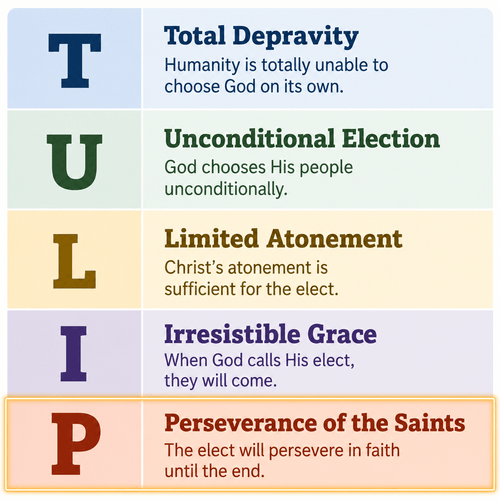
Many people call themselves ‘four-point Calvinists’. They accept God’s sovereign choice and his saving power, but believe Christ died for all in some general sense. Many of them are godly Christians, and we gladly call them brothers and sisters. But we believe the five points of Calvinism belong together like links in a chain. If the Father chose a people and the Spirit will surely bring them to faith, then the Son’s death fits the same plan. Taking out one link leaves the Father, Son and Spirit working towards different goals.
Can I tell an unbeliever ‘Jesus died for you’?
It’s worth noticing the sermons in the book of Acts never use that exact phrase. The apostles preached Christ crucified and risen, and then called everyone to repent and believe (Acts 17:30; 16:31). Packer made a helpful point: the gospel is not first a statement about whom Jesus died for, but an invitation to trust Jesus, who died for sinners and now offers himself as Saviour. So you can truthfully tell anyone, ‘Christ died for sinners. Come to him, and he will receive you.’ That message is true for every person you meet, and it carries all the warmth the gospel needs.
If Christ did not die to save them, how is it fair to judge the non-elect?
The non-elect are not judged for being non-elect. They’re judged for their own sins, because God ‘will render to each one according to his works’ (Romans 2:6). No one goes to hell because they wanted Christ and were turned away. Everyone who rejects him does so willingly. We must also remember that mercy, by its very nature, is never owed. God says, ‘I will have mercy on whom I have mercy’ (Romans 9:15), and every act of mercy he shows is a free gift.
Did Jesus die for Judas?
Judas walked with Jesus for 3 years. He heard His teaching, saw His miracles and even had his feet washed by Him. He received more of Jesus’ kindness than most people ever will. Yet Jesus ‘knew from the beginning’ who would betray him (John 6:64), and he called Judas ‘the son of destruction’ (John 17:12). Jesus did not die to save Judas, and Judas was not saved. His story is a serious warning: being close to Jesus is not the same as belonging to Jesus.
Doesn’t limited atonement kill evangelism and missions?
History says the opposite. George Whitefield preached to huge crowds in Britain and America. William Carey, often called the father of modern missions, sailed to India in 1793 and gave his life to reaching its people. Charles Spurgeon preached the gospel to millions. All of them believed in definite atonement. In fact, this teaching gives evangelism confidence: when Paul was afraid in Corinth, the Lord told him, ‘I have many in this city who are my people’ (Acts 18:10). We do not preach merely hoping someone might respond; we preach knowing that Christ’s sheep will hear his voice.
How can I know that Jesus died for me?
Do not start by asking, ‘Am I elect?’ Start by asking, ‘Do I trust Jesus?’ The Bible promises that ‘everyone who calls on the name of the Lord will be saved’ (Romans 10:13). Faith in Christ is itself a fruit of his death, so if you truly trust him, you have every reason to believe he died for you. Paul knew the Thessalonians were chosen because the gospel came to them ‘in power and in the Holy Spirit and with full conviction’ (1 Thessalonians 1:4–5). Over time, the Spirit confirms this inside us (Romans 8:16) and shows it in a changed life.
Related Reads
- Catholic vs Protestant Salvation: What’s Wrong With Rome’s Gospel?
- 1 John 2:2 Meaning: Did Jesus Pay for the Sins of the Whole World?
- Limited Atonement: The Biblical Case for Particular Redemption
- How Is God Just If He Condemns the Non-Elect?
- 4-Point Calvinism: Can I Be a Calvinist and Deny Limited Atonement?
- Common Grace Vs Saving Grace: How Are They Different?
- Doesn’t the ‘World’ in John 3:16 Mean Everyone?
- Can God Want All To Be Saved While Electing Only Some?
- The Synod of Dort: The Debate That Gave Us TULIP
- Would Judas Have Been Forgiven If He Repented?