Ask a Calvinist to explain their theology in one word, and you’ll likely get a flower. TULIP has become the most famous acronym in Reformed theology—five letters that summarise five centuries of debate about grace, human will, and what it actually means to be saved. For some believers, it’s a source of deep comfort. For others, it’s a source of real controversy. For most people encountering it for the first time, it’s simply confusing: five unfamiliar terms bolted together, each sounding more severe than the last.
This post is the front door to our full five-part series on the Doctrines of Grace. Here you’ll get a clear, plain-English walkthrough of what each letter actually teaches, how the five points hang together as a single argument rather than five separate opinions, where the acronym came from, and where to go next if you want the full biblical case for any one point.
The short answer
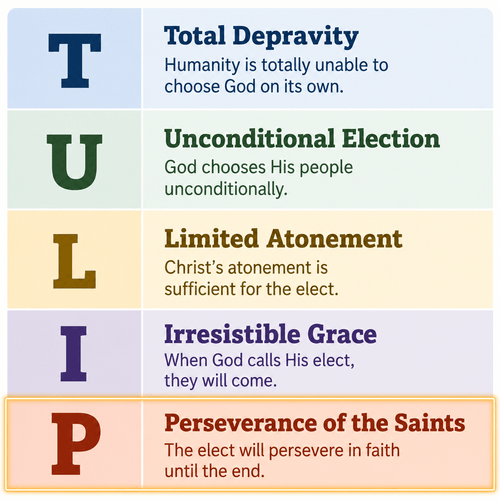
TULIP is an acronym summarising five points of Reformed theology, formulated in response to the Arminian Remonstrance of 1610: Total Depravity, Unconditional Election, Limited Atonement, Irresistible Grace, and Perseverance of the Saints. Together they argue that salvation, from beginning to end, is God’s work rather than a co-operative project between God and man.
What Does TULIP Stand For?
Each letter names a distinct doctrine, but they’re best understood as five angles on a single conviction: that fallen human beings cannot save themselves, and so God must—and does—save entirely by His own initiative and power.
| LETTER | DOCTRINE | IN ONE SENTENCE |
|---|---|---|
| T | Total Depravity | Sin has corrupted every part of us, leaving us unable to save ourselves or even to want to. |
| U | Unconditional Election | God chose who would be saved based on His own grace alone, not on foreseen faith or merit. |
| L | Limited Atonement | Christ’s death actually secured the salvation of those the Father gave Him, rather than merely making salvation possible for all. |
| I | Irresistible Grace | When God calls someone effectually, His grace overcomes their resistance and they come to faith. |
| P | Perseverance of the Saints | Those truly saved by God will be kept by Him and will endure in faith to the end. |
Read individually, several of these can sound harsh out of context—”limited” atonement and “irresistible” grace are notorious for being misheard before they’re understood. Read together, they form a single, coherent claim: salvation is God’s doing from start to finish, not a divine offer that human effort completes.
Where Did TULIP Come From?
TULIP wasn’t Calvin’s own summary of his theology—the acronym postdates him by centuries and the tidy flower-word is a later teaching device, not a 16th-century original. The five points themselves emerged as a direct response to a specific challenge: in 1610, a group of Dutch theologians who followed Jacobus Arminius issued the Remonstrance, a five-point protest against strict Reformed teaching on grace and predestination. The Synod of Dort convened in 1618–19 to weigh that challenge point by point, and its official rulings—the Canons of Dort—became the five points as we now know them.
That history matters, because it shows TULIP was never meant to stand alone. It was a reply in a specific argument, not a freestanding system invented from nothing. For the full story of the Synod, the Remonstrance, and how the debate actually unfolded, see our companion piece on the Synod of Dort.
The Five Points of Calvinism, Explained
Here’s a short walkthrough of each doctrine, with a link to the full biblical case for anyone who wants to go deeper.
T — Total Depravity
Total depravity doesn’t claim people are as evil as they could possibly be. It claims sin has reached and corrupted every part of a person—mind, will, and affections—so that, left to ourselves, we’re unable to turn to God or even to want to. It’s the foundational point: every other letter in TULIP is really an answer to the problem this one describes. Read the full case for Total Depravity →
U — Unconditional Election
Unconditional election teaches that God’s choice of who would be saved rests entirely on His own grace and purpose, not on anything foreseen in us—not our faith, our character, or our future decisions. If depravity is total, election can’t be conditioned on something depraved people would supply. Read the full case for Unconditional Election →
L — Limited Atonement
Limited atonement—sometimes called particular redemption—is the most contested of the five. It teaches that Christ’s death didn’t merely make salvation possible for everyone in general; it actually secured salvation for those the Father gave Him. The cross doesn’t just open a door; it guarantees that everyone for whom Christ died will walk through it. Read the full case for Limited Atonement →
I — Irresistible Grace
Irresistible grace doesn’t mean God drags unwilling people into the kingdom against their wishes. It means that when God calls someone effectually, He changes their heart so that they come freely and gladly—the resistance is overcome from within, not overridden from without. Read the full case for Irresistible Grace →
P — Perseverance of the Saints
Perseverance of the saints teaches that those who are truly saved will be kept by God’s power and will endure in faith to the end—not because their own grip is unbreakable, but because His is. This is the doctrine popularly (if imprecisely) known as “once saved, always saved.” Read the full case for Perseverance of the Saints →
How the Five Points Fit Together
TULIP is often taught as a list, but it’s really a chain of reasoning, and seeing the links is what makes the system click.
- Total depravity creates the problem. If sin has corrupted the whole person, salvation can’t begin with an unaided human decision.
- Unconditional election supplies the solution’s origin. Since we can’t qualify ourselves, God’s choice must rest on His own grace, not our merit.
- Limited atonement gives the choice its object. God’s electing purpose is carried out at the cross, where Christ actually secures—not merely offers—salvation for those He represents.
- Irresistible grace applies the achievement. What was decided in eternity and secured at the cross is worked out in time as God draws His people to faith.
- Perseverance of the saints guarantees the outcome. Because the first four points are entirely God’s work, the fifth follows: He who began the work will finish it.
Pull out any one point and the others start to wobble. Deny total depravity, and unconditional election looks unnecessary. Deny limited atonement, and you have to explain why a universal, effective payment doesn’t save everyone. This is why Calvinists tend to defend TULIP as a package rather than a menu—though, as the next section explains, not everyone agrees the package should be treated as final.
Common Objections to TULIP
TULIP attracts more pushback than almost any other topic in Reformed theology, and the objections deserve honest engagement rather than dismissal.
- “It makes God unfair.” The usual reply is that fairness would mean everyone receiving justice, not mercy—grace, by definition, is never owed, so extending it to some is not an injustice to the rest.
- “It removes human responsibility.” Reformed theology has always affirmed both divine sovereignty and genuine human responsibility side by side, even without claiming to fully resolve the tension between them.
- “‘Limited’ atonement is a harsh way to describe the cross.” Defenders argue every view of the atonement limits it somewhere—either its extent (who it saves) or its power (whether it actually saves anyone)—and would rather limit the extent than the power.
- “TULIP flattens the richness of Reformed theology into five slogans.” This is a fair caution even among Calvinists themselves—see the next section.
Is TULIP the Whole of Reformed Theology?
No—and this is worth saying plainly. TULIP addresses one topic: the doctrine of salvation, and specifically the mechanics of how grace operates in a sinner’s life. It says almost nothing directly about worship, the sacraments, church government, or the sweep of covenant theology, all of which are just as central to the Reformed tradition. Some Reformed theologians have argued the five-point summary, useful as a teaching tool, can leave people thinking Calvinism is smaller than it actually is. We explore that concern directly in Is ‘TULIP’ a Sufficient Summary of Reformed Theology? For the broader Reformation convictions that TULIP sits inside—Scripture alone, faith alone, grace alone, Christ alone, and glory to God alone—see The Reformation’s Five ‘Solas’.
Why TULIP Still Matters
Whatever you make of the acronym, the underlying question is not a museum piece: when someone comes to faith in Christ, whose achievement is that, finally? TULIP’s answer—God’s, from first to last—isn’t meant to produce fatalism or pride. Rightly understood, it’s meant to produce rest. If salvation depended even partly on the strength of your own choosing, assurance would always be provisional. If it rests entirely on God’s electing love, Christ’s finished work, and the Spirit’s persevering grace, then the anxious believer has genuine ground to stand on. That, more than any flower, is what the five points are ultimately for.
Tough Questions, Honest Answers
Did John Calvin invent TULIP?
No. Calvin died in 1564, decades before the acronym existed. The five points were formulated at the Synod of Dort (1618–19) in response to the Arminian Remonstrance of 1610, and the tidy TULIP acronym itself is a later teaching device, popularised well after Dort. Calvin’s own theology runs much wider than these five points.
Is TULIP the same thing as Calvinism?
Not quite. TULIP is a summary of Calvinism’s teaching on salvation specifically—it doesn’t cover worship, church government, the sacraments, or covenant theology, all of which are part of the wider Reformed tradition. Think of TULIP as one important room in a much larger house, not the whole house.
Which point of TULIP is the most controversial?
Limited atonement (particular redemption) usually draws the most objection, even from within otherwise Reformed circles—see our piece on 4-Point Calvinism for how that debate plays out among Calvinists themselves.
Do all Calvinists agree on all five points?
No. Some self-identified Calvinists hold four of the five points and reject or modify limited atonement—sometimes called “four-point Calvinism” or Amyraldianism. The Synod of Dort’s rulings represent the historic confessional standard, but the tradition has always contained internal debate on this point specifically.
Does believing in TULIP mean I don’t have free will?
Reformed theology affirms that human beings make real, voluntary choices—nobody is forced to sin or forced to believe against their will. What it denies is libertarian free will in the sense of a will untouched by sin’s corruption and able to choose God unaided. The choice is real; it simply isn’t neutral.
How is TULIP different from Arminianism?
Arminianism, following the 1610 Remonstrance, teaches that grace enables but doesn’t guarantee faith, that election is based on God foreseeing who would freely believe, that Christ’s atonement was made for all people without exception, that grace can be resisted, and that genuine believers can potentially fall away. TULIP was formulated point-by-point as the Reformed answer to each of these claims.
Where should I start if I want to understand TULIP properly?
Start with Total Depravity—it’s the foundation the other four points build on, and the one most often misunderstood. From there, the five-part series in this hub walks through the doctrines in their logical order, each with the full biblical case.
Related Reads
- Total Depravity: The Doctrine That Makes Grace Make Sense
- Unconditional Election: Why God’s Choice Is Entirely His Own
- Limited Atonement: The Biblical Case for Particular Redemption
- Irresistible Grace: How God’s Call Actually Works
- Perseverance of the Saints: Why True Believers Cannot Finally Fall Away
- The Synod of Dort: The Debate That Gave Us TULIP
- Is ‘TULIP’ a Sufficient Summary of Reformed Theology?
- The Ordo Salutis: What Are the Seven Steps in Our Salvation?
- Did Jesus Teach Calvinism? John 6 and the Doctrines of Grace
- God Helps Those Who Help Themselves: Is It in the Bible?