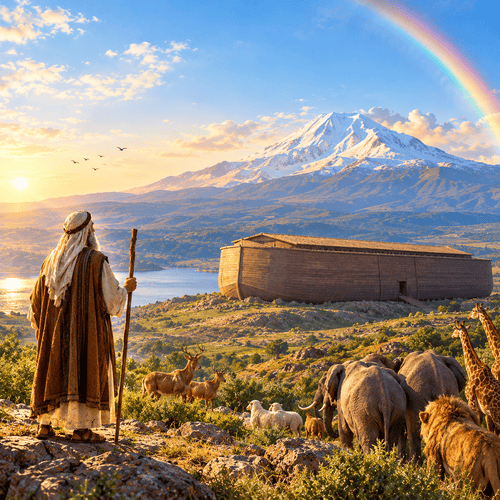
The first mountains named in the Bible aren’t famous for a battle, a temple or a king. They’re famous for a boat. After the great Flood, “the ark came to rest on the mountains of Ararat” (Genesis 8:4).
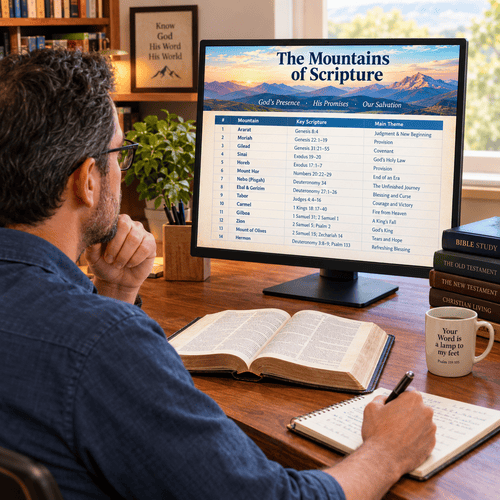
This post is part of our Mountains of Scripture series on Old Testament mountains with New Testament meaning. We have already climbed Moriah, Sinai, Zion, Carmel, Pisgah and the Mount of Olives. Now we climb Ararat. For the big picture, start with our overview, Mountains in the Bible: From Eden to the New Jerusalem.
So what does Mount Ararat in the Bible teach us? It shows that in the Flood, God’s judgement and God’s rescue happened in one single event. The same waters that destroyed the world lifted the ark to safety.
MOUNT ARARAT AT A GLANCE
Region: Ancient Urartu—today eastern Turkey, Armenia and north-west Iran
Modern peak: Mount Ararat (Ağrı Dağı), about 5,137 metres high
Main theme: Judgement and rescue in one event
New Testament links: Matthew 24:37–39; Hebrews 11:7; 1 Peter 3:20–21; 2 Peter 2:5; 3:5–7
Where Is Mount Ararat?
Read Genesis carefully. The ark didn’t land on “Mount Ararat”. It came to rest on “the mountains of Ararat”—plural. In the Bible, Ararat is a land, not one peak. The name matches Urartu, a kingdom the ancient Assyrians wrote about. It lay in the high country around Lake Van, in today’s eastern Turkey, Armenia and north-west Iran.
The Bible mentions this land again: Sennacherib’s sons “escaped into the land of Ararat” (2 Kings 19:37), and Jeremiah names it among Babylon’s enemies (Jeremiah 51:27). Ararat was a real place in real history.
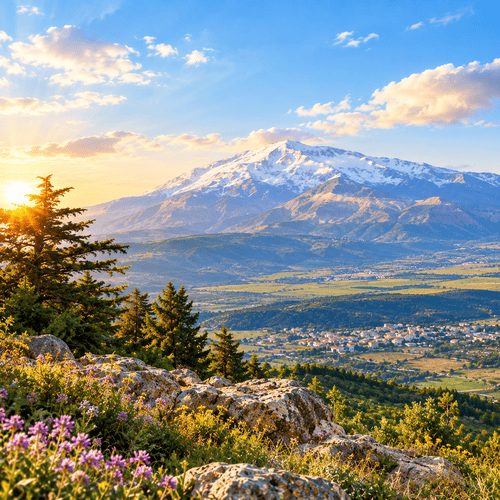
Today the name belongs to one great volcanic peak. Mount Ararat (Ağrı Dağı) rises about 5,137 metres (16,854 feet), Turkey’s highest mountain, with Little Ararat beside it. Its snowy summit is a national symbol for neighbouring Armenia.
Ancient Aramaic and Syriac tradition points instead to Mount Cudi (Judi), further south near the Turkey–Iraq border. The honest answer is that Scripture names the region, not the exact summit.
What Happened on the Mountains of Ararat?
Genesis gives careful dates, like a ship’s logbook—the way history is written, not myth.
Timeline: The Flood Year
- Noah’s 600th year, month 2, day 17: Noah enters the ark; “all the fountains of the great deep burst forth” (Genesis 7:11).
- First 40 days: Rain falls on the earth (Genesis 7:12).
- First 150 days: The waters prevail on the earth (Genesis 7:24).
- Month 7, day 17: The ark rests on the mountains of Ararat (Genesis 8:4).
- Month 10, day 1: The mountain tops are seen (Genesis 8:5).
- 40 days later: Noah sends out a raven, then a dove three times (Genesis 8:6–12).
- Year 601, month 2, day 27: The earth is dry, and God calls the family out (Genesis 8:14–16).
After just over a year in the ark, three “firsts” took place on Ararat:
- The first named mountains. Ararat is the first mountain name in Scripture.
- The first altar. “Then Noah built an altar to the LORD” (Genesis 8:20). Rescued people worship.
- The first covenant in full. God promised a covenant before the Flood (Genesis 6:18)—the Bible’s first use of the word. Afterwards He sealed it with the rainbow (Genesis 9:8–17).
Judgement and Rescue in One Event
In the Flood, judgement and salvation are one event seen from 2 sides.
First, the judgement. “The LORD saw that the wickedness of man was great in the earth, and that every intention of the thoughts of his heart was only evil continually” (Genesis 6:5). The Flood was not a natural accident. It was a holy God’s response to human sin.
Then, the rescue. “But Noah found favour in the eyes of the LORD” (Genesis 6:8)—the Bible’s first use of the Hebrew word for grace. Noah found grace in verse 8; only in verse 9 are we told he was “a righteous man”. Grace came first. Noah was not saved because he was better than others; he was made different because God was gracious.
See how the rescue worked:
- One way in. God told Noah to “set the door of the ark in its side” (Genesis 6:16). One ark, one door. Jesus says, “I am the door. If anyone enters by me, he will be saved” (John 10:9).
- God closed the door. “And the LORD shut him in” (Genesis 7:16). Noah did not keep himself safe; God did. Those whom God saves, He keeps.
- God remembered. “But God remembered Noah” (Genesis 8:1). In the Bible, God “remembering” means He acts on His promise.
- Saved through the water. Eight people “were brought safely through water” (1 Peter 3:20). The water that drowned the world carried the ark above the judgement.
THE ARK TOOK THE STORM
Every drop of rain that fell on Noah’s family fell first on the ark. Even the pitch that sealed it (Genesis 6:14) comes from the same Hebrew root as the word for “atonement”—a covering. On the cross, Jesus took the full storm of God’s anger against sin. For those in Him, the judgement still falls, but it falls on Him. “There is therefore now no condemnation for those who are in Christ Jesus” (Romans 8:1).
A Place of Rest After Judgement
Genesis 8:4 contains a beautiful word-play. The Hebrew verb for “came to rest” sounds like Noah’s name. At his birth his father said, “this one shall bring us relief” (Genesis 5:29). On Ararat, the ark—and Noah—finally came to rest. Before that, the dove “found no place to set her foot” (Genesis 8:9)—literally, no resting place. A world under judgement offers no rest.
The Flood also reads like a new creation. As God’s Spirit hovered over the waters in Genesis 1, so “God made a wind blow over the earth” (Genesis 8:1)—the same Hebrew word—and dry land appeared again. God then repeated to Noah His words to Adam (Genesis 9:1). Noah is a second Adam—but not the last one.
In Scripture, mountains are where heaven and earth meet. Eden is called “the holy mountain of God” (Ezekiel 28:14). L. Michael Morales has shown how the books of Moses trace a pattern of ascending God’s mountain—from Eden, to the ark on Ararat, to Sinai. The pattern ends on the “great, high mountain” of the new creation (Revelation 21:10). And Jesus offers the rest Noah’s name pointed to: “Come to me, all who labour and are heavy laden, and I will give you rest” (Matthew 11:28).
How the New Testament Uses the Flood
Jesus, Peter and the writer of Hebrews all treat the Flood as real history. They use it to teach about Christ’s return, baptism and faithful witness.
Jesus and “the Days of Noah” (Matthew 24:37–39)
“For as were the days of Noah, so will be the coming of the Son of Man. For as in those days before the flood they were eating and drinking, marrying and giving in marriage, until the day when Noah entered the ark, and they were unaware until the flood came and swept them all away…”
Matthew 24:37–39
People were living normal lives. Their problem was that they were “unaware”. They heard Noah’s warning and saw the ark rising, yet carried on as if nothing would change. Then, suddenly, it was too late.
Jesus spoke these words while sitting “on the Mount of Olives” (Matthew 24:3). From the mountain of His return, He pointed back to Ararat, the mountain of rescue after judgement.
The Flood and Baptism (1 Peter 3:20–21)
“…eight persons, were brought safely through water. Baptism, which corresponds to this, now saves you, not as a removal of dirt from the body but as an appeal to God for a good conscience, through the resurrection of Jesus Christ.”
1 Peter 3:20–21
“Corresponds” translates the Greek antitypos. The Flood is the first picture; baptism is the matching one. Both speak of death and new life. Noah’s old world went under, and he came out into a washed, new world.
But Peter is careful. Baptism saves “through the resurrection of Jesus Christ”, not by washing the body. The water is the sign; Christ is the Saviour. The Westminster Confession of Faith (28.5) agrees: grace and salvation are not “so inseparably annexed unto it” that no one can be saved without it, or that every baptised person is surely born again.
Jesus called His own death a baptism (Luke 12:50). He went under the flood of God’s judgement so that we could come through it. Martin Luther’s baptism service even included a “Flood Prayer” on this theme. And God saved Noah’s whole household (Genesis 7:1)—covenant grace reaching into families (Acts 16:31).
Noah, “a Herald of Righteousness” (2 Peter 2:5)
God “preserved Noah, a herald of righteousness, with seven others, when he brought a flood upon the world of the ungodly” (2 Peter 2:5). A herald announced the king’s word in public. Noah did not just build a boat; he preached. Every hammer blow was a sermon.
Noah believed God about “events as yet unseen” and so became “an heir of the righteousness that comes by faith” (Hebrews 11:7). Meanwhile, “God’s patience waited” (1 Peter 3:20). God is still patient, “not wishing that any should perish” (2 Peter 3:9). But the door of the ark did close.
Water Then, Fire Next (2 Peter 3:3–7)
Peter warns that scoffers will say “all things are continuing as they were from the beginning of creation” (2 Peter 3:4). His answer is the Flood: “the world that then existed was deluged with water and perished”, and the present world is “stored up for fire” (2 Peter 3:6–7).
The scoffers’ idea—that everything has always carried on slowly in the same way—drives long-age thinking today. And Peter’s argument only works if the Flood was as wide as the coming judgement.
Was the Flood Worldwide? Why It Matters
Some Christians say the Flood was a large local flood in Mesopotamia. But Genesis, and the way Jesus and Peter read it, point clearly to a worldwide Flood:
- The mountains were covered. “All the high mountains under the whole heaven were covered” (Genesis 7:19). Water cannot stand for months above one region’s mountains and stay out of the rest of the world.
- It lasted over a year. Local floods rise and fall in days or weeks.
- The ark makes no sense for a local flood. God could simply have told Noah to move, and birds could have flown away.
- God’s promise depends on it. God promised “never again shall there be a flood to destroy the earth” (Genesis 9:11). If the Flood was local, that promise has been broken many times.
- Jesus and Peter treat it as universal. The flood “destroyed them all” (Luke 17:27), and only eight were saved (1 Peter 3:20).
- Noah is in Jesus’ family line. Luke traces Jesus’ ancestry through “the son of Noah” back to Adam (Luke 3:36–38).
The physical world fits. Sea-creature fossils lie high in the world’s mountain ranges—even near the summit of Mount Everest. Psalm 104 describes the Flood’s end: “The mountains rose, the valleys sank down” (Psalm 104:8), sending the waters off the land. Our posts on mountain formation and the young earth explore this.
The ark’s design fits too. In 1993, a team led by Seon Won Hong at the Korea Research Institute of Ships and Engineering tested its proportions (Genesis 6:15). It balanced stability, strength and comfort well and could have handled waves of around 30 metres.
Where Is Noah’s Ark Today?
“Where is Noah’s ark?” is one of the most searched Bible questions online. Ancient writers such as Berossus and Josephus reported remains in the mountains. Modern claims include:
- The Durupınar site: a boat-shaped formation about 30 kilometres south of Mount Ararat, spotted in 1959. Geologists who studied it, including creation geologist Andrew Snelling, concluded it is natural rock.
- The “Ararat anomaly”: a dark shape in the summit ice on American spy-plane and satellite photos, most likely rock and ice.
- The 2010 wood claim: a Hong Kong group reported wooden rooms high on the mountain. Other researchers, including Flood believers, raised serious doubts, and it was never confirmed.
Some creation geologists add that today’s volcanic peak may have grown after the Flood, so the ark likely landed elsewhere in the region.
The honest answer is that we do not know where the ark is, and it may no longer exist. Our faith does not hang on finding it. We believe the Flood happened because God’s word says so, and Jesus confirmed it.
THE ARK YOU NEED ISN’T ON A MOUNTAIN
Even if someone found the ark tomorrow, it could not save anyone. The ark was a picture; the real Ark is a Person. “There is salvation in no one else” (Acts 4:12). The question that matters most is not “Where is Noah’s ark?” but “Am I in Christ?”
A Covenant for a Broken World
On Ararat, God made a covenant with Noah, every living creature and the earth itself (Genesis 9:8–17). O. Palmer Robertson calls it “the covenant of preservation”. God promised to keep the world going while His plan of salvation unfolds: “While the earth remains, seedtime and harvest… shall not cease” (Genesis 8:22). Abraham Kuyper rooted much of his teaching on “common grace”—God’s kindness to all people—in this covenant (see Acts 14:17).
The sign was the rainbow: “I have set my bow in the cloud” (Genesis 9:13). The Hebrew word is the normal word for a warrior’s bow. Many see a picture here: God hung up His bow of war, pointing away from the earth.
But Ararat also shows what the Flood could not do. Before it, man’s heart was “only evil continually” (Genesis 6:5). After it, beside Noah’s altar, God said “the intention of man’s heart is evil from his youth” (Genesis 8:21). The Flood washed the earth but not the human heart. Soon Noah himself got drunk and fell into shame (Genesis 9:20–21). The world needed a new heart—and a better Noah.
Ararat and the Other Mountains in This Series
| MOUNTAIN | WHAT HAPPENED | HOW IT POINTS TO CHRIST |
|---|---|---|
| Ararat | The ark rests after the Flood | Christ brings us through judgement into rest |
| Moriah | God provides a sacrifice for Isaac | God provides His own Son |
| Sinai | God gives the law | Christ keeps the law and brings a better covenant |
| Zion | God’s city and King | Christ is the true King |
| Carmel | Fire falls; the LORD is God | There is one true God and Saviour |
| Pisgah | Moses sees the promised land | Christ leads His people into true rest |
| Olives | Jesus ascends and will return | Christ will come again, as in Noah’s days |
Conclusion: Come into the Ark
Mount Ararat stands between two worlds: behind it, a world judged by water; before it, an altar, a rainbow and a promise.
That is exactly what happened at the cross. There God’s judgement against sin fell in full, and there His people were rescued in full. Jesus is the true Noah who brings rest, the true Ark who takes the storm, and the true Herald who still calls, “Come.” The days of Noah will come again. Today the door is open. Come into the Ark.
Tough Questions, Honest Answers
Can you climb Mount Ararat today?
Yes. Because Mount Ararat lies in a sensitive border area near Armenia and Iran, climbers need a permit from the Turkish government and normally go with a licensed local guide. Most climbs take about five days, including time to get used to the height. The summit is icy, so crampons and good fitness are needed. Rules can change, so check the current requirements before planning a trip.
How did all the animals fit on Noah’s ark?
God told Noah to bring two of every “kind” (Genesis 6:20), with seven pairs of clean animals (Genesis 7:2)—not every species. A “kind” is a wider group; dogs, wolves and foxes, for example, likely came from one dog kind. Creation researchers estimate around 1,400 land-animal kinds, which means fewer than 7,000 animals, many of them young and small. Sea creatures did not need to come aboard. John Whitcomb and Henry Morris calculated the ark’s space as equal to more than 500 railway livestock wagons.
Were dinosaurs on Noah’s ark?
If dinosaurs were land animals made on day six (Genesis 1:24–25), then dinosaur kinds were on the ark, because two of every land animal “in which there was the breath of life” went in (Genesis 7:15). Even the largest dinosaurs hatched from eggs not much bigger than a football, so young animals would have fitted easily. After the Flood, many died out in a changed world. The “Behemoth” of Job 40:15–24 may describe such a creature.
Is the Genesis Flood copied from the Epic of Gilgamesh?
The Babylonian Epic of Gilgamesh tells of a man named Utnapishtim who survives a flood in a boat that lands on a mountain. But the differences are huge. Its many gods quarrel and are frightened by the flood they cause; in Genesis, one holy God judges sin. Its boat is a cube that would roll over at sea; the ark’s shape is stable. Hundreds of flood stories exist around the world. The best explanation is that they are bent memories of a real event, and Genesis is the true record.
Who are the “spirits in prison” in 1 Peter 3:19?
This is one of the hardest verses in the New Testament. One strong view, held by Augustine and many later teachers, is that Christ, by His Spirit, preached through Noah to the people of his day (compare 1 Peter 1:11). Those people are now “in prison”, awaiting judgement. Another view is that Christ announced His victory to fallen angels. Neither view teaches a second chance after death: “it is appointed for man to die once, and after that comes judgement” (Hebrews 9:27).
Is “one will be taken and one left” about the rapture?
In Matthew 24:39–41, Jesus first says the flood “swept them all away”, then says “one will be taken and one left”. In the Flood, those taken away were taken in judgement, and “only Noah was left” (Genesis 7:23). So many careful readers think “taken” here means taken in judgement, and “left” means kept safe—the opposite of the popular view. Either way, Jesus’ main point is clear: be ready.
Did the ark land on the same date Jesus rose from the dead?
Some have noticed that the ark rested “in the seventh month, on the seventeenth day” (Genesis 8:4). If the early calendar began in autumn, that month later became the first month, Nisan, when God reset the calendar at the Exodus (Exodus 12:2). Passover fell on Nisan 14, and Jesus rose on the third day, around Nisan 16 or 17. It is an interesting link, but we cannot be certain how the ancient calendar worked, so we hold it lightly.
Related Reads
- Mountains in the Bible: From Eden to the New Jerusalem
- Mount Moriah in the Bible: Araunah’s Threshing Floor and Why It Matters
- Mount Sinai in Arabia: What Paul Meant in Galatians 4:25
- Mount Nebo (Pisgah): The Law, the Promise and Rest Christ Gives
- Mounts Gerizim and Ebal: Blessing, Curse and the Cross
- Mount Zion Meaning: From David’s Hill to the People of God
- Mount Carmel in the Bible: Elijah’s Fire and the Cross of Christ
- Mount of Olives in the Bible: Where the King Wept and the Glory Returns
- Mount Hermon in the Bible: Dew, Watchers and the Gates of Hell
- What Noah’s Ark Teaches Us About Christ: 4 Biblical Connections
- Why Noah’s Flood Was Global: Scientific Evidences Often Overlooked
- How Many Animals Were on Noah’s Ark? Solving the Genesis Puzzle
- Ancient Flood Stories Compared: What Makes Noah’s Account Different?
- Jesus ‘Preached to Spirits in Prison’: What Did Peter Mean?