The most fought-over piece of land on earth began as a farmer’s floor for beating wheat.
Today, armed guards watch it day and night, and 3 world religions call it holy. But 3,000 years ago, it was just a rocky hilltop in Jerusalem where a man named Araunah separated grain from husk.
So how did a farmer’s work floor become the place where God’s temple stood? And why does the Bible link it to a father who once climbed a mountain to kill his own son?
The answer isn’t really about land. It’s about one place where God stopped death again and again—and about the day He didn’t stop it. In this post, we shall explore Mount Moriah in the Bible, see how Scripture ties its two great stories together, and discover why both point straight to Jesus.
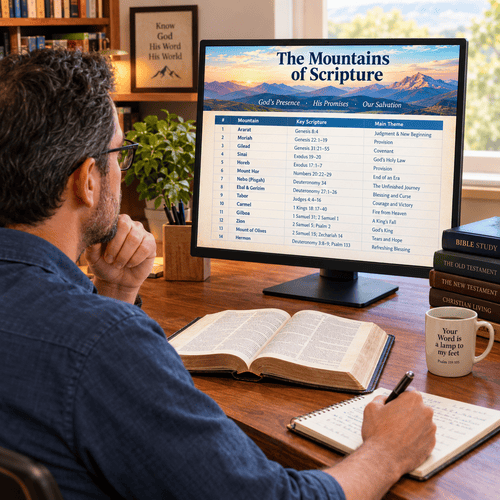
Moriah is the first stop in our Mountains of Scripture series, where we climb the great mountains of the Old Testament and see how each one points to Jesus. From here the series goes on to Mount Sinai, Mount Zion, Mount Carmel, the Mount of Olives and Mount Nebo.
KEY TERM: MORIAH
Moriah is the name of a hilly area near Jerusalem (Genesis 22:2). Later, the Bible uses the same name for the hill where King Solomon built God’s temple (2 Chronicles 3:1). Today most people call this hill the Temple Mount.
What Happened on Mount Moriah?
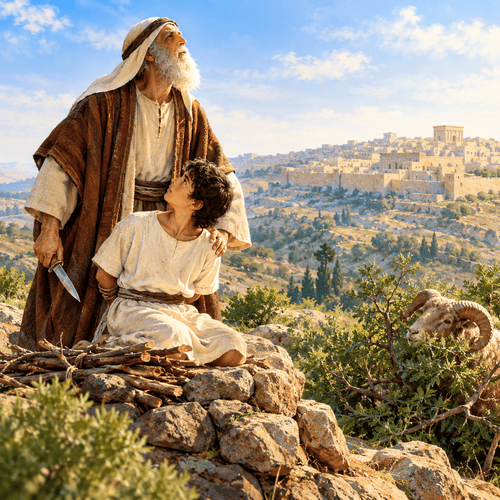
Moriah first appears in one of the hardest chapters in the Bible. God tells Abraham, the father of the Jewish nation:
“Take your son, your only son Isaac, whom you love, and go to the land of Moriah, and offer him there as a burnt offering on one of the mountains of which I shall tell you.”
Genesis 22:2
Isaac was the son God had promised. Abraham had waited twenty-five years for him. Look at the words: your son, your only son, whom you love. God stacks them up so we feel the weight.
Abraham obeyed. Isaac carried the wood up the hill and asked, “where is the lamb for a burnt offering?” Abraham replied, “God will provide for himself the lamb” (Genesis 22:7–8). At the last moment, the angel of the LORD called out: “Do not lay your hand on the boy” (Genesis 22:12). Abraham “lifted up his eyes” and saw a ram caught in a thicket (Genesis 22:13). The ram died in Isaac’s place. It was a substitute—something that takes the place of another.
“The LORD Will Provide”
Abraham then named the place:
“So Abraham called the name of that place, ‘The LORD will provide’; as it is said to this day, ‘On the mount of the LORD it shall be provided.’”
Genesis 22:14
In Hebrew, “The LORD will provide” is Yahweh Yireh (older Bibles say Jehovah-jireh). The verb is ra’ah, “to see”. When God sees a need, He provides. Notice, too, that the saying looks ahead: “it shall be provided.” The ram was not the end of the story.
The Puritan commentator Matthew Henry saw this. God spared Abraham’s son, he noted, but one day He would not spare His own.
The Threshing Floor of Araunah
Jump forward about a thousand years. King David orders a census—an official count of his fighting men. Counting is not wrong in itself (Numbers 1). But his commander Joab tried to stop him (2 Samuel 24:3). David seems to have trusted in the size of his army rather than in God. Soon “David’s heart struck him”, and he confessed, “I have sinned greatly” (2 Samuel 24:10).
Offered three punishments by the prophet Gad, David chose to fall into God’s hands, “for his mercy is great” (2 Samuel 24:14). A plague killed seventy thousand people. Then, as the angel reached out to destroy Jerusalem, God said:
“It is enough; now stay your hand.” And the angel of the LORD was by the threshing floor of Araunah the Jebusite.
2 Samuel 24:16
KEY TERM: THRESHING FLOOR
A threshing floor was a flat, hard patch of ground, usually on a hilltop. Farmers beat their harvested grain there, then threw it into the air. The wind blew away the light husks (called chaff), and the good grain fell back down.
In the Bible, the threshing floor became a picture of judgement: God separating good from bad.
David saw the angel holding “a drawn sword stretched out over Jerusalem” (1 Chronicles 21:16). He fell on his face and begged God to punish him instead: “these sheep, what have they done?” (2 Samuel 24:17).
A Sacrifice That Cost Something
Gad told David to build an altar on Araunah’s floor. Araunah was a Jebusite, one of the people who lived in Jerusalem before David captured it. He offered everything for free, but David refused:
“No, but I will buy it from you for a price. I will not offer burnt offerings to the LORD my God that cost me nothing.”
2 Samuel 24:24
God “answered him with fire from heaven” (1 Chronicles 21:26), and the plague stopped. Then David declared, “Here shall be the house of the LORD God” (1 Chronicles 22:1).
Dale Ralph Davis, the Presbyterian pastor and Old Testament scholar, notes how surprising this ending is. 2 Samuel does not close with David’s greatest victory, but with a guilty king at an altar. Even Israel’s best king needed a sacrifice.
How the Bible Ties the Two Together
Is it coincidence that both happened on the same hill? No. Scripture joins the dots:
“Then Solomon began to build the house of the LORD in Jerusalem on Mount Moriah, where the LORD had appeared to David his father, at the place that David had appointed, on the threshing floor of Ornan the Jebusite.”
2 Chronicles 3:1
Outside Genesis 22, this is the only verse in the Bible that names “Moriah”. The Chronicler, the writer of 1 and 2 Chronicles, wants us to see that Abraham’s mountain and David’s threshing floor are the same place. And the two stories follow the same pattern.
Two Stories on One Hill: The Same Pattern (read each row from left to right)
| STEP IN THE STORY | ABRAHAM ON MORIAH | DAVID AT THE THRESHING FLOOR |
|---|---|---|
| Death is coming | Abraham’s knife over Isaac (Genesis 22:10) | The angel’s sword over Jerusalem (1 Chronicles 21:16) |
| Eyes are lifted | Abraham “lifted up his eyes” and saw the ram (Genesis 22:13) | David “lifted his eyes” and saw the angel (1 Chronicles 21:16) |
| God stops the hand | “Do not lay your hand on the boy” (Genesis 22:12) | “It is enough; now stay your hand” (2 Samuel 24:16) |
| A substitute dies | A ram dies instead of Isaac | Animals die on David’s altar instead of the people |
| God sees or appears | “The LORD will provide” (Genesis 22:14) | “Where the LORD had appeared to David” (2 Chronicles 3:1) |
| The place becomes God’s | “The mount of the LORD” | “Here shall be the house of the LORD God” |
Four more clues confirm the link:
- The same Hebrew word. “Will provide” (Genesis 22:14) and “had appeared” (2 Chronicles 3:1) both come from ra’ah, “to see”. Abraham said the LORD would be seen here. A thousand years later, He was.
- The same name. “The mount of the LORD” became a common name for the temple hill (Psalm 24:3; Isaiah 2:3).
- The same fire. God sent fire from heaven on David’s altar, and again when Solomon opened the temple (2 Chronicles 7:1).
- The end of a long wait. Moses spoke of “the place that the LORD your God will choose” (Deuteronomy 12:5). At Araunah’s floor, Israel finally knew where it was.
Some critics claim the Chronicler invented this link late. But the Book of Jubilees (second century BC) and the historian Josephus (first century AD) both place Abraham’s sacrifice on the temple hill. John Calvin, the French reformer, also judged it likely. Above all, Chronicles is God’s inspired word (2 Timothy 3:16).
Did God or Satan Move David?
Here is a puzzle. The two accounts of the census seem to name different movers behind it. (We look at this question in more depth in Who Incited David’s Census: God or Satan?)
Two Accounts of One Event: Who Moved David to Count the People?
| BIBLE PASSAGE | WHAT IT SAYS |
|---|---|
| 2 Samuel 24:1 | “Again the anger of the LORD was kindled against Israel, and he incited David against them, saying, ‘Go, number Israel and Judah.’” |
| 1 Chronicles 21:1 | “Then Satan stood against Israel and incited David to number Israel.” |
SO WHICH IS IT? BOTH.
Both verses are true at once. Bible teachers call this concurrence: God and His creatures act in the same event, but in different ways and for different reasons.
- God ruled over the whole event. Israel had sinned, and He was bringing judgement—and, through it, mercy.
- Satan was the tool. He wanted to harm Israel and ruin David.
- David made a real choice. He was no puppet, and he confessed his guilt.
We see this pattern across the Bible. Joseph told his brothers, “you meant evil against me, but God meant it for good” (Genesis 50:20). When Jesus was crucified, His enemies did “whatever your hand and your plan had predestined to take place” (Acts 4:28).
The Westminster Confession of Faith (1646) says God’s rule reaches even to sin, “and that not by a bare permission”. Yet “the sinfulness thereof proceedeth only from the creature, and not from God” (5.4). Calvin taught the same in his Institutes (1.18): God uses even Satan as His tool, yet the guilt stays with the sinner. So Satan’s attack still served God’s plan. It led David to the very spot where the temple would stand.
From Moriah to the Cross
This is why these stories matter so much. Both are types of Christ.
KEY TERM: TYPE
A type is a real person, event or object in the Old Testament that God designed as a picture of something greater to come. It is like a shadow: the right shape, but not the real thing. Geerhardus Vos, the Dutch-American Bible scholar, taught that a true type grows out of what the event meant in its own time.
Shadow and Fulfilment: How Moriah Points to Jesus
| ON MORIAH (THE SHADOW) | IN CHRIST (THE REAL THING) |
|---|---|
| God asks for Abraham’s “only son… whom you love” (Genesis 22:2) | God gives “his only Son” (John 3:16) |
| Isaac carries the wood up the hill (Genesis 22:6) | Jesus carries His own cross (John 19:17) |
| “God will provide for himself the lamb” (Genesis 22:8) | “Behold, the Lamb of God, who takes away the sin of the world!” (John 1:29) |
| Abraham does not hold back his son (Genesis 22:12) | God “did not spare his own Son” (Romans 8:32) |
| David’s sacrifice stops the plague (2 Samuel 24:25) | Jesus’ death turns away God’s anger (Romans 3:25) |
| David, the guilty shepherd, asks to be punished for his sheep (2 Samuel 24:17) | Jesus, the innocent Good Shepherd, “lays down his life for the sheep” (John 10:11) |
| The threshing floor, a place of judgement | Jesus bears the judgement, so His people are gathered in like wheat (Matthew 3:12) |
The Blow That Wasn’t Stopped
On Moriah, God stopped the knife. On Araunah’s floor, He stopped the sword. At the cross, He did not stop it. But sinners like us could only be spared by Someone who would not be spared Himself:
“He who did not spare his own Son but gave him up for us all, how will he not also with him graciously give us all things?”
Romans 8:32
Paul is borrowing the language of Genesis 22. In the Greek Old Testament, “spare” is the very word used of Abraham not holding back Isaac.
Jesus’ death was a propitiation (Romans 3:25). This means a sacrifice that turns away God’s anger by fully paying what justice demands. At Araunah’s floor, the plague stopped when the sacrifice was made. At the cross, the sword struck the Shepherd so the sheep could go free.
Timeline: Moriah Through History
Most dates are approximate.
- About 2000 BC: Abraham takes Isaac to “the land of Moriah”, and God provides a ram (Genesis 22).
- About 975 BC: David’s census brings a plague. David buys Araunah’s threshing floor and builds an altar (2 Samuel 24).
- About 966 BC: Solomon begins the temple on Mount Moriah (1 Kings 6:1; 2 Chronicles 3:1).
- 586 BC: The Babylonians destroy Solomon’s temple.
- 516 BC: Jews back from exile finish a smaller second temple.
- About AD 30–33: Jesus dies and rises again, calling His body the true temple.
- AD 70: The Romans destroy the temple. The sacrifices stop and have never restarted.
- AD 691: The Islamic shrine called the Dome of the Rock is completed on the hill.
Why a Rebuilt Temple Is Not the Goal
Some Christians eagerly await a third temple on Mount Moriah, with animal sacrifices restarted. But the New Testament points elsewhere:
- Jesus is the temple now. “He was speaking about the temple of his body” (John 2:21).
- Worship is not tied to one hill. “Neither on this mountain nor in Jerusalem will you worship the Father” (John 4:21).
- The sacrifices are finished. “There is no longer any offering for sin” (Hebrews 10:18).
- God’s people are His house. Believers are “living stones” in “a spiritual house” (1 Peter 2:5).
- The final city has no temple. “Its temple is the Lord God the Almighty and the Lamb” (Revelation 21:22).
Gregory K Beale, in The Temple and the Church’s Mission (2004), argues the temple was always a small model of a much bigger plan: God’s presence filling the whole earth. In Christ and His church, that plan is now spreading. O Palmer Robertson, in The Israel of God (2000), likewise shows the promises about land and temple find their “Yes” in Jesus (2 Corinthians 1:20).
Remember, too, that God’s house stood on land bought from a foreigner. That was a hint: God always meant His house to be “a house of prayer for all peoples” (Isaiah 56:7). Returning to animal sacrifices would be like clinging to a shadow after the real person has arrived.
What Moriah Means for Us Today
Moriah is not just history. It speaks to us today:
- God sees, and God provides. If He gave His Son, He will not hold back what you truly need (Romans 8:32).
- Sin is serious. One proud decision cost seventy thousand lives. Sin is never small to God.
- Real worship costs something. Like David, we should not offer God what costs us nothing.
- God rules even over evil. Nothing in your life is outside His control.
- You do not need a holy hill. You need a Saviour. God now meets people in Jesus, wherever they are.
People still argue about who owns the mountain. But the bigger question is this: are you trusting the Lamb God provided there?
Abraham said, “God will provide for himself the lamb.” Centuries later, John the Baptist pointed at Jesus and gave the answer: “Behold, the Lamb of God.” The knife was stopped on Moriah. The sword was stopped on Araunah’s floor. At the cross, the blow fell on Jesus—so that it would never fall on those who trust in Him.
Tough Questions, Honest Answers
What does the name “Moriah” mean?
Nobody knows for certain. Many scholars link it to the Hebrew verb ra’ah, “to see”, so it may mean something like “seen by the LORD” or “chosen by the LORD”. Some ancient Jewish teachers linked it to myrrh, a sweet-smelling spice used in worship. The Greek Old Testament simply translated it as “the high land”. Whatever its exact meaning, the Bible fills the name with meaning: this is the place where God sees, provides and makes Himself known.
Where is Mount Moriah today? Is the Dome of the Rock built on it?
Mount Moriah is the hill in the Old City of Jerusalem now called the Temple Mount. Its top is covered by a large stone platform that King Herod built. The golden-domed Islamic shrine called the Dome of the Rock, finished in AD 691, stands over a large rock on this platform. Many believe this rock lies close to where the temple once stood, though experts still debate the exact spot. For Christians, the exact square metre matters less than what happened there. God’s presence is no longer tied to that hill, but to Jesus.
Was Jesus crucified on Mount Moriah?
The Bible does not say so. It tells us Jesus died at Golgotha, “the Place of a Skull”, which was “near the city” (John 19:20) and “outside the gate” (Hebrews 13:12). The temple hill was inside the city, so Jesus was not crucified on the temple platform itself. Some teachers argue that Golgotha lay within the wider “land of Moriah”, since Genesis 22:2 speaks of a land, not one peak. That is possible, but we should not claim more than Scripture says. The link between Moriah and the cross is about God’s pattern and meaning, not exact map points.
Why does David pay 50 shekels of silver in 2 Samuel but 600 shekels of gold in 1 Chronicles?
This is not a contradiction. Look closely at what is being bought. In 2 Samuel 24:24, David buys “the threshing floor and the oxen” for 50 shekels of silver—enough for the altar that day. In 1 Chronicles 21:25, he pays 600 shekels of gold for “the site”, meaning the whole area that would later hold the temple. Many careful commentators explain it this way: one is the first, small purchase, and the other is the full price of the larger site. Both books agree on the main point: David paid in full, and the temple hill was bought, not taken.
Why is he called Araunah in Samuel but Ornan in Chronicles?
Both names refer to the same man. Araunah was probably not a Hebrew name, and foreign names were often spelled in different ways when written in Hebrew. Some scholars think “Araunah” may even be a title meaning “lord” in an old non-Hebrew language, which would suggest he was an important man among the Jebusites. Ornan is likely a later, more Hebrew-sounding form of the name. Different spellings of the same name are common in the Bible, such as Jehoram and Joram. This shows the writers stayed close to their sources rather than tidying everything up.
Do Muslims believe Abraham offered Ishmael, not Isaac?
Many Muslims today believe that, but the Qur’an itself does not name the son in its account (Surah 37). Early Muslim teachers were divided, and some named Isaac. Genesis, written many centuries earlier, is perfectly clear: “your only son Isaac, whom you love” (Genesis 22:2). By this time, Ishmael had already been sent away (Genesis 21). Christian faith rests on God’s written word, not on later traditions, and Genesis leaves no doubt about which son climbed the mountain.
Why did God punish 70,000 people for David’s sin?
This is one of the hardest questions in the story. First, 2 Samuel 24:1 tells us God’s anger was already “kindled against Israel”, so the people were not innocent. David’s sin was the trigger, but it was not the only cause. Second, a king in Israel stood for his people, so his sin affected the whole nation, just as Adam’s sin affected all of us (Romans 5:12). Third, God is the giver of life, and He wrongs no one when He judges sinners. The real wonder is not that God judged, but that He stopped—“It is enough”—and showed mercy at the altar, pointing ahead to the cross.
Related Reads
- Mountains in the Bible: From Eden to the New Jerusalem
- Mount Sinai in Arabia: What Paul Meant in Galatians 4:25
- Mount Zion Meaning: From David’s Hill to the People of God
- Mount Carmel in the Bible: Elijah’s Fire and the Cross of Christ
- Mount of Olives in the Bible: Where the King Wept and the Glory Returns
- Mount Nebo (Pisgah): The Law, the Promise and Rest Christ Gives
- Mount Ararat in the Bible: Where Judgement Ended and Rescue Began
- Mount Hermon in the Bible: Dew, Watchers and the Gates of Hell
- Mounts Gerizim and Ebal: Blessing, Curse and the Cross
- Why Did God Command Isaac’s Sacrifice?
- Who Incited David’s Census: God or Satan?
- The Names of God and What Each One Really Means
- Will There Be a Third Jewish Temple in Jerusalem?
- The Passover Lamb and Christ: Understanding Bible Typology