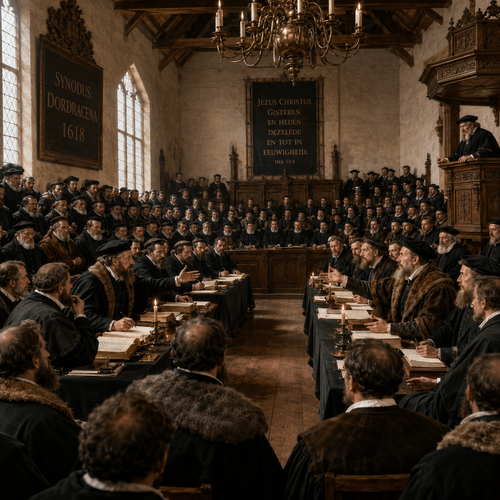
Most people associate the Synod of Dort with a flower—the TULIP, to be precise. If anyone has read up on the five points of Calvinism, arranged as TULIP—total depravity, unconditional election, limited atonement, irresistible grace, perseverance of the saints—they’re likely aware of a gathering that sat in a Dutch town four centuries ago. Well, here’s the first surprise: the synod never used the word TULIP. It wouldn’t have recognised it. The acronym is English, and it wasn’t coined until nearly 300 years later.
So what actually happened at Dort? Why did hundreds of churchmen travel across Europe in the winter of 1618 to argue about predestination—the question of how, and on what basis, God chooses to save people? And how did their work end up summarised by the flower? This is the story of the debate that gave us TULIP, though, as we shall see, it gave us a good deal more besides.
Why Did The Synod Meet?
The synod met to settle an argument that had split a church and very nearly split a country.
The argument began with one theologian. Jacobus Arminius (1560–1609) was a gifted Dutch pastor who became professor of theology at the University of Leiden in 1603. He’d studied in Geneva under Theodore Beza, John Calvin’s own successor, so he knew the Calvinist system from the inside. But Arminius came to doubt one of its central claims: that God’s choice of who’d be saved—His “election”—was an unconditional decision of God’s will, settled before anyone had done anything good or bad. Arminius taught instead that God chose those He foresaw would believe. Election, in Arminius’s view, was conditional on foreseen faith.
His Leiden colleague Franciscus Gomarus (1563–1641) held the older line fiercely, and the two clashed in public. The quarrel didn’t stay in the lecture hall. Predestination became a national talking point; one writer joked even the fishmongers in the Leiden market were arguing about it.
Arminius died in 1609. The following January, around 45 ministers who shared his concerns met at The Hague and signed a protest document, drafted mainly by the court preacher Johannes Uytenbogaert. Because it took the form of a formal protest—a remonstrance—its signatories became known as the Remonstrants, and their five-point summary as the Five Articles of Remonstrance. They asked the government to revise the church’s official standards, or at least to shield their minority view. The opposing party hit back in 1611 with a Counter-Remonstrance, and so earned their own nickname: the Counter-Remonstrants.
Notice the irony, because it shapes everything that follows: it was the Arminians who first reduced the dispute to five points. So what we now call “the five points of Calvinism” actually began life as answers to the Arminians’ five articles.
What turned a church quarrel into a national emergency was politics. The disagreement landed squarely on top of an existing power struggle. On one side stood Johan van Oldenbarnevelt (1547–1619), the most powerful statesman in the land, who favoured tolerating the Remonstrants and guarding the independence of the provinces. On the other stood Prince Maurice of Orange (1567–1625), head of the army, who backed the Calvinist party and a stronger, more unified state. In 1617 Maurice made his loyalties public by walking out of his Arminian-led congregation to worship with a Calvinist preacher instead. Arminians were even accused, unfairly, of being soft on Catholic Spain, so that to their enemies their theology began to look like treason. By 1618 the country was close to civil war—and Maurice had the soldiers. Oldenbarnevelt was arrested, and the government summoned a national synod to settle the doctrine once and for all.
So the synod met to do three things at once: decide a question of doctrine, discipline a movement, and hold a fracturing nation together.
Dort, Dordt, or Dordrecht? A quick word on the name, since we will meet all three spellings. The synod sat in the Dutch city of Dordrecht. “Dordt” is the local short form, and “Dort” is simply its English version. All three are correct; this article uses “Dort” because it’s the most common in English.
Who Was In The Room?
Dort was no small committee. It ran for roughly six months—the first session was on 13 November 1618, and the assembly worked through some 154 formal sittings into the following spring.
On the Remonstrant side, the leading figures were Simon Episcopius (1583–1643), Arminius’s brilliant successor at Leiden and the spokesman for the group that was summoned to defend their views; Johannes Uytenbogaert, who’d drafted the original protest; and, in the wings were two powerful sympathisers—statesman Johan van Oldenbarnevelt and legal scholar Hugo Grotius (1583–1645).
On the Calvinist side stood Franciscus Gomarus and, presiding over the whole assembly, Johannes Bogerman (1576–1637), a pastor from Leeuwarden elected as the synod’s president. Festus Hommius (1576–1642) served as secretary.
What made Dort genuinely remarkable was that it wasn’t only Dutch. Partly to answer the Remonstrants’ complaint that they could never get a fair hearing at home, the government invited churches from across Protestant Europe to send delegates. They came from Great Britain—including the respected theologians John Davenant and Samuel Ward—from the German territories of the Palatinate, Hesse, Bremen and Nassau, and from the Swiss cities of Geneva, Basel, Bern, Zürich and Schaffhausen. France was invited too, but its king forbade its Protestant delegates to attend. In all, somewhere around 84 voting members took part. It was, arguably, the most internationally representative gathering the churches of the Calvinist tradition have ever held.
One detail cuts hard against the popular picture of Dort as a den of hardliners. Among the orthodox delegates themselves there was real disagreement over the fine print of predestination: whether, in the logical order of God’s decrees, His choice to elect came “before” or “after” His decision to permit the fall. (The technical labels are supralapsarian for the first view and infralapsarian for the second, from the Latin lapsus, meaning “the fall.”) Bogerman himself leaned to the stricter, supralapsarian side, yet he argued for wording the synod’s conclusions so the more moderate majority could sign them in good conscience. Dort, in other words, was a moderating gathering, not an extreme one.
What Did The Synod Decide? The Canons Of Dort
The Remonstrants were summoned not as partners in a debate but as defendants. After weeks of wrangling over procedure, Bogerman expelled them in January 1619, and the synod settled down to examine their writings and prepare a reply.
That reply is the Canons of Dort. The Canons are built as five “heads of doctrine,” each one answering a matching Remonstrant article—with one neat exception: the third and fourth heads were deliberately rolled into a single section, because the synod judged that human corruption and God’s work of conversion couldn’t really be pulled apart. So there are five topics but four sections. Each head has two halves: a positive statement of the teaching drawn from Scripture, and a blunt counterpart headed “Rejection of Errors.”
In the synod’s own order, the heads cover divine election; the death of Christ; human corruption and conversion; and the perseverance of believers. Alongside the Canons, the synod reaffirmed two older statements—the Belgic Confession and the Heidelberg Catechism—as faithful summaries of the faith. Collectively, the three documents became known as the Three Forms of Unity, and they still anchor churches in the Calvinist tradition around the world today.
So Where Did TULIP Actually Come From?
Here’s the twist that most accounts quietly get wrong.
The Synod of Dort didn’t give us the word TULIP. The acronym is English—it doesn’t even work in Dutch or Latin, the two languages the synod actually used. John Calvin, who died in 1564, never spoke a word of English and would have been baffled by it.
The trail is surprisingly short. The acrostic seems to have begun in a lecture given in 1905 by an American Presbyterian minister, Cleland Boyd McAfee, to a church union in Newark, New Jersey. It first reached print in 1913, in an article by William H Vail recalling that lecture. It was then popularised by Loraine Boettner’s 1932 book The Reformed Doctrine of Predestination, and finally cemented for modern readers by a slim 1963 booklet, The Five Points of Calvinism: Defined, Defended, Documented, by David N. Steele and Curtis C Thomas. In other words, the flower bloomed nearly three centuries after the synod, and on the far side of the Atlantic.
There’s a second surprise hiding inside the acronym. If you follow the synod’s own order of topics, the points don’t spell TULIP at all—they spell ULTIP. Election (the “U”) came first at Dort, because that was the question the Arminians had pressed hardest, and everything else flowed from it. As historian W. Robert Godfrey observes, nobody was ever going to remember “ULTIP,” so the tidier, more logical TULIP won the day. The order we memorise is a teaching aid, not the synod’s sequence.
And one more thing is worth saying plainly, because it’s often misunderstood: the five points aren’t a summary of all of Calvinism. They’re five particular answers to five particular Arminian objections about salvation. For a fuller picture of the tradition we’d have to reach for whole confessions such as the Heidelberg Catechism or the Westminster Confession of Faith. As theologian JI Packer put it, if the doctrine of salvation has only one point, it’s simply this: that God saves sinners. TULIP unpacks that one sentence; it was never meant to replace the rest of Christian teaching.
What Else Was On Dort’s Agenda?
If TULIP were all the synod produced, it would still matter. But the delegates handled a striking amount of ordinary church business too—most of it before the Remonstrants even arrived.
First on the agenda, astonishingly, wasn’t predestination at all but a Bible. The synod commissioned the first complete Dutch translation made directly from the original Hebrew, Aramaic and Greek, funded by the national government. Published in 1637, this Statenvertaling (“States’ Translation”) became the Dutch counterpart to the King James Version—a sister project working from the same kinds of sources—and it went on to shape the Dutch language itself for the next three centuries. The delegates even debated which word the translation should use to address God, and laid down careful rules for the translators’ marginal notes.
The synod also tackled a long list of practical questions. It ordered that children be taught the catechism in three settings—at home, at school and at church. It issued articles on how Sunday should be kept. It drew up rules to govern the universities, and revised the church’s order of government—the Church Order of Dort—which would steer congregational life for generations. It even faced a hard colonial-era question that sits uncomfortably with modern readers: whether the children of non-Christian servants and enslaved people in the Dutch East Indies should be baptised. The synod’s answer: they should first be old enough to be taught the faith and to ask for baptism themselves.
It was, in short, a working council, not a single-issue tribunal.
What Happened To The Remonstrants?
The synod’s victory was sealed not only with ink but with the power of the state, and that part of the story should not be tidied away.
Within days of the synod finishing its main work, Johan van Oldenbarnevelt, the Remonstrants’ great political ally, was beheaded at The Hague on 13 May 1619, on a treason charge that many, then and since, have judged a grave injustice. Hugo Grotius was sentenced to life imprisonment, though he later pulled off one of history’s more inventive escapes, smuggled out of his castle prison hidden in a chest of books. Around two hundred Remonstrant ministers were removed from their pulpits; many were banished, and some went abroad to found exile communities.
The story doesn’t end there. After Maurice died, the exiles were allowed home in 1625, and they organised themselves as the Remonstrant Brotherhood, which still exists in the Netherlands today. It’s worth remembering, too, the Remonstrants weren’t the cartoon villains they’re sometimes made out to be. They were serious, prayerful readers of the Bible who believed they were defending the goodness and fairness of God. We may think they were wrong—the synod certainly did—but we’d still treat them as honest opponents rather than enemies.
Why The Synod Of Dort Still Matters
Four centuries on, Dort still matters for two very different reasons.
- The first is doctrinal. The Canons of Dort remain one of the great confessional statements of the Christian church, treasured by millions who’ve never heard the synod’s name but who pray and live by its central conviction: that salvation is God’s gift from first to last, and not, in the end, our own achievement. That’s a deeply comforting idea once we sit with it. It means a struggling believer’s security rests on God’s faithfulness, not on the strength of our own grip.
- The second reason is a warning. Dort also shows what happens when the church reaches for the sword of the state to enforce its conclusions. The doctrine the synod defended was true, but the way it was enforced—with an execution, imprisonments, banishments and silenced opponents—was still wrong. Holding both of those thoughts at once is part of reading church history honestly.
So the next time someone hands you a TULIP, you’ll remember the rest of the story: a flower that grew in America, planted in soil first turned over by a six-month council in a Dutch town, which set out to answer five questions and ended up shaping a language, a nation and a church.
The Five Articles, Side By Side
Here’s how the two sides lined up, point by point:
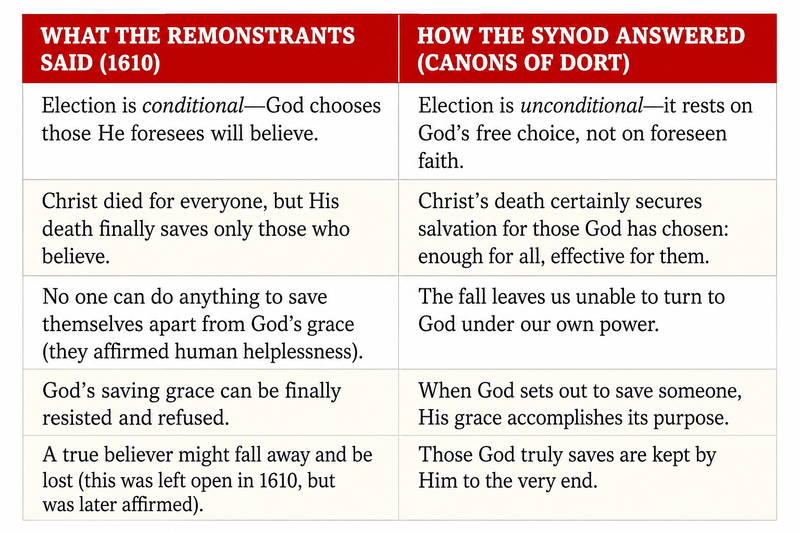
Note the third row. The Remonstrants openly affirmed we cannot save ourselves apart from God’s grace, so the common claim that “Arminians deny human sinfulness” is simply mistaken. The real dispute was never about whether we need grace, but about how that grace works.
Tough Questions, Honest Answers
Did the Synod of Dort invent the word TULIP?
No. The synod produced the Canons of Dort in 1619, but the TULIP acronym is English and only about a century old. It traces to a 1905 lecture by Cleland Boyd McAfee, first appeared in print in 1913, and was popularised by Loraine Boettner in 1932 and by David N Steele and Curtis C Thomas in 1963—nearly 300 years after the synod met.
When and where was the Synod of Dort held?
The Synod of Dort met in the Dutch city of Dordrecht from 13 November 1618 to May 1619, running for around 154 sessions over roughly six months. It was an international assembly, with delegates from Britain, the German territories and Switzerland joining the Dutch members.
Who were the Remonstrants, and what did they believe?
The Remonstrants were followers of theologian Jacobus Arminius. In 1610 they signed a five-point protest—a “remonstrance”—arguing for conditional election, a universal atonement, human helplessness apart from grace, resistible grace, and (at first tentatively) the possibility that a believer could fall away. Importantly, they affirmed human sinfulness; the claim that they denied it is a caricature.
What is the difference between the Canons of Dort and TULIP?
The Canons of Dort are the actual document the synod produced in 1619: five heads of doctrine (the third and fourth combined), each answering an Arminian article. TULIP is a much later English mnemonic that summarises those heads. The Canons are the source; TULIP is a memory aid—and it even reorders the points.
Was the Synod of Dort a fair hearing for the Arminians?
By modern standards, no. The Remonstrants were summoned as defendants rather than equal participants, and were expelled in January 1619 after disputes over procedure. The outcome also owed much to the political victory of Prince Maurice’s party. The Canons can be true and the process still open to criticism — both are worth saying.
Does “limited atonement” mean Christ’s death was not valuable enough for everyone?
No. The idea is better described as definite or particular redemption: Christ’s death is sufficient for all and effective for those it saves. The “limit” concerns whom it was intended to save, not its worth or power. The old summary runs: sufficient for all, efficient for the chosen.
What did the Synod of Dort accomplish besides challenging Arminianism?
A great deal. It commissioned the Statenvertaling, the first Dutch Bible translated from the original languages; ordered the teaching of the catechism at home, school and church; issued guidance on keeping Sunday; regulated the universities; revised the church’s order of government; and ruled on the baptism of servants’ and enslaved people’s children in the Dutch East Indies.
Related Reads
- The Calvinist–Arminian Debate: The Strongest Objections to Calvinism Answered
- Supra Vs Infra: What the ‘Lapsarian’ Debate’s All About
- For Whom Did Christ Die? The Biblical Case for Definite Atonement
- Prevenient Grace: 5 Reasons the Doctrine Fails
- Monergism vs Synergism: Is Salvation God’s Work Alone?
- Salvation: By Faith Alone or by Works? The Biblical Answer
- Romans 9 Calvinism and Arminianism: The Whole-Chapter Debate
- What Is Hyper-Calvinism—and Why Do Calvinists Reject It?
- What Is TULIP Calvinism? The Five Points Explained
- Did Jesus Teach Calvinism? John 6 and the Doctrines of Grace
- Belgic Confession: The Story Behind the 1561 Draft
- Does Colossians 1:20 Teach Universal Reconciliation?
- Free Will vs Free Agency: Is "Agency" the Better Word?
- Predestination: 4 Views Compared and Weighed by Scripture