A very long list of wrong answers
Almost every generation of Christians has been certain it had found the beast. Nero was the first candidate, and a reasonable one. Then came a long line of popes, then Napoleon, then Hitler and Stalin. Prophecy paperbacks in the 1970s kept a nervous eye even on Henry Kissinger and Mikhail Gorbachev. Others pointed at supermarket barcodes, credit cards, national identity numbers, microchips under the skin, vaccination certificates and, lately, digital money issued by central banks.
Every one of those identifications was announced with confidence. Every one has failed. And each failure quietly cost the church a little of its credibility with the world it’s trying to reach.
That record should make us careful. Revelation 13 is the word of God, written so ordinary Christians under real pressure can understand it. The difficulty has never been the text itself—but rather, the habit of reading Revelation as a coded news bulletin about the distant future.
What follows is the reading that has been the mainstream confessional Protestant interpretation for centuries—going by the plain sense of the passage, where we let Revelation define its own words.
What the chapter actually says
Revelation 13 introduces two beasts, and most confusion begins by running them together.
- The first rises out of the sea (Revelation 13:1-10). It has seven heads and ten horns, wears blasphemous titles, receives its authority from the dragon—identified in Chapter 12 as Satan. This beast makes war on God’s people for 42 months. This is political power: empire, government, the sword.
- The second rises out of the earth (Revelation 13:11-18). It has two horns like a lamb but speaks like a dragon, and performs wonders to persuade the world to worship the first beast. Later in Revelation, it is given a plainer name: the false prophet (16:13; 19:20). This second beast isn’t a rival government. It’s false religion and propaganda—much like the publicity department of an empire.
Notice the shape of it. The dragon, beast and false prophet form a counterfeit of the Father, Son and Holy Spirit, and the second beast does for the first exactly what the Spirit does for Christ: it glorifies another and gathers worshippers to him. John is showing us a forgery of the Trinity. That matters, because the mark will turn out to be a forgery too.
Then comes the passage in question:
Also it causes all, both small and great, both rich and poor, both free and slave, tobe marked on the right hand or the forehead, so that no one can buy or sell unless he has the mark, that is, the name of the beast or the number of its name. This calls for wisdom: let the one who has understanding calculate the number of the beast, for it is the number of a man, and his number is 666. (Revelation 13:16-18)
The word translated “mark” is the Greek charagma—not a mysterious word, but an everyday commercial and legal term whose ordinary uses tell us most of what we need to know.
What charagma meant to John’s earliest readers
- The imperial stamp pressed on legal and business documents, carrying the emperor’s name and regnal year.
- The brand burnt on a slave to show who owned him.
- The tattoo worn by a soldier or temple devotee to show whose he was.
- The image and inscription struck into a coin.
Every one of those uses says the same three things: ownership, loyalty, permission to trade. Hold those three words; they’re the whole passage in miniature.
The mark is a forgery of something else
Here’s the argument that settles the question, and it comes from Revelation itself.
Long before John mentions the mark of the beast, he has already described a mark of God. In Chapter 7 an angel is told to seal the servants of our God on their foreheads (Revelation 7:3), and in chapter 9 the locusts may not harm anyone who has the seal of God on their foreheads (Revelation 9:4). In Chapter 14, immediately after our passage, the redeemed appear with His name and His Father’s name written on their foreheads (Revelation 14:1). The book then closes with the promise that God’s servants will see His face, and His name will be on their foreheads (Revelation 22:4).
So Revelation shows us two marked populations, placed side by side on purpose: one bears the name of the Lamb, the other the name and number of the beast. Now apply the test. Nobody expects the seal of God to be physical; no Christian is waiting for an angel with ink. We all grasp what it means: God knows those who’re His, and He will keep them. But if the seal isn’t a physical object, the mark can’t be one either. The two are halves of one picture. Read one as a symbol and the other as an implant, and you have torn that picture down the middle. Commentator Gregory Beale states it plainly: the mark is a parody, a deliberate imitation of the seal, and must be read in the same manner as the thing it imitates.
The Old Testament backs this reading. “Hand” and “forehead” aren’t a random pair of body parts. They come from the law: You shall bind them as a sign on your hand, and they shall be as frontlets between your eyes (Deuteronomy 6:8; see also Exodus 13:9, 16). Nobody thought the command was about skin. The hand is what you do; the forehead is what you think and confess. Together they mean the whole person, outside and in.
So the mark is total allegiance to an anti-Christian order—in what you do with your hands and profess with your mind. This brings us to a conclusion many readers find surprising. And truly freeing.
The heart of the matter
The mark isn’t received. It’s rendered. It’s not something done to you against your will. It’s something you do—a loyalty given, a confession made, a line crossed.
Why the number 666?
Four lines of evidence converge, and they reinforce rather than compete with one another.
- 6 falls short of 7. In Scripture 7 is the number of completeness. 6 always just misses the mark. Three 6s is therefore not simply “very evil”; it’s failure repeated at every level. The beast is a permanent 666 straining to be 777. But he never quite arrives.
- It’s “the number of a man.” Verse 18 says so. In Hebrew and Greek, letters also served as numerals, so any name could be added up—a practice called gematria, which John’s readers would have recognised at once. Write “Nero Caesar” in Hebrew consonants and the letters total exactly 666.
- A strange variant reading confirms it. A few ancient manuscripts, including Papyrus 115 and Codex Ephraemi, read 616 instead. That looks like a problem until you see why: the Latin form of the emperor’s name drops a letter—Nero rather than Neron—and that spelling totals exactly 616 in Hebrew. Two spellings of one name, two totals, both preserved by the scribes. No other candidate in 2000 years of guessing accounts for that.
- Solomon’s gold. Now the weight of gold that came to Solomon in one year was 666 talents of gold (1 Kings 10:14). That sits at the hinge of his life, where wisdom and wealth begin to curdle into the very things Deuteronomy 17 warned a king against. The number already carried a warning in Israel’s memory.
So 666 isn’t a name tag on one individual. It’s a character sketch: human, impressive, religious. And always short, infinitely short, of God.
“Calculate” doesn’t mean “crack the code”
- Verse 18 says This calls for wisdom. We encounter the phrase once more, at Revelation 17:9, where it introduces an explanation John gives at once rather than a puzzle left hanging.
- The wisdom asked for is discernment: the ability to look at a magnificent political and religious order and see a beast. It’s not asking for arithmetic ingenuity.
The part most readers skip: buying and selling
The mark controls trade: no one can buy or sell unless he has the mark. Modern readers hear that and think of today’s banking technology. John’s readers would have thought of their working week.
In the cities of Asia Minor, commerce ran through trade guilds—associations of bakers, dyers, silversmiths, dockworkers—and membership was how you obtained supplies, contracts and customers. Guild life was also religious life: shared meals in a temple precinct, honours offered to the emperor. That’s exactly the pressure behind the letters earlier in the book, where believers at Pergamum and Thyatira were urged to eat food offered to idols (Revelation 2:14, 20). For most believers, refusing didn’t mean being killed. It meant losing their income.
Refusing rarely cost Christians their life. It cost them their trade. The machinery survives in the records. Around AD 112 Roman governor Pliny the Younger described to Emperor Trajan how he tested suspected Christians, releasing those who offered incense and cursed Christ. Under Emperor Decius, the empire issued certificates confirming the bearer had sacrificed—paperwork proving loyalty, without which ordinary life became impossible.
For most Christians in most centuries, the first cost of faithfulness hasn’t been the sword. It has been the invoice: the contract not renewed, the licence not granted, the promotion quietly given to someone else. That’s what the passage describes, and it is why it still describes us.
How each end-times view reads the mark
Christians differ about the mark not because they read the number differently, but because they read the whole book differently. The question underneath is whether Revelation gives us a timetable of future events or interprets the meaning of history.
| VIEW | WHAT THE MARK IS | WHAT IT TELLS YOU TO EXPECT |
|---|---|---|
| Amillennial (William Hendriksen, Anthony Hoekema, Gregory Beale, Vern Poythress, Kim Riddlebarger) | Allegiance to state power fused with false religion in every age, with Nero’s Rome as the model. | Recurring pressure through the church age, sharpening at the end. Economic exclusion of the faithful. No escape route for the church. |
| Postmillennial / partial preterist (Kenneth Gentry, Greg Bahnsen) | Nero and the imperial cult; 666 is his name in Hebrew letters. | Fulfilled in the first century. There’s nothing in future to dread; after all, this view expects the gospel to advance as history progresses |
| Historicist (the Reformers, the Puritans, Matthew Henry) | The papacy, and submission to its claimed authority over conscience. | A long unfolding across church history, ending in the collapse of the false church. |
| Historic premillennial (George Eldon Ladd, Robert Mounce, Wayne Grudem) | A personal antichrist is expected at the end, though the mark stays largely symbolic. | Real persecution is expected with the church present for it. Then a literal thousand-year reign will begin. |
| Dispensational premillennial (John Nelson Darby, CI Scofield, John Walvoord, Tim LaHaye) | A literal physical mark imposed by one future world ruler. | A rebuilt temple, a cashless global economy, technological signs—and no chance today’s Christians will face them, the church being removed first. |
| Full preterist (Max King, Don Preston) | Wholly fulfilled in AD 70 | Nothing at all. Confessional churches reject this, since it empties the promise of Christ’s bodily return. |
Two clarifications keep this honest. Our position isn’t “nothing is left to happen”: John writes many antichrists have come (1 John 2:18), and Paul expects a final outbreak of lawlessness before the end (2 Thessalonians 2:3-12). The pattern is perennial and escalating. And the date of the book is disputed—Irenaeus placed it about AD 95, others argue for the 60s—but the argument holds either way, since the legend that Nero would return from the dead was still circulating decades later. Nero is the archetype, not the headline.
What most readers expect without ever choosing to
Most Christians have never sat down and chosen a position on the millennium. They’ve simply absorbed one—through prophecy paperbacks, novels, conference charts and now short videos. Absorbed that way, it produces four expectations:
- The mark is a device—an implant, a tattoo, a barcode, a digital wallet.
- The antichrist is one identifiable man, probably alive now, probably somewhere in world governance.
- We will not be here for it, so the whole subject is a matter of curiosity rather than courage.
- You might be tricked into damnation, which turns Revelation 14:9-11 from a warning into a source of private dread.
None of those four is drawn from the text, and all four carry a cost. They train believers to read the news for clues, which makes us easy prey for conspiracy theories and poor witnesses when a theory dies. They leave us braced for the spectacular and unprepared for the ordinary shape the pressure takes—the quiet penalty for refusing to say what everyone else says. And they breed needless fear: pastors do meet people who believe they may already have taken the mark by accident.
Other views you may run into
It’s worth knowing how others read the chapter, if only to recognise the arguments.
- Roman Catholic interpretation today is broadly historical: the beast is the imperial cult, the mark first-century loyalty to Rome.
- Eastern Orthodox piety expects a personal antichrist and a genuine seal; the writings of Elder Paisios of Mount Athos shaped popular resistance to barcodes and identity cards in Greece.
- Seventh-day Adventist teaching makes the mark enforced Sunday worship, the seal of God Sabbath observance, and 666 a Latin papal title.
- Jehovah’s Witnesses identify the beast as the world political system, its image as the United Nations, and the mark as support for that system.
- Critical scholarship treats the book as first-century resistance writing with no future reference at all.
- Popular numerology supplies the rest: the barcode claim (mistaken, since the guard bars are not the digit six), the “www” theory, and an endless supply of names that add up if you try hard enough.
Nobody takes the mark by accident
If the mark is apostasy—open, chosen allegiance to a power demanding the worship owed to Christ—then two things follow at once.
- First, you cannot stumble into it. There’s no paperwork that damns a person who loves Christ, no scanner that can transfer a soul. The fear that asks “what if I took it without knowing?” mistakes the mark for magic, and Scripture never treats God’s judgement as a clerical accident.
- Second, those who belong to Christ are kept. The sealing of Chapter 7 comes before the marking of Chapter 13 for a reason. Our Lord said false christs would arise to lead astray, if possible, even the elect (Matthew 24:24)—words that quietly tell us it’s not possible.
So the passage doesn’t leave us scanning the horizon for barcodes. It leaves us a question we can answer today. When the cost of confessing Christ arrives in the ordinary currencies of a career, a reputation or a licence to trade, let’s draw comfort in remembering whose name is on our hands and foreheads. Revelation 13 was written to make faithful people brave, not nervous. Its warning is severe and its comfort greater: the beast has 42 months; the Lamb has the book of life.
Tough Questions, Honest Answers
Could someone who has taken the mark ever be forgiven?
Revelation 14:9-11 is fearful language, and it’s meant to be. But it describes the final condition of those who go on worshipping the beast to the end, not a category of living people whom the gospel can no longer reach. Scripture never turns away anyone who comes to Christ: whoever comes to me I will never cast out (John 6:37). Peter publicly denied his Lord and was restored to the ministry within weeks. If you’re troubled by this question, take that trouble as evidence rather than as accusation—the person who has genuinely given his heart to the beast isn’t lying awake worrying about it.
Is the beast a person or a system?
The choice is a little too tidy, and several modern commentators press this point helpfully. Vern Poythress observes Revelation’s symbols regularly work at more than one level at once, so the beast can be a recurring pattern of power which takes concrete personal form in particular rulers—Nero yesterday, others since. Gregory Beale makes a similar case: the beast is a corporate reality with individual heads. This is why John can say both that antichrist is coming and that many antichrists have come (1 John 2:18). Reading the beast as a system doesn’t require us to deny it may have a final and terrible human face.
Does it matter if 666 turns up in my phone number, my address or a receipt?
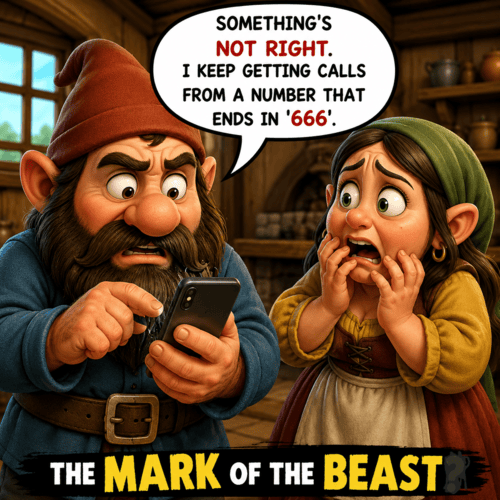
No, and it’s worth understanding why not. Ancient number-letter calculation worked on names written in Hebrew or Greek, where letters genuinely doubled as numerals; it has nothing to do with modern digits printed by a card machine. Biblical numbers are qualitative before they’re quantitative—they describe a character, not a serial code. The barcode story that circulated for decades wasn’t even factually right about barcodes. Anxiety over stray digits is precisely the fear that Revelation was written to cure, and giving in to it hands the beast a small victory for free.
Should Christians refuse biometric identity cards or digital payment systems?
These are matters of Christian prudence, not prophecy, and believers may reach different conclusions in good conscience. Paul teaches submission to civil government in ordinary matters (Romans 13:1-7), and a payment method is an ordinary matter. At the same time, there’s genuine wisdom in noticing any system able to include everyone is also able to exclude someone, and Revelation 13:17 tells us that power will one day be used against the church. So the Christian test isn’t the technology but the confession: we refuse at the point where using something requires us to say what we cannot say, or deny what we cannot deny. Treating a payment system as the fulfilment of prophecy, rather than as a possible instrument of pressure, is the mistake that keeps discrediting us.
Is the Westminster Confession’s statement that the pope is antichrist still binding?
The original 1646 text of the Confession, and the Baptist confession of 1689 which followed it, did identify the pope in those terms. The Reformers reasoned that way because they saw an office claiming Christ’s own prerogatives over the conscience. American Presbyterian revisions in 1788 and 1903 removed the clause, while some churches retain the original wording to this day. Honesty requires admitting the tradition is divided here, and that the historicist framework which produced the identification isn’t the framework most confessional exegetes now use. The Reformers’ real point still stands. Christ alone rules the conscience, and any power that claims that place for itself, whether religious or political, is behaving as Revelation 13 says the beast behaves.
What did the earliest Christians actually think 666 meant?
They were markedly more cautious than their modern successors. Writing around AD 180, Irenaeus knew of the 616 reading and rejected it as a scribal slip, then offered three possible names that add up to 666 while refusing to settle on any of them—remarking that it was safer to wait than to guess. Hippolytus and Victorinus of Pettau were similarly restrained. It’s a striking fact that the interpreters closest to John in time and language were the least confident about naming a candidate, and the most confident about what the number signified: a power that imitates God and falls short.
How do I help a family member who lives in fear of prophecy?
Don’t begin with charts, and don’t begin by winning the argument—fear is rarely dislodged by better chronology. Ask instead what exactly they’re afraid of, because the answer is usually specific and usually addressable. Then read the sealing passages together (Revelation 7:3; 14:1) alongside John 10:27-29, and let the two marks be seen side by side. It also helps enormously to change the reading diet, and to start Revelation where John starts it: with the throne room of Chapters 4 and 5, where the Lamb holds the scroll before any beast appears. Remember too the book opens by pronouncing a blessing on those who read it (Revelation 1:3), which isn’t how anyone would introduce a horror story.
Related Reads
- What Is Dispensational Premillennialism? A Biblical Assessment
- What Is Historic Premillennialism? A Biblical Assessment
- What Is Amillennialism? A Biblical Assessment
- What Is Postmillennialism? The Optimistic End-Times View Explained
- Antichrist Alert: The Bible’s Chilling Portrait of the End-Time Figure
- What is the Great Tribulation? Understanding Bible End-Time Prophecy
- Satan’s Final Defeat: Reformed Perspectives on Revelation 20
- Daniel’s 70 Weeks Prophecy: A Reformed Reading of Daniel 9
- Bible Mystery: Who Are the 144,000 Really?
- Letters to the 7 Churches: A Complete Guide
- Revelation and Daniel 7: Is Johnxe2x80x99s Vision the Sequel?