Ask a Christian what God the Father did to save them, and most will answer straight away: He planned it. Ask what God the Son did, and the answer comes even faster: He died for us and rose again. Ask what God the Holy Spirit did, and very often the room goes quiet.
That silence is a problem. Most believers have next to nothing at all to say about Him. Or we speak of Him only as a feeling, a power, or an atmosphere in a worship service. Theologian Frederick Dale Bruner once described Him as the shy member of the Trinity, always pointing away from Himself and towards Jesus. He is shy in that sense. But He isn’t small. Or optional.
Here’s the claim this article will make, and try to prove from Scripture: the Father planned our salvation, the Son purchased it, and the Holy Spirit applies it to us personally. Not one step of our salvation—from the very first stirring of interest in Christ to the raising of our body on the last day—happens without Him. Take the Spirit out, and nothing reaches us. The rescue would be complete in heaven. But lost and useless on earth.
| THE FATHER | THE SON | THE HOLY SPIRIT |
|---|---|---|
| Plans salvation. He chose a people before the world was made and sent his Son to save them. | Accomplishes salvation. He lived the obedient life we owe and died the death we deserve. | Applies salvation. He brings the finished work of Christ into an actual human heart. |
One God, three persons, one single rescue. The three are never in competition. But they’re never confused either, and the third person has real work to do.
First things first: He’s a “He”, not an “It”
Before we trace what the Spirit does, we have to settle what He is. A great deal of confused thinking comes from imagining the Spirit as a kind of holy electricity that God switches on.
Scripture won’t allow that. Look at what the Spirit is said to do:
- He speaks. In Acts 13:2 he says, “Set apart for me Barnabas and Saul.” Electricity does not speak.
- He can be grieved. Paul writes, “And do not grieve the Holy Spirit of God” (Ephesians 4:30). You cannot hurt the feelings of a force.
- He decides. He gives gifts “as he wills” (1 Corinthians 12:11). A power has no will of its own.
- He can be lied to, and that’s lying to God. Peter tells Ananias he has lied to the Holy Spirit, and then says plainly that he has lied to God (Acts 5:3-4).
So the Holy Spirit is a person, equal in nature and glory with the Father and the Son, and fully God. If He were a lesser being or an impersonal energy, the deepest work in our salvation would be done by something less than God. When the Spirit acts on our heart, it’s God Himself at work.
He worked in Christ before He ever worked in you
Most discussions of the Spirit start with our experience. That’s the wrong end of the rope. The Spirit’s saving work is first of all work done in and for Jesus. Only then does it reach us.
Follow the life of Christ: the Spirit is there at every turning point.
| MOMENT IN CHRIST’S LIFE | SCRIPTURE | WHAT THE SPIRIT DID |
|---|---|---|
| Conception | Luke 1:35 | Formed the human nature of Jesus in Mary’s womb, without sin. |
| Baptism | Matthew 3:16; Luke 4:18 | Descended on him and equipped him publicly for his ministry. |
| Ministry | Luke 4:14; Matthew 12:28 | Empowered his preaching and his casting out of demons. |
| The cross | Hebrews 9:14 | Sustained him as he offered himself to God without blemish. |
| Resurrection | Romans 1:4; 1 Timothy 3:16 | Raised him and declared him publicly to be the Son of God. |
| Pentecost | Acts 2:33 | Was poured out by the risen Christ on his people. |
Notice the last line especially. Peter says the ascended Jesus received the promised Spirit from the Father and poured Him out. So the Spirit who comes to you is the Spirit of the risen Christ. He doesn’t bring us a general religious experience. He brings us Jesus.
KEY TERM: UNION WITH CHRIST
This is the single most important idea in the whole article, so let’s make it plain.
“Union with Christ” means a Christian isn’t merely a person who has been given a set of benefits by Jesus. A Christian is a person who has been joined to Jesus Himself, so closely that the New Testament can say we died with Him, were raised with Him, and are seated with Him (Ephesians 2:5-6).
And who joins us to Him? The Holy Spirit. John Calvin, whom BB Warfield later called the theologian of the Holy Spirit, put it like this: the Spirit is the bond by which Christ effectively binds us to Himself.
This changes how we read everything below. The Spirit doesn’t hand out forgiveness from one counter and holiness from another. He gives us Christ. And every blessing comes to us in Christ. It’s a package deal.
Promised long before, poured out at last
The Spirit didn’t begin working in the New Testament. He hovered over the waters at creation (Genesis 1:2). He came upon judges, kings and prophets. David, terrified after his sin, begged God, “and take not your Holy Spirit from me” (Psalm 51:11). So the Spirit was certainly at work under the old covenant.
But there was a promise of something greater. Two passages carry it:
- Ezekiel 36:26-27. God promises, “And I will give you a new heart, and a new spirit I will put within you… And I will put my Spirit within you, and cause you to walk in my statutes.” Note the order carefully: God gives the new heart first, and obedience follows as the result.
- Joel 2:28-29. God promises to pour out His Spirit on all flesh, not merely on a few chosen leaders.
At Pentecost, Peter stands up and says this is that. The promise has landed. The difference between the old covenant and the new isn’t that the Spirit was absent before and present now. It’s a difference of measure, of permanence, and of scope. Before, He came upon particular people for particular tasks, and could depart. Now He indwells every believer permanently, young and old, male and female, from every nation on earth.
Why we could never have made the first move
Now we come to the part of the doctrine that people find hardest.
The Bible doesn’t describe unbelievers as basically healthy people who need better information. And some convincing. It describes them as spiritually dead (Ephesians 2:1), hostile to God and unable to submit to His law (Romans 8:7), and unable to receive spiritual truth:
“The natural person does not accept the things of the Spirit of God, for they are folly to him, and he is not able to understand them because they are spiritually discerned” (1 Corinthians 2:14).
That word “able” is the sticking point. The problem isn’t only that the sinner won’t come. It’s that He cannot, because He doesn’t want to and has no capacity to want to. Jesus says it directly:
“No one can come to me unless the Father who sent me draws him” (John 6:44).
So what breaks the deadlock? Two works of the Spirit, closely joined.
- Illumination. The Spirit opens the mind so the gospel, which seemed foolish or boring hitherto, is suddenly seen as true and beautiful. This isn’t new information added to the Bible. It’s new sight given to the reader. Think of a man looking at a masterpiece in a dark room; the Spirit doesn’t repaint the picture, He turns on the light.
- Effectual calling. Alongside the general invitation that goes out whenever the gospel is preached, the Spirit issues an inward call that actually achieves what it summons. Luke describes it in one short sentence about Lydia: the Lord opened her heart to pay attention to what Paul said (Acts 16:14). Paul did the preaching. God did the opening.
The Westminster Confession describes this beautifully in Chapter 10: God enlightens the mind, renews the will, and draws sinners to Christ, yet so that they come most freely, being made willing by His grace. Read that last part again. Nobody is dragged into the kingdom kicking and screaming. The Spirit changes what we want, so we come running.
A WORD ABOUT ORDER
The steps described in this article are set out in a logical order, not a timetable.
New birth, faith, and being declared right with God do not happen on Monday, Tuesday and Wednesday. They happen together, in an instant. We separate them here only so that you can see clearly what depends on what, in the same way a doctor might describe how a heartbeat works without suggesting that the chambers of your heart take turns over three days.
The new birth: the Spirit makes the dead live
“Regeneration” is simply the theological word for being born again. It is the moment God gives spiritual life to someone who had none.
Jesus explains it to Nicodemus, a respected religious teacher, in John 3. He does not tell him to try harder or study more. He tells him he must be born of water and the Spirit, and then adds this:
“The wind blows where it wishes, and you hear its sound, but you do not know where it comes from or where it goes. So it is with everyone who is born of the Spirit” (John 3:8).
Two things follow from that picture, and both matter.
- The Spirit is sovereign in it. You do not command the wind. You do not schedule it or produce it. It comes where it wills. In the same way, no preacher, parent or programme can manufacture the new birth in anyone.
- The Spirit is unmistakable in it. You cannot see the wind, but you can certainly see what it does. Nobody is born again invisibly and permanently without any change appearing.
Paul says the same thing without the picture: God saved us “by the washing of regeneration and renewal of the Holy Spirit” (Titus 3:5), and he says it immediately after ruling out anything we contributed. The Canons of Dort call regeneration a work no less powerful than creation itself, or the raising of the dead. That’s exactly the right comparison. What did the world contribute to its own creation? What did Lazarus contribute to his own resurrection?
This is why the older writers insisted new birth comes before faith, not after it. RC Sproul put it memorably: we don’t believe in order to be born again; we’re born again in order that we may believe. A dead man doesn’t decide to start breathing. He’s made alive, and then he breathes.
Even our faith is His gift
If the Spirit gives us life, what’s the very first thing that living heart does? It turns from sin and trusts Christ. That’s repentance and faith.
And here’s the point people often miss: those two responses are genuinely ours. They’re also gifts from God.
- Faith is a gift. “For by grace you have been saved through faith. And this is not your own doing; it is the gift of God” (Ephesians 2:8).
- Believing is granted. Paul tells the Philippians that it has been granted to them not only to believe in Christ but also to suffer for his sake (Philippians 1:29).
- Repentance is granted. When the church hears that Gentiles have been converted, they conclude that God has granted repentance that leads to life (Acts 11:18).
- Even confessing Christ is his work. “No one can say ‘Jesus is Lord’ except in the Holy Spirit” (1 Corinthians 12:3).
Does that make us robots? Not at all. When we trusted Christ we weren’t pushed. Or hypnotised or forced. We looked at Him and we wanted Him. That desire was real and it was ours. It simply wasn’t self-generated. The Spirit gave us the eyes, and then you looked.
This is where the doctrine turns out to be comforting rather than cold. If faith were finally our own achievement, our salvation would rest on the quality of our believing. And every weak day would be a reason to panic. If the Spirit gave it, the one who began it will sustain it.
Declared right, and welcomed home
Justification
“Justification” means God declares a guilty sinner righteous in His sight. It’s a legal declaration, like a verdict in a courtroom, not a process of gradually improving.
We must be very careful here. The ground of justification is entirely outside us: it’s the perfect obedience and sacrificial death of Christ, credited to our account. The Spirit adds nothing whatsoever to that ground. He doesn’t make us a little bit righteous so that God can then accept us.
What the Spirit does is give us the faith that receives what Christ has done. And yet Scripture does link Him to justification directly:
“But you were washed, you were sanctified, you were justified in the name of the Lord Jesus Christ and by the Spirit of our God” (1 Corinthians 6:11). The verdict is Christ’s achievement; the Spirit is the one who delivers it to us.
Adoption
Justification makes us legally innocent. Adoption makes us family. It’s possible to acquit a stranger in court and never see him again. God doesn’t stop at acquittal.
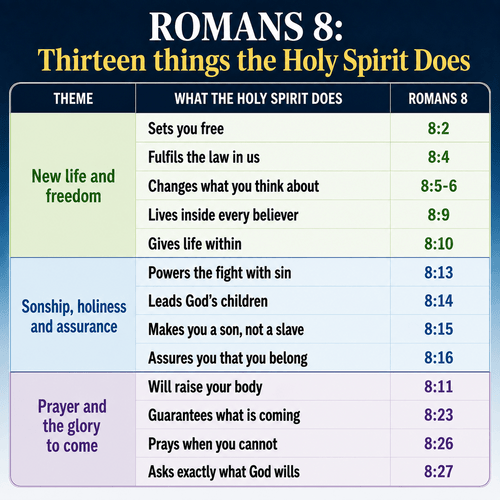
“For you did not receive the spirit of slavery to fall back into fear, but you have received the Spirit of adoption as sons, by whom we cry, ‘Abba! Father!’ The Spirit himself bears witness with our spirit that we are children of God” (Romans 8:15-16).
Two gifts are packed into those verses. The first is relationship: we may address the Almighty with the word a small child uses for his father. The second is assurance: the Spirit testifies alongside our own spirit that this is really true of us.
This answers a question many sincere Christians ask in the dark: how can I know I truly belong to Him? Part of the answer is objective, in the promises of Scripture. Part of it is this inner witness—not a mystical voice or a private revelation, but a settled, Spirit-given confidence that God really is my Father.
Made holy: the long, real work of change
“Sanctification” means being made holy: being progressively freed from sin and shaped to resemble Christ. Two things must be held together here, and the Bible speaks of both.
| DEFINITIVE SANCTIFICATION | PROGRESSIVE SANCTIFICATION | |
|---|---|---|
| What it means | At conversion we’re decisively set apart to God and cut off from sin’s rule. | Across our whole life we’re gradually changed to be more like Christ. |
| When | A completed past event. | An ongoing process until death. |
| Scripture | 1 Corinthians 6:11; Romans 6:2, 6 | 2 Corinthians 3:18; Romans 8:13 |
| Why it matters | You’re not trying to become a saint; you already are one, and must live like it. | You are not there yet; struggle is normal, not proof that you are unconverted. |
The Spirit drives both. Paul tells the Thessalonians God chose them “to be saved, through sanctification by the Spirit and belief in the truth” (2 Thessalonians 2:13). And he describes the goal in one of the most hope-filled sentences in the New Testament: we’re being transformed into the same image from one degree of glory to another, and this comes from the Lord who is the Spirit (2 Corinthians 3:18).
But notice how the Spirit works. He doesn’t do it around us, as though we were spectators. Romans 8:13 says that “by the Spirit you put to death the deeds of the body”—we do the putting to death, by His power. Galatians 5 says the same: walk by the Spirit, and you will not gratify the desires of the flesh. Walking is something we do with our own legs.
Philippians 2:12-13 holds the two sides together in a single breath: work out your own salvation with fear and trembling, for it is God who works in you. Not “so you have nothing to do”, but “therefore get to work, because the power is really there”.
TWO DITCHES ALONG THE ROAD
Christians fall off this road in opposite directions, and the Spirit’s work rules out both.
The first ditch is passivity. “Let go and let God” sounds humble, but Scripture never tells us to relax while the Spirit fights sin on our behalf. It tells us to fight, in His strength.
The second ditch is self-effort. Trying to change by sheer willpower and religious routine produces either pride or despair. Paul asks the Galatians whether, having begun by the Spirit, they’re now being perfected by the flesh. The answer is no.
Kevin DeYoung has named the modern version of the problem: the hole in much contemporary Christian teaching is holiness itself, which we’ve quietly stopped expecting God to produce in ordinary people. The Spirit produces exactly that, and Galatians 5:22-23 names the crop: love, joy, peace, patience, kindness, goodness, faithfulness, gentleness and self-control. Note the word is fruit, singular. It grows as one cluster, slowly, in season, the way fruit always does.
Sealed: why He will not lose us
Everything so far raises an obvious anxiety. If the Christian life is a real fight, and I really can fail, what stops me from falling away entirely?
Paul answers with two commercial pictures his readers would have known well.
- A seal. “In him you also, when you heard the word of truth… and believed in him, were sealed with the promised Holy Spirit” (Ephesians 1:13). In the ancient world a seal marked ownership and guaranteed that a document or a cargo would arrive untampered with.
- A deposit. The Spirit is called the guarantee of our inheritance (Ephesians 1:14; 2 Corinthians 1:22; 5:5). The Greek word describes a down payment: money handed over now which both proves the buyer is serious and commits him to paying the rest.
So the Spirit in us isn’t merely a helper for today. He’s God’s own pledge that He intends to finish. Our perseverance doesn’t finally rest on the strength of our grip on Christ, but on the strength of His grip on us, applied by the Spirit who lives inside us.
Raised: the Spirit finishes what He started
The last step of salvation isn’t the soul floating away. It’s the body coming out of the ground. And the same Spirit does that too.
“If the Spirit of him who raised Jesus from the dead dwells in you, he who raised Christ Jesus from the dead will also give life to your mortal bodies through his Spirit who dwells in you” (Romans 8:11).
Follow the logic. The Spirit raised Jesus. That same Spirit now lives in us. Therefore our resurrection isn’t a vague hope, but a settled consequence. Romans 8:23 calls the Spirit the firstfruits, the first ripe portion of a harvest that guarantees the rest of the field is coming.
And so the arc closes. The Spirit gave us life when we were spiritually dead; He will give us life when we’re physically dead. Richard Gaffin has spent much of his career pressing this point: the gift of the Spirit and the resurrection of Christ belong together. So that the Christian’s present experience is the beginning of the age to come, not merely a preparation for it.
The Spirit and the Bible aren’t rivals
One last safeguard, and it protects us from two opposite mistakes.
Some people want the Spirit without the Word. They look for fresh messages, impressions and experiences that go beyond Scripture, and they measure spiritual health by intensity of feeling. But the Spirit is the author of Scripture (2 Peter 1:21), and the sword He uses is the word of God (Ephesians 6:17). He doesn’t contradict what He himself wrote.
Others want the Word without the Spirit. They’re careful, orthodox and doctrinally precise, and yet cold. But right words on a page cannot raise the dead. Paul reminded the Thessalonians that his gospel came to them not only in word but also in power and in the Holy Spirit.
Michael Horton has argued the point at length: the Spirit works through the ordinary means of preaching, sacrament and prayer, rather than around them. JI Packer caught the balance in one image, calling the Spirit’s work a floodlight ministry—the lamp that stays hidden in the dark so the building in front of you can be seen. The Spirit glorifies Christ, not Himself (John 16:14). So if a claimed work of the Spirit leaves people fascinated with experiences rather than with Christ, something has gone wrong.
Usual wrong turns, briefly
It’s worth naming the main detours plainly, since each one quietly reduces the Spirit’s role.
| THE WRONG TURN | WHAT IT CLAIMS | THE PROBLEM WITH IT |
|---|---|---|
| Salvation is our decision | God offers, and the deciding vote is ours. | Makes the new birth depend on the dead man’s choice. But Jesus says we are born of the Spirit, not of the will of man (John 1:13). |
| Grace only makes salvation possible. It’s we who close the deal. | The Spirit gives everyone enough help to choose, and the rest is up to us. | Turns effectual calling into an offer that often fails. Scripture presents it as a summons that always achieves its purpose (Romans 8:30). |
| The Spirit’s work in us begins as a second blessing—after conversion | Real believers receive the Spirit’s baptism later, as a separate stage. | Paul says all believers were baptised in one Spirit into one body (1 Corinthians 12:13). Growth in the Spirit is real; a two-tier church is not. |
| We can attain sinless perfection, even in this life | The Spirit can free a believer from all sin in this life. | John says if we claim to be without sin we deceive ourselves (1 John 1:8). Sanctification is real but unfinished until glory. |
So what?
If all this is true, three things follow for the ordinary Christian.
- We must stop taking credit. Every good thing in our spiritual life, including our interest in reading a post such as this, traces back to a work we didn’t begin.
- We may stop despairing. The one who started this is God the Holy Spirit, and He doesn’t abandon unfinished work. Philippians 1:6 is a promise about Him.
- We must start asking. Jesus said the Father gives the Holy Spirit to those who ask Him (Luke 11:13). If the Spirit is the one who gives sight, life, faith and holiness, then the most sensible thing a Christian can do is ask for more of His work, and then go and use the ordinary means—Scripture, prayer, the gathered church—through which He has promised to give it.
The Spirit will not draw attention to Himself while He does it. He never has. He will simply keep making Christ look glorious to us, and keep making us look more like Christ, until the day He raises our body and the work is done.
Tough Questions, Honest Answers
Acts 7:51 says people “always resist the Holy Spirit”. Does that not disprove everything above?
It would, if that verse were describing the Spirit’s inward work of new birth. But Stephen is describing something different: the outward ministry of the prophets, and the message they carried. Israel heard the truth for centuries and pushed it away, exactly as their fathers had done. That kind of resistance is not only possible, it is the natural condition of every unconverted heart, and it happens every Sunday in churches around the world. The distinction Scripture requires us to draw is between this general call, which can be and constantly is refused, and the inward effectual call, which changes what a person wants so that they willingly come. Stephen’s hearers proved the first point by stoning him.
What’s blasphemy against the Holy Spirit, and could I have committed it?
Jesus warns of an unforgivable sin in Matthew 12:31-32, and he says it in a very specific setting: religious leaders were watching him cast out demons by the Spirit’s power and calling that work satanic. Blasphemy against the Spirit is therefore a settled, clear-eyed attribution of the Spirit’s work to the devil, by people who know better and harden themselves anyway. It is not swearing in anger, not a blasphemous thought that horrifies you, and not a season of doubt. The classic pastoral counsel here is sound: the very fact that you are frightened of having committed it is strong evidence that you have not, because that fear is itself a work of the Spirit in a heart that still cares. A hardened blasphemer does not lie awake worrying about it.
David prayed that God would not take his Holy Spirit from him. Can the Spirit leave a believer today?
David is praying under the old covenant, and he almost certainly has Saul in view, from whom the Spirit departed along with his office as king (1 Samuel 16:14). Under that covenant the Spirit came upon particular people for particular tasks, and could be withdrawn. The new covenant promise is different in kind. Jesus says the Spirit will be with us for ever (John 14:16), and Paul says believers are sealed with him until the day of redemption (Ephesians 4:30). A Christian can certainly grieve him, quench him, and go through long stretches where they feel nothing of his comfort. But the presence itself is not on loan, and losing the sense of him is not the same as losing him.
If every believer already has the Spirit, why does Paul command us to be filled with the Spirit?
Because indwelling and filling are two different things. Indwelling is permanent and universal among Christians: if anyone does not have the Spirit of Christ, he is not a Christian at all (Romans 8:9). Filling is repeated and varies. The command in Ephesians 5:18 is in a form that means “keep on being filled”, and in Acts the same people are filled more than once. The picture is not of receiving more of the Spirit, as though he came in portions, but of more of you coming under his control. That is why the command sits in a passage about singing, thankfulness and how you treat your family. Being filled shows up in ordinary relationships, not in exotic experiences.
If the Spirit alone gives new life, what is the point of evangelism and prayer for the lost?
God ordains the outcome and the means to that outcome together, and never sets them against each other. The Spirit normally works through the preaching of the gospel, which is why Paul asks how people can believe in someone they have never heard of (Romans 10:14). Far from making evangelism pointless, this doctrine is what makes it hopeful. If conversion depended on finding the right technique or the right emotional pressure, the burden would be crushing and the results would be manipulated. Because it depends on the Spirit, we can speak plainly, love people patiently, and leave the outcome with God. Charles Spurgeon, who believed all of this firmly, was one of the most energetic evangelists of his century, and he saw no tension at all.
How can I tell the difference between the Spirit’s leading and my own thoughts or feelings?
Start by noticing what Scripture actually promises. The Spirit is never said to give private information about which job to take or whom to marry; he is said to lead God’s children (Romans 8:14) in the specific sense of putting sin to death and producing Christlike character. So the reliable tests are not inward warmth but outward conformity. Does this impulse agree with Scripture? Does it make you more humble, more honest, more patient? Does it point you towards Christ rather than towards your own specialness? Wise Christians also test their sense of leading against the counsel of mature believers, because the Spirit works in the church and not merely in isolated individuals. Strong feelings are not proof of anything; obedience over time is.
What about infants who die, or people who cannot understand the gospel because of age or disability?
We should be careful here, because the Spirit is not bound to work only through conscious understanding. John the Baptist was filled with the Spirit before he was born (Luke 1:15), which is enough to show that regeneration does not require adult comprehension. Scripture does not give us a full doctrine on this question, so we should not pretend to more certainty than we have. What we can say is that salvation is never earned by intellectual capacity, that God has committed himself to being merciful, and that the judge of all the earth will do right (Genesis 18:25). Faithful pastors have generally held out real hope for the children of believers who die in infancy, on the basis of God’s covenant promises to families, while leaving the wider question in God’s hands rather than in ours.
Related Reads
- The Holy Spirit’s Indwelling: How Can I Be Sure I Have It?
- Is the Holy Spirit a Person or Just a Power? What the Bible Actually Says
- Regeneration or Faith? Which Comes First in Salvation?
- Assurance of Salvation: How Can I Know I’m Truly Saved?
- Salvation: By Faith Alone or by Works? The Biblical Answer
- Unconditional Election: Why God’s Choice Is Entirely His Own
- Irresistible Grace: How God’s Call Actually Works
- Ephesians 5:18: What Does It Mean to Be Filled with the Spirit?