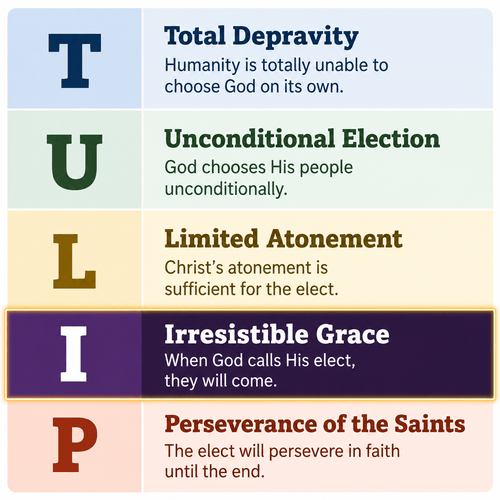
IThis post is part of our five-part series on the Doctrines of Grace—the biblical teachings known by the acronym TULIP. The name “Doctrines of Grace” reflects the Reformed conviction that every one of the five points answers the same question from a different angle: whose doing is salvation? Total Depravity shows why we cannot save ourselves. Unconditional Election shows us God’s choice rests on His grace, not our merit. Limited Atonement shows Christ’s death actually secured our redemption. Irresistible Grace shows us God’s call overcomes our resistance. Perseverance of the Saints shows us God keeps us to the end. Together, the five make the case that salvation belongs to God—from first to last.
The name “irresistible grace” has probably done more damage to the doctrine than any critic ever could. It conjures images of God overriding human choice—a divine force that bulldozes through the will and compels faith whether the person wants it or not. That picture is wrong, and the Reformed tradition has always known it is wrong. Irresistible grace does not mean God coerces anyone into believing. It means He changes what people want. This post explains what irresistible grace actually teaches, why it is deeply biblical, and why it is one of the most pastorally powerful doctrines in Scripture.
What Is Irresistible Grace?
Irresistible grace—sometimes called “effectual calling”—is the teaching that when God calls His chosen people to salvation, that call always achieves its goal. It does not merely offer salvation and wait to see who responds. It accomplishes what it sets out to do: it brings spiritually dead sinners to life, and they come willingly.
The distinction that unlocks the whole doctrine is between two kinds of divine call. Scripture distinguishes between the general call—the outward invitation of the gospel broadcast to all who hear it—and the effectual call—an inner work of the Holy Spirit that accompanies the gospel in the hearts of God’s elect and unfailingly produces regeneration and faith. The general call can be, and often is, rejected. The effectual call cannot ultimately be resisted, because it changes the very will that would otherwise resist.
Put simply: God does not drag His people to Himself against their wills. He changes their wills so they come willingly. Even gladly.
The Biblical Case for Irresistible Grace
- Ezekiel 36:26–27 — A New Heart: The most vivid Old Testament promise of the effectual call comes through Ezekiel. “I will give you a new heart, and a new spirit I will put within you. And I will remove the heart of stone from your flesh and give you a heart of flesh. And I will put my Spirit within you, and cause you to walk in my statutes and be careful to obey my rules.” Notice the grammar. There is no “if” here—no condition the people must meet first. God says “I will” five times in two verses. He will give the new heart. He will remove the heart of stone. He will put his Spirit within them. He will cause them to walk in his statutes. This is a promise of monergistic transformation: God acting to produce a people who will walk with him. The result—obedience and love—follows the inner transformation rather than preceding it.
- John 6:44 — The Drawing of the Father: Jesus makes the same point in His bread-of-life discourse: “No one can come to me unless the Father who sent me draws him.” . The word translated “draws”—helkō in Greek—is not a gentle wooing. It is used elsewhere in the New Testament for physically hauling in a fishing net (John 21:6) and for dragging a man before a magistrate (Acts 16:19). The Father’s drawing is effective, not merely invitational. Jesus reinforces this earlier in the same passage: “All that the Father gives me will come to me.” (v. 37) All of them—not some, not most—come.
- Acts 16:14 — Lydia’s Heart Opened: Luke records the conversion of Lydia—the first recorded European convert—in a single sentence that says everything: “The Lord opened her heart to pay attention to what was said by Paul.” Paul preached. But it was the Lord who opened the heart. The preaching was the external, general call; the opening of the heart was the internal, effectual work of the Spirit. This is the consistent pattern across the book of Acts—God goes before the preacher and does what the preacher cannot do.
- 1 Corinthians 1:23–24 — To Those Who Are Called: Paul writes that the preaching of the cross is “a stumbling block to Jews and folly to Gentiles, but to those who are called, both Jews and Greeks, Christ the power of God and the wisdom of God.” The gospel is preached to all, yet the same message lands very differently on different hearers. To many it is foolishness. To “those who are called” it is power and wisdom. Paul’s explanation is not that the called are wiser or more spiritually open-minded—he has spent the previous verses demolishing exactly that idea. The difference is in the calling itself. Those who are effectually called receive the gospel not as nonsense but as the very power of God.
- Romans 8:30 — The Golden Chain: Paul’s sequence in Romans 8 leaves no gaps: “And those whom he predestined he also called, and those whom he called he also justified, and those whom he justified he also glorified.” Every person predestined is called. Every person called is justified. Every person justified is glorified. There is no attrition. The calling here is not a general offer extended and declined by many—it is the effectual call that produces faith and justification with certainty.
What “Irresistible” Does and Does Not Mean
This is the doctrine’s most misunderstood corner, and it deserves careful treatment.
What it does not mean:
Irresistible grace does not mean no one ever resists God’s general call. The Bible is full of people who do. Stephen says to the Sanhedrin: “You stiff-necked people, uncircumcised in heart and ears, you always resist the Holy Spirit.” (Acts 7:51) People resist God’s outward call constantly. That is the human condition under total depravity.
Irresistible grace does not mean God forces someone to believe against their inclinations. It does not mean a person sits there wanting nothing to do with God, and God jams faith in anyway. That would not be salvation—it would be coercion. It is not what Reformed theology teaches, and it is not what the Bible describes.
What it does mean:
Irresistible grace means that when God decides to save a person, He does not stop at the outward proclamation. He works inwardly by the Holy Spirit to change the very inclinations of the heart. The person who was spiritually dead and wholly indisposed towards God is made alive, given new desires, and comes freely and willingly to Christ.
Jonathan Edwards made this point in his treatise, Freedom of the Will. True freedom, Edwards argued, is not the abstract ability to choose against our nature—it is acting in accordance with our deepest desires. God does not override the will; He transforms it. The converted sinner does not come to Christ reluctantly, wishing they could have stayed away. They come with joy, because God has given them a heart that now finds Christ beautiful. The miracle is not that God overpowers the will but that He renews it.
This is why “effectual calling” is a more precise name for the doctrine than “irresistible grace.” It describes what actually happens rather than suggesting divine arm-twisting.
Regeneration Precedes Faith
One implication of effectual calling is particularly important and frequently misunderstood: regeneration logically precedes faith rather than following it. We do not believe and then receive the new birth; we are born again and therefore believe.
This runs against the grain of much popular evangelicalism, which tends to picture conversion as: hear the gospel → decide to believe → receive the Spirit. The Reformed order is: hear the gospel → Spirit works inwardly → new heart believes.
The reason this order matters is grounded in total depravity. If we are truly spiritually dead—unable to respond to God on our own—then faith cannot be the first thing. Dead people do not generate spiritual life. Something must happen to us before we can respond. That something is regeneration: a creative act of God that gives us the capacity to believe in the first place.
Jesus describes exactly this to Nicodemus: “Unless one is born of water and the Spirit, he cannot enter the kingdom of God. That which is born of the flesh is flesh, and that which is born of the Spirit is spirit.” (John 3:5–6) The new birth is not something Nicodemus produces—it is something done to him by a Spirit that “blows where it wishes.” (v. 8) You no more choose your spiritual birth than you chose your physical one.
Irresistible Grace and Human Responsibility
If God’s call is effectual and certain, are we genuinely responsible for how we respond to the gospel? Reformed theology answers yes, and holds both truths without dissolving either.
The general call of the gospel is a genuine, sincere offer to every person who hears it. When a preacher says “Come to Christ,” that is not a performance or a hollow formality—it is a real invitation, and hearers are genuinely responsible for how they respond. Those who reject it bear real culpability for that rejection.
What irresistible grace adds is that no one responds rightly to the gospel without God’s inward work. Human responsibility is real; human ability, apart from grace, is absent. The difference between a person who comes to faith and a person who does not is not that the believer was wiser or more spiritually perceptive. The difference is grace—and the absence of pride in the believer is the natural result of understanding this.
Paul keeps both truths in tension throughout his letters. He urges, pleads, and argues with people to believe, treating their response as genuinely up to them. He also attributes every conversion ultimately to God. Scripture does not dissolve this tension for us so much as insist we hold it.
The Comfort of Effectual Calling
Like unconditional election, irresistible grace is often perceived as cold and abstract. In pastoral practice it is the opposite.
Consider the person who has prayed for years for an unbelieving spouse, child, or close friend. If conversion depends finally on the unaided choice of a spiritually dead human will, then prayer for the unconverted is close to hollow—you are asking God to do something that rests entirely outside his control. But if God can open hearts—if he can take out a heart of stone and put in a heart of flesh—then prayer for the lost is the most powerful thing you can do. You are appealing to a God who actually can do what you are asking.
Consider the believer looking back on their own conversion. If you came to Christ, it is because God came to you first. Your faith is not your contribution to your salvation—it is the first fruit of God’s saving work in you. That eliminates all grounds for pride and replaces them with overwhelming gratitude.
Augustine captured it long before the Reformation: “Thou madest us for Thyself, and our heart is restless, until it repose in Thee.” The effectual call is not a violation of the self—it is the restoration of the self to the relationship it was made for.
Tough Questions, Honest Answers
Is irresistible grace the same as coercion?
No. Coercion means forcing someone to act against their will. Irresistible grace means God changes the will itself. The person who comes to Christ under the effectual call is not gritting their teeth and coming against their wishes—they are coming with joy, because the Spirit has transformed their desires. The man who was blind to the beauty of Christ has his eyes opened; he then sees and believes freely. Calling this coercion is like calling surgery violence because the patient was unconscious when it happened.
What about people who resist the gospel their whole lives?
They resist the outward, general call—and Scripture is clear that this resistance is real and culpable (Acts 7:51; Matthew 23:37). What they never receive is the effectual, inward call of the Spirit. The Reformed tradition does not teach that God tries to convert everyone and that some manage to hold out against him indefinitely. It teaches that God’s effectual call is given to his elect and always achieves its purpose; others hear the outward call and reject it, and bear responsibility for that rejection.
Doesn’t this make God responsible for people going to hell?
No. God does not send anyone to hell who does not deserve to go. The reprobate are not condemned for failing to respond to a call they were never given the ability to answer—they are condemned for their own sin, which is genuine and culpable. The miracle is not damnation; that is what justice looks like. The miracle is salvation—that God would rescue any from the condition we all deserved.
How can I know if God has called me effectually?
Through the evidence of genuine faith and repentance. If you have turned from sin and placed your trust in Christ, that is the very response the effectual call produces. You need not peer behind a heavenly curtain to check your name. The Westminster Confession puts it directly: “This certainty is not a bare conjectural and probable persuasion grounded upon a fallible hope; but an infallible assurance of faith founded upon the divine truth of the promises of salvation.” Living faith in Christ is the evidence. You do not need anything more.
If grace is irresistible, why does the Bible command us to believe?
Because commands address responsibility, not ability. When Paul tells the Philippians to “work out your own salvation with fear and trembling” (Philippians 2:12), he is not implying they can do this unaided—the very next verse gives the reason: “for it is God who works in you, both to will and to work for his good pleasure.” (v. 13) The command is genuine; the response is real; and God is working in and through both. The fact that God must enable obedience does not make the command hollow—it makes the resulting obedience certain. Scripture never resolves this tension into a tidy formula; it simply insists that both God’s sovereignty and human responsibility are real.
What is the difference between the general call and the effectual call?
The general call is the outward proclamation of the gospel—the preacher on Sunday, the tract on the doorstep, the friend sharing their faith over coffee. It goes out to everyone who hears, it is a sincere offer, and it can be, and often is, rejected. The effectual call is something the Holy Spirit does inwardly, accompanying the outward word in the hearts of God’s elect. It does not bypass the general call—it works through it—but it adds an internal illumination and drawing that the general call alone cannot produce. Every person who is saved hears both calls. Many who hear the general call never receive the effectual call. No one who receives the effectual call fails to come.
Does irresistible grace mean my faith is not really mine?
The general call is the outward proclamation of the gospel—the preacher on Sunday, the tract on the doorstep, the friend sharing their faith over coffee. It goes out to everyone who hears, it is a sincere offer, and it can be, and often is, rejected. The effectual call is something the Holy Spirit does inwardly, accompanying the outward word in the hearts of God’s elect. It does not bypass the general call—it works through it—but it adds an internal illumination and drawing that the general call alone cannot produce. Every person who is saved hears both calls. Many who hear the general call never receive the effectual call. No one who receives the effectual call fails to come.
Related Posts