For a long time, Nineveh has been a problem. The Bible mentions the city often. As the capital of Assyria, the empire that swallowed the northern kingdom of Israel; as the city Jonah is sent to. It’s also the city Nahum said God would wipe off the map. But outside the Bible, there was no trace of the city. No ruins anyone could point to. No name on a map. For centuries, a person could reasonably ask whether this famous city ever existed at all.
Then the diggers arrived.
Between 2022 and 2026, archaeologists working at Nineveh—today part of the Iraqi city of Mosul—have pulled a remarkable series of finds out of the ground. A 12-tonne carved wall panel showing an Assyrian king standing between his gods. A burnt layer of ash, arrowheads and human bones at one of the city gates. A two-metre stone monument, discovered in June 2026, whose inscription has not yet been fully read. Nineveh archaeology is now having its most productive decade in over a century.
So what does all this mean for the Bible?
A city the world forgot. But the Bible didn’t
In 401 BC, a Greek soldier named Xenophon marched his army along the Tigris River. He passed a huge deserted wall. He wrote about it in his memoirs. He had no idea he was walking past Nineveh. The city had been dead for barely 200 years. And already, nobody remembered the name.
That isn’t normal. Great cities usually leave a shadow. Nineveh left a blank. Assyrian buildings were made mostly of mud brick, which melts back into mud when the roofs go. What was left was a grassy hill that looked like any other hill in northern Iraq.
The blank lasted until the 1840s. A French diplomat, Paul-Émile Botta, began digging at a mound called Khorsabad in 1843. An English traveller, Austen Henry Layard, started digging near Mosul in 1845 and moved to the mound of Kuyunjik in 1847. His Iraqi assistant, Hormuzd Rassam, later took over and made some of the greatest finds of all. Slowly, palace by palace and inscription by inscription, the lost capital came back.
One detail from those early years is worth pausing on, because it teaches us how to think about all the rest.
Isaiah 20:1 mentions an Assyrian king called Sargon. For a long time, no other ancient source knew of any such king. Critics even cited this as a textbook example of biblical error: the prophet had invented a monarch. Then Botta dug at Khorsabad and found the man’s palace, covered in his own inscriptions. Sargon II was real, powerful, and exactly where the Bible had placed him.
What the diggers found in 2025 and 2026
Nineveh was closed for years. War, then the occupation of Mosul by the group calling itself Islamic State between 2014 and 2017, put the site out of reach. When the archaeologists came back, they found both terrible damage and unexpected treasure.
Here’s the story of the digs in one table.
| DATE | WHAT CAME OUT OF THE GROUND | WHY IT MATTERS FOR THE BIBLE |
|---|---|---|
| 1830 | The Taylor Prism: a six-sided clay cylinder covered in cuneiform, recording the campaigns of King Sennacherib. | Contains Sennacherib’s own account of his attack on Judah and King Hezekiah. Compare 2 Kings 18–19. |
| 1843 | The palace of Sargon II at Khorsabad, found by Paul-Émile Botta. | Confirms a king named only in Isaiah 20:1 and previously dismissed as invented. |
| 1847–53 | Nineveh identified and excavated by Austen Henry Layard and Hormuzd Rassam: the South West Palace, the North Palace, and a library of over 20,000 clay tablets. | Proves the city existed, and gives us Assyrian records of the same period the Bible describes. |
| 1849–51 | The Lachish reliefs: carved panels showing the Assyrian siege of a Judean city. | A picture of the events behind 2 Kings 18:14 and 2 Chronicles 32:9, drawn by the attackers themselves. |
| 2016 | Islamic State bulldozed the Mashki Gate and the Adad Gate and destroyed objects in the Mosul Museum. | A modern act of destruction that, strangely, led directly to new discoveries. |
| 2022 | 7 marble reliefs of Sennacherib, buried under the floor of the Mashki Gate. Found by Iraqi archaeologists with the Penn Museum team led by Michael Danti. | Fresh, undamaged pictures of Assyrian soldiers, siege camps and prisoners being deported. |
| May 2025 | A relief 5.5 metres long, 3 metres high and about 12 tonnes, showing King Ashurbanipal between the gods Ashur and Ishtar. Found in the North Palace throne room by the Heidelberg team under Aaron Schmitt and Stefan Maul. | The clearest picture we have of what Assyrian kings believed about their gods—the very belief Scripture challenges. |
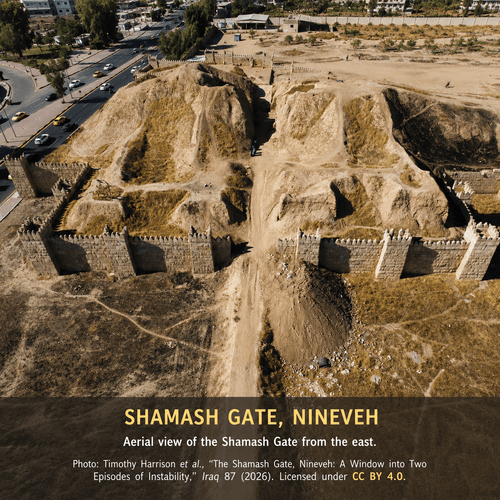
| April 2026 | A published report in the journal Iraq by Timothy Harrison, Nicolò Marchetti and colleagues on the Shamash Gate: a burnt destruction layer from 612 BC. | Physical remains of the night Nineveh fell—the event Nahum and Zephaniah announced in advance. |
| June 2026 | A stele about 2 metres tall and 1.55 metres wide, carved from Mosul marble, showing Ashurbanipal, with cuneiform on the back. Found at the Shamash Gate by a joint Iraqi–American mission working under the University of Chicago. | A brand-new royal inscription. Its full text has not yet been published. |
The Mashki Gate, 2022
The Mashki Gate was one of the great gates in Nineveh’s 12 kilometres of city wall. Islamic State bulldozed it in 2016. When archaeologists came to rebuild it, they dug below the floor and found something nobody expected: beautifully carved marble panels from the time of Sennacherib, showing archers drawing their bows, fortified army camps, prisoners being led away, and vines and palm trees.
The panels had been cut down and reused as ordinary building material when the gate was repaired in ancient times. That’s why they survived. Buried face-down under a floor, they escaped the sack of 612 BC and they escaped the bulldozers of 2016. Michael Danti, who directed the American side of the work, said nobody had predicted finding Sennacherib reliefs inside a city gate.
The North Palace relief, May 2025
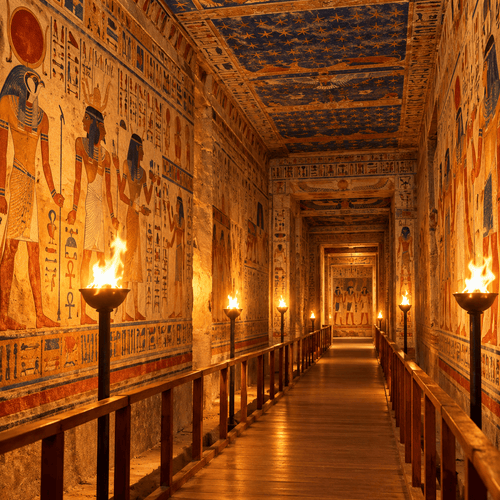
A team from Heidelberg University has been digging in the heart of Ashurbanipal’s North Palace since 2022. In 2025 they announced the recovery of an enormous carved slab from the throne room. In the centre stands the king. On one side is Ashur, the national god of Assyria. On the other is Ishtar, the goddess said to protect Nineveh. Behind them are protective spirits, including a figure half-man and half-fish. A great winged sun disc probably crowned the whole scene.
Aaron Schmitt, who leads the excavation, pointed out what makes this unique. Among all the Assyrian palace reliefs we know, none shows the great gods themselves. This one does. It stood in a niche directly facing the entrance to the throne room—the single most important wall in the empire.
It was found smashed and buried in a pit, probably dug in the third or second century BC. That is why the Victorian excavators never found it.
The Shamash Gate, 2026
Two separate things happened here, and it is worth keeping them apart.
- The excavation report. Timothy Harrison and his colleagues dug at the Shamash Gate across three seasons from 2021 to 2023 and published their results in 2026. In the central passage of the gate they found a layer of destruction from the late seventh century BC: bronze and iron arrowheads, human bones lying where they fell, collapsed masonry, pockets of ash and charcoal, and 196 fragments of a large limestone stele of Ashurbanipal that had been deliberately smashed and burnt.
- The new stele. Separately, on 6 June 2026, a joint Iraqi–American mission clearing rubble at the same gate found a much better preserved monument: about two metres tall, carved from Mosul marble, with a high relief of Ashurbanipal on the front and two smaller royal figures plus a long cuneiform inscription on the back. Early readings suggest it records building works the king carried out at Nineveh and across the empire. The announcement came on 24 June 2026. The full translation is still awaited.
A strange mercy
Islamic State destroyed the Mashki Gate, wrecked the Mosul Museum, and dug tunnels through the mound at Nebi Yunus and beneath the Shamash Gate.
Yet the bulldozing of the Mashki Gate is what led archaeologists to dig below its floor, where the Sennacherib reliefs lay hidden. The tunnels under Nebi Yunus exposed an Assyrian palace nobody had reached.
None of this excuses the destruction. But it is a reminder of something Joseph told his brothers: men mean evil, and God means it for good (Genesis 50:20). God is not at the mercy of vandals.
Nahum’s words, read against the ashes
The book of Nahum is short, fierce, and almost entirely about one subject: the coming end of Nineveh. Nahum wrote while Assyria still looked invincible. Nineveh at that point was probably the largest city on earth, protected by 12 kilometres of wall and around 15 to 18 gates.
Yet the city fell in 612 BC to a coalition of Babylonians, Medes and Scythians. The Shamash Gate report gives us, for the first time in detail, a close-up of that collapse. Set the two side by side.
| WHAT SCRIPTURE PREDICTED (ESV) | WHAT THE EXCAVATIONS FOUND |
|---|---|
| There will the fire devour you (Nahum 3:15); fire has devoured your bars (Nahum 3:13). | Pockets of ash and charcoal through the destruction layer at the Shamash Gate. The North Palace itself burned after 612 BC. Burning is written into the stratigraphy. |
| The gates of your land are wide open to your enemies (Nahum 3:13). | The destruction deposit lies in the central passageway of a city gate. The fighting reached the gate, and the gate didn’t hold. |
| Hosts of slain, heaps of corpses, dead bodies without end (Nahum 3:3). | Human remains, no longer laid out as burials but scattered and disturbed, mixed with bronze and iron arrowheads and collapsed stone. |
| I will cut off the carved image and the metal image from the house of your gods. I will make your grave, for you are vile (Nahum 1:14). | A royal stele of Ashurbanipal broken into 196 pieces and burnt, lay in the rubble. The 12-tonne throne-room relief of the king with his gods was also smashed and buried. |
| He will make Nineveh a desolation, a dry waste like the desert (Zephaniah 2:13). | The city was never rebuilt as a capital. Within two centuries even its name was forgotten, until the 1840s. |
We must be careful here, and not overstate our case. A layer of ash proves Nineveh burned. It doesn’t, on its own, prove Nahum was inspired. What it does prove is that Nahum was describing a real city, in real terms, and the thing he said would happen is exactly the thing that did happen.
One detail deserves a note of caution. Nahum 2:6 says the river gates are opened, the palace melts away. Some writers claim the archaeology proves that a flood broke Nineveh’s walls. That story comes mainly from Greek writer Diodorus Siculus, writing centuries later, and the evidence on the ground is disputed. We shouldn’t lean on it. There’s more than enough that’s solid without it.
Sennacherib in his own words
The most famous overlap between Assyrian records and the Bible concerns King Sennacherib, who ruled from 705 to 681 BC and made Nineveh his capital.
In 701 BC he invaded Judah. The Bible tells the story in 2 Kings 18–19, Isaiah 36–37 and 2 Chronicles 32. He captured the fortified towns of Judah, demanded a heavy tribute from King Hezekiah, and besieged Jerusalem. Then, the Bible says, the angel of the LORD struck the Assyrian camp, and Sennacherib withdrew and went home.
Sennacherib left his own account, carved on clay prisms recovered from Nineveh. He lists 46 fortified Judean cities taken. He boasts he shut Hezekiah up in Jerusalem like a bird in a cage. He lists the tribute in detail.
Now notice what he doesn’t say.
- He didn’t claim to have captured Jerusalem. For a king who catalogued his conquests obsessively, this is loud silence. He besieged the city, caged the king—and then the story simply stops.
- He didn’t claim to have killed or replaced Hezekiah. Assyrian practice was to remove rebel kings. Hezekiah stayed on his throne.
- He says nothing about how the campaign ended. Assyrian royal records don’t record defeats. They’re propaganda, and behave like propaganda.
Meanwhile the Bible records something else the Assyrians would never have advertised. Sennacherib went home to Nineveh and was murdered by 2 of his own sons while worshipping in the temple of his god (2 Kings 19:37; Isaiah 37:38). Babylonian and Assyrian sources independently confirm Sennacherib was assassinated by a son, and that Esarhaddon took the throne after a struggle.
Put simply: on every point where the two accounts can be checked against each other, they fit. Where they differ, the difference is exactly the kind you’d expect between honest history and official propaganda.
The gods who couldn’t save
This is where the 2025 relief becomes more than an art discovery.
When Sennacherib’s officer stood outside Jerusalem’s wall and shouted at the people, his argument was theological. Has any of the gods of the nations ever delivered his land out of the hand of the king of Assyria? (2 Kings 18:33). He listed conquered cities and their useless gods, and then made his real point: the God of Israel would be no different.
Hezekiah took that taunt into the temple and spread it before the LORD. His prayer names the issue precisely. The gods of the nations were no gods, but the work of men’s hands, wood and stone (2 Kings 19:18). Therefore they were destroyed. Therefore save us, he prays, that all the kingdoms of the earth may know that you, O LORD, are God alone (2 Kings 19:19).
For a long time that Assyrian taunt was only a text on a page in the Bible. Now we can see it. A 12-tonne wall of stone, facing the throne room, showing the king standing shoulder to shoulder with Ashur and Ishtar, guarded by spirits, crowned by a winged sun. This is the empire preaching its own sermon: our king is beloved of the gods.
And the archaeologists found that sermon in pieces, in a pit, under a burnt palace, in a city nobody could name for 2000 years.
Jonah’s Nineveh: the mercy that came first
Long before Nahum, another prophet was sent to this city. He hated the assignment. Jonah didn’t shirk the task because it was dangerous. He ran because he was afraid God would forgive them. I knew that you are a gracious God and merciful, slow to anger and abounding in steadfast love, and relenting from disaster (Jonah 4:2).
Two questions come up constantly about Jonah’s Nineveh, and both deserve straight answers.
Was Nineveh really that big?
Jonah 3:3 calls it an exceedingly great city, three days’ journey in breadth. The walled city was about 12 kilometres around—walkable in a day. So what does three days mean?
Two reasonable answers. First, the phrase may cover greater Nineveh: the capital plus the ring of towns and countryside it administered, which is how ancient writers often spoke of major cities. Second, a three days’ journey may describe the visit rather than the distance—the customary length of an official mission, one day to arrive, one to do business, one to depart. Neither answer requires us to bend the text.
And the 120,000?
God ends the book by speaking of 120,000 persons who do not know their right hand from their left (Jonah 4:11). Some take this as young children, which would imply a total population of several hundred thousand across the wider district—large, but not impossible for the capital of the ancient world’s greatest empire. Others take it as a description of moral ignorance, meaning the whole population. Either reading holds together.
Why no Assyrian record of the repentance?
There’s no Assyrian text describing a king of Nineveh in sackcloth. People sometimes present this as a fatal problem. It simply is not. Assyrian royal inscriptions exist to glorify the king, not record humiliation. We’ve already seen Sennacherib edited out his own failure at Jerusalem. An empire that edits out its military defeats isn’t going to publish its national day of repentance before a foreign prophet’s God.
There’s one more reason a Christian cannot treat Jonah’s Nineveh as a fable. Jesus didn’t. The men of Nineveh will rise up at the judgement with this generation and condemn it, for they repented at the preaching of Jonah, and behold, something greater than Jonah is here (Matthew 12:41). Our Lord speaks of them as real people who will stand at the last day. He also uses Jonah’s three days as the sign of his own burial and resurrection. If Nineveh is a story, Christ’s argument collapses.
What archaeology cannot do
The Bible isn’t true because a spade agrees with it. Its authority doesn’t rest on the discoveries of any excavator, any museum, or university. It rests on God, who is truth itself and who spoke it. If every tell in Iraq were bulldozed tomorrow, Scripture would be exactly what it was this morning.
This matters practically. If we tell people archaeology proves the Bible, we hand them a faith that lives or dies with the next press release. The next dig season will produce something confusing. Some question will stay open for 50 years. A faith built on excavation reports is built on sand.
What we are claiming, and what we’re not
We’re not claiming archaeology proves the Bible is the word of God. It cannot. No object dug from the ground can demonstrate that a text is breathed out by God.
We’re not claiming all archaeologists’ questions have been settled in our favour. Several are genuinely open and disputed among Christians.
We’re claiming the Bible’s Nineveh keeps turning out to be the archaeologists’ Nineveh: the same kings, the same warfare, the same gods, the same ending.
We’re claiming this is precisely what we should expect if Scripture is God’s true record of real history—and increasingly awkward to explain if it is not.
Why all this matters for how we read the Bible
Step back from the trenches and look at the shape of the whole thing.
One city receives a prophet and is spared. The same city, roughly a century and a half later, is levelled so completely its name is lost. The mercy was real. The judgement was real. And the second didn’t cancel the first; it followed it.
That isn’t a story about ancient Iraq. It’s a warning written into the ground. God’s patience is genuine. But it’s not the same thing as approval. Do you presume on the riches of His kindness and forbearance and patience, not knowing that God’s kindness is meant to lead you to repentance? (Romans 2:4).
The empire that seemed permanent lasted a few generations after Nahum wrote. The word spoken against it outlived it by 2500 years and is still being read today, in a hundred languages, by people who’ve never heard of Ashur or Ishtar. That contrast is the real argument of this post.
Nahum said God would make Nineveh a grave (Nahum 1:14), and Zephaniah said she’d become a dry waste where flocks would lie down (Zephaniah 2:13–15). That’s not poetic exaggeration—it’s a description of what actually happened. The greatest city on earth became a grassy hill so anonymous that Xenophon marched past it without recognising it, and the world didn’t know where Nineveh was until Layard began to dig in the 1840s. Tyre and Babylon carry the same signature: Ezekiel said Tyre would be scraped bare like a rock where fishermen spread their nets (Ezekiel 26:4–5, 14), and Isaiah and Jeremiah said proud Babylon would never be inhabited again but left to desert creatures (Isaiah 13:19–22; Jeremiah 51:37). Three great capitals, three announced ruins, three sets of ruins.
Nineveh’s kings believed the gods were on their side, and carved it 12 tonnes deep into the wall of the throne room. They were wrong. Hezekiah, cornered and outgunned, prayed the whole earth might know the LORD alone is God. And His God did.
The spade didn’t decide that. But it’s quietly, patiently, season after season, digging up fresh evidence.
Tough Questions, Honest Answers
Where is Nineveh today, and can we actually visit it?
Nineveh lies on the eastern bank of the Tigris, inside the modern city of Mosul in northern Iraq. Its two great mounds are Kuyunjik, which holds the palaces, and Nebi Yunus. Parts of the site are accessible, and there are plans for a Mosul Civilisation Museum and a long-term ambition to have Nineveh recognised as a UNESCO World Heritage site. But this is a working excavation and conservation zone in a city recovering from war, so access changes and local guidance should be followed. It’s worth remembering why it’s worth visiting at all: not to strengthen a weak faith with a strong feeling, but because God works in real places, and this is one of them.
Is the tomb of Jonah at Nebi Yunus genuine?
The shrine at Nebi Yunus, which means “prophet Jonah” in Arabic, was revered by Christians and Muslims for centuries and was destroyed by Islamic State in 2014. The tradition that Jonah is buried there is late and cannot be traced back to anything reliable, and Scripture tells us nothing about where Jonah died. What the destruction did reveal was remarkable in a different way: tunnels dug beneath the shrine exposed an Assyrian palace, probably built by Esarhaddon, that archaeologists had never reached. We can hold the historical claim loosely and be glad about the discovery. Our confidence rests on the book of Jonah, not on a building above a supposed grave.
Did the Bible borrow its flood story from the tablets found at Nineveh?
In 1872 George Smith, working on tablets from Ashurbanipal’s library in the British Museum, read out a Babylonian flood account with a boat, a survivor and birds sent out to test the waters. It caused a sensation, and it’s still used to argue Genesis is a copy. But a shared memory of a real event is a far better explanation than literary theft, and the differences matter more than the similarities. In the Babylonian version the gods send a flood because humans are noisy, then panic at what they’ve done and swarm around the sacrifice like flies. In Genesis, one holy God judges real sin, in righteousness, and binds himself by covenant never to do it again. Similar furniture; a completely different house.
How much of Nineveh has actually been dug up?
Only a small fraction. The walled city covered roughly 750 hectares, and the wall ran about 12 kilometres with somewhere between 15 and 18 gates. Most of that has never been excavated, and a good deal now lies under modern Mosul. This should make us modest in two directions at once. It means grand claims that “archaeology has proved” some detail are usually premature, and it also means that arguments from silence—“no evidence has been found, so it did not happen”—are very weak indeed. We’re reading a handful of pages from a very long book.
Are the objects destroyed by Islamic State lost for ever?
Some are, and we should grieve that honestly; a smashed original cannot be un-smashed. But less has been lost than the early reports suggested. A number of pieces destroyed on camera in the Mosul Museum were plaster casts, the originals being safe in Baghdad. Damaged sculpture is being reassembled, and 3D scanning has allowed detailed replicas of finds such as the Mashki Gate reliefs to be studied and displayed while the originals remain in Iraq. Rebuilding is slow, patient work carried out largely by Iraqis reclaiming their own heritage.
Why should Christians care about Assyrian history at all?
Because our faith isn’t a set of timeless ideas that could have happened anywhere. It’s a report of what God has done at particular moments, in particular places, under named kings. Luke dates the birth of Christ by a Roman census and the coming of John the Baptist by a list of governors and high priests, precisely because these things happened in public. Assyria is part of that public record: it’s the empire God used to chastise His people, and the empire He then judged. To study is to pay attention to the world in which God actually worked.
So does archaeology prove the Bible is the word of God?
No, and it was never designed to. Archaeology can show Scripture speaks accurately about a world we can still touch. It can’t show Scripture is breathed out by God, because that’s a claim about the source of a text, not about pottery. Scripture’s authority comes from God Himself, and the settled inward certainty that it is His word is the work of the Holy Spirit, given as we read and hear it. Evidence like this is a genuine gift and worth taking seriously. But it’s a signpost, not the destination. Anyone waiting for archaeology to make faith unnecessary is waiting for something that will never arrive. And they’ll miss what’s already in their hands.
Related Reads
- Hezekiah and Assyria: 7 Archaeological Discoveries Confirm Scripture
- Is the Bible Historically Reliable? Here’s What the Evidence Shows
- Babylon Archaeology: How the Ruins Confirm Bible Accounts
- The Destruction of Tyre: How Ezekiel’s Prophecy Was Fulfilled, Stone by Stone
- Did the Hittites Exist? How Archaeology Vindicates the Bible
- Caiaphas Ossuary: How the Finds Back Bible Reliability
- Sodom and Gomorrah: New Evidence That Backs the Bible
- Jesus in Jonah: The Storm, the Fish and the Saviour
- Jesus in Nahum: The Judge Who Is Also Our Refuge
- The Mesha Stele: How It Backs Scripture on Omri and Moab
- Could Jonah Have Survived in a Whale’s Belly? What Science Says