Near the end of the 1st century, the Apostle John, then an old man living as a prisoner on the rocky island of Patmos, was given a vision. We call it the book of Revelation.
But before John describes a single trumpet, seal or bowl, he does something very ordinary. He writes 7 letters.
He sends them to 7 small congregations strung along one road in the Roman province of Asia, which is the western edge of modern Turkey. One of those churches was exhausted. One was terrified. One was poor and didn’t know how rich it was. One was rich and didn’t know how poor it was. All 7 were ordinary.
This matters far more than most readers notice. Revelation isn’t a locked box waiting for someone clever to find the key. It’s a letter that was posted, carried and read aloud to real people who were frightened, tempted and tired. The visions aren’t there to satisfy our curiosity about the future. They’re there to keep ordinary believers standing.
7 Real Churches on 1 Real Road
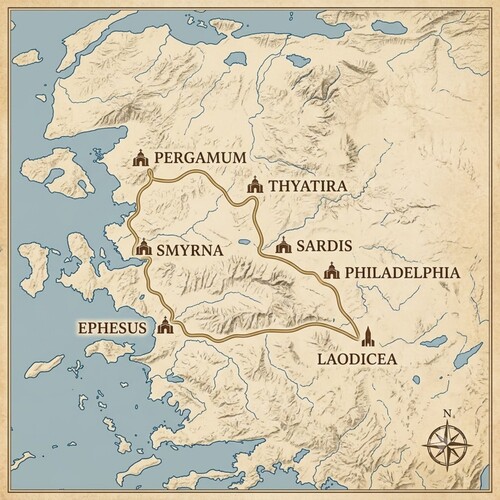
Start with something almost boringly practical. Look at the order of the 7 cities in Revelation 1:11: Ephesus, Smyrna, Pergamum, Thyatira, Sardis, Philadelphia, Laodicea.
That’s not a random list. It’s a delivery route.
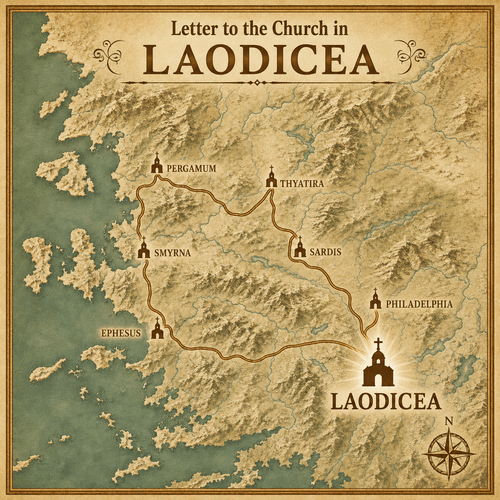
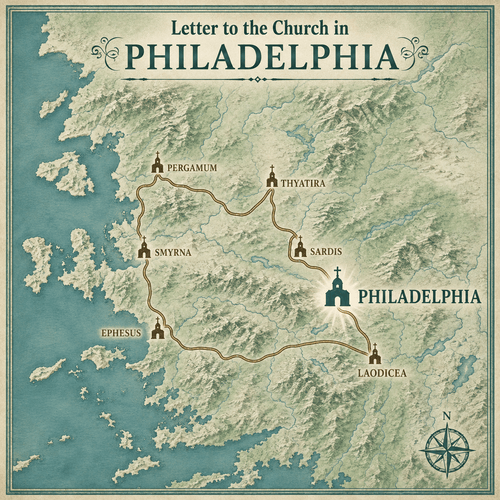
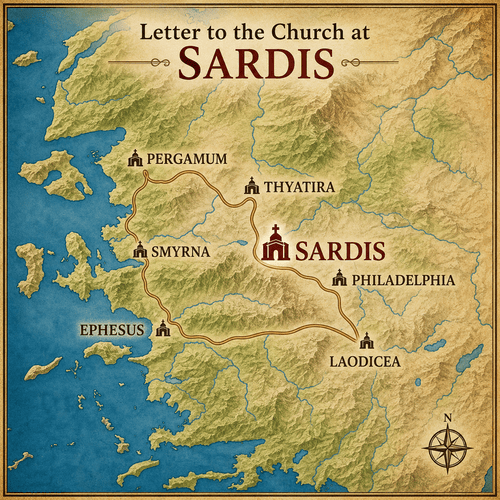
Ephesus was the great port city, the natural place for a letter arriving by sea to be dropped off. From Ephesus the Roman road ran north up the coast to Smyrna, then further north to Pergamum. There it turned inland and swung south-east to Thyatira, then south to Sardis, then east to Philadelphia, and finally further east to Laodicea. Draw those seven dots on a map and join them, and you get a rough circle of about 160 kilometres, moving clockwise.
A messenger carrying a scroll would have walked exactly that loop. He would have stopped at each city, read the whole scroll aloud to the gathered congregation, and moved on to the next.
2 things follow from this, and they shape everything else in this guide.
- These were actual congregations. Real believers with real names, real debts, real neighbours and real fears. Whatever else Revelation is doing, it was doing something for them first.
- Every church heard all 7 letters. The messenger didn’t tear off one page at Sardis and leave the rest behind. The Ephesians heard the warning to Laodicea. The Laodiceans heard the comfort given to Smyrna. This is why each letter ends with the plural: “He who has an ear, let him hear what the Spirit says to the churches” (Revelation 2:7). Not “to the church”. To the churches.
Hold on to that plural. It’s the single most important detail in Revelation 2 and 3, and we shall come back to it more than once.
The Same 7 Steps, Every Time
Read the 7 letters one after another and you’ll start to feel a rhythm. That’s because John is following a template. Each letter has the same parts, in the same order.
| THE 7 PARTS OF EACH LETTER | WHAT IT DOES |
|---|---|
| 1. The command to write | “To the angel of the church in Ephesus write” (Revelation 2:1). The letter is dictated by Christ, not composed by John. |
| 2. Christ introduces himself | Always beginning “The words of Him who…”, and always borrowing an image from the vision of Christ in Revelation 1:12–20. |
| 3. “I know” | Christ names what the church has done well. He sees the hidden faithfulness that nobody else noticed. |
| 4. “But I have this against you” | The charge. Christ names the specific sin or failure, not a vague mood. |
| 5. A call to repent or endure | Never a general appeal. A clear, concrete instruction for that church. |
| 6. A call to hear | “He who has an ear, let him hear what the Spirit says to the churches.” |
| 7. A promise to the conqueror | A reward for “the one who conquers”. Every single one of these promises is paid out later in the book, in Revelation 20–22. |
Once we see the pattern, the interesting thing is where it breaks. The gaps are deliberate, and they’re fraught with meaning.
WHERE THE PATTERN BREAKS—AND WHAT THAT TELLS US
Smyrna and Philadelphia receive no rebuke. These were the two weakest, poorest and most harassed congregations among the 7. Christ has nothing to hold against them. Weakness isn’t the same thing as failure.
Laodicea receives no commendation at all. It was the wealthiest church on the route. It’s the only one about which Christ has nothing good to say.
Sardis receives almost none. Only “a few names” there had kept their clothes clean (Revelation 3:4). A remnant, not a congregation.
The pattern is a warning to comfortable churches. Outward success and spiritual health are running in opposite directions across these 7 letters. That’s not an accident; it’s the point.
There’s a further detail worth pausing over. 6 of the 7 letters contain a command to repent. Repentance here isn’t a one-off decision made years ago and filed away. It’s the normal, ongoing posture of a healthy church.
Why Jesus Introduces Himself Differently Each Time
In Revelation 1, John sees the risen Christ standing among 7 golden lampstands. The description is piled high with images: hair white as wool, eyes like flames, feet like glowing bronze, a sharp 2-edged sword coming out of His mouth, 7 stars in His right hand.
Then, in each of the 7 letters, Christ picks out 1 or 2 of those images and applies them to that particular church. He doesn’t repeat Himself. Or pick at random.
| CHURCH | HOW CHRIST DESCRIBES HIMSELF | WHY THAT IMAGE, FOR THAT CITY |
|---|---|---|
| Ephesus | Holds the 7 stars, walks among the lampstands (2:1) | A church losing its first love needs to know that Christ is still walking in the room. |
| Smyrna | The first and the last, who died and came to life (2:8) | Smyrna had been destroyed and rebuilt centuries earlier. A city that came back from death hears from the Lord who did the same. |
| Pergamum | Has the sharp 2-edged sword (2:12) | The Roman governor at Pergamum held the “right of the sword” — legal power to execute. Christ quietly announces whose sword actually matters. |
| Thyatira | Eyes like a flame of fire, feet like burnished bronze (2:18) | Thyatira was a metalworking town. The image is drawn straight from the trade its people knew. |
| Sardis | Has the 7 spirits of God and the 7 stars (3:1) | A dead church cannot revive itself. Life comes from the Spirit whom Christ holds. |
| Philadelphia | The holy one, the true one, who has the key of David (3:7) | A small church shut out of the synagogue hears from the one who alone decides which doors open. |
| Laodicea | The Amen, the faithful and true witness (3:14) | A church that thought its own assessment of itself was reliable meets the only witness who is never wrong. |
What the Cities Themselves Tell Us
2 scholars did more than anyone else to open this up. Sir William Ramsay travelled through Asia Minor in the late 19th century and wrote The Letters to the Seven Churches of Asia. Colin Hemer later refined and corrected his work in a careful study of the local background. Between them they showed something that changes how the letters read: again and again, Christ speaks to each church in the language of its own streets.
| CITY | WHAT WAS TRUE OF THE PLACE | WHAT IT EXPLAINS |
|---|---|---|
| Ephesus | A wealthy port whose harbour was silting up. The city was later abandoned entirely and is ruins today. | “I will come to you and remove your lampstand from its place, unless you repent” (2:5). |
| Smyrna | Public buildings ringed the summit of Mount Pagos; visitors described the city as wearing a crown. An early centre of emperor worship. | “Be faithful unto death, and I will give you the crown of life” (2:10). |
| Pergamum | The provincial capital. Home to a vast altar of Zeus, the serpent-emblem healing cult of Asclepius, and the first provincial temple to a Roman emperor. | “I know where you dwell, where Satan’s throne is” (2:13). |
| Thyatira | A town run by trade guilds. Membership was needed to work, and guild dinners involved idol worship and sexual immorality. | The pressure behind the woman called “Jezebel” (2:20) was economic before it was theological. |
| Sardis | Built on a cliff thought impossible to capture. It fell twice to small raiding parties who climbed up at night while the sentries slept. Famous for its woollen cloth. | “If you will not wake up, I will come like a thief” (3:3); the promise of white garments (3:4–5). |
| Philadelphia | On a fault line. Flattened by the earthquake of AD 17. Many residents lived outside the walls for years, afraid of aftershocks. The city was twice renamed in honour of emperors. | “I will make him a pillar in the temple of my God. Never shall he go out of it… and my own new name” (3:12). |
| Laodicea | A banking centre so rich it refused imperial disaster aid and rebuilt itself. Known for glossy black wool and for an eye ointment produced in the region. | “I am rich, I have prospered, and I need nothing… you are wretched, pitiable, poor, blind, and naked” (3:17). |
4 Ways People Read These Letters
Now we come to the reason this series belongs in a study of last things. What are these 7 letters actually about? Four main answers are on offer.
| READING | THE CORE CLAIM | THE MAIN DIFFICULTY |
|---|---|---|
| Church-age (historicist) | This view suggests the 7 churches are 7 consecutive periods in church history, running from the apostles to the end of the world. Ephesus is the apostolic age, Sardis the Reformation era, Laodicea the last generation before Christ returns. | Nothing in the text says this. The scheme keeps being redrawn as history refuses to cooperate. |
| Past-fulfilment (preterist) | The letters address 1st-century conditions in Asia Minor and nothing beyond them. | True as far as it goes, but it struggles to explain why the letters are so carefully shaped for repeated public reading. |
| Timeless-type (idealist) | 7 means completeness. The churches are portraits of spiritual conditions found in every age. | Correct in what it affirms, but it can float free of the real cities and lose the local texture entirely. |
| Historical and paradigmatic | Genuinely historical letters to 7 genuine congregations, deliberately shaped as a complete set so the whole church, in every age, can hear itself addressed. | Requires patient work in both history and theology. It doesn’t produce a chart. |
The 4th reading is the one this site takes, and the case for it isn’t complicated.
- The plural settles it. “What the Spirit says to the churches” appears at the end of every letter. The text itself tells us that each message is meant for all of them.
- 7 is the Bible’s number for completeness. There were more than 7 churches in the province. Colossae, Troas and Hierapolis all had congregations, and they don’t make the list. 7 were chosen because 7 signals wholeness, not because 7 were all that existed.
- All 7 conditions exist right now. You can find a loveless orthodox church, a persecuted faithful church, a compromising church, a tolerant church, a dead church, a small faithful church and a smug church in any city on earth this Sunday. They’re not stages in a sequence. They’re simultaneous possibilities.
- The letters end where the visions end. Every promise to the conqueror reappears in the closing chapters. The letters aren’t a preface to the book. They’re the book in miniature.
WHY THE “7 CHURCH AGES” READING DOESN’T HOLD
The idea the letters map 7 eras of history became widely known through the notes of the Scofield Reference Bible and the prophetic charts of Clarence Larkin. It’s sincerely held by many, and it’s worth answering carefully.
It can’t be tested. Any period of history can be made to fit any letter with enough goodwill. A reading that can never be shown to be wrong can never be shown to be right either.
It’s provincial. The scheme traces European and North American church history and quietly ignores the African, Indian, Persian and Chinese churches, some of them older than most of the ones it names.
It empties 6 letters of meaning for their own readers. If Thyatira is really about the Middle Ages, the Christians actually living in Thyatira were handed a message addressed to somebody else entirely, a thousand years away.
It reverses the purpose of the letters. They were written to be obeyed this week, not decoded later.
It’s worth saying plainly serious, faithful scholars disagree about when Revelation was written. On the 7 letters specifically, however, these differences matter far less than people expect. Whichever date we land on, the letters were written to congregations under pressure, and they were written to be read by all 7.
Christ Among the Lampstands
What do these letters really teach underneath all the local detail?
Revelation 1:20 gives us the key: “the 7 lampstands are the 7 churches”. A lampstand isn’t a light. It’s a stand that holds a light. It has no glow of its own. Remove the lamp and it’s a piece of metal furniture.
The picture comes from the Old Testament. In the tabernacle there was 1 golden lampstand with 7 branches (Exodus 25:31–37). Prophet Zechariah saw the same object in a vision and was told the work of God is done “not by might, nor by power, but by my Spirit” (Zechariah 4:6). In Revelation the one lampstand has become 7 separate ones, scattered across a Roman province. The church is no longer gathered in a single building in a single land. It’s dispersed among the nations.
And Christ walks in the middle of them.
FOUR THINGS THE LAMPSTAND PICTURE TEACHES
The church shines with borrowed light. Its influence, its holiness and its usefulness aren’t its own achievements. Michael Horton has often made the point that the church is a creature of the word: it exists because God speaks, and it lives by continuing to hear him.
Christ is present, not distant. He doesn’t observe from orbit. He’s in the room, and the letters open with what he has seen there.
A lampstand can be removed. Ephesus was warned that its stand could be taken away. It was. The site is ruins. A congregation has no guarantee of permanence simply because it exists.
The lamp itself is never in danger. Christ never threatens to stop shining. He threatens to move the stand. His purposes don’t depend on any one congregation surviving.
This also explains why the letters take sin inside the church so seriously. Pergamum was tolerating teaching that pulled believers back into idol feasts. Thyatira was tolerating a woman who taught the same. In both cases the charge isn’t that the sin existed but that the church put up with it. A congregation that won’t deal with what’s destroying it is a lampstand asking to be moved. William Hendriksen, whose study of Revelation is titled More Than Conquerors, drew out the pastoral force of this: Christ’s praise and His rebuke come from the same love.
“To the One Who Conquers”: Warnings and Assurance
Every letter ends with a promise, and every promise has a condition attached: “To the one who conquers…”. The Greek word is nikao, which simply means to win, to overcome, to come through victorious.
This raises the question that troubles readers. If the promises go only to those who conquer, is my salvation hanging on my own staying power? Could I lose it?
Three things need saying, in order.
- The conquering is Christ’s first. Revelation 5 shows the Lion of the tribe of Judah who “has conquered”—and then reveals Him as a slain Lamb. Gregory K Beale has emphasised that believers overcome in the same manner their Lord did: by faithful witness and by suffering, not by force. We don’t win a victory. We’re brought into one.
- The warnings are real, and they’re a means of grace. God doesn’t preserve His people by making them careless. He preserves them partly through warnings like these, which are among instruments He uses to keep His own from drifting. Joel Beeke has written helpfully on this: assurance and diligence grow together, never at each other’s expense. A warning you take seriously is evidence that grace is working, not evidence that it might fail.
- The most frightening verse is actually the most comforting one. “I will never blot his name out of the book of life” (Revelation 3:5). Many read this as a hint that names can be erased. But the sentence is a strong denial, a way of saying something emphatically by ruling out its opposite. Christ isn’t warning Sardis its names are at risk. He’s guaranteeing they’re not.
So the letters hold two things together that we tend to pull apart. They’re severe. They’re also secure. The believer who reads them and thinks, “I must not drift”, is reading them exactly as intended. That thought isn’t the absence of assurance. It’s how assurance behaves.
How the Letters Open the Rest of Revelation
Here’s the reason this series begins with an overview.
Not one of the promises made to the conquerors in Chapters 2 and 3 is left hanging. Every single one is paid out in the closing vision of the new creation.
| CHURCH | THE PROMISE MADE | WHERE IT IS DELIVERED |
|---|---|---|
| Ephesus | To eat of the tree of life (2:7) | The tree of life stands in the new city (22:2, 14) |
| Smyrna | Not to be hurt by the second death (2:11) | The second death has no power over God’s people (20:6) |
| Pergamum | Hidden manna and a new name (2:17) | A new name written on the redeemed (22:4) |
| Thyatira | Authority over the nations; the morning star (2:26–28) | The saints reign (20:4); Christ names himself the morning star (22:16) |
| Sardis | White garments; name kept in the book of life (3:5) | Only those written in the Lamb’s book of life enter (21:27) |
| Philadelphia | A pillar in the temple; the name of the new Jerusalem (3:12) | The new Jerusalem descends, and God himself is its temple (21:2, 22) |
| Laodicea | To sit with Christ on his throne (3:21) | His servants reign with him for ever (22:5) |
Read that column twice. The 7 letters and the final vision are one argument. Richard Bauckham has described Revelation as a book written to reshape how believers see the world they’re already living in, and this is exactly how it does that work. The frightened congregation in Smyrna isn’t told to hold on till the trouble passes. It’s shown the end of the story and told it’s already inside it.
That’s why these letters are the right doorway into the whole subject of last things. They refuse to let the future become a spectator sport. Dennis Johnson, in his study titled Triumph of the Lamb, puts the pastoral logic simply: the visions are given so the churches can keep going. Everything in Revelation that follows Chapter 3 exists to strengthen the congregations addressed in Chapters 2 and 3.
And since the letters were read aloud to all seven churches, they’re being read aloud to ours.
What Comes Next in This Series
7 posts follow, one for each church. Each will take the same shape: the city as it actually was, the letter as Christ actually dictated it, and the message as it lands on a congregation today.
- Ephesus—the orthodox church that stopped loving
- Smyrna—poverty, prison and the crown of life
- Pergamum—faithful witness in the shadow of Satan’s throne
- Thyatira—when tolerance becomes a trap
- Sardis—the church with a reputation and no pulse
- Philadelphia—small strength and an open door
- Laodicea—rich, respected and spat out
Tough Questions, Honest Answers
Can I still visit the 7 churches today, and what’s left of them?
Yes, and all 7 sites are in modern Turkey. Ephesus is the most spectacular; it was abandoned when its harbour silted up, and the excavated marble streets, theatre and library facade draw large numbers of visitors. Smyrna is now Izmir, a busy city of several million people, so the ancient remains sit inside a modern metropolis. Pergamum, Sardis and Laodicea have substantial ruins, including Sardis’s enormous excavated synagogue and Laodicea’s recently uncovered street grid and church. Thyatira is the least impressive, reduced to a small excavated plot inside the town of Akhisar. Philadelphia, now Alasehir, retains a few pillars of a Byzantine church. Standing at Ephesus and reading Revelation 2:5 about a lampstand being removed is a sobering experience. However, we should be careful: the warning was about a congregation, not about tourism.
Why these 7 cities, when Colossae, Troas and Hierapolis also had churches?
Because the number 7 is doing theological work. Paul had written to Colossae, Luke records a congregation at Troas, and Colossians 4:13 mentions believers at Hierapolis, so there were certainly more than 7 churches in the region. The 7 chosen sit on a single practical postal circuit, which explains the route. But the deeper reason is that 7 is the Bible’s standard number for fullness and completion, used repeatedly throughout Revelation itself for seals, trumpets, bowls and spirits. By addressing 7, Christ addresses the whole church. The omission of Colossae is therefore not a snub; it’s a signal the list is representative rather than exhaustive.
Who were the Nicolaitans, and what were they teaching?
We can’t be certain. The earliest guess, from Irenaeus in the 3nd century, links them to Nicolaus of Antioch, one of the 7 men appointed in Acts 6:5, though this may be no more than an educated inference from the similar name. What the text tells us is more useful than what tradition guesses. In Pergamum the Nicolaitans are mentioned alongside the teaching of Balaam, which drew Israel into idol feasts and sexual sin (Numbers 25; 31:16), and the same combination appears at Thyatira under the name Jezebel. Several scholars have noted the name itself may be a deliberate wordplay meaning something like “conqueror of the people”, forming a dark mirror of the “one who conquers” in each letter. The teaching, in substance, was permission: permission for believers to join the guild dinners and civic ceremonies that kept them employed and accepted. It was compromise dressed as freedom, and it remains the most common form of pressure the church faces.
Does Revelation 3:10 promise the church will be taken away before the great tribulation?
The verse says Christ will keep Philadelphia’s believers “from the hour of trial that is coming on the whole world”. Some read “keep from” as removal from the earth before a future tribulation. But the same Greek construction appears in John 17:15, where Jesus prays His disciples would not be taken out of the world but kept from the evil one. There, plainly, it means protection while remaining inside the danger, not extraction from it. That is the more natural reading here too, especially since the promise is made to one small congregation in the first century, and since Revelation elsewhere shows the saints preserved through tribulation rather than exempted from it. The comfort on offer is better than escape: Christ guards His people in the fire, and none of them is lost.
Can a believer’s name really be blotted out of the book of life?
Revelation 3:5 promises the conqueror, “I will never blot his name out of the book of life.” Notice that this is a promise, not a threat. It is a way of saying something positively by firmly denying its opposite, rather like a doctor saying “you will certainly not die from this.” The imagery of a citizen register that could be struck through would have been familiar in a Roman city, and Christ takes that familiar fear and cancels it. Scripture is consistent here: those given to the Son are kept by him (John 10:28–29), and those written in the Lamb’s book from the foundation of the world are not lost (Revelation 13:8; 17:8). The verse doesn’t put our name at risk; it settles it.
Is Revelation 3:20 an invitation to unbelievers?
It’s one of the best loved verses in the Bible and one of the most misapplied. The words are spoken to a church, not to an individual outsider, and they come at the end of a stinging rebuke to a congregation that thought it needed nothing. The shocking picture is of Christ standing outside his own church, shut out by its self-sufficiency, asking to be let back in. The meal He offers is fellowship restored, not conversion begun. None of this means the verse cannot be applied to individuals; the same Christ calls sinners in the same way, and generations of believers have come to Him through these words. But the primary sense should be preached first, because a comfortable church needs to hear it far more urgently than a curious enquirer does.
Were the letters written under Nero or Domitian, and does the date change how we read them?
The traditional view, resting on the testimony of Irenaeus, places Revelation late in the reign of Domitian, around AD 95. A serious minority case has been made for an earlier date in the late 60s, before the destruction of Jerusalem, principally by Kenneth Gentry. The arguments turn on how one reads the imperial references, the state of the churches described and the condition of Laodicea after the earthquake of AD 60. For the seven letters specifically, remarkably little hangs on the answer. On either date the congregations faced the same realities: local hostility, economic exclusion through the trade guilds, pressure to honour the emperor, and the slow erosion of love and vigilance from within. It is worth knowing the debate, and worth refusing to let it become a test of faithfulness.
Related Reads
- Letter to the Church in Ephesus: Right Doctrine, Lost Love
- Letter to the Church at Smyrna: Faithful Unto Death
- Satan’s Final Defeat: Reformed Perspectives on Revelation 20
- What Will Heaven Really Be Like? Insights from Revelation 21
- A Name No One Else Knows: Revelation 19:12’s Mystery
- The Mark of the Beast: What Revelation 13 Really Means by ‘666’
- What is the Great Tribulation? Understanding Bible End-Time Prophecy
- Letter to the Church at Pergamum: Where Satan’s Throne Stood
- Letter to the Church at Thyatira: Love Without Discernment
- Letter to the Church in Sardis: Alive, Yet Dead
- Letter to the Church at Philadelphia: The Open Door
- Letter to the Church at Laodicea: When Lukewarm Is Worse Than Cold