7 letters. 7 churches. 5 of them get a telling-off.
2 do not. One is Philadelphia. The other is Smyrna.
And here’s the strange thing. The 2 churches Jesus doesn’t correct are also the 2 He does not rescue. To the church at Smyrna He says nothing critical at all. Not one word. Then He tells them prison is coming, that some of them will die, but they shouldn’t be afraid.
That’s the puzzle this letter sets in front of us. If God loves a church, why does He let it be crushed? And if a church is doing everything right, why is it poor? Or hated, even hunted?
Smyrna answers both questions. But it answers them in a way that turns most of our thinking upside down.
The Letter in Full
“And to the angel of the church in Smyrna write: ‘The words of the first and the last, who died and came to life. I know your tribulation and your poverty (but you are rich) and the slander of those who say that they are Jews and are not, but are a synagogue of Satan. Do not fear what you are about to suffer. Behold, the devil is about to throw some of you into prison, that you may be tested, and for ten days you will have tribulation. Be faithful unto death, and I will give you the crown of life. He who conquers will not be hurt by the second death.’” (Revelation 2:8–11)
4 verses. Around 80 words in English. And almost every phrase was chosen for this city and no other.
The One Who Died and Came Back
Every letter in Revelation 2 and 3 begins with Jesus describing Himself. He never uses the same description twice. Each one is picked to fit the trouble or predicament that church is facing.
To Smyrna He says He’s “the first and the last, who died and came to life”.
Both halves matter enormously.
“The first and the last” isn’t a new title. It belongs to God Himself in the Old Testament. In Isaiah 44:6 the Lord says, “I am the first and I am the last; besides me there is no god.” Jesus takes the title and applies it to Himself without explanation or apology. He isn’t a great man speaking about God. He’s God speaking.
“Who died and came to life” is the reason it comforts. A church about to be executed is hearing from someone who has already been executed—and who walked back out. He isn’t offering advice from a safe distance. He has been where they’re headed.
That’s the hinge of the whole letter. Christians are joined to Christ so closely the New Testament can say we died with Him and will live with him (Romans 6:5). If that’s true, death isn’t a wall for the believer. It’s a door He has already opened from the inside.
Notice how the letter ends: the winner “will not be hurt by the second death”. The letter opens with Christ’s death and life, and closes with our safety from death. The whole letter is wrapped in resurrection.
Smyrna: The City That Came Back From the Dead
To feel the force of this letter we need to know the town. Colin Hemer and William Ramsay both wrote major studies showing how closely each of the 7 letters fits its own city, and Smyrna is perhaps the clearest example of all.
Smyrna sat about 56 kilometres north of Ephesus, on a superb natural harbour. It was rich, elegant, proud. Ancient writers called it the ornament of Asia. Today it’s Izmir, the third-largest city in Turkey.
Three details from its history light up the text.
Timeline: Why Smyrna Heard This Letter Differently
- Around 600 BC—the city dies. The Lydians destroyed Smyrna. It lay in ruins, more or less abandoned, for roughly 300 years.
- Around 290 BC—the city rises. Lysimachus, one of the generals who divided up Alexander the Great’s empire, rebuilt it on a new site. Smyrna was famous as the city that had died and come back to life. Then Jesus introduces Himself as the one who died and came to life.
- 195 BC—Rome moves in. Smyrna became the first city in the region to build a temple to the goddess Roma—the city of Rome worshipped as a deity. Loyalty to Rome wasn’t just politics here. It was religion.
- AD 26—the great honour. 11 cities competed for the right to build a temple to the emperor Tiberius. Smyrna won. This made the city a centre of what historians call the imperial cult—the official worship of the emperor as a god.
- Around AD 95—the letter arrives. A small, poor congregation lives in a city whose civic pride is built on emperor worship.
- Around AD 155—Polycarp burns. The most famous pastor of Smyrna is executed for refusing to say the words “Caesar is Lord”. More on him shortly.
One more detail. The public buildings ringing the top of Mount Pagos above the city were so striking that ancient writers described them as a crown on Smyrna’s head. The city literally advertised itself as crowned. Jesus promises this church “the crown of life”.
None of this is mere decoration. It’s the reason the letter lands.
“Your Poverty (But You’re Rich)”
Jesus says He knows two things: their tribulation and their poverty.
Tribulation translates a Greek word that means pressure or crushing—the kind of weight that grinds something down. This isn’t a difficult season. It’s sustained hostility.
Poverty here is the stronger of the two Greek words available. It doesn’t mean “struggling to make ends meet”. It means having nothing at all—the condition of a beggar.
So the poorest people in one of the wealthiest cities on the coast. How did that happen?
- Property was seized or looted. Hebrews 10:34 speaks of believers whose possessions were plundered.
- Work dried up. Most trades were organised into guilds, and guild membership involved shared meals in honour of the guild’s god. Christians who wouldn’t join lost their livelihood.
- Many were poor to begin with. Paul reminded the Corinthians not many of them were powerful or well-born (1 Corinthians 1:26).
Then comes the interruption in brackets: “but you are rich”.
That’s Christ’s own audit of their accounts. And it’s the exact opposite of what He says to the last church in the series.
Two Churches, Two Bank Balances
| COMPARE | SMYRNA (REVELATION 2:8–11) | LAODICEA (REVELATION 3:14–22) |
|---|---|---|
| What the church said about itself | Nothing recorded—they had little to boast of | “I am rich, I have prospered, and I need nothing” |
| What Christ said about them | “You are rich” | “Wretched, pitiable, poor, blind, and naked” |
| Actual money | Destitute | Wealthy banking and textile city |
| Correction from Christ | None at all | Total—he threatens to spit them out |
| What he tells them to do | Be faithful unto death | Buy from him gold refined by fire |
| The lesson | Wealth in heaven can look like nothing on earth | Wealth on earth can hide spiritual bankruptcy |
This single comparison dismantles prosperity teaching more thoroughly than any argument does. The richest church among the 7 receives the sharpest rebuke. The poorest receives none. If material blessing were the measure of God’s favour, Jesus got these two letters the wrong way round.
The riches He means are real ones: being chosen, being adopted into God’s family, and holding an inheritance that Peter says can never fade or spoil (1 Peter 1:4). Those can’t be confiscated by a mob or frozen by a magistrate.
“A Synagogue of Satan”: The Hardest Line in the Letter
This phrase has been badly misused in history, so we must be careful here.
First, what the words actually say. A synagogue is simply an assembly or gathering—the word itself carries no insult. Satan means accuser. Slander here translates a word meaning defamation: speaking evil of someone in order to damage them.
So Jesus is describing a group in Smyrna who claimed the name “Jew” while working to have Christians arrested. He says their gathering is serving the accuser rather than God.
Five Things That Must Be Said Together
- This is a family argument, not a racial one. John was Jewish. Jesus was Jewish. The first church was entirely Jewish. This is criticism from inside, exactly like the Old Testament prophets, who said far harsher things about Israel than this (read Isaiah 1 or Amos 5).
- The issue is the claim, not the ancestry. “Those who say they are Jews and are not” echoes Paul in Romans 2:28–29: a true Jew is one inwardly. The New Testament defines covenant identity by faith in the Messiah, not by paperwork.
- The charge is behaviour. They were informing on Christians to Roman officials. The accounts of Polycarp’s death sixty years later show the same pattern in the same city. To accuse is Satan’s trade; to join it is to take his side, whoever you are.
- Revelation 3:9 is the answer to every abuse of this verse. Jesus uses the identical phrase to the church at Philadelphia—and then promises that those people will come, bow down, and learn that he has loved his church. That is a promise of mercy and conversion. Christ’s plan for them is grace, not destruction.
- The Bible never licenses hatred of Jewish people. Where Christians have used this verse to justify persecution, they’ve inverted it: they’ve taken up the role of the accuser while claiming the name of Christ. Paul, writing about his own countrymen, said his heart’s desire was their salvation (Romans 10:1). That’s the only posture available to us.
WHAT ABOUT ISRAEL TODAY?
The Bible presents one people of God running right through both Testaments. The church isn’t a replacement for Israel but the continuation of the same olive tree, with believing Gentiles grafted in (Romans 11:17–24).
That’s why this letter can call the opposing group false Jews and still expect them to be saved in Revelation 3:9. And it’s why Romans 11 remains open. Charles Hodge and John Murray both read Romans 11:26 as pointing to a future large-scale turning of Jewish people to Christ. John Calvin was more cautious about that reading. The disagreement is old and respectful, and this letter doesn’t settle it.
What the letter does settle is the tone. A believer can’t be a triumphalist. Or contemptuous.
Who Actually Puts Them in Prison?
“Do not fear what you are about to suffer. Behold, the devil is about to throw some of you into prison, that you may be tested.”
Read that sentence slowly, because it contains one of the most useful pieces of theology in the New Testament.
The devil does the throwing. But look at the purpose: “that you may be tested”. Testing isn’t the devil’s goal. The devil wants them to give up their faith. Testing—proving something to be genuine—is God’s goal.
One event. Two intentions. Theologians call this concurrence: God and a creature both act in the same event, but with completely different aims. And God is never the author of the evil in it.
- Joseph’s brothers meant to harm him; God meant the same act for good (Genesis 50:20).
- Job’s losses came from Satan’s hand—but only within limits God set in advance (Job 1–2).
- The cross was lawless men doing what God’s hand had planned beforehand (Acts 2:23; 4:27–28).
RC Sproul used to press this point with a memorable phrase: there’s no such thing as a maverick molecule. Nothing runs loose. If one atom in this universe were outside God’s control, no promise in Scripture could be trusted.
Three small words in the verse make the same point quietly:
- “Is about to”—even the timing is granted, not seized.
- “Some of you”—not all. The selection is not the devil’s to make.
- “Ten days”—a limit, set before the first arrest happens.
The devil in this letter is on a lead, and Christ is holding it. That’s why the command is “do not fear” rather than “you will be spared”. Michael Reeves argues the fear of God is the one fear that drives out all others. Smyrna is that argument in flesh and blood.
What Are the “Ten Days”?
Four main readings have been offered. Here they are, with an honest assessment of each.
| VIEW | WHAT IT SAYS | ASSESSMENT |
|---|---|---|
| Literal | An actual 10-day episode of arrests | Possible, but nothing in history confirms it, and it makes the verse useless to every later reader |
| A short set period | In Hebrew usage “10 days” simply means a brief, complete stretch of time (Genesis 24:55; Numbers 11:19) | Strong. Fits the plain sense and the pastoral purpose |
| An echo of Daniel | Daniel and his friends were tested for exactly 10 days and then vindicated (Daniel 1:12–14) | Strongest. Revelation is saturated with Daniel, and the point is identical—a fixed test, then vindication |
| 10 Roman persecutions | 10 waves of persecution from Nero to Diocletian | Unlikely. The list is artificial, and it would have meant nothing to the people who first read the letter |
GK Beale, in his major commentary on Revelation, takes the number as a symbol of a limited period decreed by God rather than a calendar measurement. That’s the reading we follow.
The pastoral force is the same on every view except the last: this persecution has an end date, and it wasn’t set in Rome.
“Be Faithful Unto Death”
The phrase means “faithful right up to the point of death”—not “faithful until you eventually die of old age”. Christ is asking for a loyalty that doesn’t stop short even at execution.
Then the promise: “I will give you the crown of life.”
The Greek word here isn’t the word for a royal crown. It’s the word for the wreath given to the winner of an athletic contest, or to a citizen honoured by his city. Smyrna hosted games. Smyrna’s skyline was described as a crown. Priests of the emperor’s temple wore crowns. Jesus takes the city’s highest image of honour and hands it to the people the city despises.
And “crown of life” almost certainly means the crown which is life—eternal life itself is the prize (compare James 1:12).
IF GOD KEEPS HIS PEOPLE, WHY THE COMMAND?
Some readers feel a tension here. If Christ preserves everyone who truly belongs to Him, why command them to be faithful? And if some of them are about to be killed, in what sense were they kept?
The answer is that God preserves His people through means, and commands are one of those means. A warning isn’t evidence that God might fail. It’s one of the instruments He uses so that He does not.
Philippians 2:12–13 puts both halves in one breath: work out your own salvation with fear and trembling, for it is God who works in you. The command and the promise aren’t rivals. The command is how the promise arrives.
And note the verb: “I will give you the crown.” Given, not earned. This is a reward of grace to people who are already His.
Winning by Losing
“He who conquers will not be hurt by the second death.”
Conquers is a battlefield word—the word for winning. But look at how these Christians win. They win by being arrested, tried and killed. Revelation later states the paradox openly: they conquered by the blood of the Lamb and by their testimony, and they didn’t cling to their lives even when facing death (Revelation 12:11).
Richard Bauckham has made this the centre of his reading of Revelation: the Lamb’s victory is won through faithful suffering, never through force. Dennis Johnson makes the same point pastorally—the church’s losses in this book are its victories, seen from the wrong side.
The 2nd death is Revelation’s own term, and the book defines it later: the lake of fire, final and irreversible separation from God (Revelation 20:14; 21:8).
So the exchange on offer is this. They may have to face the 1st death—the death of the body. They will never come near the 2nd. Jesus said the same thing in Matthew 10:28: fear the one who can destroy both soul and body, not the one who can only kill the body.
The wording is deliberately understated. “Will not be hurt” is a double negative in Greek, an emphatic way of saying it will not so much as touch you. The second death will not even brush past.
Polycarp: The Letter’s Own Ending
About 60 years after the letter arrived, its promise was tested in public.
Polycarp was the pastor of Smyrna and, according to early sources, a disciple of the apostle John himself. Around AD 155, he was arrested during a wave of mob violence. The account of his death, called the Martyrdom of Polycarp, is the earliest surviving description of a Christian execution outside the New Testament.
The proconsul offered him a way out. All he had to do was swear by the emperor and curse Christ. Polycarp’s reply has echoed ever since: “86 years I have served Him, and He has done me no wrong.”
The proconsul threatened wild animals. Polycarp was unmoved. The proconsul threatened fire. Polycarp answered the fire the governor could light burns for an hour and then goes out, but there’s a fire of judgement that does not.
He was burned at the stake. The account records the crowd, including members of the local synagogue, helped gather the wood—on a Sabbath. It also says the church afterwards spoke of him receiving the crown of immortality.
That’s the vocabulary of Revelation 2:10, used by people who had read the letter and then lived it.
READ THE LETTER, THEN READ THE ROOM
Ignatius of Antioch passed through this region around AD 108 on his way to be killed in Rome. He wrote a letter to the Christians at Smyrna and another to Polycarp personally.
Within two generations, then, this one small congregation received a letter from the risen Christ, a letter from a martyr on his way to die, and the honour of burying its own pastor as a martyr.
Christ told them what was coming. It came. And the church survived it.
A Confession Written Under the Sword
Skip forward 14 centuries. In 1561 a pastor named Guido de Brès wrote a statement of faith for churches being hunted by the Spanish authorities in the Low Countries. He wrapped a copy and threw it over the wall of the castle at Tournai, with a note explaining that these believers were loyal subjects who would obey the government in everything—but would rather have their backs beaten and their tongues cut out than deny Christ.
It didn’t save him. He was hanged in 1567.
That document, the Belgic Confession, is still one of the standard confessions of many churches today. It wasn’t composed in a comfortable study. It was composed in Smyrna’s situation by a man who ended in Smyrna’s manner.
That’s worth knowing because it explains a certain sober tone in the historic confessions. The oldest catechism in that tradition opens by asking what a Christian’s only comfort is, in life and in death—and answers we aren’t our own but belong to our faithful Saviour. That question wasn’t academic for the people who first answered it. It was the question in the cell.
How This Letter Reaches Us
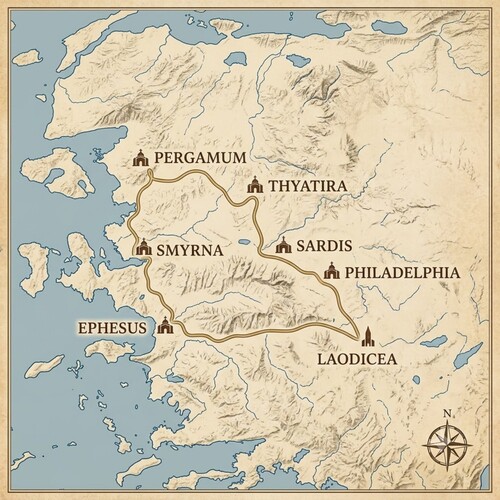
Every one of the 7 letters ends the same way: “let him hear what the Spirit says to the churches”—plural. All 7 letters were sent to all 7 churches, and beyond them to us. Vern Poythress notes the 7 cities lie on a real postal circuit through the region, so the messenger carrying Revelation would have read every letter aloud in every town.
Which means Smyrna isn’t a museum piece.
- For the persecuted church now. In many countries today, following Christ still costs employment, property, family and life. The pattern of Smyrna—faith and poverty arriving together—is the ordinary experience of a large part of the global church. This letter is addressed to them in the most direct way.
- For comfortable Christians. Carl Trueman has written about Western Christians moving from the cultural centre to the margins. That shift is real, and it’s uncomfortable. But it’s not prison, and honesty requires us to say so. Borrowing Smyrna’s language for mild social awkwardness cheapens the letter and insults the people actually living it.
- For anyone taught that faith guarantees an easy life. Jesus doesn’t promise Smyrna deliverance. He promises them a crown. John Piper has argued for years suffering isn’t an interruption in the Christian life but part of its design. This letter is his proof text.
Smyrna teaches us Christ’s assessment of a church may be the exact reverse of everyone else’s—including the church’s own. A congregation with no money, no influence, no protection and no future in the eyes of its city was told by the Lord of history: you’re rich.
He didn’t tell them the pressure would lift. He told them who was holding the lead, how long it would last, and what waited on the other side.
“Be faithful unto death, and I will give you the crown of life.”
Tough Questions, Honest Answers
Where is Smyrna today, and is there still a church there?
Smyrna is modern Izmir, on the west coast of Turkey, and it’s 1 of only 2 of the 7 cities that has remained a major inhabited city without a break. Today, it’s home to more than 4 million people, in a country that’s overwhelmingly Muslim. A small Christian community does still exist, including congregations that trace their presence back several centuries. And a church building named after Polycarp still stands in the city. So the answer is yes—just barely, and after enormous cost. That in itself is a quiet fulfilment of the letter: Christ never promised Smyrna comfort or numbers, only that the 2nd death would not touch those who held on.
Why do Smyrna and Philadelphia receive no correction when the other 5 do?
It isn’t because they were flawless. No congregation is, and Christ isn’t pretending otherwise. It’s because the specific dangers He addresses in the other 5 letters had not taken root in these 2. Ephesus had lost its first love; Pergamum and Thyatira had tolerated false teaching; Sardis was spiritually asleep; Laodicea was rich and self-satisfied. Smyrna and Philadelphia were both weak, both poor, and both under external attack—and pressure from outside rarely produces the compromises that comfort produces. The pattern is worth noticing: in these 7 letters, prosperity does far more damage to a church than persecution does.
Is the crown of life only for martyrs?
No. James 1:12 promises exactly the same crown to anyone who remains steadfast under trial, with no mention of execution at all. What Revelation 2:10 does is apply that general promise to the sharpest possible case: even if faithfulness costs us our life, the crown still stands. Martyrs receive particular honour in Scripture, and Revelation gives them a special place under the altar in Chapter 6. But the crown itself is the inheritance of every believer who endures, and the enduring is itself a gift of God rather than an achievement that earns the prize.
How many crowns does the New Testament promise?
5 different expressions appear: an imperishable crown (1 Corinthians 9:25), a crown of boasting or rejoicing (1 Thessalonians 2:19), a crown of righteousness (2 Timothy 4:8), the crown of life (James 1:12; Revelation 2:10), and a crown of glory (1 Peter 5:4). Some teachers treat these as 5 separate awards handed out for 5 different achievements, rather like medals. The better reading is that these are 5 descriptions of one inheritance, viewed from different angles—it’s imperishable, it’s joyful, it’s righteous, it’s life, and it’s glorious. Scripture nowhere lists them together or ranks them, and building a system of heavenly prize categories from scattered images puts more weight on them than they can carry. Every crown in the New Testament is given, not won.
Does this letter teach the church has replaced Israel?
It teaches fulfilment, not replacement, and the difference is important. Paul’s picture in Romans 11 is a single olive tree: some natural branches were broken off through unbelief, wild branches were grafted in, and the natural branches can be grafted back. It is one tree throughout—one covenant people, running from Abraham to the present, with the Messiah at the centre. So the church doesn’t take Israel’s place; believing Jews and believing Gentiles together are the continuation of the same people. Revelation 3:9 seals the point by promising the very group described as false Jews will one day bow and learn that Christ loved his church, which reads far more like conversion than rejection.
What happened to Christians who denied Christ under torture and later repented?
This was a fierce dispute in the early church. After the persecutions of the 3rd century, large numbers who’d cracked under pressure—known as the lapsed—wanted to return. Novatian argued they could never be readmitted; Cyprian of Carthage argued for restoration after a serious period of repentance, and Cyprian’s position eventually prevailed. The biblical ground for the decision is Peter, who denied Christ three times with curses and was restored by Christ personally (John 21:15–19). Scripture distinguishes between a settled, final rejection of Christ and a terrible failure of nerve followed by grief and return. As 2 Timothy 2:13 puts it, when we are faithless He remains faithful—He cannot deny Himself.
Why does the letter address “the angel” of the church?
The Greek word simply means messenger, and it can refer to a heavenly being or a human one. 3 main suggestions have been offered: a guardian angel over the congregation, a heavenly counterpart representing the church, or the human leader who would read the letter aloud. The 3rd has the practical advantage of explaining how a letter gets delivered at all, and the whole book is written to be read out in gatherings (Revelation 1:3). Whichever view is taken, the content is plainly aimed at the congregation itself—the commands and promises are addressed to people who can be imprisoned and killed, which settles the matter for practical purposes.
Related Reads
- Letters to the 7 Churches: A Complete Guide
- Letter to the Church in Ephesus: Right Doctrine, Lost Love
- Standing Firm: A Biblical, Reformed View of Spiritual Warfare
- Satan’s Final Defeat: Reformed Perspectives on Revelation 20
- What is the Great Tribulation? Understanding Bible End-Time Prophecy
- Letter to the Church at Pergamum: Where Satan’s Throne Stood