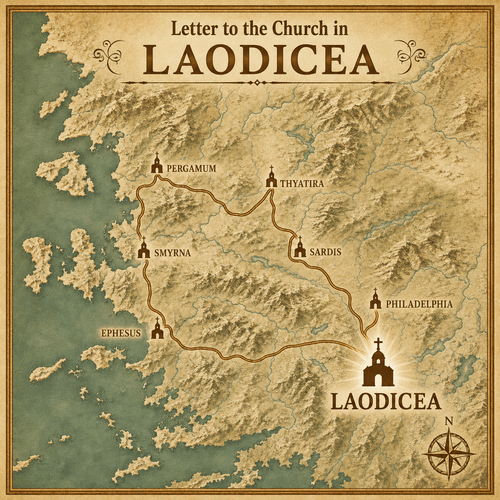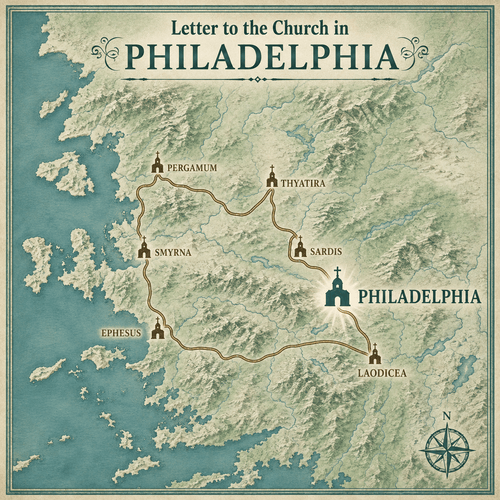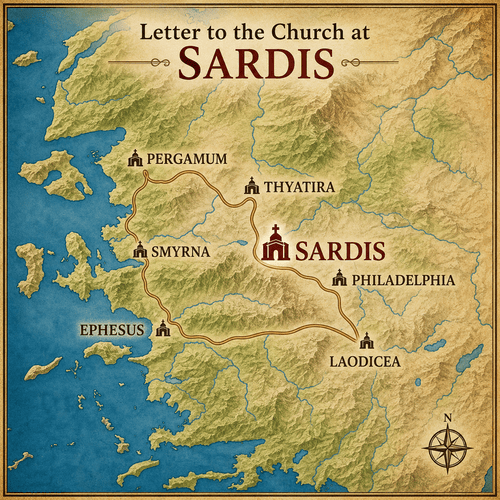
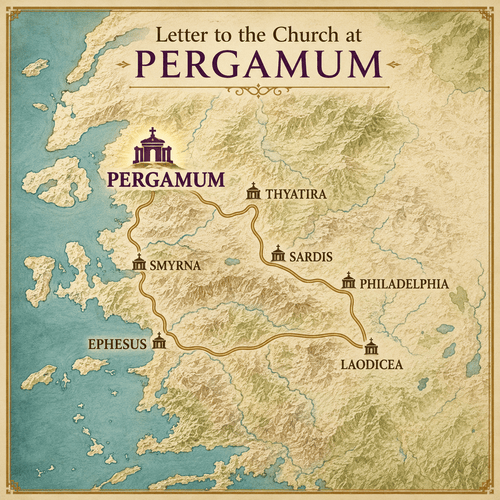
Imagine living in a city where the government could legally put you to death for being a Christian. Imagine a man from your own congregation being executed for refusing to call Caesar a god. Now imagine after all of that, Jesus writes your church a letter—and the biggest problem He raises isn’t the executioner. It’s the dinner invitations.
That’s the letter to the church at Pergamum (Revelation 2:12–17).
It’s the 3rd of 7 short letters the risen Christ dictates to Apostle John in Revelation 2 and 3. It’s only 6 verses long. Yet it contains one of the strangest sentences in the whole Bible: Christ tells this congregation they’re living where Satan’s throne is.
This post walks through the letter line by line, in plain English, explaining the difficult words and the historical background as we go.
THE HEART OF THE LETTER IN 1 SENTENCE
Pergamum is the church that survived the sword and lost to the smile. It stood firm when the state tried to kill it. Then it quietly gave way when the culture invited it to dinner.
Persecution had failed to destroy the church. Yet compromise was very nearly succeeding. That’s why Christ writes—and why this letter still matters.
A City on a Mountain: Why Pergamum Was Different
Every one of the seven letters is tailored to its own city. Christ speaks to each congregation using pictures drawn from the streets they walked down every day. So to understand the letter, we first need to understand the place.
Pergamum (also spelled Pergamon) stood in the west of what is now Turkey, roughly 15 miles inland from the Aegean Sea. Its centre sat on a steep hill rising almost 1,000 feet above the plain below. You could see it from a great distance. It looked like a throne room carved out of a mountain.
This wasn’t a quiet country town. It was the political capital of the Roman province of Asia—the seat of Roman government, Roman law and Roman courts.
Timeline: how Pergamum became what it was
- 281–133 BC—A royal capital. Pergamum ruled its own kingdom under the Attalid kings. They built a famous library of around 200,000 scrolls. The writing material called parchment takes its name from this city.
- 133 BC—Handed over to Rome. King Attalus III left his entire kingdom to Rome in his will. Pergamum became the administrative capital of Rome’s new province of Asia.
- 29 BC—First in emperor worship. Pergamum became the first city in Asia permitted to build a temple to the goddess Roma and to the emperor Augustus. Organised worship of the emperor in that province began here.
- Through the Roman period—A city of famous gods. The Great Altar of Zeus dominated the acropolis. There was a temple of Athena. Below the city lay the Asklepion, a healing shrine devoted to Asklepios, whose symbol was a snake and whose worshippers called him Sotēr—Greek for saviour.
- AD 90s—John writes. By now there’s a small Christian congregation in this city. One of its members has already been killed.
“The Sharp Two-Edged Sword”: Why Christ Introduces Himself This Way
“And to the angel of the church in Pergamum write: ‘The words of Him who has the sharp two-edged sword.’” (Revelation 2:12)
Christ chooses this title deliberately. Here’s why.
The Roman governor of Asia held what Latin sources call the ius gladii—literally, the right of the sword—legal power to order a person’s execution. Pergamum was where that power sat. When a Christian in the province of Asia was put on trial for life, this is the city where the sentence came from.
So Jesus opens by holding up a sword of his own.
- Rome’s sword was iron. It could end a life. It had already ended one in this congregation.
- Christ’s sword comes out of His mouth. It’s His word. Hebrews 4:12 says the word of God is “living and active, sharper than any two-edged sword.”
- Only one of these swords reaches the soul. Jesus had already said so plainly: “Do not fear those who kill the body but cannot kill the soul” (Matthew 10:28).
There’s a sting in the text. We expect Christ to raise His sword against Rome. Instead, in verse 16, He raises it against people inside the church. The most dangerous sword in Pergamum wasn’t held by the governor.
There’s also a quiet connection to the rest of the letter. When Prophet Balaam set out to curse Israel, the angel of the LORD blocked his path “with his drawn sword in his hand” (Numbers 22:31). Balaam himself was later killed by the sword (Numbers 31:8). The same sword that once stopped Balaam is now drawn against Balaam’s pupils in Asia Minor.
“Where Satan’s Throne Is”: What Did Jesus Actually Mean?
“I know where you dwell, where Satan’s throne is. Yet you hold fast my name, and you did not deny my faith even in the days of Antipas my faithful witness, who was killed among you, where Satan dwells.” (Revelation 2:13)
A throne isn’t simply a chair. It’s the seat of ruling power—the place from which authority is exercised. Christ is saying that in Pergamum, evil wasn’t scattered and casual. It was organised, official and enthroned.
Christians suggest several explanations. Here they are, with their strengths and weaknesses.
| THE SUGGESTION | WHAT SUPPORTS IT | THE WEAKNESS |
|---|---|---|
| The Great Altar of Zeus | A vast horseshoe-shaped altar on the acropolis, shaped rather like a throne and visible for miles. Its carvings show the gods crushing snake-legged rebels. | No ancient writer ever calls this altar a throne. |
| The centre of emperor worship | Pergamum led the whole province in emperor worship. This was the religion that actually put Christians on trial and killed them. | By the AD 90s other cities had imperial temples too. |
| The Asklepion healing shrine | Asklepios was titled “saviour” and his emblem was a serpent. Pilgrims came from across the empire seeking healing. A counterfeit saviour, complete with a snake. | It was a hospital-shrine, not a seat of political power. |
| The seat of Roman justice | Pergamum held the right of the sword. Antipas died “among you”. This is where the death sentences came from. | This explains the sword in verse 12 better than it explains the word “throne”. |
| A migrated Babylonian priesthood | Popularised in the nineteenth century by Alexander Hislop and still repeated online. | There’s no historical evidence for it at all. It should be set aside. |
Our view: the phrase is deliberately broad
We don’t think Christ is pointing at one building. He’s describing a city where idol worship, civic pride, commercial life and state force had all been welded into one system. Pergamum was the place in that province where all of those wires met. Wherever you looked—up at the altar, out at the imperial temple, down at the healing shrine, or across the governor’s court—the same power was seated.
Gregory Beale, whose commentary on Revelation is among the most detailed, argues the language of the 7 letters is soaked in Old Testament imagery, and this phrase points to Pergamum as the provincial headquarters of idolatrous imperial power rather than to one monument. Richard Bauckham likewise reads Revelation as a sustained exposure of the Roman imperial system as a rival religion, not merely a rival government. That’s exactly what a throne implies.
THE DETAIL MOST READERS MISS
In Revelation 2:13 the same Greek verb (katoikeō, “to dwell” or “to settle down”) is used twice.
“I know where you dwell…”
“…where Satan dwells.”
The saints reside where Satan resides. They share a postcode. And Christ states it as a fact He already knows, not as an accident He needs an explanation for.
This isn’t a mistake in God’s planning. It is God’s planning. He put a lampstand in that street on purpose.
And notice the limit built into the sentence. Satan has a throne. He doesn’t have the throne. Two chapters later John is shown the throne room of heaven, and there’s only one seat in it that matters (Revelation 4–5). Satan’s authority in Pergamum is real, but it’s borrowed, permitted and temporary.
Antipas: The Man Christ Named
Antipas is the only Christian martyr named in the whole book of Revelation. We know nothing else about him. No family, no office, no last words. He’s a nobody from a provincial city.
And Christ gives him his own title.
In Revelation 1:5, Jesus is called “the faithful witness.” In Revelation 2:13, Antipas is called “my faithful witness.” The Greek word behind “witness” is martys—the word from which we get martyr. In the New Testament it means someone who testifies, someone who says out loud what they’ve seen and believe. In Pergamum, saying it out loud got you killed. You can watch the word change meaning inside the Bible itself.
- Christ decorates the unknown. The Roman records that condemned Antipas are lost. The sentence that honours him is still being read 1,900 years later.
- Faithfulness under fire isn’t raw willpower. It’s the visible proof that grace holds. A man doesn’t walk to an execution on the strength of an opinion.
- Christ’s first word is “I know.” Before any correction, before any warning, He tells them He has seen the address they live at and the cost they’ve paid.
The Teaching of Balaam: When Dinner Did What Cursing Couldn’t
“But I have a few things against you: you have some there who hold the teaching of Balaam, who taught Balak to put a stumbling block before the sons of Israel, so that they might eat food sacrificed to idols and practice sexual immorality.” (Revelation 2:14)
Christ now reaches back about 1,400 years for an illustration. The congregation would have known the story well.
The Balaam file
- Numbers 22–24—The hired prophet. Balak, king of Moab, hires a prophet named Balaam to curse Israel. God will not permit it. Balaam opens his mouth four times, and four times a blessing comes out instead.
- Numbers 25—The collapse. Shortly afterwards, Israelite men are drawn into the worship of Baal of Peor through the women of Moab and their sacrificial feasts. 24,000 die in the plague that follows.
- Numbers 31:16—The revelation. We’re told who engineered it. Balaam advised it. He couldn’t curse them, so he taught Balak how to make them curse themselves.
- 2 Peter 2:15 and Jude 11—The verdict. The New Testament treats Balaam as the pattern of the teacher who sells the people of God for personal advantage.
The Balaam strategy in one line
What cursing couldn’t do, dinner did.
Balaam discovered you don’t need to defeat God’s people. You only need to get them to sit down at the wrong table.
Notice Christ names two specific offences, not vague worldliness:
- Eating food sacrificed to idols. The Greek word is eidōlothyta—meat that had been offered in a pagan temple and then eaten at the temple feast.
- Sexual immorality. The Greek word is porneia, covering sexual activity outside marriage. Temple feasts routinely ended this way.
These are the exact two prohibitions the apostles had issued in Acts 15:29. Christ isn’t inventing a new rule for Pergamum. He’s enforcing apostolic policy that was already about 40 years old.
Why anyone found this persuasive
It’s tempting to picture the Balaamites as people who simply wanted to sin. That’s not what was happening. Get this wrong, and we’ll miss the letter’s application entirely.
Pergamum, like every Roman city, was organised around trade guilds—associations of potters, dyers, bakers, silversmiths and traders. Guild membership was how you got contracts, credit and customers. The guilds held their banquets in temple precincts. The meal was preceded by a sacrifice. The evening frequently ended in the immorality attached to it.
So a Christian tradesman faced a very practical question. Refuse, and you lose your livelihood, your business network, even your standing. Attend, and it’s only a meal—surely?
The Balaamites weren’t arguing for vice. They were arguing for survival. That’s precisely why the argument worked, and why it still does.
Where the line actually falls
Apostle Paul had already answered this in 1 Corinthians 8–10, and he draws the line with real care. This isn’t squeamishness about groceries. It’s a question of whose table we’re sitting at.
| THE SITUATION | THE VERDICT | THE REASON |
|---|---|---|
| Meat bought in the public market, origin unknown | Permitted | “Eat whatever is sold in the meat market without raising any question on the ground of conscience” (1 Corinthians 10:25). An idol is nothing; the meat is God’s. |
| A meal in a private home, where a guest points out the meat was offered in worship | Refrain | Not because the food is polluted, but for the sake of the other person’s conscience and what your eating would say to them. |
| Deliberate attendance at the temple feast itself | Forbidden | “You cannot partake of the table of the Lord and the table of demons” (1 Corinthians 10:21). Here the meal is an act of worship, and attendance is a confession of loyalty. |
Balaam’s teaching lives in that 3rd row. It’s not liberty. It’s holding 2 memberships at once and calling it wisdom.
The Nicolaitans: The Same Poison, a Different Label
“So also you have some who hold the teaching of the Nicolaitans.” (Revelation 2:15)
The Nicolaitans appear in only 2 places in the Bible. The comparison is the point.
| EPHESUS (REVELATION 2:1–7) | PERGAMUM (REVELATION 2:12–17) | |
|---|---|---|
| The Nicolaitans | Their works were hated (2:6) | Their teaching was hosted (2:15) |
| Strength | Sharp doctrinal watchfulness | Courage and loyalty under real danger |
| Failure | Had abandoned their first love | Had abandoned their discernment |
| The lesson | Truth without love goes cold | Love without truth goes soft |
Two congregations. Two opposite failures. One Lord walking among both lampstands. Neither church could have diagnosed itself.
Who were they? Early church writer, Irenaeus of Lyons connected the name to Nicolas of Antioch, one of 7 men chosen in Acts 6:5. Clement of Alexandria preserves a different version, in which Nicolas’s followers twisted something he’d said. The evidence is thin and the accounts disagree, so we shouldn’t be dogmatic about the man.
We don’t need to be. Christ links them to Balaam with the words “so also”. Whatever their origin, their teaching produced the same two results: idol feasts and sexual licence. The text tells us what we need to know.
You may also have heard that “Nicolaitan” means “conqueror of the people” and refers to clergy dominating a congregation. The word-play is possible—Grant Osborne and Robert Mounce both mention it, and both are cautious about it—but nothing in the passage is about church officers. The passage is about idol food and immorality.
“Therefore Repent”: Why the Whole Church Was Told Off
“Therefore repent. If not, I will come to you soon and war against them with the sword of my mouth.” (Revelation 2:16)
This is the theological centre of the letter, and it’s the part most often skipped.
Read verse 14 again. It says some there hold the teaching of Balaam. Not all. Probably not even many. Yet the command in verse 16 is addressed to the entire congregation: repent.
Why? Because the sin Christ names isn’t only the false teaching. It’s tolerating it. The majority hadn’t adopted the Balaamite line. They’d simply decided it wasn’t worth a fight. And Christ treats the decision as the congregation’s own sin.
The three marks of a true church
The Belgic Confession of 1561, one of the great summaries of the Protestant faith, says a true church is recognised by three things:
The pure preaching of the gospel
The right administration of the sacraments
The faithful exercise of church discipline
Pergamum clearly had the first. They held fast Christ’s name and refused to deny the faith under threat of death. What they’d let go was the third.
A church that will not exercise discipline will end up being disciplined.
Watch the pronouns in verse 16, because they’re precise. Christ says He will come to you—the congregation—and make war against them—the false teachers. The judgement falls on the teachers. The visitation falls on the church that gave them a chair.
And His weapon is “the sword of my mouth”. That means the word of God. It means preaching. Christ makes war on error not with committees, campaigns or force, but with truth spoken plainly.
That shouldn’t be mistaken for a gentle option. The same word that’s life to some is judgement to another (2 Corinthians 2:15–16). That’s why the ordinary, weekly, unglamorous preaching of Scripture isn’t a warm-up act for the church’s real work. It is the church’s weapon.
The Hidden Manna: A Better Meal
“To the one who conquers I will give some of the hidden manna…” (Revelation 2:17)
Look at how exactly the promise is shaped against the temptation. They’re being pressed to eat at the idol’s table. Christ answers by offering them a meal.
- Manna was the bread God gave Israel daily in the wilderness (Exodus 16). It was food that came down from heaven for people who had no other way of eating.
- “Hidden” points to Exodus 16:33–34, where a jar of manna was placed before the LORD and kept. Jewish writings from the centuries before Christ speak of that jar being concealed and then restored when the Messiah came.
- Jesus takes the picture and applies it to Himself. “I am the living bread that came down from heaven” (John 6:51). The true manna isn’t a substance. It’s a person.
And here the letter touches the Lord’s Supper. Paul’s sentence about the 2 tables in 1 Corinthians 10:21 could have been written for Pergamum. There’s a meal that belongs to Christ, and there’s a meal that belongs to demons. And no one can eat at both.
John Calvin insisted in the Lord’s Supper believers aren’t merely reminded of Christ but genuinely fed by Him through the Holy Spirit. If that’s true, the Christian tradesman in Pergamum wasn’t being asked to give up a good dinner for a dry ceremony. He was being asked to leave a counterfeit feast for a real one.
The White Stone and the New Name
“…and I will give him a white stone, with a new name written on the stone that no one knows except the one who receives it.” (Revelation 2:17)
This is the most puzzling image in the 7 letters. Small white stones had several uses in the ancient world, and scholars have proposed all of them.
| WHAT THE WHITE STONE MAY PICTURE | HOW IT WORKED IN DAILY LIFE | HOW WELL IT FITS |
|---|---|---|
| A juror’s voting stone | In an ancient court, jurors dropped a white stone for acquittal and a black one for condemnation. | Very strong. Pergamum was the city that handed down death sentences. And acquittal is the heart of the gospel. |
| A banquet token | A small tile (a tessera) that admitted the bearer to a feast. | Very strong. It stands right beside the promise of manna in the same sentence. |
| A victor’s token | Given to winners at the public games, exchangeable for a prize. | Good. The promise is made to “the one who conquers”. |
| An amulet with a secret name | Pagan charms carried divine names thought to give the bearer power. | Possible. Christ gives the real name that the counterfeits imitate. |
| A freed slave’s token | Evidence that a slave had been legally set free. | Possible, and deeply moving for a persecuted congregation. |
Our view: acquittal and admission belong together
The two strongest readings aren’t rivals. They’re two halves of one gift. The white stone is the verdict and the ticket. Not guilty, and now come and eat.
That is the shape of the gospel itself. Pardon that ends in a meal.
Then there’s the new name. Isaiah had promised God’s people “shall be called by a new name that the mouth of the LORD will give” (Isaiah 62:2). A name in Scripture isn’t a label. It’s an identity, given by someone with the authority to give it.
What about the strange clause—a name “that no one knows except the one who receives it”? This is not secret knowledge for a spiritual elite. It’s the personal character of grace. Christ doesn’t save crowds in bulk. He knows His people one at a time, and each one carries assurance that can’t be transferred, borrowed or faked. It corresponds to what Paul describes when he writes that “the Spirit himself bears witness with our spirit that we are children of God” (Romans 8:16).
EVERYONE IN REVELATION IS MARKED
Later in the book, those who belong to the beast receive a mark on the hand or the forehead (Revelation 13:16–17). Without it, they cannot buy or sell.
Here, those who belong to Christ receive a stone with a new name.
There is no third, unmarked category. The only question is whose name you carry.
The Christian in Pergamum may lose the guild token that gets him into the banquet hall. He will be handed the stone that gets him into the feast.
Are These Letters a Map of Church History?
Some popular prophecy charts treat the seven letters as seven ages of church history, with Pergamum representing roughly AD 312 to 606—the period when the church became entangled with the empire. It is a tidy idea, and the fit is superficially attractive.
We do not think it stands up.
- Nothing in the text signals it. There is no hint that these congregations represent time periods. The dates are supplied entirely from outside.
- These were real letters to real congregations. The seven cities sat on a genuine postal route through the province of Asia. Real people read these words in the AD 90s.
- Christ makes the application universal himself. “He who has an ear, let him hear what the Spirit says to the churches” (Revelation 2:17). Plural. Every letter is addressed to all seven congregations, and so to all congregations.
Dennis Johnson and Vern Poythress both argue that the seven letters function as a complete diagnostic set for the church in every age. That is why the letter to Pergamum has never gone out of date, and why it does not need a date assigned to it.
What Pergamum Says to Us
Christ’s diagnosis of this church raises an uncomfortable question. Which has destroyed more congregations across history—hostility or hospitality?
Pergamum survived the sword. It nearly didn’t survive the invitation.
Michael Horton has argued at length the greatest danger to the Western church isn’t open opposition but a quiet hollowing out, in which the faith keeps its vocabulary while losing its content. Carl Trueman has traced how deeply modern people are shaped by the desire to be recognised and accepted by the culture around them. Neither observation is new. Balaam worked it out first.
The modern trade guild isn’t a temple association. But the pressure is the same shape: the professional body, the industry norm, the public statement everyone is expected to endorse, the social platform where dissent is expensive. The question is not whether Christians should be involved in ordinary public life. Scripture assumes they will be. The question is where involvement quietly becomes confession.
A SIMPLE TEST FOR THE PERGAMUM QUESTION
Before joining in, ask:
Does this require me to perform an act of worship, or something functioning as one?
Does this require me to stay silent about Christ as the price of entry?
Does this require me to do something Scripture forbids?
Will those watching read my presence as agreement?
The first 3 concern obedience. The 4th concerns witness. Balaam only needed one of them to come out wrong.
And one more word to a congregation that’s trying to be kind. Tolerance isn’t automatically a virtue. In Pergamum, tolerance was the sin. It was tolerance of a specific teaching, held by identifiable people, inside a congregation with the authority to act. Refusing to act wasn’t gentleness. It was neglect of the people being led astray.
Yet notice how the letter is ordered. Before Christ says “I have a few things against you”, he says “I know where you dwell.” The rebuke comes from someone who has already counted the cost of your address. He has seen the pressure. He remembers Antipas by name. And to everyone still standing in that street he holds out a hidden meal, a white stone, and a name that is theirs alone.
Tough Questions, Honest Answers
Where is Pergamum today, and can you visit the ruins?
Yes. The site lies within the modern town of Bergama, in İzmir Province in western Turkey, and it is open to visitors. A cable car carries you up to the acropolis, where you can see the foundations of the Great Altar of Zeus, the temple of Trajan and one of the steepest theatres surviving from the ancient world. A short distance away lies the Asklepion, the healing shrine, with its colonnaded walkway and sacred spring. In the town below stands the Red Basilica, a huge brick temple originally built for Egyptian gods and later converted into a church. Standing there makes the letter concrete: this really was a mountain covered in the machinery of organised religion.
Is the Great Altar of Zeus in Berlin really “Satan’s throne”, and did the Nazis copy its design?
The altar was excavated by the German engineer Carl Humann in the 1870s and 1880s, shipped to Berlin, and reassembled inside the Pergamon Museum, where it stands today. It is often claimed that Albert Speer modelled the Nuremberg rally platform on it, and there is genuine architectural resemblance, though how directly one caused the other is debated by historians. What we should resist is the leap from that to treating the stones themselves as a portal or a dwelling place for Satan. Scripture never teaches that evil is stored in masonry. The altar was a monument to a system of worship, and the system is what Christ was addressing, not the marble.
How did Antipas die? Was he really roasted alive inside a bronze bull?
The tradition that Antipas was shut inside a hollow bronze bull and roasted appears in later church calendars and commentaries, well after the New Testament period. It is not impossible; that method of execution genuinely existed in the ancient world. But the sources are late and we cannot verify them, so we should not present the story as fact. Scripture tells us only that he was killed among them, and it tells us the one thing that actually matters about him: Christ calls him “my faithful witness”. That is a better epitaph than any detail history could supply.
Does the letter to Pergamum describe a period of church history from about AD 312 to 606?
This scheme appears in many prophecy charts, matching each of the seven churches to an era, with Pergamum representing the age when Constantine brought the church under imperial patronage. We do not think it can be sustained. Nothing in Revelation hints that these congregations stand for time periods, and the dates have to be supplied from outside the text. The letters were written to seven real churches on a real postal circuit in the province of Asia, and Christ himself makes the application universal by telling each congregation to hear what the Spirit says to the churches. Reading Pergamum as a slot in a timetable actually weakens the letter, because it lets present-day readers file it under history rather than under themselves.
Can Christians today eat halal meat, prasad, or food from a temple or shrine?
Paul’s answer in 1 Corinthians 10 gives us a workable rule. Food bought in an ordinary shop or served at an ordinary meal may be eaten with thanks, without investigating its history, because an idol has no real existence and the earth belongs to the Lord. If someone deliberately tells you that a particular item was offered in worship, it is right to decline, not because the food has been contaminated but because of what your eating would say to the person who told you. Prasad is the clearest case, since it is offered precisely as food that has been presented to a deity and is being shared as a blessing from that deity; receiving it normally functions as participation, so a polite refusal is the honest course. Taking part in the act of worship itself is never open to us. Where relationships are involved, refuse the offering warmly, explain briefly, and stay for the conversation.
Were the Nicolaitans followers of Nicolas of Antioch, and does the name mean clergy ruling over the laity?
Irenaeus of Lyons connected them to Nicolas, one of the seven men appointed in Acts 6:5, while Clement of Alexandria records a version in which Nicolas’s followers distorted something he had taught. The accounts are late and inconsistent, so the historical identification remains uncertain and we should hold it loosely. The interpretation that the name means “conquering the people” and refers to clergy dominating a congregation is grammatically possible but contextually unlikely, since the passage says nothing about church office. What Christ actually tells us is that their teaching ran parallel to Balaam’s, producing idol feasts and sexual immorality. That is the definition we should work with.
Is the new name on the white stone Christ’s name or my own, and will I know it in this life?
The wording favours a name given to the believer, since Christ says it is written on the stone and known by the one who receives it. Elsewhere in Revelation, Christ also writes his own name and God’s name on his people (Revelation 3:12), so the two ideas belong together: the name we receive is ours precisely because it comes from him. The clause about no one else knowing it is not an invitation to hunt for a hidden word; it describes how personal salvation is. Assurance in this life is real, and the Spirit bears witness with our spirit that we are children of God, yet the full weight of that name is something we will only carry when we see him. Until then, we do not need to know what it says. We need to know who gave it.