Nobody writes articles asking if King Hezekiah was real. Nobody doubts King Ahab. But ask about King David, and the argument begins.
The reason is simple. The Bible doesn’t describe David as a small local chief. It describes him as a shepherd boy who became king over all 12 tribes of Israel, captured Jerusalem, defeated the Philistines, extended his power far to the north, and received the promise his family would rule forever. That’s a very big claim. And big claims attract doubt.
For about 20 years, from the mid-1980s, a group of scholars argued David wasn’t a real man at all. He was a legend, they said, rather like King Arthur in English stories: a hero invented long afterwards to give a small nation a glorious past. These scholars are usually called minimalists, because they argue the Bible tells us very little about real history.
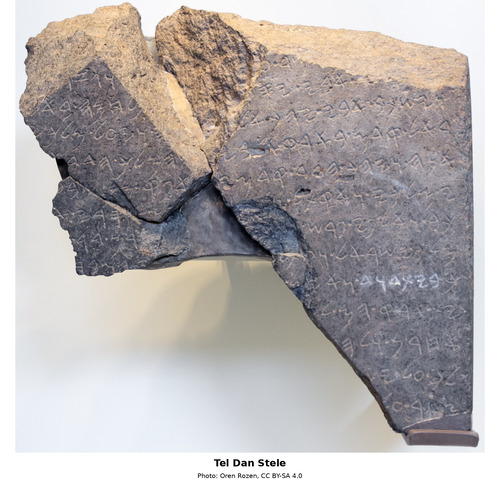
Then, in 1993, a broken piece of black stone was pulled out of the ground in northern Israel, and the argument changed forever.
This post walks you through what archaeologists actually found. Three inscriptions that name David or his family. Five excavation sites that tell us what his kingdom looked like. And, just as importantly, an honest account of what hasn’t been found, and why that’s exactly what we should expect.
Timeline: how the question changed
- Before 1993—The doubt is at its strongest. Philip Davies, Thomas Thompson and Niels Peter Lemche argue David is a literary invention of a much later age.
- 1993—The Tel Dan Stele is found. An enemy king, writing in stone, refers to the kingdom of Judah as “the House of David”.
- 1994 to 1997—2 more possible mentions of David are proposed, on the Mesha Stele from Moab and on an Egyptian temple wall at Karnak.
- 2005 to 2015—Large stone buildings are excavated in Jerusalem. At Khirbet Qeiyafa, a fortified town is dated by science to almost exactly the years the Bible gives David.
- 2018 to 2026—A wave of new work: Tel ‘Eton, the copper mines of the southern desert, a huge rock-cut ditch in Jerusalem, and a major scientific dating programme that has quietly changed our view of the Jerusalem of 1000 BC.
Part I: The three inscriptions
An inscription is simply writing carved into stone or scratched into pottery. For a historian, it’s the strongest kind of evidence there is, because it was written at the time, by people who had no idea we’d be reading it 3,000 years later.
Three inscriptions have been proposed as mentions of David. They’re not equally strong.
1. The Tel Dan Stele—the certain one
A stele is a standing stone slab set up to announce a victory or a royal decree. In 1993, a team led by Israeli archaeologist Avraham Biran found a fragment of one built into a wall at Tel Dan, in the far north of Israel.
The stele was set up by Hazael, an Aramaean king from Damascus, around 841 BC. It boasts of his victory over two kings. And in line nine appears a phrase in Aramaic letters: “the House of David”.
This matters more than people sometimes realise. Hazael was an enemy. He had no reason whatever to flatter Israel or invent a glorious past for it. He simply used the ordinary name by which the southern kingdom of Judah was known to its neighbours: the dynasty of David. Kingdoms aren’t named after imaginary founders.
The find is also unusually secure. The fragment was discovered in situ—in its original place—during a controlled scientific excavation, photographed and recorded as it came out of the soil. That’s why accusations of forgery that followed the discovery never gained any traction among archaeologists.
There’s a new development here. In 2024, French scholar Michael Langlois published a fresh study in the Israel Exploration Journal. Using a photographic technique called Reflectance Transformation Imaging, which lights an object from many angles to reveal marks the eye cannot see, he compared the letter shapes on the two surviving fragments. He found they were written by two different hands. His conclusion was blunt: the way the fragments have been fitted together since 1995 must be abandoned, because the second fragment does not continue the lines of the first.
So does that undo the case? No. Here’s why. The phrase “House of David” sits on Fragment A, on its own, in a line of text that’s complete and undisputed. The reading of “House of David” itself is untouched.
2. The Mesha Stele—the disputed one
The Mesha Stele is a large Moabite victory stone found in Jordan in 1868 and now in the Louvre in Paris. In 1992, before Tel Dan was even discovered, French epigrapher André Lemaire, proposed that line 31 also read “House of David”.
That reading has been fought over ever since.
- Against: In 2019 Israel Finkelstein, Nadav Na’aman and Thomas Römer argued from high-resolution photographs the letters don’t support Lemaire. They proposed instead the name Balak, the Moabite king of Numbers 22 to 24.
- For: Michael Langlois, using the same imaging technique he later applied to Tel Dan, identified a small dot in the stone. Ancient scribes used such dots to separate words. It falls exactly where the reading “House of David” requires a word to end.
- Still contested: André Lemaire and Jean-Philippe Delorme defended the original reading again in 2022. The question remains genuinely open among specialists.
Our honest verdict: this is probable, not proven. And the case for David doesn’t depend on it in the slightest.
3. The Shishak list at Karnak—the possible one
On a temple wall at Karnak in Egypt, Pharaoh Shoshenq I—the Shishak of 1 Kings 14:25—carved a list of places he raided around 925 BC. Egyptologist Kenneth Kitchen suggested two of the name-rings should be read as “the heights of David”, and noticed they sit in a group of places in the Negev, the southern desert where David had operated in his years as an outlaw.
If Kitchen is right, this would be the earliest of the three, carved roughly 45 years after David died—as Kitchen himself put it, within living memory of the man. But one of the consonants doesn’t match Hebrew spelling in the way we’d like, and the reading has never won broad agreement. We list it as possible and leave it there.
| INSCRIPTION | DATE | WHAT IT SAYS ABOUT DAVID | HOW CERTAIN IS IT? |
|---|---|---|---|
| Tel Dan Stele | c. 841 BC | An enemy Aramaean king calls the kingdom of Judah “the House of David”. | Certain. Found in a controlled dig, in place. |
| Mesha Stele | c. 840 BC | Line 31 may read “House of David”, placing Judah’s influence east of the Dead Sea. | Disputed. Leading scholars argue both ways; the imaging evidence currently favours the reading. |
| Shishak list, Karnak | c. 925 BC | Two name-rings may read “the heights of David”, in a group of Negev place names. | Possible. One consonant is irregular and therefore, not widely accepted. |
Part II: Jerusalem, the city itself
If David ruled from Jerusalem, we should expect to find a real city there in the 10th century BC. For years, critics pointed out very little 10th-century building had been found, and drew the obvious conclusion: Jerusalem was a village, and David at most a village chief.
That argument has been quietly dismantled, and mostly by scholars who were not trying to help the Bible at all.
The radiocarbon breakthrough of 2024
WHAT IS RADIOCARBON DATING, AND WHY WAS IT A PROBLEM HERE?
All living things absorb carbon. When they die, one form of that carbon decays at a known, steady rate. By measuring how much is left in a seed, a bone or a piece of wood, scientists can calculate how long ago it died. It is the most reliable dating tool archaeology has.
But there is a snag. For the years roughly 800 to 400 BC, the method becomes blurry—a problem scientists call the Hallstatt plateau. Samples from a 300-year window can all return the same unhelpful answer. Sorting out the Iron Age in Israel has been hampered by this for decades.
The 2024 study broke through it, using tree-ring calibration to sharpen the results.
A team including Johanna Regev, Elisabetta Boaretto, Yuval Gadot and Joe Uziel published more than 100 radiocarbon dates from four excavation areas in the City of David. The samples were ordinary organic material: grape seeds, date pits, even bat skeletons.
18 of the 103 samples fell in the early Iron Age, the period of David and Solomon. Most weren’t found in 10th century buildings, because so few survive. They were found inside the mortar and fill of later ones—rubbish and debris from an earlier occupied city, scooped up and reused by later builders. The report concluded this clearly indicates widespread occupation of a kind not yet determined, regularly underestimated because so little architecture from the period has survived.
Here’s how Joe Uziel summarised the finding: during the 10th century BC, the days of David and Solomon, the city appears to have been occupied in different areas and to have been larger than researchers had previously thought.
The most striking comment came from Yuval Gadot, who has long leaned towards the sceptical side of this debate. Speaking to Israeli newspaper Haaretz about his own results, he said:
“If my pendulum has to move somewhere, it now goes more in the direction of the city than the village because of these results.”
Yuval Gadot, Tel Aviv University
That sentence is worth more than a 100 pages of argument. A scholar who didn’t want this result reported it anyway because that’s what the evidence showed.
The moat, and the buildings on the ridge
Excavations in the Givati car park in the City of David have uncovered a vast ditch cut straight into the bedrock: around 30 metres wide and at least six to nine metres deep, running across the city ridge, and requiring the quarrying out of roughly half a million cubic feet of solid stone. It separated the lower city from the high ground to the north, where the palace and later the temple stood.
It was in use by the end of the period archaeologists call Iron Age IIA, which covers roughly 1000 to 900 BC. When it was first cut is genuinely unknown, and a much earlier date can’t be ruled out. So we can’t claim David dug it. We can claim something more modest and more useful: Jerusalem was a place where monumental engineering on that scale was carried out. That’s not a village.
Further up the ridge sit the Stepped Stone Structure and the Large Stone Structure. The late Eilat Mazar excavated the latter and argued it was David’s palace. Nadav Na’aman and others are more cautious. Here we should be careful too, and follow the example of archaeologist Avraham Faust, who said of his own site that the link to David rests on circumstantial grounds rather than on direct archaeological evidence. The buildings are real, they’re monumental, and they’re in the right place. Whose they were, we cannot yet say.
Part III: The kingdom outside Jerusalem
A king needs more than a capital. He needs fortified towns on his borders, officials, a system of writing, and control of trade. 5 sites, taken together, show all 4.
| SITE | DATED TO | WHAT WAS FOUND | THE HONEST COMPLICATION |
|---|---|---|---|
| Khirbet Qeiyafa | c. 1000–970 BC | A fortified town with massive walls, two gates, planned housing, no pig bones, and early Hebrew writing. Occupied for only 20 to 30 years, then destroyed. | Some scholars argue it was Philistine or Canaanite rather than Judahite. The dating itself is not disputed. |
| Tel ‘Eton | 10th century BC | A large “governor’s residency”—an administrative building implying officials and taxation. | Excavator Avraham Faust himself says the link to David is circumstantial, not proven. |
| Khirbet al-Ra’i | c. 1050–950 BC | A border settlement with Canaanite, Philistine and Israelite material, destroyed by fire. Proposed as biblical Ziklag. | The Ziklag identification is firmly rejected by Aren Maeir. The settlement data, however, stands. |
| Khirbet en-Nahas and Timna | 11th to 9th centuries BC | Large-scale copper mining and smelting, run by an organised authority controlling long-distance trade. | Whether Israel, Edom or both controlled it is debated. The organisation itself is not. |
| The Negev fortresses | 10th century BC | More than 60 fortresses documented along the roads running from the copper mines up towards Judah. | Dating individual forts is difficult. The network as a whole is well attested. |
What the 5 sites collectively show
- Fortification: Khirbet Qeiyafa is the earliest fortified city known in Judah. 17 burnt olive pits from its destruction layer were split between laboratories in Belfast and Oxford, and both returned the same answer: the first third of the 10th century BC. That is the era the Bible assigns to David, arrived at by physics rather than by faith.
- Planning: Yosef Garfinkel has argued Khirbet Qeiyafa shares a distinctive town plan—a double wall with houses built into it—with Beth Shemesh, Tell en-Nasbeh, Khirbet ed-Dawwara and Lachish. Repeated planning across several towns means a central authority. This argument drew heavy criticism when published, but no one has explained the shared plan any other way.
- Writing: Inscribed pottery from Khirbet Qeiyafa shows people in 10th-century Judah could write. A kingdom that keeps records is a kingdom that can be remembered accurately.
- Reach: The copper industry of the southern desert and the fortress chain that protected its roads show a power projecting itself hundreds of kilometres from the highlands — which is precisely what 2 Samuel 8:14 describes when it says David “put garrisons in Edom”.
Part IV: The best objection, and the answer that dissolves it
The strongest argument against a Davidic kingdom was never about David. It was about buildings. It runs like this: great kings leave great architecture; 10th-century Judah has little great architecture; therefore 10th-century Judah had no great king.
The most interesting answer comes not from a defender of the Bible but from a Tel Aviv University archaeologist. Erez Ben-Yosef excavated the ancient copper mines at Timna. He expected to find Egypt had run them. Instead he found they were run by local nomads—people who lived in tents. And these tent-dwellers were operating a sophisticated industry, controlling territory, organising labour on a large scale and trading internationally.
Ben-Yosef drew a sharp methodological conclusion, which he called the architectural bias.
Archaeologists assume that stone buildings mean permanent settlement, and that political complexity requires cities, palaces and monumental architecture. That assumption hides the possibility of highly organised societies which controlled territory and ran large industries while leaving almost nothing behind in stone.
Erez Ben-Yosef, summarising his argument in Vetus Testamentum, 2019
Think carefully about what this does to the objection. If a tent-dwelling people can run an international copper industry and leave barely a wall behind, the absence of grand 10th-century palaces in Jerusalem proves nothing at all about whether a kingdom existed there. The silence isn’t evidence of absence. It’s evidence of how little survives.
Part V: What the evidence proves, in four levels
The most common failure in writing on this subject is to flatten everything into one claim. So here is the case sorted from the firmest ground to the softest.
Four levels of certainty
Level 1—Established beyond reasonable dispute: By the middle of the 9th century BC, a hostile neighbouring king referred to the kingdom of Judah as “the House of David”. A dynasty was named after a founder roughly a century after that founder lived. This is exactly the evidence a real founding king leaves behind.
Level 2—Well supported: A 10th-century kingdom in Judah with fortified towns, planned urban layouts, a working script, administrative buildings and commercial reach into the southern copper mines.
Level 3—Circumstantial: The identification of any particular building as David’s palace, or any particular ruin as a specific biblical town such as Ziklag. Plausible, unproven, and stated as such by the excavators themselves.
Level 4—Absent, and expected to be absent: An inscription written by David, his throne, his tomb. Jerusalem has been continuously occupied, repeatedly destroyed, and quarried down to bedrock in places; the Temple Mount cannot be excavated at all; and a young kingdom’s records were written on materials that do not survive three thousand years in that climate.
That last point deserves emphasis, because it’s where readers are most often misled. Nobody has found an inscription written by David. Nobody has found one written by most ancient kings. The question is never “has everything been found?” but “does what we have found fit, or contradict?” And every piece we have fits.
Why this matters more than it first appears
It would be possible to read all of this as an interesting historical puzzle and nothing more. It isn’t.
The promise made to David isn’t a promise about a man. It’s a promise about a line:
“And your house and your kingdom shall be made sure forever before me. Your throne shall be established forever.”
2 Samuel 7:16, ESV
The New Testament takes that promise and stakes everything on it. Matthew opens his Gospel by tracing Jesus back to David. Paul introduces the gospel as concerning God’s Son, “who was descended from David according to the flesh” (Romans 1:3, ESV). The risen Christ names himself at the very end of Scripture: “I am the root and the descendant of David” (Revelation 22:16, ESV).
A dynastic claim is a historical claim. If there were no David, there’s no line, no promise and no fulfilment. The Christian faith isn’t a set of timeless ideas that would survive the loss of its history. It’s an account of what God has actually done, in a particular land, among a particular family, at a particular time. It therefore stands or falls with the record.
Which is why the spade matters. Not because God needs archaeology to defend Him, and not because a stone from Tel Dan can create faith in anyone. But because the God of Scripture acts in the world He made, and leaves ordinary traces that real action leaves. Three inscriptions and five sites won’t persuade a heart that doesn’t want to be persuaded. They’ll, however, remove a great many excuses. They show, once again, that the confidence Scripture invites is no leap in the dark.
Tough Questions, Honest Answers
Where is King David’s tomb, and is the site on Mount Zion the real one?
The Bible says David “slept with his fathers and was buried in the city of David” (1 Kings 2:10, ESV), which points to the ridge south of the Temple Mount, not to Mount Zion. The building shown to visitors on Mount Zion today became associated with David only in the medieval period, more than 2000 years after his death, and no serious archaeologist defends it. Several rock-cut tombs on the correct ridge have been proposed instead, but they were badly damaged by later quarrying and nothing decisive survives. This shouldn’t trouble us. Scripture doesn’t ask us to venerate David’s grave. Peter’s point in Acts 2:29 is precisely that David’s tomb was still occupied—unlike the tomb of the Son he was promised.
Did King David really write the Psalms?
73 psalms carry a heading connecting them to David, and several give a specific occasion in his life. These headings are ancient and were treated as part of the text by the Jewish community that preserved them. More importantly, Jesus Himself attributes Psalm 110 to David and builds an argument on it (Mark 12:35 to 37), which settles the matter for anyone who accepts His authority. The Psalter as a book was clearly compiled over a long period, and some psalms are plainly by others—Asaph and the sons of Korah are named. So the right answer isn’t that David wrote all of them, but that the collection genuinely begins with him, and that the Spirit who inspired him also governed the whole book’s formation.
Could “House of David” on the Tel Dan Stele mean something else—a place name, or a god called Dod?
This was the main line of resistance after 1993. Some suggested the letters were a place name, like Bethlehem, or referred to a supposed deity named Dod. Neither has survived scrutiny: no such place is known, and no god named Dod is attested anywhere in the region. Decisively, the phrase stands in parallel with “king of Israel” in the same text, which means it must name a kingdom in the same way. When an argument requires inventing an otherwise unknown god to avoid an obvious reading, the obvious reading is almost certainly correct.
Is there any archaeological evidence for Goliath and the Philistines?
The Philistines are among the best-attested peoples in the region. Their cities have been excavated—Ashkelon, Ashdod, Ekron and Gath—with a distinctive pottery, diet and culture that arrived from the Aegean world, exactly as the Bible’s hints suggest. At Gath, Goliath’s home town, excavators led by Aren Maeir found a pottery fragment inscribed with 2 names closely resembling “Goliath” in form and language. That’s not Goliath’s own signature; it’s something quieter and in some ways better, showing that this was a genuine Philistine name in that place at roughly that period. The Bible wasn’t inventing a name nobody actually bore.
What archaeological evidence is there for Solomon and the First Temple?
Solomon is harder than David, because no inscription naming him has yet been found, and the Temple Mount itself can’t be excavated for political and religious reasons. What we do have is suggestive: monumental gates at Hazor, Megiddo and Gezer of similar design, matching 1 Kings 9:15 remarkably well, though their dating is argued over. A small ivory pomegranate and a stone model shrine from Khirbet Qeiyafa illuminate the architectural details described in 1 Kings 6 and 7. We should hold this loosely and say so honestly. The absence of a Solomonic inscription is a gap in our knowledge, not a defect in the text.
When exactly did David reign, and how do scholars work that out?
The usual dates are roughly 1010 to 970 BC, with some scholars preferring 1009 to 969 BC. These are reached by counting backwards from fixed points—above all the Assyrian records, which can be tied to a datable solar eclipse in 763 BC—and then working back through the reign lengths given in Kings and Chronicles. The Bible itself supplies the figure of forty years for David (2 Samuel 5:4). The remarkable thing is that radiocarbon dates from Khirbet Qeiyafa, produced by an entirely independent method, land in the same window. Two systems that know nothing of each other agreeing is a strong sign that both are tracking something real.
Can anyone alive today prove descent from King David?
Various Jewish families have preserved traditions of Davidic descent, and the exilarchs of Babylon claimed it for centuries. But no genetic test can establish it, because there’s no verified sample of David’s DNA to compare anything against, and 3000 years of intermarriage would blur any signal beyond recovery. The genealogies of Matthew 1 and Luke 3 were preserved for a theological purpose, not a genetic one: to establish Jesus is the promised heir. That line has already arrived at the destination.