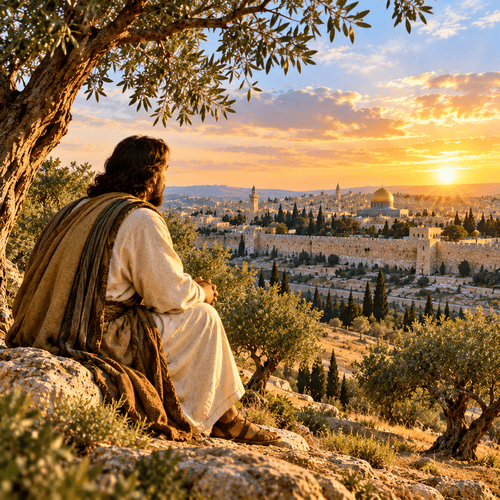
Stand on the Mount of Olives today and Jerusalem lies spread out before you. Below, thousands of white graves cover the slope, and ancient olive trees twist out of the ground in a quiet garden.
The Mount of Olives in the Bible is far more than a good viewpoint. Scripture keeps returning to this one ridge at the great turning points of the story of salvation. A king climbs it in tears. God’s glory pauses on it as it leaves His temple. A prophet promises that the LORD’s own feet will one day stand on it.
Centuries later, Jesus rides down it as King, weeps over Jerusalem from its slope, teaches about the end of the age on its summit, prays in agony at its foot—and goes up into heaven from its top.
Our case is simple: the rejected King weeps where David wept, and the glory that left from this mountain came back to it in Jesus—and will come back again.
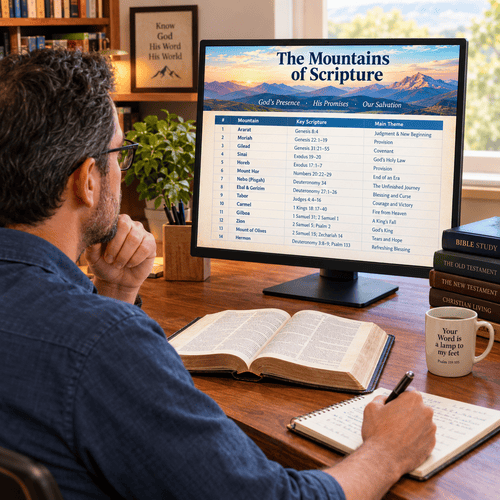
This post is part of our Mountains of Scripture series on Old Testament mountains with New Testament meaning. We have already climbed Moriah, Sinai, Zion and Carmel. The Mount of Olives is where several of their threads—the temple, the King and the glory of God—come together.
Where Is the Mount of Olives?
The Mount of Olives is a ridge of hills just east of Jerusalem’s Old City. It rises a little over 800 metres, slightly higher than the Temple Mount, with the Kidron Valley in between. Luke says it lies “a Sabbath day’s journey” from the city (Acts 1:12)—roughly one kilometre.
The name comes from its olive groves. Olives meant oil, and oil meant anointing: Israel’s kings and priests were anointed with it. The Hebrew word Messiah means “Anointed One.” Even the hill’s name points to the One it would welcome.
DID YOU KNOW?
The southern end of this ridge was once called “the mount of corruption” (2 Kings 23:13). There Solomon built shrines for the false gods of his foreign wives (1 Kings 11:7). The hill where Israel’s king turned to idols later became the hill where the true King prayed, “not my will, but yours, be done” (Luke 22:42).
The Mount of Olives in the Old Testament
1. David Climbs It Weeping (2 Samuel 15:30)
King David’s own son, Absalom, has stolen the hearts of the people and seized the throne. David must run for his life. He crosses the brook Kidron (2 Samuel 15:23) and climbs the Mount of Olives:
But David went up the ascent of the Mount of Olives, weeping as he went, barefoot and with his head covered.
2 Samuel 15:30, ESV
Rejected by his people and betrayed by his son, David learns that his trusted adviser Ahithophel has joined the rebels too (2 Samuel 15:31). Yet he does not grab back his crown by force. He sends the ark back to Jerusalem and says of God, “let him do to me what seems good to him” (2 Samuel 15:26). On the summit, he worships (2 Samuel 15:32).
Later, when his plan fails, Ahithophel hangs himself (2 Samuel 17:23). Keep that detail in mind.
2. God’s Glory Pauses There (Ezekiel 11:23)
About four hundred years later, around 592 BC, the prophet Ezekiel is in exile in Babylon. In a vision he sees the temple filled with idols (Ezekiel 8). Then the glory of the LORD slowly leaves. It moves from the inner room to the threshold (Ezekiel 10:4), then to the east gate (Ezekiel 10:18–19), and finally out of the city altogether:
And the glory of the LORD went up from the midst of the city and stood on the mountain that is on the east side of the city.
Ezekiel 11:23, ESV
That mountain is the Mount of Olives. God leaves step by step, as if reluctant.
Later Ezekiel sees “the glory of the God of Israel… coming from the east” (Ezekiel 43:2), entering the temple again by the east gate. The glory leaves eastward—and returns from the east.
3. The LORD’s Feet Will Stand There (Zechariah 14:4)
After the exile, around 520 BC, the prophet Zechariah looks ahead to the great Day of the LORD:
On that day his feet shall stand on the Mount of Olives that lies before Jerusalem on the east, and the Mount of Olives shall be split in two from east to west by a very wide valley.
Zechariah 14:4, ESV
Zechariah adds, “Then the LORD my God will come, and all the holy ones with him” (14:5), and “the LORD will be king over all the earth” (14:9). Notice the puzzle: God is spirit (John 4:24), so how can the LORD have feet? The New Testament answers.
The Mount of Olives in the New Testament
During His last week Jesus spent His nights on this hill (Luke 21:37) and prayed there “as was his custom” (Luke 22:39). Five great events happen on its slopes.
The Triumphal Entry: The King Comes Down from the East
Jesus begins His entry into Jerusalem at Bethphage, on the Mount of Olives (Matthew 21:1). He rides a donkey to fulfil Zechariah 9:9: “behold, your king is coming to you… humble and mounted on a donkey.” Luke tells us exactly where the praise breaks out—“already on the way down the Mount of Olives” (Luke 19:37).
Notice the direction. The glory left eastward to this mountain; now, from this mountain, the King comes from the east towards the temple. The glory has come back—not as a cloud, but as a Man. “We have seen his glory,” says John (John 1:14).
Jesus Weeps over Jerusalem
Halfway down the slope, Jesus stops. The crowd is cheering, but He is crying:
And when he drew near and saw the city, he wept over it, saying, “Would that you, even you, had known on this day the things that make for peace! But now they are hidden from your eyes.”
Luke 19:41–42, ESV
He goes on to describe enemies surrounding the city and leaving “not… one stone upon another,” because Jerusalem “did not know the time of your visitation” (Luke 19:43–44). This came true in AD 70. The Jewish historian Josephus records that Rome’s Tenth Legion camped on the Mount of Olives during the siege. Jesus wept on the very ground where the armies would stand.
Here’s the heart of the matter: the rejected King weeps where David wept. Both were rejected by their own people. But David wept for his own loss; Jesus weeps for the people rejecting Him.
The Olivet Discourse: The Glory Leaves the Temple Again
A few days later, Jesus speaks His final words to the temple leaders: “See, your house is left to you desolate” (Matthew 23:38). Then Matthew writes:
Jesus left the temple and was going away… As he sat on the Mount of Olives, the disciples came to him privately, saying, “Tell us, when will these things be, and what will be the sign of your coming and of the close of the age?”
Matthew 24:1, 3, ESV
Compare Ezekiel’s vision:
| EZEKIEL 8–11 | MATTHEW 21–24 |
|---|---|
| The temple is full of idols (Ezek 8) | The temple has become “a den of robbers” (Matt 21:13) |
| The glory leaves the temple (Ezek 10:18) | Jesus leaves the temple (Matt 24:1) |
| The glory stands on the mountain east of the city (Ezek 11:23) | Jesus sits on the Mount of Olives (Matt 24:3) |
| Judgement follows: Babylon destroys the temple (586 BC) | Judgement follows: Rome destroys the temple (AD 70) |
| The glory will return from the east (Ezek 43:2) | The Son of Man will come “with power and great glory” (Matt 24:30) |
Jesus answers both questions. Much of the first part was fulfilled in AD 70, since He said, “this generation will not pass away until all these things take place” (Matthew 24:34), as Richard France argued. Jesus then turns to “that day and hour” which no one knows (Matthew 24:36)—His return at the end of history.
Gethsemane: The Anointed One Is Crushed
After the Last Supper:
And when they had sung a hymn, they went out to the Mount of Olives. Then Jesus said to them, “You will all fall away because of me this night. For it is written, ‘I will strike the shepherd, and the sheep of the flock will be scattered.’”
Matthew 26:30–31, ESV
Jesus quotes Zechariah 13:7—the chapter just before “his feet shall stand on the Mount of Olives.” On this very mountain He follows Zechariah’s script in order: the Shepherd is struck before the LORD stands in victory.
He crosses the Kidron (John 18:1), as David did, into Gethsemane, which means “oil press.” Here olives were crushed for oil; here the Anointed One is crushed in soul as He faces the cup of God’s wrath (Isaiah 53:10). And here, like David, He surrenders to His Father: “Nevertheless, not my will, but yours, be done” (Luke 22:42).
The Ascension: The Glory Goes Up from Olivet
Forty days after His resurrection:
He was lifted up, and a cloud took him out of their sight… “This Jesus, who was taken up from you into heaven, will come in the same way as you saw him go into heaven.” Then they returned to Jerusalem from the mount called Olivet.
Acts 1:9, 11–12, ESV
That is the cloud of God’s glory that once filled the tabernacle (Exodus 40:34). Again the glory leaves from the Mount of Olives—with the promise that it will return.
Two Kings on One Mountain: David and Jesus
The links between David’s flight and Jesus’ final night are too many to be chance. This is typology—a God-designed pattern where an earlier person points to Christ:
| KING DAVID (2 SAMUEL 15–19) | KING JESUS (THE GOSPELS) |
|---|---|
| Crossed the brook Kidron (15:23) | Crossed the brook Kidron (John 18:1) |
| Climbed the Mount of Olives weeping (15:30) | Wept over Jerusalem from Olivet (Luke 19:41) |
| Betrayed by his trusted friend Ahithophel (15:31) | Betrayed by His friend Judas (Matthew 26:47–49) |
| The betrayer hanged himself (17:23) | The betrayer hanged himself (Matthew 27:5) |
| “Let him do to me what seems good to him” (15:26) | “Not my will, but yours, be done” (Luke 22:42) |
| Fled from a rebel to save his own life | Went willingly to die for rebels |
| Returned to his throne in Jerusalem (19:15) | Will return in glory (Acts 1:11) |
Jesus Himself applied Psalm 41:9, long linked with Ahithophel, to Judas: “He who ate my bread has lifted his heel against me” (John 13:18). He is the greater David, bearing rejection to save those who rejected Him.
The Glory Leaves from There—and Returns There
Timeline: The Glory and the Mount of Olives
- c. 592 BC—The glory departs: God’s glory leaves the defiled temple and stands on the Mount of Olives (Ezekiel 11:23).
- c. 520 BC—The promise: Zechariah foretells that the LORD’s feet will stand on the Mount of Olives (Zechariah 14:4).
- c. AD 30–33—The glory arrives in person: Jesus comes down Olivet as King, then leaves the temple for the mountain (Luke 19; Matthew 24).
- Forty days after Easter—The glory ascends: Jesus is taken up in the cloud from Olivet (Acts 1:9–12).
- The last day—The glory returns: “This Jesus… will come in the same way” (Acts 1:11).
Whose Feet Will Stand on the Mount of Olives?
- The LORD of Zechariah 14 is Jesus. Zechariah says, “the LORD my God will come, and all the holy ones with him” (14:5). Paul takes those words and applies them to “the coming of our Lord Jesus with all his saints” (1 Thessalonians 3:13). Jesus does the same (Matthew 25:31). The LORD with feet is God the Son made flesh.
- Jesus deliberately acted out Zechariah. The donkey (Zechariah 9:9), the thirty pieces of silver (Zechariah 11:12–13), the struck Shepherd (Zechariah 13:7) and the pierced One (Zechariah 12:10; John 19:37) all meet in Him. He walked through these texts on purpose.
- The New Testament fulfils Zechariah’s pictures in Christ. The “living waters” flowing from Jerusalem (14:8) become the Spirit flowing from Jesus (John 7:37–39). “The LORD will be king over all the earth” (14:9) becomes “All authority in heaven and on earth has been given to me” (Matthew 28:18). “Holy to the LORD,” once on the high priest’s turban, ends up on cooking pots (14:20–21)—everything belongs to God, as in Revelation’s city with no temple, “for its temple is the Lord God the Almighty and the Lamb” (Revelation 21:22).
What About the Mountain Splitting in Two?
Many sincere Christians, especially those taught dispensational theology, expect a physical split, often linked with a rebuilt temple and renewed sacrifices. We gladly agree Jesus will return bodily and visibly, and God could split any mountain. But the splitting is best read as a prophetic picture:
- Prophets use mountains as pictures. Isaiah’s levelled mountains (Isaiah 40:4) were fulfilled in John the Baptist’s ministry (Luke 3:4–6) with no change to the landscape. Zechariah himself tells a great mountain, “Before Zerubbabel you shall become a plain” (Zechariah 4:7).
- The valley is a way of escape. God’s people “shall flee by the valley of my mountains” (14:5). God opens a way out of judgement—in Christ (John 14:6).
- “In the same way” describes manner, not map coordinates. Jesus will return as He left—bodily, visibly, with the clouds (Acts 1:11). Yet His coming will be like lightning from east to west (Matthew 24:27), and “every eye will see him” (Revelation 1:7): a worldwide event, not a local one.
- A rebuilt sacrificial system would undo the cross. Hebrews insists that after Christ’s one sacrifice, “there is no longer any offering for sin” (Hebrews 10:18).
- Our hope is the heavenly city. Believers have already “come to Mount Zion… the heavenly Jerusalem” (Hebrews 12:22). “For here we have no lasting city, but we seek the city that is to come” (Hebrews 13:14).
John Calvin read the split mountain as a picture of God removing every obstacle to gather His people, not a geological forecast.
More Threads Worth Noticing
- The ashes of the heifer. The red heifer’s ashes cleansed from contact with death (Numbers 19), and the Mishnah says it was burned on the Mount of Olives. Hebrews points from “the ashes of a heifer” to “the blood of Christ,” which cleanses our conscience (Hebrews 9:13–14).
- False messiahs gathered there. Josephus tells of an Egyptian who led crowds to the Mount of Olives promising Jerusalem’s walls would fall (Acts 21:38)—just the false christs Jesus warned of (Matthew 24:24–26).
Why the Mount of Olives Matters for You
- Jesus’ tears are real. If you still resist Him, His tears are an invitation, not just a warning (Ezekiel 33:11).
- Gethsemane was for you. Jesus drank the cup of wrath so that all who trust Him never will.
- The ascended King is coming back. That hope calls us to live ready (1 John 3:2–3).
The glory left from this mountain, came back to it in Jesus, went up from it in a cloud—and will return. The real question is not where His feet will stand, but whether we will be able to stand when He appears (Malachi 3:2).
Tough Questions, Honest Answers
Why are so many Jews buried on the Mount of Olives?
Jewish burials have taken place here for some three thousand years, and estimates run to around 150,000 graves. Many Jews believe the resurrection of the dead will begin here when Messiah comes, drawing on Zechariah 14:4 and Joel 3, where God judges in “the Valley of Jehoshaphat” (traditionally linked with the Kidron Valley). Christians share the hope of bodily resurrection, but we place it in a Person rather than a place. Jesus said, “I am the resurrection and the life” (John 11:25), and He raised Lazarus on this very hillside. What matters is not where we are buried, but whom we are buried in: “the dead in Christ will rise first” (1 Thessalonians 4:16).
Did Jesus ascend from Bethany or from the Mount of Olives?
Both. Luke 24:50 says Jesus led the disciples “as far as Bethany,” while Acts 1:12 says they returned “from the mount called Olivet.” Bethany sits on the eastern slope of the Mount of Olives, so these describe the same area. Luke wrote both books, and he clearly saw no conflict. He simply describes the place from two angles—once by the village, once by the mountain.
Did Jesus really sweat blood in Gethsemane?
Luke says “his sweat became like great drops of blood falling down to the ground” (Luke 22:44). The word “like” may describe how heavily the sweat fell. Some doctors point to a rare condition, haematidrosis, where extreme stress makes tiny blood vessels near the sweat glands burst. Honesty also requires noting that some early manuscripts do not include Luke 22:43–44, and the ESV marks this. Either way, every Gospel agrees that His agony was real: “My soul is very sorrowful, even to death” (Mark 14:34).
Why did Jesus ask the Father to remove the cup?
This was not doubt or rebellion. It shows that Jesus is truly human. In the Old Testament, “the cup” is a common picture of God’s wrath against sin (Psalm 75:8; Isaiah 51:17; Jeremiah 25:15). The sinless Son rightly shrank from drinking it. Yet His human will bowed perfectly to the Father’s will: “Nevertheless, not my will, but yours, be done.” The prayer shows both how terrible the cross was and how fully He chose it for us.
If God is sovereign, why did Jesus weep over Jerusalem?
Scripture teaches both truths side by side. God rules over all events, including the cross itself (Acts 4:27–28). Yet He takes “no pleasure in the death of the wicked” (Ezekiel 33:11), and He sincerely calls sinners to come. Jerusalem’s guilt was its own: “you were not willing” (Matthew 23:37). Jesus’ tears show that God’s sovereignty is not cold or careless. There is mystery here, but not contradiction. The sovereign Lord grieves over sin and its ruin.
Are the olive trees in Gethsemane from Jesus’ time?
Probably not the trunks you see today. Josephus records that the Romans cut down the trees around Jerusalem during the siege of AD 70. A 2012 scientific study dated some of the old Gethsemane trees to around the twelfth century. However, olive trees can regrow from their roots, so today’s trees may spring from much older root systems. Either way, they stand where Jesus prayed, and they still look out on the same valley.
What can visitors see on the Mount of Olives today?
Visitors can see the Church of All Nations beside the Garden of Gethsemane; Dominus Flevit (“The Lord Wept”), a teardrop-shaped chapel remembering Luke 19:41; the Pater Noster Church, with the Lord’s Prayer displayed in many languages; and the small Chapel of the Ascension near the summit. Most of these mark traditional sites rather than exact spots. The view itself is the real treasure: from the top, you can see the city over which Jesus wept.
Related Reads
- Mountains in the Bible: From Eden to the New Jerusalem
- Mount Moriah in the Bible: Araunah’s Threshing Floor and Why It Matters
- Mount Sinai in Arabia: What Paul Meant in Galatians 4:25
- Mount Zion Meaning: From David’s Hill to the People of God
- Mount Carmel in the Bible: Elijah’s Fire and the Cross of Christ
- Mount Nebo (Pisgah): The Law, the Promise and Rest Christ Gives
- Mount Ararat in the Bible: Where Judgement Ended and Rescue Began
- Mount Hermon in the Bible: Dew, Watchers and the Gates of Hell
- Mounts Gerizim and Ebal: Blessing, Curse and the Cross
- Why Did Jesus Ride on a Donkey?
- Gethsemane’s Mystery: Why Did Jesus Sweat Blood?
- God’s Cup of Wrath: What It Is and Who Must Drink It
- High and Lifted Up: Why the Ascension Truly Matters
- The Fall of Jerusalem: How History Confirms Jesus’s Prophecies