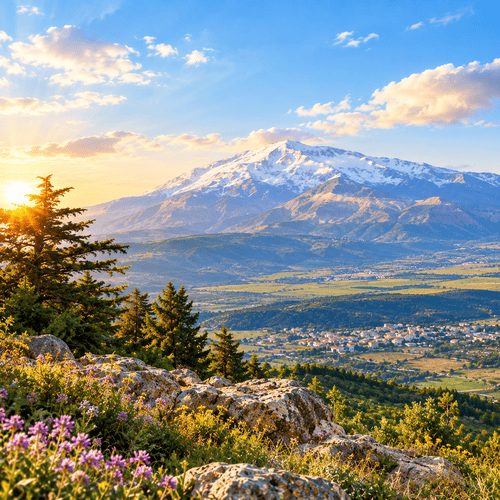
Mount Hermon is the giant of the Bible lands. Its snowy peak rises far above everything else in Israel’s world, and on a clear day you can see it from the Sea of Galilee, some 60 kilometres away.
Yet Hermon is named only around a dozen times in the Old Testament, and never in the New. So why include it in our series on the mountains of the Bible?
Because 3 things meet on this one mountain: a beautiful picture of God’s blessing in Psalm 133; a famous story from an ancient Jewish book, 1 Enoch, about rebel angels landing on its summit; and 2 turning points in the life of Jesus that took place in its shadow. In this post we shall walk through all 3 and carefully separate what Scripture teaches from what later tradition added. The true story, as we shall see, is far better than the legend.
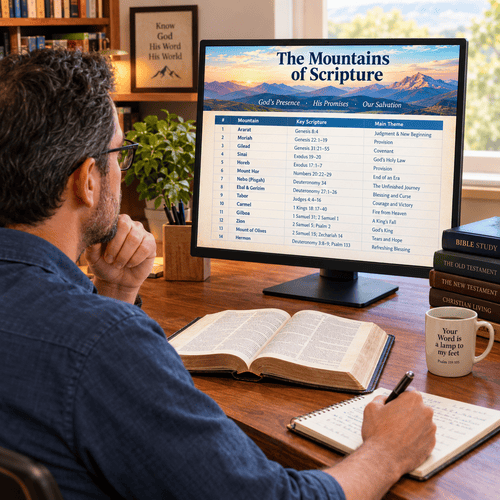
This post is part of our Mountains of Scripture series on Old Testament mountains with New Testament meaning. We have already climbed Ararat, Moriah, Sinai, Zion, Carmel, the Mount of Olives and Nebo. Now we climb Hermon. For the big picture, start with our overview, Mountains in the Bible: From Eden to the New Jerusalem.
Where is Mount Hermon?
Mount Hermon is the southern end of the Anti-Lebanon mountain range. Today its slopes are shared by Lebanon, Syria and the Israeli-held Golan Heights.
| FACT | DETAIL |
|---|---|
| Height | 2,814 metres (9,232 feet) at the summit—the highest point in the region |
| Location | About 60 km north of the Sea of Galilee; nearly 200 km north of Jerusalem |
| Other names in the Bible | Sirion, Senir and Sion (Deuteronomy 3:9; 4:48) |
| Water | Its melting snow feeds the springs at Dan and Banias, the main sources of the Jordan River |
| Today | The summit lies on the Syria–Lebanon border; the southern slopes hold Israel’s only ski resort |
The name Hermon probably comes from a Hebrew root, ḥ-r-m, meaning “set apart” or “devoted”—the root behind things devoted to God, or devoted to destruction. So Hermon may have meant “the sacred mountain”. That fits the facts. The Old Testament calls one part of it Baal-hermon, “the lord of Hermon” (Judges 3:3; 1 Chronicles 5:23). Archaeologists have found around thirty ancient shrines and temples on its slopes, mostly from the Roman period. One of them, Qasr Antar, sits on the summit itself—the highest temple of the ancient world.
Hermon in the Old Testament: Israel’s northern wall
For Israel, Hermon marked the edge of the promised land. Moses describes the land taken east of the Jordan as stretching from the Valley of the Arnon to Mount Hermon (the Sidonians call Hermon Sirion, while the Amorites call it Senir) (Deuteronomy 3:8–9). Joshua’s victories reached as far as Baal-gad in the Valley of Lebanon below Mount Hermon (Joshua 11:17).
Notice the pattern. Hermon is where the conquest stopped. Beyond it lay the nations and their gods. Hermon was a boundary mountain, standing between the land the Lord had claimed for His people and the lands of the nations.
In Israel’s poetry, Hermon is called to praise: Tabor and Hermon joyously praise your name. The mountain the nations worshipped is itself called to worship its Maker.
The dew of Hermon: Psalm 133 and the gift of unity
Hermon’s best-known appearance is in one of the shortest psalms in the Bible:
Behold, how good and pleasant it is when brothers dwell in unity! It is like the precious oil on the head, running down on the beard, on the beard of Aaron, running down on the collar of his robes! It is like the dew of Hermon, which falls on the mountains of Zion! For there the LORD has commanded the blessing, life forevermore.
Psalm 133:1–3
This is a Song of Ascents, sung by pilgrims walking up to Jerusalem for the great feasts. Picture families from all twelve tribes, from the far north and the deep south, climbing the road together. That is the unity the psalm celebrates.
In a land with long, dry summers, dew keeps plants alive, and Hermon’s dew was famously heavy. But Hermon is nearly 200 km from Zion. The psalmist is not giving a weather report. He asks us to imagine the rich dew of the far north falling on dry Jerusalem. That, he says, is what unity among God’s people is like. The psalm teaches three simple things:
- Unity comes down from above. Oil runs down; dew falls. Neither is made on the ground. Unity is a gift God gives, not something we produce by effort or organisation.
- Unity flows from the head. The oil starts on the high priest’s head and runs down to his robes. Christ, our great High Priest, received the Spirit without measure (John 3:34) and poured Him out on His people (Acts 2:33). Our unity flows from union with Him.
- Unity is where God commands blessing. There—among a united people—the Lord commands life forevermore. No wonder Jesus prayed that His people may all be one (John 17:21).
Notice one more detail: Hermon’s best gift, its dew, is pictured as serving Zion.
The tall mountain that envied Zion
Psalm 68 takes that thought further. It pictures God marching in victory to His chosen home, and then speaks to a mountain:
O mountain of God, mountain of Bashan; O many-peaked mountain, mountain of Bashan! Why do you look with hatred, O many-peaked mountain, at the mount that God desired for his abode, yes, where the LORD will dwell forever?
Psalm 68:15–16
Bashan was the region at Hermon’s southern foot, and its “many-peaked mountain” is most likely Hermon itself. Picture it: a towering mountain glaring with jealousy at a little hill. Height means nothing to God. He chose Zion.
Then comes the climax: You ascended on high, leading a host of captives in your train (Psalm 68:18). Paul applies this verse to Christ’s ascension (Ephesians 4:8). The contest between the mountains ends with the risen Jesus going up in triumph, His defeated enemies behind Him. Hold on to that picture. It is the key to what follows.
Hermon in 1 Enoch: the mountain of the Watchers
1 Enoch is a collection of ancient Jewish writings. Its oldest section, the Book of the Watchers (chapters 1–36), was probably written in the third century BC. Aramaic fragments were found among the Dead Sea Scrolls, and the full text survives in Ge’ez, the old language of Ethiopia. It was not written by the Enoch of Genesis 5; like many books of its time, it borrows a famous ancient name.
The book retells Genesis 6:1–4 at great length. Two hundred angels, called Watchers, desire human women. Their leader, Semyaza, makes the others swear an oath and bind themselves by a curse. They descended in the days of Jared on the summit of Mount Hermon, and the book says the mountain was named for that oath (1 Enoch 6:6)—a play on Hermon and ḥerem, a curse or ban. The Watchers take wives and teach people sorcery and weapon-making; their children become devouring giants; and God binds the Watchers in darkness until judgement day (1 Enoch 10).
George Nickelsburg, a leading scholar of 1 Enoch, has argued this northern setting is deliberate, since Dan and Hermon were old centres of worship. He also linked the Watchers’ oath to a Greek inscription from the summit temple that seems to speak of oath-takers. We should hold that link loosely. The inscription is Roman, centuries later than 1 Enoch, and scholars debate whether it echoes the story or is simply a local formula.
What is clear is this: by Jesus’ day, Hermon carried a dark reputation in Jewish imagination as the place where rebellion against heaven touched the earth.
What the apostles actually say
Several New Testament passages echo this tradition. The question is not whether the apostles knew the story—they clearly did—but what they chose to affirm
| PASSAGE | WHAT IT CLEARLY TEACHES | WHAT IT DOES NOT SAY |
|---|---|---|
| Jude 14–15 | Quotes 1 Enoch 1:9 as a true word about God’s coming judgement | That the whole book of 1 Enoch is Scripture |
| Jude 6 | Some angels left their proper place and are kept in chains for judgement | Hermon, an oath, two hundred angels or their names |
| 2 Peter 2:4–5 | God did not spare angels who sinned; their judgement is set beside the Flood | That these angels fathered children |
| 1 Peter 3:19–22 | Christ proclaimed to imprisoned spirits linked with Noah’s day; all powers are now subject to Him | That anyone receives a second chance after death |
Does Jude make 1 Enoch Scripture?
Jude writes: Enoch, the seventh from Adam, prophesied, saying, “Behold, the Lord comes with ten thousands of his holy ones” (Jude 14). Some argue this makes 1 Enoch part of the Bible. It does not. Quoting a true statement does not approve its whole source. Paul quotes the poet Aratus (Acts 17:28), the playwright Menander (1 Corinthians 15:33) and the Cretan prophet Epimenides (Titus 1:12). Jude affirms that this one saying is true, and nothing more. Neither the Jewish people nor the church as a whole ever received 1 Enoch as Scripture. Augustine of Hippo set it aside in The City of God because its origin could not be trusted.
Jude 6 and 2 Peter 2:4
Jude speaks of the angels who did not stay within their own position of authority, but left their proper dwelling, kept in eternal chains under gloomy darkness until the judgement of the great day (Jude 6). Peter says God cast them into hell, using a verb built on “Tartarus”, the Greek name for the deepest prison of the underworld (2 Peter 2:4).
The vocabulary overlaps with 1 Enoch. But look at what the apostles do with it. They confirm the core—angels rebelled, and God holds them for judgement—and leave every colourful detail behind. No Hermon. No oath. No names. No giants. Jude does compare them with Sodom, which likewise pursued “other flesh” (Jude 7); the common thread is crossing God-given boundaries, and whether that makes the angels’ sin sexual is still debated. As we argued in our post on the Nephilim, nothing here requires half-angel, half-human beings.
The spirits in prison (1 Peter 3:19)
This is one of the hardest verses in the New Testament; even Martin Luther admitted he was not sure what Peter meant:
Christ also suffered once for sins, the righteous for the unrighteous, that he might bring us to God, being put to death in the flesh but made alive in the spirit, in which he went and proclaimed to the spirits in prison, because they formerly did not obey, when God’s patience waited in the days of Noah.
1 Peter 3:18–20
- Christ preached through Noah to the people of Noah’s day, who are now “in prison”. Augustine held this view; Wayne Grudem defends it today.
- Christ proclaimed victory over fallen angels after His resurrection. Thomas Schreiner and many modern scholars take this view.
- Christ offered the dead a second chance. This must be rejected: death is followed by judgement, not a new offer (Hebrews 9:27; Luke 16:26).
The second reading is the strongest. When the New Testament uses “spirits” on its own like this, it normally means non-human spirits. “Proclaimed” simply means “announced”, not necessarily preaching the gospel. And Peter uses the same verb, “went”, in verse 22, where Christ has gone into heaven and is at the right hand of God, with angels, authorities, and powers having been subjected to him. The journey is the ascension—the same victory march we met in Psalm 68.
Notice that this view needs nothing from Enoch’s Hermon story, only what Peter himself teaches (2 Peter 2:4–5). And notice why he mentions it. He is writing to suffering Christians: the powers behind your persecutors are already defeated.
THREE GUARDRAILS FOR READING HERMON
- Scripture interprets tradition, never the other way round.
- Where the apostles stop, we stop: they confirm angelic rebellion and judgement, and go no further.
- Keep Christ at the centre: every text about the powers points to His victory over them (Colossians 2:15).
Caesarea Philippi: the gates of hell at Hermon’s foot
At the southern foot of Hermon, a powerful spring once flowed from a great cave. The Greeks dedicated it to Pan, the goat-legged god of the wild, and the place became Paneas (today Banias). Herod the Great built a white marble temple there to honour Caesar Augustus, as the historian Josephus records. Herod’s son Philip made the town his capital and named it Caesarea—“Philip’s Caesarea”.
Consider what gathered here: Baal on the mountain, Pan in the cave, Caesar in the temple. Every kind of false lordship stood side by side, on gentile ground beyond Israel’s old border. Here, of all places, Jesus asked His disciples who He was, and Peter answered, You are the Christ, the Son of the living God (Matthew 16:16). Then Jesus said:
And I tell you, you are Peter, and on this rock I will build my church, and the gates of hell shall not prevail against it.
Matthew 16:18
The Greek says “the gates of Hades”. In the Bible, the gates of Sheol or Hades picture death’s power to hold its prisoners (Isaiah 38:10; Job 38:17). So Jesus’ main meaning is clear: death will not be able to hold His church. He holds the keys of Death and Hades (Revelation 1:18).
Does the location add anything? Michael Heiser argued that Jesus deliberately chose this spot to challenge the dark powers linked with Hermon. The setting is surely no accident—Matthew tells us exactly where this happened—but the meaning of Jesus’ words comes from Scripture, not from the cave. And gates do not attack; gates defend. The picture is of a church advancing, while the kingdom of death fails to keep its captives.
Remember, too, that Hermon stood on the line between Israel and the nations. In our post on the divine council we saw how Deuteronomy 32:8–9 pictures the nations placed under lesser powers. At that very boundary, Jesus announces a church that will cross it and reach every nation (Matthew 28:19). And from then on He spoke of His cross (Matthew 16:21). Death’s gates would be broken not by force but by His dying and rising.
The Transfiguration: was it on Hermon?
Six days later, Jesus led them up a high mountain by themselves. And he was transfigured before them, and his face shone like the sun (Matthew 17:1–2). The Gospels do not name the mountain. There are two main candidates:
- Mount Tabor. Christians have pointed to Tabor since at least the fourth century, when Cyril of Jerusalem named it. But it is only about 575 metres high, lies far to the south, and was probably inhabited in Jesus’ day.
- Mount Hermon. It is truly a “high mountain”, right beside Caesarea Philippi, where they had just been. Many modern scholars favour it, perhaps its lower slopes.
Hermon is the more likely site, but we cannot be certain. Peter, who was there, calls it simply the holy mountain (2 Peter 1:18)—holy because of who stood on it.
In the same letter Peter writes, we did not follow cleverly devised myths (2 Peter 1:16), and later mentions the angels who sinned (2:4). If Hermon was the place, the contrast is striking. Legend told of rebels coming down on Hermon to corrupt the world. The Gospel tells of the true Son shining with heavenly glory, while the Father says, This is my beloved Son, with whom I am well pleased; listen to him (Matthew 17:5). The mountain of myth became the mountain of eyewitness glory.
Why Mount Hermon matters for us
Mount Hermon is a kind of parable. People worshipped it, built temples on it and told stories of rebel angels on its summit. Yet in Scripture it always bows. It praises its Maker. It gives its dew to Zion. It glares at the small hill God chose, and loses. And it stands silent while Jesus announces a church that death cannot hold.
So we need neither fear the legends nor chase them. The powers are real, but they are judged, chained and subject to the risen Christ. Our hope is on another mountain altogether: you have come to Mount Zion and to the city of the living God, the heavenly Jerusalem (Hebrews 12:22). And there, as Psalm 133 promised, the Lord has commanded the blessing—life forevermore.
Tough Questions, Honest Answers
Is Mount Hermon named in the New Testament?
No. The New Testament never names Hermon. It mentions the district of Caesarea Philippi (Matthew 16:13), a town at the mountain’s foot, and a high mountain for the Transfiguration (Matthew 17:1), which Peter later calls the holy mountain (2 Peter 1:18). Hermon’s New Testament importance comes through the events that happened in its shadow, not through its name.
Is “Mount Sion” in Deuteronomy 4:48 the same as Mount Zion?
No. Deuteronomy 4:48 uses a rare name for Hermon, Si’on, which older English Bibles such as the King James Version print as “Sion”. Jerusalem’s Mount Zion is a different Hebrew word, Tsiyyon. The confusion comes from the King James Version also spelling Zion as “Sion” in the New Testament (for example, Hebrews 12:22). The ESV avoids the problem by reading “Mount Sirion (that is, Hermon)”.
Is Mount Hermon the highest mountain in Israel?
Not exactly. Hermon’s main summit, at 2,814 metres, lies on the border between Syria and Lebanon. The highest point Israel has held since 1967 is on Hermon’s southern shoulder, at about 2,236 metres. The highest point inside Israel’s internationally recognised borders is Mount Meron in Galilee, at about 1,200 metres.
Can you visit Mount Hermon today?
Yes, in part. The southern slopes in the Golan Heights host Israel’s only ski resort, with a cable car that runs in both winter and summer. At the mountain’s foot, Banias Nature Reserve lets visitors see the cave of Pan, the ruins of Caesarea Philippi and a waterfall. Access to higher areas depends on the security situation, so check current travel advice before planning a trip.
Why is the Book of Enoch in the Ethiopian Bible but not ours?
The Ethiopian Orthodox Tewahedo Church has a wider canon that includes 1 Enoch and Jubilees, which is why the full text survived in Ge’ez. Other churches never received it, because it was not written by the real Enoch and parts of it clash with Scripture. For example, Genesis 4:22 credits Tubal-cain with metalwork, while 1 Enoch 8 credits a fallen angel. The book is useful for understanding Jewish thought in New Testament times, but it should be read as history, not as God’s Word.
Do demons come from the spirits of the Nephilim?
1 Enoch 15 teaches that evil spirits came out of the bodies of the dead giants, and this idea is popular online today. Scripture never says so. Jesus speaks of the devil and his angels (Matthew 25:41), and Revelation 12:9 shows Satan thrown down and his angels were thrown down with him. The simplest biblical reading is that demons are fallen angels. Scripture does not tell us everything about their origin, so we should not build doctrine on 1 Enoch.
Does Mount Hermon have a role in end-times prophecy?
No biblical prophecy names Hermon in connection with the last days. Online speculation links it to returning Watchers, aliens or a base for the antichrist, but none of this has any support in Scripture. The mountain at the centre of biblical hope is Zion, the city of God: there stood the Lamb with His people (Revelation 14:1), and to that heavenly Zion every believer has already come (Hebrews 12:22).
Related Reads
- Mountains in the Bible: From Eden to the New Jerusalem
- Mount Ararat in the Bible: Where Judgement Ended and Rescue Began
- Mount Moriah in the Bible: Araunah’s Threshing Floor and Why It Matters
- Mount Sinai in Arabia: What Paul Meant in Galatians 4:25
- Mount Nebo (Pisgah): The Law, the Promise and Rest Christ Gives
- Mounts Gerizim and Ebal: Blessing, Curse and the Cross
- Mount Zion Meaning: From David’s Hill to the People of God
- Mount Carmel in the Bible: Elijah’s Fire and the Cross of Christ
- Mount of Olives in the Bible: Where the King Wept and the Glory Returns
- Shouldn’t the Book of Enoch Be In the Bible? Why Isn’t It?
- Who Were the Nephilim in the Bible? Genesis 6 Explained
- What Is the Divine Council? Psalm 82 and the Unseen Realm
- Jesus ‘Preached to Spirits in Prison’: What Did Peter Mean?
- Mountaintop Moments: The Transfiguration’s Timeless Truths