Nearly 2,900 years ago, a proud king ordered his workers to carve a boast into a block of black stone: “Israel has utterly perished for ever.”
He was wrong. Israel didn’t perish. But the stone survived, and today it’s one of the clearest witnesses outside the Bible that the Bible tells the truth about real kings, places and wars.
The king was Mesha of Moab. His stone is called the Mesha Stele. Where sceptics call the Old Testament a book of late myths, this stone says otherwise. And here’s the surprise: it was written by an enemy of Israel, who worshipped a different god. Yet time and again, his stone agrees with the Bible.
Jesus said that if His followers were silent, “the very stones would cry out” (Luke 19:40). Well, here’s a stone that really has spoken. Let us listen.
QUICK FACTS: THE MESHA STELE AT A GLANCE
- What it is: a stele (say “STEE-lee”) is a tall stone slab carved with writing. Kings used them to boast of their victories.
- Who made it: King Mesha of Moab. Moab was a small kingdom east of the Dead Sea, in what’s now Jordan.
- When: about 840 BC, in the days of the prophet Elisha.
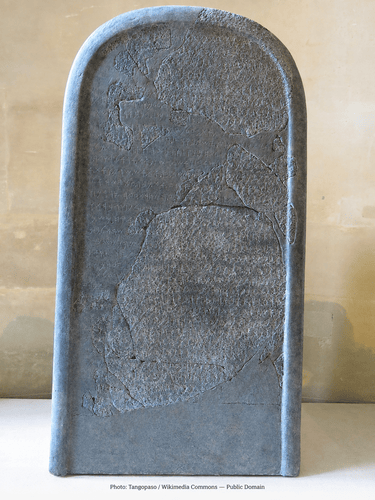
- What it looks like: black basalt, about 1.2 metres tall, with 34 lines of writing.
- Where it was found: Dhiban in Jordan, the Bible’s town of Dibon, in 1868.
- Where it is now: the Louvre Museum in Paris.
- Why it matters: it names Omri king of Israel, the God of Israel, the tribe of Gad and more than a dozen Bible towns.
How a Smashed Stone Was Saved
The story of how we got this stone is almost as dramatic as what it says.
Timeline: From the Desert to the Louvre
- 1868: Local Bedouin show the stone to Frederick Augustus Klein, a missionary from Alsace. He is the first European to see it.
- 1869: Charles Clermont-Ganneau, a young French scholar, sends a helper to make a squeeze. This is a copy made by pressing wet paper onto the stone so it takes the shape of the letters. A fight breaks out, and the wet paper tears, but it still holds most of the text.
- Late 1869: Local people heat the stone in a fire, pour cold water over it and break it into pieces.
- 1870s: Clermont-Ganneau gathers about two-thirds of the pieces and uses the squeeze to fill the gaps.
- Today: the rebuilt stone and the squeeze are kept together in the Louvre Museum in Paris.
Think about this. Without that torn sheet of paper, made only months before the stone was smashed, much of the text would be lost for ever. That was not luck. The Bible teaches that God rules even over small details: “The lot is cast into the lap, but its every decision is from the LORD” (Proverbs 16:33).
What Does the Mesha Stele Say?
The stele is a royal inscription (writing carved into a hard surface). Mesha tells his own story and often mentions Chemosh, the national god of Moab. Here are the main points, with the stone’s line numbers:
- Who he is (lines 1–2): “I am Mesha, son of Chemosh-yatti, king of Moab, the Dibonite.”
- Why Moab suffered (lines 4–6): “Omri was king of Israel, and he oppressed Moab many days, for Chemosh was angry with his land.”
- What came next (lines 6–8): Omri’s son also said, “I will oppress Moab.” Israel held Medeba for “40 years”.
- How Mesha fought back (lines 10–21): he captured Ataroth, Nebo and Jahaz, killed many Israelites and carried off “the vessels of YHWH”.
- What he built (lines 21–31): walls, reservoirs, a road by the River Arnon and a high place (an altar on raised ground) for Chemosh.
- His big boast (line 7): “Israel has utterly perished for ever.”
Keep that last line in mind. We shall come back to it.
Where the Stone and the Bible Agree
Now to the heart of the matter. The table below sets what the stone says beside what the Bible says (ESV), and explains why each match is important.
| WHAT THE STONE SAYS | WHAT THE BIBLE SAYS | WHY IT MATTERS |
|---|---|---|
| Mesha was king of Moab. | “Now Mesha king of Moab was a sheep breeder…” (2 Kings 3:4) | The Bible names the right king, of the right land, at the right time. |
| Omri king of Israel ruled over Moab. | Moab paid Israel “100,000 lambs and the wool of 100,000 rams” (2 Kings 3:4). | Both say Moab served Israel and paid tribute (goods paid by a weak king to a stronger one). |
| Moab broke free from Omri’s family. | “After the death of Ahab, Moab rebelled against Israel.” (2 Kings 1:1) | The same revolt, from opposite sides. |
| Chemosh was Moab’s god. | “O people of Chemosh!” (Numbers 21:29) | The Bible knew Moab’s religion accurately. |
| “The men of Gad” had lived in Ataroth “from of old”. | “And the people of Gad built Dibon, Ataroth, Aroer” (Numbers 32:34) | Even Moab’s king admits Israelites had lived there a long time. |
| Mesha took “the vessels of YHWH” from Nebo. | YHWH (“the LORD”) is Israel’s God all through the Old Testament. | The oldest known writing of God’s personal name outside the Bible. |
| Dibon, Medeba, Nebo, Jahaz, Aroer, Kiriathaim and Horonaim. | “Over Nebo and over Medeba Moab wails.” (Isaiah 15:2; see also Jeremiah 48) | The Bible’s map of Moab is accurate. |
YHWH is God’s personal name, which English Bibles usually print as “the LORD”. By boasting that he dragged Yahweh’s holy objects before Chemosh, Mesha left us proof that Israel worshipped Yahweh in the ninth century BC—exactly as the Bible says.
How the Mesha Stele Backs the Bible on Omri
Who was Omri? According to 1 Kings 16, he was the commander of Israel’s army. When King Elah was murdered, the troops made Omri king “that day in the camp” (1 Kings 16:16). He founded a dynasty—a family line of kings. His son was the famous Ahab, husband of Jezebel.
In the thirty-first year of Asa king of Judah, Omri began to reign over Israel, and he reigned for twelve years… He bought the hill of Samaria from Shemer for two talents of silver, and he fortified the hill and called the name of the city that he built Samaria
1 Kings 16:23–24
Here is how the stele supports this short record, point by point:
- It names him correctly. The stone calls him “Omri, king of Israel”, exactly the title the Bible gives him.
- It confirms his power. The Bible only hints at “the might that he showed” (1 Kings 16:27). The stone shows Omri was strong enough to conquer northern Moab.
- It confirms his family line. “His son succeeded him,” says Mesha. The Bible agrees: “Ahab his son reigned in his place” (1 Kings 16:28).
- It confirms Moab was under Israel. The stone’s “oppression” is the Bible’s tribute of lambs and wool (2 Kings 3:4).
- It confirms Israelite building east of the Jordan. Mesha says the king of Israel built Ataroth and Jahaz. Archaeologists have also found a royal palace from Omri’s time at Samaria.
- It fits the Bible’s timeline. The stone says “forty years”. Add up the Bible’s reigns:
| KING OF ISRAEL | REIGN IN THE BIBLE (ESV) | APPROXIMATE DATES (BC) |
|---|---|---|
| Omri (founder) | 12 years (1 Kings 16:23) | 885–874 |
| Ahab (his son) | 22 years (1 Kings 16:29) | 874–853 |
| Ahaziah (his grandson) | 2 years (1 Kings 22:51) | 853–852 |
| Jehoram/Joram (his grandson) | 12 years (2 Kings 3:1); half of this is 6 years | 852–841 |
| Total: Omri to halfway through Jehoram | About 40 years. Ancient reigns often overlapped by a year, which shortens the simple total of 42. | About 885–846 |
Edwin Thiele, the scholar best known for working out the dates of 8 kings, placed this period at 885–846 BC—about forty years, just as Mesha says.
Other enemies agree. The kings of Assyria (a great empire in today’s Iraq) called Israel “the House of Omri”. On the Black Obelisk of Shalmaneser III (about 841 BC), King Jehu is called “son of Omri”. Remember this detail.
WHY DOES THE BIBLE SAY SO LITTLE ABOUT OMRI?
Why does the Bible give mighty Omri only 8 verses? Because it measures kings by faithfulness to God, not power: “Omri did what was evil in the sight of the LORD, and did more evil than all who were before him” (1 Kings 16:25).
The prophet Micah even used Omri’s name as a warning: “For you have kept the statutes of Omri, and all the works of the house of Ahab” (Micah 6:16).
Puritan commentator Matthew Henry put it well: “Many a bad man has been a stout man.” (Stout means strong and brave.) He also saw why Omri was worse than Jeroboam: “Jeroboam caused Israel to sin by temptation, example, and allurement; but Omri did it by compulsion.” In other words, Omri used his power to force false worship on his people.
The lesson: the Bible knew Omri was mighty. It simply wasn’t impressed.
Does the Stone Contradict the Bible? Three Honest Answers
Critics say the two disagree. Here are their strongest points.
1. “The stone says Moab rebelled under Omri’s son, but the Bible says it was after Ahab died.”
In Hebrew and Moabite, son often meant “descendant” or “successor”. We have seen the proof: the Assyrians called Jehu “son of Omri”, though Jehu was not related to Omri and actually destroyed his family!
The “forty years” show Mesha means Omri’s grandson Jehoram. Revolts also grow in stages: Moab stopped paying tribute after Ahab died (2 Kings 1:1), Jehoram attacked (2 Kings 3), then Mesha took back town after town. A victory stone reports the result, not every step.
2. “The stone never mentions Israel’s invasion in 2 Kings 3.”
True—and that tells us about Mesha, not the Bible. Kings carved their wins in stone, never their near-defeats. Compare the two accounts below. Which one tells the whole story?
| DETAIL | MESHA STELE | THE BIBLE (2 KINGS 3) |
|---|---|---|
| Moab served Israel | Yes, but blames it on Chemosh’s anger | Yes |
| Israel, Judah and Edom invade Moab | Not mentioned | Yes, in full detail |
| Moab’s army is beaten and its towns ruined | Not mentioned | Yes (2 Kings 3:24–25) |
| Israel goes home without taking Moab’s capital | Not mentioned (Moab is simply free) | Yes, honestly recorded (2 Kings 3:27) |
| The sins of Israel’s own kings | Not applicable | Yes, openly (1 Kings 16:25; 2 Kings 3:2–3) |
The Bible records Israel’s failures as well as its victories. That is not propaganda. That is truthful history.
3. “Mesha’s god sounds just like the Bible’s God.”
The stone does share some Bible words. Chemosh is “angry”. Mesha “devoted” 7,000 people at Nebo to his gods. (Devoted, or herem in Hebrew, means given over completely to a god, usually by destruction.) But the differences are huge:
- Chemosh is angry for no reason. The stone gives no moral cause; his anger comes and goes like a moody king’s.
- Yahweh judges with justice and patience. God waited four hundred years before judging Canaan, “for the iniquity of the Amorites is not yet complete” (Genesis 15:16).
- Yahweh judges His own people too. The Bible says Moab would be ashamed of Chemosh “as the house of Israel was ashamed of Bethel” (Jeremiah 48:13). No pagan stone criticised its own nation like that.
Shared words don’t mean a shared God. Chemosh mirrored Mesha’s ambition; the LORD is the holy Judge of all the earth.
Does the Stone Mention the “House of David”?
Line 31 of the stone is badly damaged. In 1994 the French epigrapher (an expert in reading ancient inscriptions) André Lemaire suggested that its broken letters read “House of David”—that is, the royal family of Judah.
Not everyone agrees. In 2019 Israel Finkelstein, Nadav Na’aman and Thomas Römer argued for “Balak”, the Moabite king of Numbers 22. But Michael Langlois used modern imaging and found a small dot—the mark scribes used to separate words—exactly where the “House of David” reading needs it. In 2022 Lemaire and Jean-Philippe Delorme published clearer readings of three letters supporting “House of David”, the reading most experts now favour.
OUR POSITION ON LINE 31
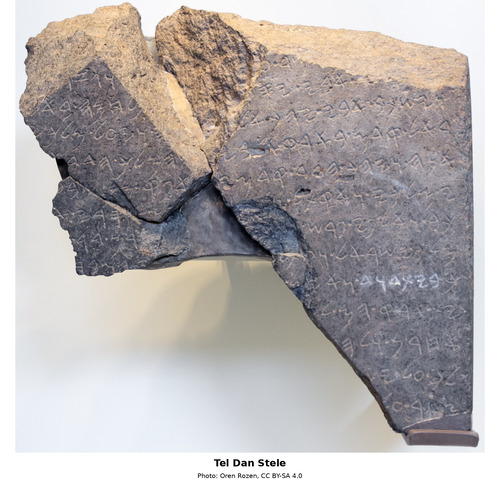
We think “House of David” is the best reading. It matches the Tel Dan Stele, another enemy inscription that clearly names the “House of David”.
But we want to be careful and fair. Our case doesn’t depend on Line 31. Even if that line is never settled, the stone still names Omri, Mesha, Moab, Gad, Yahweh and more than a dozen Bible towns.
Scripture tells us to be ready, “always being prepared to make a defence… yet do it with gentleness and respect” (1 Peter 3:15). Honest arguments are stronger arguments.
The Boast That Failed
Now back to Mesha’s proudest line: “Israel has utterly perished for ever.”
History has answered him. Israel’s northern kingdom lasted more than a century after Mesha, Judah longer still, and the God of Israel is worshipped today on every continent. But Moab? In the sixth century BC Babylon crushed it, and it disappeared from history. No one today prays to Chemosh.
The prophet Jeremiah had foretold exactly this: “Moab shall be destroyed and be no longer a people, because he magnified himself against the LORD” (Jeremiah 48:42). Mesha predicted the end of Israel. God predicted the end of Moab. Only one of them was right.
How Should Christians Use a Stone Like This?
Finds like this are a gift, but we must use them rightly. We do not believe the Bible because archaeologists approve of it. We believe it because it is the Word of God.
The Westminster Confession of Faith (1646) says our “full persuasion and assurance of the infallible truth and divine authority thereof, is from the inward work of the Holy Spirit, bearing witness by and with the Word in our hearts” (1.5). In simple words: the Holy Spirit finally convinces us the Bible is true.
So what is the place of evidence? John Calvin, in his Institutes of the Christian Religion (1.8.13), called outside proofs “secondary aids to our feebleness”. They do not create faith, but they strengthen it.
Robert Dick Wilson, a Princeton scholar of ancient languages, compared foreign kings’ names in the Old Testament with their names on ancient monuments and found them preserved with remarkable care. The Mesha Stele adds one more witness.
A Stone That Still Speaks
So what has this enemy stone told us?
- The people are real: Mesha, Omri and Omri’s family line.
- The places and events are real: Moab served Israel, then broke free after Ahab’s death.
- The God is real: Israel worshipped Yahweh, just as the Bible says.
- The Bible is honest: it records Israel’s failures, while Mesha hides his.
A proud king carved his words in stone to make them last. His stone broke and his kingdom vanished. God’s Word has never been broken. As Jesus prayed, “Sanctify them in the truth; your word is truth” (John 17:17). If God’s Word is true about Omri and Moab, we can trust it about what matters most—our sin, our Saviour and our eternal hope.
Tough Questions, Honest Answers
Where is the Mesha Stele today, and can I see it?
The Mesha Stele is kept in the Louvre Museum in Paris, in its section on the ancient Near East. The paper squeeze that saved so much of its text is displayed with it. When you look closely, you can tell apart the original black pieces of stone from the parts that were filled in later. Copies of the stone are shown in other places too, including in Jordan, where it was found. If you cannot travel, good photographs are easy to find online. Either way, it is a reminder that the Bible’s history can be checked against real objects you can stand in front of.
Is the Mesha Stele a fake?
No. Scholars of every background accept it as genuine. A European saw it lying in place in 1868, a paper copy was taken before it was broken, and its letters match other writing from the same period. Fakes did appear soon afterwards: in the 1870s a Jerusalem dealer named Moses Wilhelm Shapira sold “Moabite” pottery and figures, and Charles Clermont-Ganneau helped expose them as forgeries. The real stele gave experts a standard to test the fakes against. Christians should welcome that kind of careful testing, because truth does not fear questions: “test everything; hold fast what is good” (1 Thessalonians 5:21).
How is the Mesha Stele different from the Tel Dan Stele?
Both are victory stones written by enemies of Israel at about the same time, and both mention Israel’s kings. The Mesha Stele was written by the king of Moab, in the Moabite language, and was found east of the Dead Sea in 1868. The Tel Dan Stele was written in Aramaic, probably by Hazael, king of Damascus, and was found in northern Israel in 1993. On the Tel Dan Stele the words “House of David” are clear, while on the Mesha Stele they are likely but damaged. The Tel Dan Stele is kept in the Israel Museum in Jerusalem. Together, they are two independent enemy voices confirming that David’s royal family was real.
Who was Chemosh?
Chemosh was the national god of Moab, much as Baal was the god of the Phoenicians. The Bible calls the Moabites the “people of Chemosh” (Numbers 21:29) and calls Chemosh “the abomination of Moab” (1 Kings 11:7). Sadly, King Solomon built a high place for Chemosh near Jerusalem, and centuries later good King Josiah tore it down (2 Kings 23:13). Mesha believed Chemosh first punished Moab and then saved it. But the Bible teaches there is only one living God, who rules every nation, even those that do not know Him: “I am the LORD, and there is no other, besides me there is no God” (Isaiah 45:5). Chemosh is forgotten; the God of Israel is still worshipped worldwide.
Did Mesha really sacrifice his son, and why did Israel go home?
Yes. When Mesha was trapped in his capital, “he took his oldest son who was to reign in his place and offered him for a burnt offering on the wall. And there came great wrath against Israel. And they withdrew from him and returned to their own land” (2 Kings 3:27). The text does not say whose “wrath” this was. Matthew Henry thought it meant human outrage: “There was great indignation against Israel for driving him to this extremity.” Others think it was God’s displeasure at the cruelty of the war. What the verse does not say is that Chemosh had real power; the Bible never gives a false god credit. Israel had already won the battle, as Elisha promised (2 Kings 3:18), but chose not to take the city.
Who were the Moabites, and why do they matter to Christians?
The Moabites were descendants of Lot, Abraham’s nephew: “He is the father of the Moabites to this day” (Genesis 19:37). They were often Israel’s enemies, and the law even kept them out of the assembly of the LORD (Deuteronomy 23:3). Yet God’s grace reached into Moab. Ruth, a Moabite widow, said to Naomi, “Your people shall be my people, and your God my God” (Ruth 1:16). She became the great-grandmother of King David and is named in the family line of Jesus (Matthew 1:5). God’s saving love is not limited by nation or background; He chooses and calls people from among His enemies.
How do scholars know how old the Mesha Stele is?
Several separate clues point to the same date, about 840 BC. First, the stone names Omri and his son, whose reigns are dated by both the Bible and Assyrian records to the ninth century BC. Second, the shapes of the letters match other inscriptions from that time; experts call the study of ancient handwriting palaeography. Third, its language is Moabite, a close cousin of Hebrew, written in the old alphabet used across the region in that century. Finally, the events it describes fit the revolt recorded in 2 Kings 3. The date does not depend on the Bible alone, which makes its agreement with the Bible all the more striking.
Related Reads
- Curse of Jericho: Was 1 Kings 16:34 Forged to Fit Joshua?
- Evidence King David Existed: Three Inscriptions, Five Sites
- The Fall of Jericho: Does Archaeology Back the Bible Account?
- Hezekiah and Assyria: 7 Archaeological Discoveries Confirm Scripture
- Archaeology: Confirming Bible Names, Places, Dates
- Kings vs Chronicles: Why Does the Bible Tell Israel’s Story Twice?
- Jesus in 2 Kings: 7 Ways the Book Points to Christ
- Slaughter of the Canaanites: Would a Loving God Command It?
- Nineveh Archaeology and the Bible: What the 2026 Digs Found