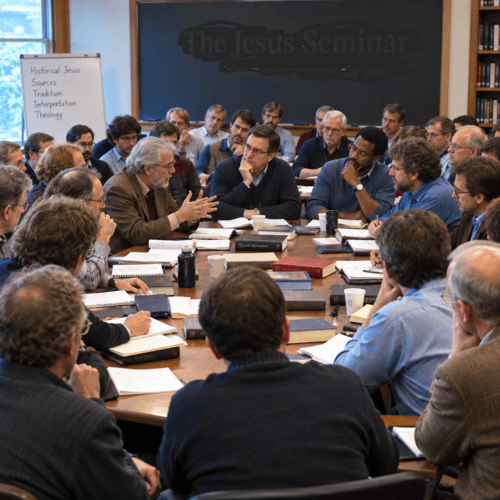
Picture a room full of professors. Each one holds a handful of coloured beads. Someone reads out a saying of Jesus—“Love your enemies” or “I am the way.” Then the professors vote. They drop a red bead into a box if they think Jesus really said it. They drop a black bead if they think He never did.
When the counting is over, the result is shocking. The group decides Jesus never said around 82% of the words the Gospels give Him. They said He never claimed to be God. They said He didn’t rise bodily from the grave.
This really happened. The group was called the Jesus Seminar, and its votes have made headlines around the world since 1985.
So here’s our question: The Jesus Seminar—are their views biblical? And are they even good history? Let’s look at the evidence together.
KEY TERMS YOU WILL MEET
- Historical Jesus: the Jesus scholars try to rebuild without trusting the Bible as God’s Word.
- Christ of faith: the Jesus that the church believes in and worships. The Jesus Seminar thought these were two different people. The Bible says they are one and the same.
- Gospel: one of the four books about Jesus’ life—Matthew, Mark, Luke and John. The word means “good news”.
What Is the Jesus Seminar?
The Jesus Seminar was a group of scholars who met from 1985 to decide which words and deeds of Jesus in the Gospels really came from Him. Robert W. Funk, an American New Testament scholar, started it by inviting 30 scholars to join him. John Dominic Crossan helped lead it, and Marcus Borg became one of its best-known writers. Over the years, more than 200 people took part. The group worked under the Westar Institute, which still exists today.
The Seminar did its work in 2 main stages:
- Stage 1—the sayings: the results came out in 1993 in a book called The Five Gospels. Notice the number. They added the Gospel of Thomas, a later writing that is not in the Bible, to the four Gospels.
- Stage 2—the deeds: the results came out in 1998 in The Acts of Jesus. Here they voted on 176 events in Jesus’ life.
The table below shows how the famous bead vote worked. Each colour carried a score, and the scores were averaged to give each saying its final colour.
| Bead colour | What the vote meant | Score |
|---|---|---|
| Red | Jesus said this, or something very like it | 3 |
| Pink | Jesus probably said something like this | 2 |
| Grey | Jesus did not say this, but the idea is close to His own | 1 |
| Black | Jesus did not say this; later believers made it up | 0 |
How the Jesus Seminar voted on each saying of Jesus.
Where Did the Seminar’s Ideas Come From?
The Seminar was one step in a long search that scholars call the quest for the historical Jesus—the hunt for a “real” Jesus hidden behind the Gospels.
Timeline: The Search for the “Real” Jesus
- 1774–1778: Hermann Samuel Reimarus’ writings claim the disciples stole Jesus’ body.
- 1835: David Friedrich Strauss writes The Life of Jesus. He calls the miracle stories myths.
- 1906: Albert Schweitzer shows that each scholar’s “real Jesus” looked a lot like the scholar himself.
- 1953: Ernst Käsemann starts a “new quest”, still doubtful about most of the Gospels.
- 1985: Robert W. Funk launches the Jesus Seminar.
- 1980s to today: a “third quest” takes Jesus’ Jewish world seriously and finds far more history in the Gospels.
Catholic writer George Tyrrell put Schweitzer’s warning sharply in 1909. He said the liberal scholars’ Christ was “only the reflection of a Liberal Protestant face, seen at the bottom of a deep well.” In other words, they looked for Jesus and found themselves.
What Did the Jesus Seminar Conclude?
In simple words, the Seminar concluded:
- Most of His words are not His: only 18% of the sayings in the Gospels were voted red or pink.
- Most of His deeds did not happen: only 16% of the events were voted red or pink.
- John’s Gospel is not history: almost nothing Jesus says in John was accepted.
- No claim to be God: Jesus did not call Himself the Son of God or the Messiah (God’s promised King).
- No end-of-the-world message: Jesus was a wise teacher, or sage, who told clever stories. He was not a prophet warning about God’s coming judgement.
- No bodily resurrection: Jesus’ dead body did not come back to life. Belief in the resurrection, they said, does not depend on what happened to the body.
IN PLAIN WORDS
The Jesus Seminar’s Jesus is a wandering Jewish wise man, nothing more. The Bible’s Jesus is the eternal Son of God who died for sinners and rose again. These aren’t 2 pictures of the same person. They’re 2 different people.
So where did the Seminar go wrong? Here are 5 problems.
Problem 1: They Decided the Answer Before They Looked
Every scholar starts with some beliefs. The question is: which ones? In the introduction to The Five Gospels, the Seminar listed “seven pillars”—the basic ideas its work stood on. The last pillar said that anyone who thinks a Gospel saying is real must prove it. In other words, the Gospels are guilty until proven innocent. No fair court works like that.
KEY TERM: NATURALISM
Naturalism is the belief that nature is all there is. There is no God who acts in the world, so there are no miracles. Start there, and you will never find a Jesus who rises from the dead—not because the evidence says no, but because your rules said no before you began.
Cornelius Van Til, the Dutch-American theologian, taught that there is no “neutral” ground. Every person reads the evidence through a set of beliefs about God. The Seminar did not leave its beliefs at the door. It brought naturalism in with it.
The Bible explains why this happens:
The natural person does not accept the things of the Spirit of God, for they are folly to him, and he is not able to understand them because they are spiritually discerned.
1 Corinthians 2:14
John Calvin said that Scripture is “self-authenticated” (Institutes 1.7.5). The Bible carries its own authority, because it comes from God. We do not grade it with beads. The Westminster Confession of Faith (1646) says the Bible’s authority depends “not upon the testimony of any man or Church, but wholly upon God” (1.4). A vote by scholars cannot give the Bible authority. And it cannot take it away.
Problem 2: Their Method Breaks Its Own Rules
Even setting faith aside, the method has serious holes:
- Circular reasoning: they decided Jesus was a wise teacher, not a prophet of the end. Then they threw out the sayings where He sounds like a prophet—and announced that He was not one.
- The “dissimilarity” test: some fellows used a rule called the criterion of dissimilarity. It only accepts a saying if it is unlike both the Jewish teaching of Jesus’ day and the teaching of the early church. But Jesus was a Jew, and He founded the church! This rule gives you a Jesus who is neither Jewish nor Christian.
- Leaning on Thomas: they treated the Gospel of Thomas as a key source. Most scholars date it to the second century, long after the apostles. Simon Gathercole has shown that it borrows from our Gospels.
- A show of hands: truth is not decided by voting. John Dominic Crossan even admitted that the beads were partly meant to catch the public’s attention.
- Not the whole field: Richard Hays of Duke University, no conservative, complained that the Seminar falsely made it look as if most scholars agreed with them.
WORTH PONDERING
“If you believe what you like in the gospels, and reject what you don’t like, it’s not the gospel you believe, but yourself.”
—Augustine of Hippo, the early church father whom John Calvin quoted more than any other
Problem 3: History Points the Other Way
The earliest evidence supports the Bible’s Jesus, not the Seminar’s.
- Paul wrote first, and he already worshipped Jesus: Paul’s letters were written around AD 48–60, before the Gospels. Yet in Philippians 2:6–11 and 1 Corinthians 8:6, Paul already treats Jesus as God. Larry Hurtado showed that Christians worshipped Jesus from the very beginning, not after a slow change from “wise man” to “God”.
- The resurrection creed is very early: a creed is a short summary of belief that people learn by heart. In 1 Corinthians 15:3–8, Paul passes on a creed he received within a few years of the cross. It names the people who saw the risen Jesus, and says that most of them were still alive.
- Eyewitnesses stood behind the Gospels: Richard Bauckham has shown that the Gospel writers worked closely with people who had seen Jesus. Luke says this plainly (Luke 1:1–4).
- Jewish students memorised well: Birger Gerhardsson showed that Jewish teachers trained their students to learn words by heart. Jesus’ teaching was not passed on carelessly.
- Even sceptics disagree with the Seminar: E. P. Sanders and Bart Ehrman do not believe the Bible is God’s Word. Yet both see Jesus as a prophet who spoke about God’s coming kingdom and the end of this age. The Seminar’s “wise man” Jesus is rejected even by many non-Christian scholars.
Tim Keller often pointed to another clue: embarrassing details. Women were the first witnesses of the empty tomb, when a woman’s word counted for little in court. People who invent a story do not add details that weaken it.
Problem 4: The Bible Speaks for Itself
The Seminar trusted Mark most, as it was probably written first. Yet even in Mark, Jesus makes huge claims. He forgives sins, which only God can do (Mark 2:5–10). And at His trial, He says this:
Again the high priest asked him, “Are you the Christ, the Son of the Blessed?” And Jesus said, “I am, and you will see the Son of Man seated at the right hand of Power, and coming with the clouds of heaven.”
Mark 14:61–62
The “Son of Man” comes from Daniel 7. He is a heavenly figure who rules God’s everlasting kingdom. That is why the high priest cried, “Blasphemy!”
How could the disciples remember Jesus’ words years later? Jesus Himself answered:
But the Helper, the Holy Spirit, whom the Father will send in my name, he will teach you all things and bring to your remembrance all that I have said to you.
John 14:26
And the apostles insisted that they were not making up stories:
For we did not follow cleverly devised myths when we made known to you the power and coming of our Lord Jesus Christ, but we were eyewitnesses of his majesty.
2 Peter 1:16
Over a century ago, the Princeton theologian B. B. Warfield argued that you cannot peel the supernatural off the Jesus of the Gospels. Take it away, and no Jesus is left.
Problem 5: Another Jesus, Another Gospel
Paul warned the Corinthians about people who preach “another Jesus than the one we proclaimed” (2 Corinthians 11:4). The Seminar’s Jesus is exactly that. A wise man who never claimed to be God cannot pay for our sins. A Jesus whose body stayed in the grave cannot give us new life. Paul is very clear:
And if Christ has not been raised, your faith is futile and you are still in your sins.
1 Corinthians 15:17
J. Gresham Machen saw the same problem in 1923. He wrote that the liberal teaching of his day was “a different religion from Christianity.” Christianity, he said, is “a way of life founded upon a message”—a message about real events. Remove the events, and you remove the gospel.
The table below puts the two pictures side by side: each row asks a basic question, then gives the Seminar’s answer and the Bible’s answer.
| Question | The Jesus Seminar says | The Bible says |
|---|---|---|
| Who is Jesus? | A wandering Jewish wise man | The eternal Son of God who became man (John 1:1, 14) |
| Did He claim to be God? | No | Yes: “before Abraham was, I am” (John 8:58) |
| Did He do miracles? | Very few; most stories grew up later | Yes, as signs of who He is (John 20:30–31) |
| Why did He die? | He was executed as a troublemaker | To give His life “as a ransom for many” (Mark 10:45) |
| Did He rise from the dead? | Not bodily | Yes, bodily: “a spirit does not have flesh and bones” (Luke 24:39) |
| Is He coming back? | He never taught that | Yes, “in the same way as you saw him go” (Acts 1:11) |
| How do we know what is true? | Scholars vote | God speaks in His Word (2 Timothy 3:16) |
Two very different Jesuses: the Seminar’s picture compared with the Bible’s.
But Don’t the Gospels Report Jesus’ Words Differently?
This is a fair question. Look at how three Gospels report Peter’s words:
- Matthew 16:16: “You are the Christ, the Son of the living God.”
- Mark 8:29: “You are the Christ.”
- Luke 9:20: “The Christ of God.”
The wording differs, but the meaning is the same. The Seminar treated such differences as proof of invention. But that is not how writers, ancient or modern, report speech.
KEY TERMS: THE VERY WORDS OR THE VERY VOICE?
- Ipsissima verba (Latin for “the very words”): a word-for-word record of what someone said.
- Ipsissima vox (Latin for “the very voice”): a true and faithful report of what someone said, but not always in exactly the same words.
A news reporter may sum up a long speech in one sentence and still tell the truth. The Gospels give us Jesus’ true voice, even when the wording differs.
Christians who hold to an error-free Bible have always understood this. The Chicago Statement on Biblical Inerrancy (1978) says plainly that free or loose quotations do not count against the Bible’s truthfulness (Article XIII).
Others say the Gospels were written to persuade, so they cannot be history. But every history book has a purpose, and a purpose is not the same as invention. Luke states his: “that you may have certainty concerning the things you have been taught” (Luke 1:4).
Why Does the Jesus Seminar Still Matter Today?
Robert W. Funk died in 2005. So why does this matter now?
- It’s still active: the Westar Institute still runs seminars and public events in 2026.
- Its ideas come back every Easter: documentaries, magazines and YouTube videos often repeat its claims, usually without naming it.
- It shaped “progressive Christianity”: Marcus Borg’s popular books taught many churchgoers to doubt the virgin birth and the bodily resurrection.
WHEN SOMEONE SAYS, “SCHOLARS HAVE PROVED JESUS NEVER SAID THAT”
- Ask, “Which scholars?” Often it is the Jesus Seminar, a small and unusual group.
- Ask, “How did they decide?” Point out that they ruled out miracles before they began.
- Point to the earliest evidence: the creed in 1 Corinthians 15 comes from within a few years of the cross.
- Point to Jesus Himself: offer to read Mark’s Gospel together. It is short and powerful.
- Stay gentle: “always being prepared to make a defence to anyone who asks you for a reason for the hope that is in you; yet do it with gentleness and respect” (1 Peter 3:15–16).
Conclusion: Whose Words Will You Trust?
So, the Jesus Seminar—are their views biblical? No. Their Jesus isn’t the Jesus of the Bible, or even of careful history. He’s made in the image of modern scholars, built on rules that shut God out before the search can begin.
The Bible’s Jesus spoke as God, died for sinners and rose bodily from the grave. His words have outlasted every vote taken about them. As He Himself said, “Heaven and earth will pass away, but my words will not pass away” (Matthew 24:35).
In the end, the real question isn’t what colour bead you’d drop for Jesus’ words. It’s what you’ll do with the One who spoke them. Peter gave the best answer of all:
Lord, to whom shall we go? You have the words of eternal life.
John 6:68
Tough Questions, Honest Answers
Why isn’t the Gospel of Thomas in the Bible?
The Gospel of Thomas is a list of 114 sayings found in Egypt in 1945, at a place called Nag Hammadi. It has no story of Jesus’ death or resurrection at all. Most scholars date it to the middle of the second century, about 100 years after Jesus, so it did not come from the apostle Thomas. Some of its sayings reflect Gnosticism, a movement that taught salvation through secret knowledge. Its last saying even claims that a woman must become male to enter the kingdom. As Michael J. Kruger argues, the church did not create the Bible; it recognised the books that already carried God’s authority, and Thomas was never one of them.
Did the Q source really exist?
“Q” comes from the German word Quelle, which means “source”. Many scholars think Matthew and Luke both used a lost collection of Jesus’ sayings, and they call it Q. But no copy of Q has ever been found, and no early Christian writer ever mentions it. Some scholars, like Mark Goodacre, think Luke simply used Matthew, so Q is not needed at all. Christians can stay relaxed about this question. The Bible does not tell us exactly how the writers gathered their material, but it does tell us that God guided what they wrote (2 Timothy 3:16).
Did Jesus ever claim to be God?
Yes, many times, though not always in the words we might expect. He forgave sins, which only God can do (Mark 2:5–7). He said, “before Abraham was, I am” (John 8:58), using God’s own name from Exodus 3:14, and His listeners picked up stones to kill Him. He accepted Thomas’ worship when Thomas called Him “My Lord and my God!” (John 20:28). His enemies understood His claims clearly, which is why they charged Him with blasphemy.
Do historians agree that Jesus existed?
Yes. Almost every historian, Christian or not, agrees that Jesus lived and was crucified under Pontius Pilate. Even Bart Ehrman, a well-known sceptic, wrote a whole book called Did Jesus Exist? (2012) to answer people who deny it. The Roman historian Tacitus and the Jewish historian Josephus both mention Him. Even the Jesus Seminar accepted that Jesus was a real man. The real debate is not whether Jesus lived, but who He truly was.
Who actually wrote the four Gospels?
The early church always named Matthew, Mark, Luke and John as the authors. Matthew and John were apostles who walked with Jesus. Papias, a church leader writing in the early second century, said Mark wrote down the preaching of the apostle Peter. Luke was a companion of Paul who carefully checked his facts with eyewitnesses (Luke 1:1–4). No ancient copy of any Gospel names a different author. That is remarkable if the names were only later guesses.
Is Bart Ehrman part of the Jesus Seminar?
No. Bart Ehrman was never a fellow of the Jesus Seminar, though people often link the two because both doubt much of the Bible. In fact, Ehrman disagrees with the Seminar’s main picture of Jesus. He argues that Jesus was an apocalyptic prophet, someone who announced that God would soon end this age and judge the world. Like the Seminar, though, he denies the bodily resurrection. He says historians can never conclude that a miracle happened, which is a rule about method, not a finding from the evidence. Christians can read Ehrman fairly while noticing that his starting point decides much of his answer.
Do the Gospels contradict each other?
The Gospels sometimes differ, but a difference is not the same as a contradiction. For example, Matthew mentions one angel at the empty tomb (Matthew 28:2), while Luke mentions two (Luke 24:4). If there were two angels, there was certainly one, and Matthew simply focuses on the one who spoke. Think of four people describing the same road accident. Their stories will differ in detail, yet a judge trusts them more, not less, because they clearly did not copy each other. Because the Gospels come from “God, who never lies” (Titus 1:2), we can be confident that, rightly understood, they agree.
Related Reads
- Jesus in the Quran vs the Bible: Who Gets Jesus Right?
- What Is Progressive Christianity? Is It Still the Christian Faith?
- Seeking the Historical Jesus: Fresh Insights and Enduring Truths
- When Were the Gospels Written? The Evidence for Early Dates
- Oral Tradition and the Gospels: How Was Jesus’ Story Kept Safe?
- Why Didn’t the Gnostic Gospels Make the Cut Into the Canon?
- Are the Gospels Eyewitness Accounts? The Mounting Evidence
- Are the Gospels Historically Reliable? Testing the Four Accounts
- Who Wrote the Gospels? Evaluating Modern Scholarship
- Did Jesus Really Exist? The Historical Evidence Sceptics Can’t Ignore