This post is part of our series, Famous Last Words. In our main post, Famous Last Words: What Believers Said Before They Died, we gathered the dying words of Christians across 20 centuries. In this series we look closely at believers in the Bible whose final words still speak today.
David is unusual in this series. The Bible actually gives his final speech a title: “Now these are the last words of David” (2 Samuel 23:1). Few people in Scripture get a heading like that. And what David says is remarkable. The great king, the giant-killer, the man who built a nation, doesn’t boast about his victories. He talks instead about another—a perfect ruler who’d come from his family and shine like the morning sun.
David also left a dying charge to son Solomon and a final public prayer. Put together, these three passages show us a man who knew he wasn’t the hero of his own story. His hope rested on God’s promise.
IN SHORT
Who: David, son of Jesse, shepherd, warrior and king of Israel for forty years.
When: About 970 BC, at around 70 years of age.
His last words: a prophetic poem (2 Samuel 23:1–7), a charge to Solomon (1 Kings 2:1–9) and a public prayer (1 Chronicles 29:10–19).
Why they matter: David’s final hope was not in his own record but in God’s “everlasting covenant”—a promise fulfilled in Jesus, the Son of David.
David’s Final Days
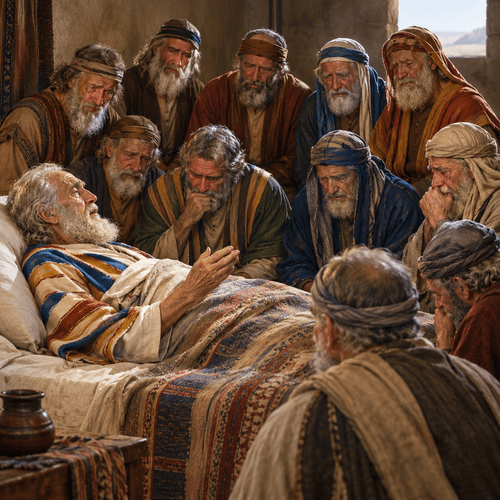
David’s last years weren’t peaceful. His own son Absalom had rebelled against him and died in the fighting. Now David was old and weak. The Bible tells us plainly “King David was old and advanced in years. And although they covered him with clothes, he could not get warm” (1 Kings 1:1).
Timeline of David’s Last Days
- A failing body (1 Kings 1:1–4). The once-mighty warrior cannot even keep warm.
- A rival king (1 Kings 1:5–27). His son Adonijah tries to seize the throne. Both prophet Nathan and Bathsheba warn David.
- Solomon crowned (1 Kings 1:28–40). David acts quickly and makes Solomon king. He swears, “As the LORD lives, who has redeemed my soul out of every adversity” (1:29).
- A final assembly (1 Chronicles 28–29). David gathers Israel’s leaders, hands Solomon the plans for the temple and leads the people in prayer.
- A last charge (1 Kings 2:1–9). On his deathbed, David gives Solomon private instructions.
- Death and burial (1 Kings 2:10–11). “Then David slept with his fathers and was buried in the city of David,” after reigning forty years.
The exact order of these events isn’t always clear, and the poem in 2 Samuel 23 isn’t dated. That’s why we look at all 3 of David’s final speeches.
| PASSAGE | TYPE | MAIN THEME |
|---|---|---|
| 2 Samuel 23:1–7 | Prophetic poem | The perfect King to come and God’s everlasting covenant |
| 1 Chronicles 29:10–19 | Public prayer | God owns everything; our days are like a shadow |
| 1 Kings 2:1–9 | Private charge to Solomon | Obey God’s law; deal with unfinished business |
“The Spirit of the LORD Speaks by Me”
David’s last words begin like this: “The oracle of David, the son of Jesse, the oracle of the man who was raised on high, the anointed of the God of Jacob, the sweet psalmist of Israel: ‘The Spirit of the LORD speaks by me; His word is on my tongue’” (2 Samuel 23:1–2).
Notice the humble start. David calls himself “the son of Jesse”—a reminder that he began as the youngest son of a farmer in Bethlehem. Then he names 3 things God did for him: God raised him up, anointed him and gave him songs.
Then David makes a bold claim. His words aren’t just his own. They’re God’s words, spoken by God’s Spirit. This is a claim to be a prophet. Centuries later, both Jesus and Peter agreed with it:
- Jesus said: “David himself, in the Holy Spirit, declared…” (Mark 12:36).
- Peter said: “Being therefore a prophet, and knowing that God had sworn with an oath to him that he would set one of his descendants on his throne…” (Acts 2:30).
This matters for how we read the Bible. The writers of Scripture didn’t think they were simply sharing their own religious ideas. As Peter later put it, “men spoke from God as they were carried along by the Holy Spirit” (2 Peter 1:21). David’s last words are a clear example of this.
The Perfect King: Like the Morning Sun
So what did God say through David? He described the kind of king the world needs:
“When one rules justly over men, ruling in the fear of God, he dawns on them like the morning light, like the sun shining forth on a cloudless morning, like rain that makes grass to sprout from the earth”
2 Samuel 23:3–4
What a beautiful picture. A just and godly ruler is like sunrise after a dark night. He’s like warm sunshine after rain, when the grass turns green. Under his rule, life flourishes.
But here’s the problem. David himself hadn’t always been that king. He’d taken another man’s wife, Bathsheba, and arranged the death of her husband, Uriah. His family was torn by rape, murder and rebellion. David knew very well he hadn’t always “ruled justly” or lived “in the fear of God.” His own psalm of repentance begins, “Have mercy on me, O God, according to your steadfast love” (Psalm 51:1).
So the perfect King of 2 Samuel 23 points beyond David. The rest of the Bible picks up the same picture of light and sunrise:
| PASSAGE | THE PROMISE OF LIGHT |
|---|---|
| Isaiah 9:2, 7 | A great light shines on people in darkness, and a King rules “on the throne of David” with endless peace. |
| Malachi 4:2 | “The sun of righteousness shall rise with healing in its wings.” |
| Luke 1:78–79 | At Jesus’ birth, Zechariah sings that “the sunrise shall visit us from on high to give light to those who sit in darkness and in the shadow of death.” |
| Revelation 22:16 | Jesus says, “I am the root and the descendant of David, the bright morning star.” |
David’s last words, then, are a prophecy of Jesus. The old king, close to death, looked forward to the King who’d be everything he himself wasn’t.
“An Everlasting Covenant”: David’s Real Hope
Then comes the heart of David’s last words: “For does not my house stand so with God? For he has made with me an everlasting covenant, ordered in all things and secure” (2 Samuel 23:5).
A covenant is a binding promise. Years earlier, God had promised David through the prophet Nathan: “your house and your kingdom shall be made sure forever before me. Your throne shall be established forever” (2 Samuel 7:16). David’s family would produce a King whose rule would never end.
Interestingly, this verse can be translated in 2 ways. The ESV reads it as a confident question: “does not my house stand so with God?” The King James Version reads it as a confession: “Although my house be not so with God; yet he hath made with me an everlasting covenant.”
EITHER WAY, THE POINT IS THE SAME
Whether David is confident or confessing, his hope rests on the same thing: not on his family’s goodness, but on God’s promise.
David’s house was full of failure. But God’s covenant was “ordered in all things and secure.” That’s the hope of every believer at death. We don’t rest on our record. We rest on God’s faithfulness.
This is exactly what we saw in our main post. Dying believers across the centuries have rested on mercy, not merit. David was one of the first to show the way.
And God kept His promise. When the angel announced Jesus’ birth, he said, “the Lord God will give to him the throne of his father David, and he will reign over the house of Jacob forever, and of his kingdom there will be no end” (Luke 1:32–33).
“Our Days on the Earth Are Like a Shadow”
David’s final public prayer, in 1 Chronicles 29, gives us more of his heart near the end. The people had just given generously towards building the temple. David did not praise their generosity. He praised God.
- God owns everything. “Yours, O LORD, is the greatness and the power and the glory and the victory and the majesty, for all that is in the heavens and in the earth is yours” (29:11).
- We only give back what is His. “For all things come from you, and of your own have we given you” (29:14).
- Life is short. “For we are strangers before you and sojourners, as all our fathers were. Our days on the earth are like a shadow, and there is no abiding” (29:15).
That last line is striking from a king. David had a palace, an army and great wealth. Yet he called himself a “stranger” and a “sojourner”—a traveller passing through. Like Abraham before him, he was looking for a better home (Hebrews 11:13–16). The Bible sums up his life simply: “he died at a good age, full of days, riches, and honour” (1 Chronicles 29:28).
A Difficult Deathbed Charge
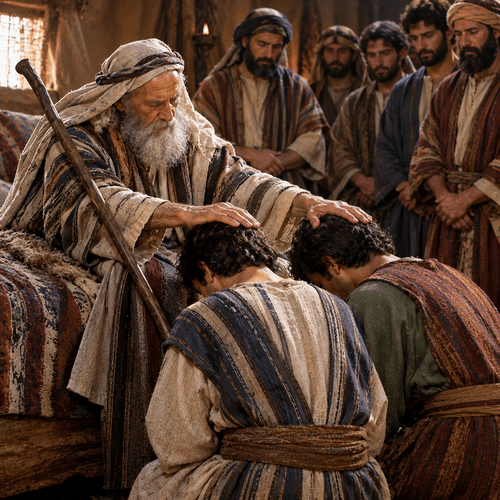
David’s private words to Solomon in 1 Kings 2 begin well: “I am about to go the way of all the earth. Be strong, and show yourself a man, and keep the charge of the LORD your God, walking in his ways” (2:2–3). A dying father could give no better advice.
But then David does something that troubles many readers. He tells Solomon to deal with 2 men:
- Joab, David’s army commander, who’d murdered 2 innocent men, Abner and Amasa, in peacetime. David says: “do not let his grey head go down to Sheol in peace” (2:6).
- Shimei, who had cursed David bitterly. David says: “do not hold him guiltless… you shall bring his grey head down with blood to Sheol” (2:9).
- But also Barzillai’s sons, whose father had helped David in his darkest hour. David says: “deal loyally with the sons of Barzillai” (2:7).
How should we understand this? 3 things help.
- It was a king’s duty to punish murder. Joab’s killings had gone unpunished for years, partly because David was too weak to act. The Law said innocent blood must not be ignored (Numbers 35:33).
- David left the details to Solomon’s wisdom. He told Solomon, “you are a wise man. You will know what you ought to do” (2:9). Solomon later gave Shimei a fair condition to live by, and Shimei died only after breaking it (1 Kings 2:36–46).
- The Bible does not hide its heroes’ flaws. David was a man after God’s heart, but he was not the Messiah. His last words include both glorious faith and the hard edges of an Old Testament king.
Compare this with the other dying men in our series. David said of Shimei, “do not hold him guiltless.” Stephen, under the stones, prayed, “Lord, do not hold this sin against them” (Acts 7:60). What made the difference? Between David and Stephen stands the cross, where the true Son of David prayed, “Father, forgive them” (Luke 23:34). David pointed to the perfect King. Jesus is that King—and His rule brings forgiveness.
David Saw Decay; His Son Did Not
David died and “slept with his fathers” (1 Kings 2:10). A 1,000 years later, on the day of Pentecost, Peter stood in Jerusalem and said: “the patriarch David… both died and was buried, and his tomb is with us to this day” (Acts 2:29).
Why mention David’s tomb? Because David had written, “you will not abandon my soul to Sheol, or let your holy one see corruption” (Psalm 16:10). David’s own body did decay in the grave. So, Peter argued, David must have been speaking about someone else—his descendant, the Messiah. And Jesus’ body did not decay. God raised Him from the dead (Acts 2:31–32).
Paul made the same point: “David, after he had served the purpose of God in his own generation, fell asleep and was laid with his fathers and saw corruption, but he whom God raised up did not see corruption” (Acts 13:36–37). The King David longed for is alive today.
What David’s Last Words Teach Us Today
- Remember where you came from. David began his last words as “the son of Jesse.” Whatever God has made of us, it’s all grace.
- Rest on God’s promises, not your record. David’s house was a mess, but God’s covenant was secure. So is every promise God makes to us in Christ.
- Life is a shadow. Even kings are travellers. Hold this world loosely and look for the better country.
- Leave a godly charge. Like David with Solomon, tell the next generation to walk in God’s ways.
- Look to the true King. David’s greatest gift to us isn’t his example but his prophecy. He points us to Jesus, the King who rules in perfect justice and love.
Conclusion: The Sunrise David Never Saw
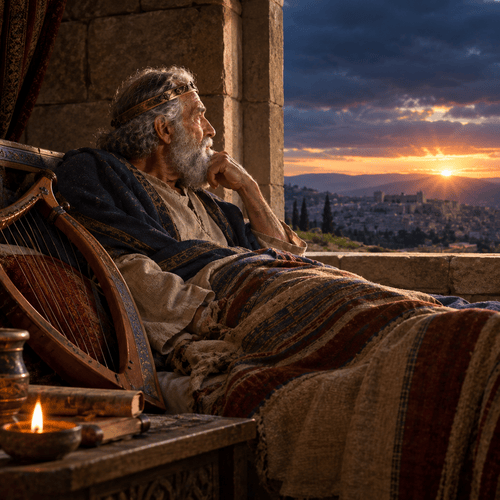
David died in Jerusalem around 970 BC, an old man who could not get warm. But his last words were full of light. He spoke of a King who would rise “like the sun shining forth on a cloudless morning.” He didn’t live to see that sunrise. Yet he died trusting God’s promise that it would come.
It did. 1,000 years later, in David’s own town of Bethlehem, the Son of David was born. He lived the just life David couldn’t, died for sins like David’s, and rose again never to see decay. Every believer who trusts Him can face death the way David did—resting on an everlasting covenant, “ordered in all things and secure.”
FAMOUS LAST WORDS SERIES
Start here: Famous Last Words: What Believers Said Before They Died
Earlier posts: Stephen’s Last Words; Paul’s Last Words
Coming next: Jacob (Genesis 49), Joseph (Genesis 50), Simeon (Luke 2) and the seven sayings of Jesus from the cross.
Tough Questions, Honest Answers
How old was King David when he died?
David was about 70 years old. He became king at 30 and reigned for 40 years—around 8 years in Hebron and 33 in Jerusalem (2 Samuel 5:4–5). The Bible says he “died at a good age, full of days, riches, and honour” (1 Chronicles 29:28).
Why is David called “a man after God’s own heart” if he sinned so badly?
Samuel used this phrase before David became king (1 Samuel 13:14), and Paul repeated it (Acts 13:22). It does not mean David was sinless. It means God chose him, and that at heart David loved God, trusted Him and returned to Him in repentance. Unlike Saul, who made excuses, David confessed his sin openly (Psalm 51). God’s grace, not David’s perfection, is the point.
Who was Abishag in the story of David?
Abishag was a young woman from Shunem chosen to care for David in his old age and keep him warm (1 Kings 1:1–4). The text makes clear that “the king knew her not”—they had no sexual relationship. After David’s death, Adonijah asked to marry her, which Solomon saw as a move to claim the throne (1 Kings 2:13–25).
Did David write all the Psalms?
No. About 73 psalms carry David’s name in their titles, and the New Testament credits him with others too. But other psalms are linked to Asaph, the sons of Korah, Solomon, Heman, Ethan and even Moses (Psalm 90). Interestingly, Psalm 72 ends with the note, “The prayers of David, the son of Jesse, are ended” (72:20).
How is Jesus the “Son of David”?
Jesus descended from David through His family line, as both Matthew 1 and Luke 3 show. The title “Son of David” was a common name for the promised Messiah, and people used it when calling on Jesus for help (Mark 10:47). Yet Jesus also showed that the Messiah is greater than David, because David himself called Him “Lord” (Mark 12:35–37).
Is there evidence outside the Bible that King David existed?
Yes. In 1993, at Tel Dan in northern Israel, a team led by the archaeologist Avraham Biran found a stone inscription from the ninth century BC that mentions the “House of David.” This is strong evidence that David was remembered as the founder of a royal family within about 150 years of his death. Some scholars also see a reference to David on the Moabite Stone (Mesha Stele).
Where is King David buried?
The Bible says David “was buried in the city of David” (1 Kings 2:10)—the oldest part of Jerusalem, south of the Temple Mount. Peter said the tomb was still known in his day (Acts 2:29). The building called “David’s Tomb” on Mount Zion today dates from much later, and most scholars do not think it is the real site. The original tomb has never been securely identified.
Related Reads
- Famous Last Words: What Believers Said Before They Died
- Stephen’s Last Words: “Lord Jesus, Receive My Spirit”
- Paul’s Last Words: “I Have Fought the Good Fight”
- Jacob’s Last Words: “I Wait for Your Salvation, O LORD”
- Joseph’s Last Words: “God Will Surely Visit You”
- Simeon’s Last Words: “Now You Are Letting Your Servant Depart in Peace”
- Jesus in 2 Samuel: The King Whose Throne Lasts Forever
- Why Does God Call David a Man After His Own Heart?
- Evidence King David Existed: Three Inscriptions, Five Sites
- Son of David: How Scripture Confirms Jesus’ Royal Lineage
- Shepherd-King: How David Is a Type of Christ
- Jesus in 1 Chronicles: How David’s Story Points to Christ