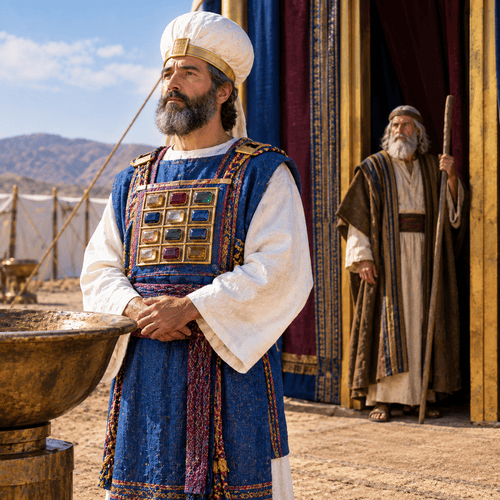
It’s the last night of the Feast of Tabernacles, and Jerusalem’s still glowing. In the Court of Women stand 4 immense golden lampstands, each fitted with four golden bowls, tended through the night by young priests on ladders. Tradition says their light could be seen across the whole city. All night the crowds have danced and sung to the sound of flutes and cymbals, commemorating the pillar of fire that once led Israel through the wilderness by night.
By day, in the temple courts near that same treasury, Jesus stands up in the afterglow of the festival and makes His claim: “I am the light of the world. Whoever follows me will not walk in darkness, but will have the light of life” (John 8:12). Every person listening had just spent a week surrounded by exactly the imagery He was now claiming for Himself.
The Pharisees don’t miss the size of the claim. They challenge Him immediately, and the argument that follows escalates through the rest of the chapter until it ends with stones being picked up to kill Him. One chapter over, Jesus repeats the claim a second time—this time immediately before opening the eyes of a man born blind. Together the declaration and the sign answer the same question from 2 directions: what does it actually mean to see?
I AM THE LIGHT OF THE WORLD, AT A GLANCE
Reference: John 8:12. Validating sign: the healing of the man born blind (John 9:1–7)—the only miracle in the Gospels where Jesus repeats the exact claim just before performing it (John 9:5). Old Testament root: the pillar of fire that led Israel through the wilderness by night (Exodus 13:21–22), echoed in the Feast of Tabernacles’ own illumination ceremony. Core claim: Jesus isn’t one more source of guidance alongside others but the light itself—“whoever follows me will not walk in darkness, but will have the light of life” (John 8:12).
This post is Part 3 of a series on Jesus’ eight “I am” statements. Start with the series introduction for the full roadmap.
The Miracle That Validates the Claim
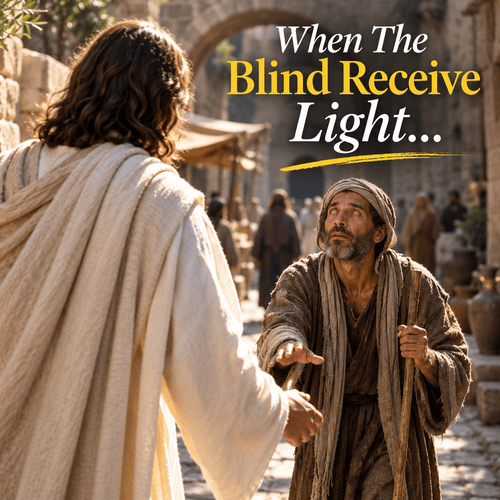
This is the only one of Jesus’ “I am” statements where He repeats the exact wording immediately before performing the sign that proves it. Approaching a man who has been blind from birth, Jesus says plainly, “As long as I am in the world, I am the light of the world” (John 9:5)—then spits on the ground, makes mud, and anoints the man’s eyes. John gives this single healing an entire chapter, the most extended treatment of any miracle in his Gospel apart from the raising of Lazarus.
| STAGE | JOHN 9 REFERENCE | WHAT HAPPENS |
|---|---|---|
| The healing | 9:1–7 | Jesus repeats “I am the light of the world,” anoints the man’s eyes with mud, and sends him to wash in the Pool of Siloam—a name John translates as “Sent” |
| Neighbours’ confusion | 9:8–12 | People who have known this man his whole life cannot agree it is really him |
| First interrogation | 9:13–17 | The Pharisees split over Him healing on the Sabbath; the man calls Jesus “a prophet” |
| Parents questioned | 9:18–23 | His parents confirm he was born blind but will not say more, “for fear of the Jews” |
| Second interrogation and expulsion | 9:24–34 | The healed man’s testimony grows bolder—“one thing I do know, that though I was blind, now I see”—and he is thrown out of the synagogue |
| Jesus finds him | 9:35–38 | Jesus seeks him out, reveals Himself as the Son of Man, and the man worships Him |
| The verdict on blindness | 9:39–41 | Jesus pronounces judgement on those who claim to see but do not |
Notice the shape of the chapter. A man born physically blind gains sight in stages—first his eyes, then his understanding of who healed him, finally full worship. The men who could see perfectly well the whole time grow more spiritually blind with every question they ask. The healing does not simply prove Jesus can restore sight. It demonstrates, in real time, exactly what He meant by claiming to be the light of the world.
Fire in the Temple Courts
The Feast of Tabernacles commemorated Israel’s forty years of wilderness wandering, and its climactic evening ceremony, held in the Court of Women, deliberately recalled the pillar of fire that guided Israel by night. God had gone before His people “by night in a pillar of fire to give them light, that they might travel by day and by night” (Exodus 13:21). The festival’s towering lamps were a yearly re-enactment of that guidance—and a reminder that, on any other night, Jerusalem simply went dark.
Jesus’ claim, spoken in that setting, was not a vague metaphor about enlightenment. It named a very specific Old Testament role and stepped directly into it.
| THE PILLAR OF FIRE (EXODUS 13) | THE LIGHT OF THE WORLD (JOHN 8) | |
|---|---|---|
| Source | Sent by God to go before Israel as a pillar of cloud by day and fire by night | Given directly by the Father; Jesus does not merely reflect the light, He is it |
| Scope | Guided one nation, on one journey, through one wilderness | Offered to “whoever follows”—no national or geographic limit (John 8:12) |
| What it illuminated | The physical path through the desert at night | “The light of men” (John 1:4)—a path through spiritual darkness |
| Outcome for those who followed | Guided safely toward the promised land, yet that generation died in the wilderness through unbelief (Hebrews 3:16–19) | “Will not walk in darkness, but will have the light of life” (John 8:12)—a promise, not merely a route |
The pillar of fire was a real and generous provision, and it did exactly what it was meant to do. But it could guide a generation’s feet without ever reaching their hearts—which is why that same generation, having followed the fire the whole way, still failed to enter God’s rest. Jesus is claiming to succeed precisely where the pillar could not: not just showing the way, but changing those who follow it.
I Am the Light of the World (John 8:12)
“I am the light of the world. Whoever follows me will not walk in darkness, but will have the light of life.” The verbs matter. This is not “whoever admires me” or “whoever agrees with me”—it is “whoever follows,” the ordinary word for discipleship, for keeping in step with someone on a road. Light, in this claim, is not simply something to look at. It is something to walk by.
The Pharisees object at once: “You are bearing witness about yourself; your testimony is not true” (John 8:13). Jesus does not back down from the size of the claim—He grounds it in the Father who sent Him, exactly as He had grounded the bread of life in the Father who gave it: “You are from below; I am from above. You are of this world; I am not of this world” (John 8:23). By the end of the same conversation the stakes are fully exposed, when Jesus tells them, “before Abraham was, I am” (John 8:58)—language so unmistakably divine that His hearers picked up stones. The light of the world is not a teacher pointing the way from a distance. He is claiming to be, Himself, where the way begins.
WHY THE PHARISEES WENT BLIND
“For judgement I came into this world, that those who do not see may see, and those who see may become blind” (John 9:39). When the Pharisees ask, “Are we also blind?” Jesus answers, “If you were blind, you would have no guilt; but now that you say, ‘We see,’ your guilt remains” (John 9:40–41). The tragedy is not that they could not see. It is that they were certain they already did—with the light of the world standing directly in front of them.
Older Roots: Light as a Sign of God’s Presence and Guidance
The pillar of fire is the most direct Old Testament background to this claim, but light carries this meaning throughout Scripture, from the first page onward.
| PASSAGE | WHAT HAPPENS | CONNECTION TO JOHN 8 |
|---|---|---|
| Genesis 1:3–4 | God’s first recorded creative act is speaking light into existence and separating it from darkness | Establishes light as bound up with God’s own character from the very beginning |
| Exodus 13:21–22 | The pillar of fire leads Israel by night through the wilderness | The direct festival background behind Jesus’ claim (see above) |
| Isaiah 9:2 | “The people who walked in darkness have seen a great light” | Quoted by Matthew of Jesus’ Galilean ministry (Matthew 4:16); light promised to a people under judgement |
| Isaiah 60:1–3 | Nations and kings are drawn to the light rising on God’s people | Anticipates light reaching beyond Israel to “whoever,” the same scope as John 8:12 |
| Psalm 27:1 | “The Lord is my light and my salvation; whom shall I fear?” | Light as personal, saving protection, not only guidance for a journey |
Read together, these passages form a single line running from creation to a promised future in which nations are drawn in by light they did not generate themselves. John 8:12 is the claim that this entire line converges on one person, standing in a lit-up temple court, telling a festival crowd that the light they had spent a week celebrating had just started following them home.
What This Means for the Church
The claim is not decoration for a sermon about positivity. It is a daily, practical statement about where clarity is actually found. Chasing certainty from ideology, achievement, or the approval of a crowd is chasing borrowed light—useful for a stretch of road, but never able to change the walker, and never able to answer for what lies past the next bend. Jesus is not offering one more source of guidance alongside all the others available. He is claiming to be the only light that does not eventually go out.
That claim also reframes what it means to keep following Him when the way is hard to see. “If we walk in the light, as he is in the light, we have fellowship with one another, and the blood of Jesus his Son cleanses us from all sin” (1 John 1:7). Walking in the light was never a promise of a fully lit path with nothing left to trust. It was, and still is, a promise about whose light a person is walking by.
Tough Questions, Honest Answers
Is the Feast of Tabernacles setting for John 8:12 secure, given the debated passage just before it (John 7:53–8:11)?
Yes. Most modern translations, including the ESV, footnote that the story of the woman caught in adultery (John 7:53–8:11) is missing from the earliest Greek manuscripts and was probably added later—a textual question worth being honest about. But that question does not touch what surrounds it. John 7:37–52 already firmly places Jesus in the temple during the Feast of Tabernacles, and 8:12 opens with “Again Jesus spoke to them,” continuing that same scene and setting. The Sukkot background to “I am the light of the world” stands regardless of how one reads the inserted passage.
Why does John 9 matter so much for interpreting John 8:12?
Because it is the one place in the Gospels where Jesus states the claim and then immediately demonstrates it in a way anyone present could verify. “As long as I am in the world, I am the light of the world” (John 9:5) is not a fresh idea in chapter 9—it is a deliberate echo of chapter 8, tying the words to a public, physically checkable sign rather than leaving the claim as language alone.
If Christ is the light of the world, why is there still so much evil, confusion, and darkness visible in it?
John answers this directly: “The light shines in the darkness, and the darkness has not overcome it” (John 1:5)—present tense, an ongoing contest rather than a finished one. The promise in John 8:12 is that those who follow Jesus will not walk in darkness, not that darkness has already vanished from the world entirely. Scripture places the full resolution at the end of the story, when “the city has no need of sun or moon to shine on it, for the glory of God gives it light” (Revelation 21:23). Until then, the light has come and cannot be put out—but the world it shines into is still, genuinely, dark in places.
Doesn’t Matthew 5:14, where Jesus calls His disciples “the light of the world,” contradict John 8:12?
No—it describes a reflected light, not a rival source. John the Baptist is described the same way earlier in John’s Gospel: “He was not the light, but came to bear witness about the light” (John 1:8). A disciple called “light” in Matthew 5:14 shines the way a moon does—by giving back light received from elsewhere, not by generating it. Jesus alone claims, in John 8:12, to be the light itself; everyone else in Scripture who is called light is being told to reflect His.
Does the detail of mud made from saliva carry any significance, or is Jesus just using what was on hand?
Commentators have long noticed the echo of Genesis 2:7, where God forms the first man from the dust of the ground—here the Creator remakes a man’s sight using dust of His own making. Whether or not John intends readers to catch that specific echo, the method itself carries a clear function in the narrative: it turns the healing into an act of obedience, not just reception. The man had to go, unhealed, to a specific pool and wash before he could see anything at all. Faith that only watches is not what the story asks for.
Why does Jesus heal on the Sabbath, deliberately provoking conflict, instead of simply waiting a day?
Because the claim itself would not permit waiting. Jesus explains His own urgency earlier in the same setting: “We must work the works of him who sent me while it is day; night is coming, when no one can work” (John 9:4). A light that only shines on convenient days is not what He is claiming to be. The Sabbath conflict is not an accident of bad timing—it is part of the proof that His authority over darkness does not pause for anyone else’s calendar.
Does “whoever follows me will not walk in darkness” mean a Christian should never experience doubt, depression, or confusion?
No—the promise concerns ultimate darkness, not every hard season. “If we walk in the light, as he is in the light, we have fellowship with one another” (1 John 1:7) describes an ongoing relationship maintained through difficulty, not a guarantee that difficulty will not come. Scripture is honest that believers pass through genuinely dark valleys (Psalm 23:4) without losing the light that walks with them through it. The promise is about whose light a person is following when the way is hard to see, not about the way always being easy to see.
Continue the Series
THIS IS PART 3 OF 9
Jesus makes eight “I am” declarations in Scripture, each validated by a sign and rooted in the Old Testament. Read the series introduction for the full roadmap, including the Bread of Life, the Door, the Good Shepherd, the Resurrection and the Life, the Way the Truth and the Life, the True Vine, and the Alpha and the Omega.
Related Reads
- Jesus’ ‘I AM’ Statements: Proclamations of Deity (Series Introduction)
- I Am the Bread of Life: Why Some Followers Walked Away (John 6:35)
- I Am the Door: The Only Way Into the Fold (John 10:7)
- I Am the Good Shepherd: A Death Freely Chosen (John 10:11)
- I Am the Resurrection and the Life: Four Days Too Late? (John 11:25)
- I Am the Way, the Truth, and the Life: One Claim, Not Three (John 14:6)
- I Am the True Vine: What Israel’s Golden Vine Could Not Be (John 15:1)
- I Am the Alpha and the Omega: Every Story’s Beginning and End (Revelation 1:8)