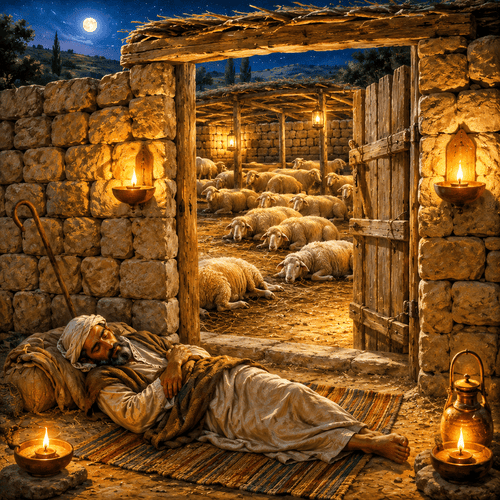
In a 1st-century Judean sheepfold, the door wasn’t always a piece of wood. Several sheep might share a single stone-walled enclosure with one narrow opening and no gate at all. At night the shepherd himself lay down across that opening. Nothing could get in or out without going over him. He wasn’t guarding the door. He was the door.
Jesus is speaking to men who understood this without explanation—and, in this case, to men who’d just thrown a healed beggar out of the synagogue for saying too plainly that Jesus had opened his eyes (John 9:34). Without a break in the scene, He turns the conversation into a parable about sheep, thieves, and a single legitimate way in. “Truly, truly, I say to you, he who does not enter the sheepfold by the door but climbs in by another way, that man is a thief and a robber” (John 10:1). Then He makes the identification explicit: “I am the door of the sheep” (John 10:7).
5 chapters earlier, at a pool beside Jerusalem’s Sheep Gate, Jesus had already demonstrated exactly what kind of authority stands behind that claim.
I AM THE DOOR, AT A GLANCE
Reference: John 10:7, 9. Validating sign: the healing at the Pool of Bethesda (John 5:1–15), located beside Jerusalem’s Sheep Gate. Old Testament root: the blood on the doorposts at the first Passover, which turned back the angel of death (Exodus 12:21–23). Core claim: Jesus isn’t one entrance among several but the sole point of legitimate access to God’s fold—“if anyone enters by me, he will be saved and will go in and out and find pasture” (John 10:9).
This post is Part 4 of a series on Jesus’ eight “I am” statements. Start with the series introduction for the full roadmap.
The Miracle That Validates the Claim
John locates this healing with unusual precision: “Now there is in Jerusalem by the Sheep Gate a pool” (John 5:2). This is the gate through which sacrificial lambs were brought into the city for the temple. The man Jesus finds there couldn’t get to the pool’s healing water on his own—he had no one to carry him in when it stirred. Jesus doesn’t wait for the water. He speaks, and the man is healed on the spot, by a word alone.
| STAGE | JOHN 5 REFERENCE | WHAT HAPPENS |
|---|---|---|
| The setting | 5:1–2 | The pool sits beside Jerusalem’s Sheep Gate, the gate sacrificial lambs passed through on their way to the temple |
| The man’s condition | 5:3–7 | Disabled for thirty-eight years, with no one to help him into the water when it is stirred |
| The healing | 5:8–9 | Jesus says simply, “Get up, take up your bed, and walk,” and the man is healed at once |
| The Sabbath conflict | 5:9–16 | The Jewish leaders begin persecuting Jesus because the healing happened on the Sabbath |
| Jesus’ defence | 5:17–18 | “My Father is working until now, and I am working”—understood at once as a claim to be equal with God |
| The verdict | 5:19–29 | Jesus claims authority to give life and to judge, prerogatives Scripture reserves for God alone |
A man who couldn’t gain entry to healing by his own effort is given entry directly, by Jesus’ word, at a gate named for the sheep. Everything the door parable will later claim in John 10 is already on display here: Jesus grants access to life that no other means, and no other person, could provide.
A Single Door in a Shepherd’s World
Jesus’ hearers would have pictured the scene instantly. A legitimate shepherd enters through the one door; “the sheep hear his voice, and he calls his own sheep by name and leads them out” (John 10:3). Anyone who avoids that door and climbs the wall instead reveals, by the very method of entry, that he has no right to be there.
The claim that follows draws directly on Israel’s own history with doors and deliverance.
| BLOOD ON THE DOORPOSTS (EXODUS 12) | I AM THE DOOR (JOHN 10) | |
|---|---|---|
| Source | The blood of a spotless lamb, applied by each household at God’s command through Moses | Jesus Himself; not applied by human hand but entered by faith |
| Function | Marked a boundary the destroyer would not cross (Exodus 12:23) | Marks the one boundary between safety and being counted among “thieves and robbers” (John 10:1, 8) |
| Scope | Protected each Israelite household, for one night, in one nation | “If anyone enters by me, he will be saved” (John 10:9)—no household or nation limit |
| Outcome | Israel was spared, and commanded to keep the memorial forever (Exodus 12:14) | Those who enter “will go in and out and find pasture” (John 10:9)—ongoing security, not a single night’s rescue |
Passover’s blood answered a single night of judgement. The claim in John 10 answers something larger: not one night spared, but a whole life kept.
I Am the Door (John 10:7, 9)
Jesus states the claim twice, with a slightly different emphasis each time. “I am the door of the sheep” (10:7) identifies Him as the one legitimate point of entry into the flock itself. “I am the door; if anyone enters by me, he will be saved and will go in and out and find pasture” (10:9) adds the strongest word available—saved—and pictures not a single crossing but an ongoing freedom: going in and out safely, finding pasture, day after day.
The claim is deliberately both narrow and wide. Narrow, because there’s exactly one door—“all who came before me are thieves and robbers” (10:8). Wide, because that one door stands open to “whoever,” with no further requirement named. Exclusivity and invitation aren’t in tension here. They’re the same sentence.
WHO ARE THE “THIEVES AND ROBBERS”?
Jesus is speaking to the Pharisees who, in the scene immediately before this one, threw the healed blind man out of the synagogue (John 9:34–41). “All who came before me are thieves and robbers” is not a verdict on Moses or the prophets, whom Jesus elsewhere affirms wrote of Him (John 5:46). It’s a verdict on false, self-appointed leaders—exactly like the men standing in front of Him, who’d just proven their instincts by casting out the one man in the story who could actually see.
Older Roots: Doors and Boundaries as a Sign of God’s Protection
The Passover doorposts are the most direct background to this claim, but doors and gates carry this weight of meaning throughout the Old Testament.
| PASSAGE | WHAT HAPPENS | CONNECTION TO JOHN 10 |
|---|---|---|
| Genesis 4:7 | God warns Cain that sin is “crouching at the door” | The door as a boundary tested by moral choice, present from Scripture’s earliest chapters |
| Exodus 12:21–23 | Blood applied to the doorposts and lintel turns back the destroyer | The direct Old Testament root behind “the door” as the line between death and life |
| Deuteronomy 6:9 | Israel is commanded to write God’s words “on the doorposts of your house” | Doorposts as the place where covenant identity is put on public display |
| Ezekiel 44:1–2 | The east gate stays shut, reserved for the prince alone, “because the Lord… has entered by it” | A striking Old Testament precedent for a gate reserved exclusively for one who holds a unique right of entry |
| Luke 23:45 | The temple curtain tears in two at Jesus’ death | Direct access into God’s presence, permanently opened—exactly what “I am the door” had already promised |
Every one of those doors marked a boundary someone else controlled—Moses, a household, a prince, a curtain maintained by priests. Jesus is claiming to be the boundary itself, standing where the boundary used to be.
What This Means for the Church
The claim rules out a comfortable middle position. There’s no version of Christianity in which Jesus is simply the best entrance among several good ones, and there is no version of it in which the door is closed to anyone who actually comes. Both halves of the claim have to be held together: one door, and “whoever” may use it. A church that only preaches the narrowness becomes harsh; a church that only preaches the welcome stops being honest about what the welcome cost.
It also reframes what security in the Christian life is meant to feel like. “Go in and out and find pasture” isn’t the language of a single decisive rescue and nothing more. It describes an ordinary, daily freedom—safe to leave, safe to return, provided for either way—under a shepherd who stands, quite literally, in the gap.
Tough Questions, Honest Answers
If Jesus is the only door, what happens to people who’ve never had the chance to hear about Him?
Scripture doesn’t give a full roster of names, but it does give principles to hold together honestly: God judges justly and never condemns anyone for rejecting a message they never received (Romans 2:12–16 describes a moral accountability based on what a person did know); and Jesus Himself says, “I have other sheep that are not of this fold. I must bring them also” (John 10:16), a statement of God’s reach that goes beyond what any of us can fully map. What stays fixed is the exclusivity of the claim itself—Jesus remains the one door—while the extent of who is drawn through it, and how, is left in the hands of a God Scripture consistently describes as both perfectly just and abundantly merciful.
Why does Jesus call everyone who came before Him “thieves and robbers” (John 10:8), when that would seem to include Moses and the prophets?
It doesn’t, and the context makes that clear. Jesus elsewhere affirms Moses directly: “If you believed Moses, you would believe me, for he wrote of me” (John 5:46). The men in view in John 10:8 are the false and self-appointed leaders of Jesus’ own generation—represented, in this very scene, by the Pharisees who’d just excommunicated the healed blind man rather than rejoice with him.
Is the Pool of Bethesda healing (John 5) really connected to “I am the door” (John 10), given how many chapters separate them?
The link is geographic and thematic rather than immediate narrative sequence. The healing happens beside the Sheep Gate, and the chapter’s real subject is Jesus’ authority to give life and pass judgement—claims of the same divine authority that stand behind “I am the door” five chapters later. John didn’t write the Gospel as an unrelated string of episodes; the Sheep Gate healing plants the authority claim that the sheepfold parable later makes explicit.
What does “go in and out and find pasture” (John 10:9) actually mean?
It’s an everyday idiom for ordinary, secure life under good leadership, used of Israel’s leaders as far back as Moses (Numbers 27:17) and Joshua (Deuteronomy 31:2). It pictures freedom of movement, not confinement—sheep who can leave the fold by day to graze and return by night without danger, because the shepherd himself is standing at the gate either way.
How is “I am the door” different from Jesus later saying “I am the way” (John 14:6)? Aren’t these the same claim twice?
They describe two different moments of the same journey. The door is a threshold—a single point of entry that must be crossed once, marking who is in the fold and who is not. The way is the path travelled after that, the ongoing route toward the Father. One claim is about how a person gets in; the other is about where a person, now inside, is actually going.
Jesus is standing in the temple courts—why use sheepfold imagery instead of a more obviously temple-based picture?
The two are more connected than they first appear. The pool where Jesus had already demonstrated His authority over life sat beside the very gate through which sacrificial lambs entered Jerusalem on their way to the temple altar (John 5:2). Shepherding language was also universally understood, drawing on a picture Scripture had used for God’s own rule since Genesis 48:15 and Psalm 23—far more accessible to the whole crowd than a technical description of temple architecture would have been.
Does “the door” connect to Jesus’ words about the “narrow gate” in Matthew 7:13–14?
Yes—they describe the same reality from two angles. Matthew 7:13–14 pictures the access point from the traveller’s side: “narrow is the gate and difficult is the way that leads to life, and those who find it are few.” John 10 pictures it from the shepherd’s side, and goes further than Matthew’s image by naming who the gate actually is. Jesus does not simply point to a narrow gate somewhere ahead. He identifies Himself as it.
Continue the Series
THIS IS PART 4 OF 9
Jesus makes eight “I am” declarations in Scripture, each validated by a sign and rooted in the Old Testament. Read the series introduction for the full roadmap, including the Bread of Life, the Light of the World, the Good Shepherd, the Resurrection and the Life, the Way the Truth and the Life, the True Vine, and the Alpha and Omega.
Related Reads
- Jesus’ ‘I AM’ Statements: Proclamations of Deity (Series Introduction)
- I Am the Bread of Life: Why Some Followers Walked Away (John 6:35)
- I Am the Light of the World: Sight Given, Sight Refused (John 8:12)
- I Am the Good Shepherd: A Death Freely Chosen (John 10:11)
- I Am the Resurrection and the Life: Four Days Too Late? (John 11:25)
- I Am the Way, the Truth, and the Life: One Claim, Not Three (John 14:6)
- I Am the True Vine: What Israel’s Golden Vine Could Not Be (John 15:1)
- I Am the Alpha and the Omega: Every Story’s Beginning and End (Revelation 1:8)
- John 10:16 Meaning: Who Are Jesus’ “Other Sheep”?